
State guide
Buying Land in Sikkim
Who can buy land in Sikkim under Article 371F and Revenue Order No. 1, stamp duty and registration, the six districts and the railway to Rangpo.
6
Districts
1% + 4%
Stamp duty + fee
5.85%
Groundwater extraction (2024)
45 km, due ~2027
Sevoke–Rangpo rail
State land record — Sikkim
Rev. 2026 · Farmland India desk
Regions
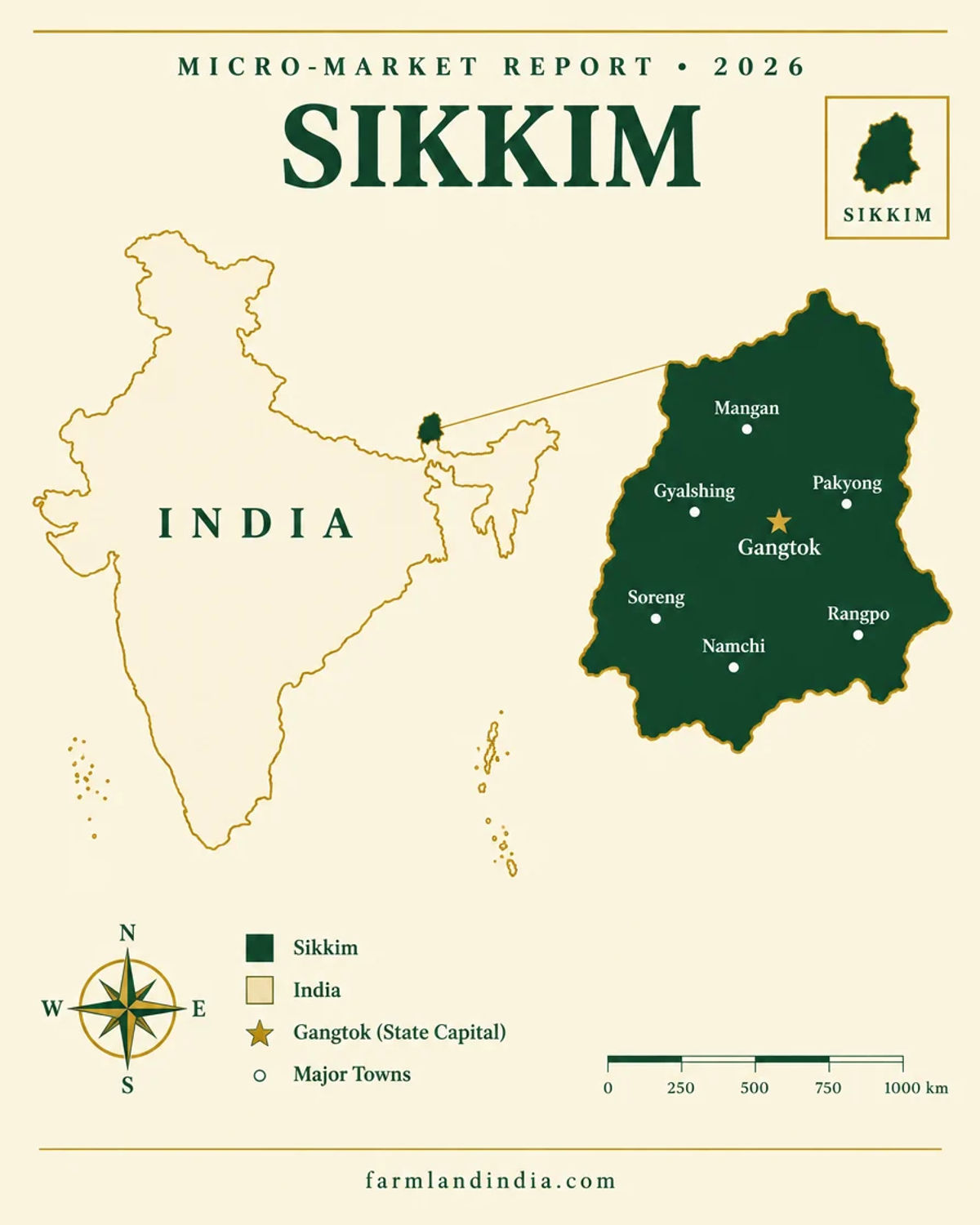
Six districts since December 2021: Gangtok (formerly East Sikkim), Mangan (North Sikkim), Namchi (South Sikkim), Gyalshing (West Sikkim), and the new Pakyong and Soreng districts
Capital
Gangtok, in Gangtok district
Who can buy
In general only Sikkimese, who show a Certificate of Identification (COI) at registration. Land of Bhutia and Lepcha owners can pass only to Bhutias or Lepchas without official sanction
Protected old laws
Article 371F(k) of the Constitution keeps in force the laws that applied in Sikkim before 26 April 1975, including Revenue Order No. 1 of 1917
Stamp duty and fee
Stamp duty 1% and registration fee 4% of the consideration, per the sale-deed procedure published by the SDM, Mangan
Registration
Through the Land Revenue and Disaster Management Department’s online registration portal and the Sub-Registrar (the SDM) of the subdivision
Land records
Parcha (the record-of-rights extract for a plot) and the khazana (land revenue) receipt, kept by the revenue staff of the subdivision
Groundwater
5.85% stage of extraction in 2024; all 40 assessment units safe (CGWB)
Sikkim — land purchase legal rules
Sikkim is one of the few states where most Indians cannot buy land at all. It joined India in 1975 on terms set out in Article 371F of the Constitution, which kept in force the laws that already applied in the kingdom. Those old laws, and the rules built on them, decide who may own land, and they protect the Bhutia and Lepcha communities in particular. What follows describes the rules as the courts and the government state them; it is not legal advice, and any purchase needs a local lawyer and the Sub-Divisional Magistrate’s office. This block applies to every district page in the state.
Article 371F(k): Clause (k) protects every law in force in Sikkim immediately before 26 April 1975. The Sikkim High Court restated in April 2026 that these old laws, including Revenue Order No. 1, are protected and cannot be set aside by a court; only the executive and the legislature can change them (Sikkim High Court, Puspa Mishra v State of Sikkim, WP(C) 45/2020, 6 April 2026).
Revenue Order No. 1 (1917): Issued on 17 May 1917 under the Chogyal, the order says that Bhutias and Lepchas may not sell, mortgage or sub-let any of their land to anyone other than a Bhutia or a Lepcha without express sanction. The High Court called the restriction community-based and “apparently discriminatory”, but held that it must be followed until it is amended or repealed.
Outsiders: Sikkim kept its restrictions on the sale of land to people from outside the state. In practice only Sikkimese can buy, with limited exceptions such as designated areas and land for industrial units, as the national press has reported (The Quint, 29 October 2020). The sale-deed checklist published by the SDM, Mangan asks for the buyer’s Certificate of Identification (COI), the document issued to Sikkimese since 1995. A buyer without a COI should assume that an ordinary purchase of land is not open to them.
Marriage and community: A 1969 notification (No. 28/LR) treats a woman as taking her husband’s community. A Bhutia or Lepcha woman who marries outside the community can sell only the land she acquired before the marriage. Families in mixed marriages should check how the rule applies before agreeing a sale.
Registration steps: A sale deed goes to the Sub-Registrar, who is the SDM of the subdivision. Notices are sent to the seller’s family, the gram panchayat, the owners of neighbouring plots and any bank that has lent on the land; if no objection arrives within a month, the deed is registered. The Registrar (the District Collector) handles special cases (SDM Mangan).
Documents: The SDM, Mangan lists the sale deed, a spot verification report, the buyer’s COI, the seller’s affidavit, the parcha of the land and the khazana (land revenue) receipt.
Leases and other routes: Leases, power-of-attorney deals and purchases in a Sikkimese person’s name are ways outsiders sometimes try to get round the rules. Do not rely on any of them without written advice from a Sikkim lawyer.
NRI and OCI buyers: Even where Sikkim’s own rules would allow it, the RBI Master Direction on immovable property bars NRIs and OCIs from acquiring agricultural land, a farmhouse or plantation property in India except by inheritance. Our NRI guide covers the options.
- Article 371F(k)
- Revenue Order No. 1, 1917
- Bhutia-Lepcha land protected
- COI needed to buy
- Outsiders generally cannot buy
- 1% stamp duty, 4% fee
- One-month objection period
- NRIs: inheritance only
State overview
Sikkim — from the Teesta valleys to Kangchenjunga
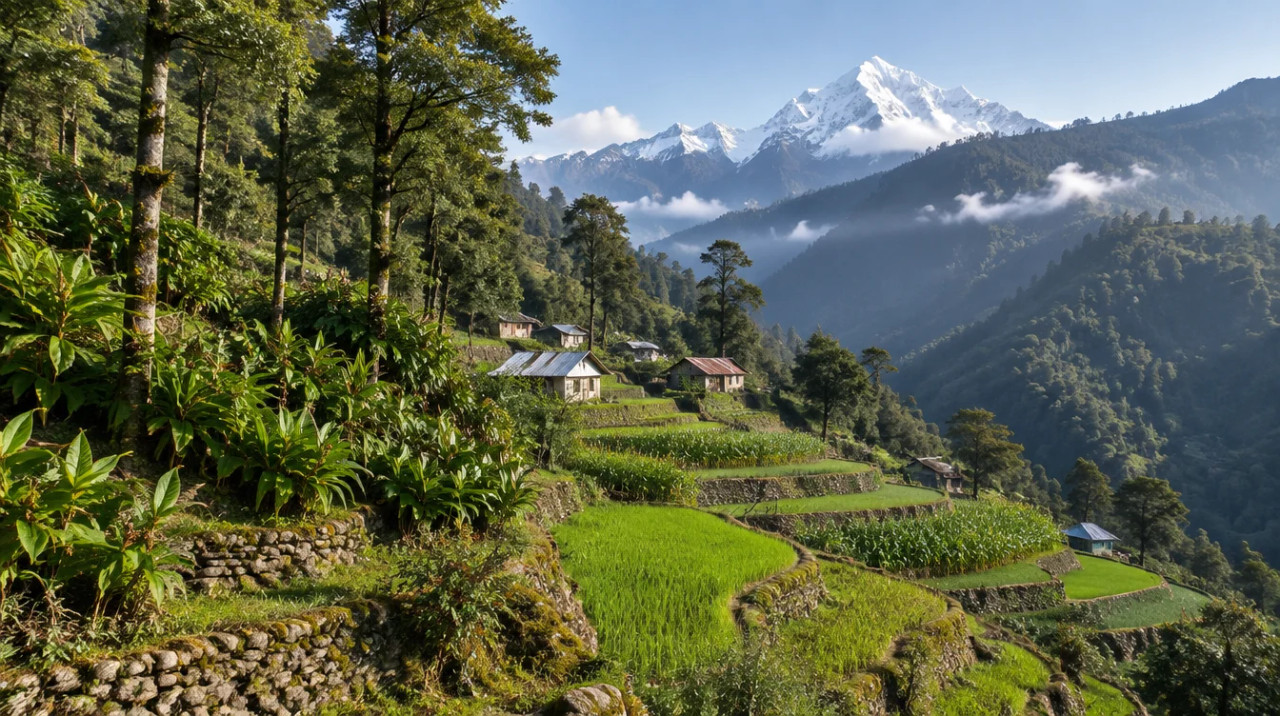
Sikkim is India’s second-smallest state by area, a narrow Himalayan state wedged between Nepal, Tibet (China), Bhutan and West Bengal. It rises from warm river valleys at a few hundred metres along the Teesta and Rangit to the Kangchenjunga massif on the Nepal border. A former Himalayan kingdom ruled by the Chogyals, it joined India in 1975. The state was reorganised on 21 December 2021 into six districts: the four old ones were renamed after their headquarters, Gangtok, Mangan, Namchi and Gyalshing, and two new districts, Pakyong and Soreng, were carved from East and West Sikkim (India Today NE, 22 December 2021[7]).
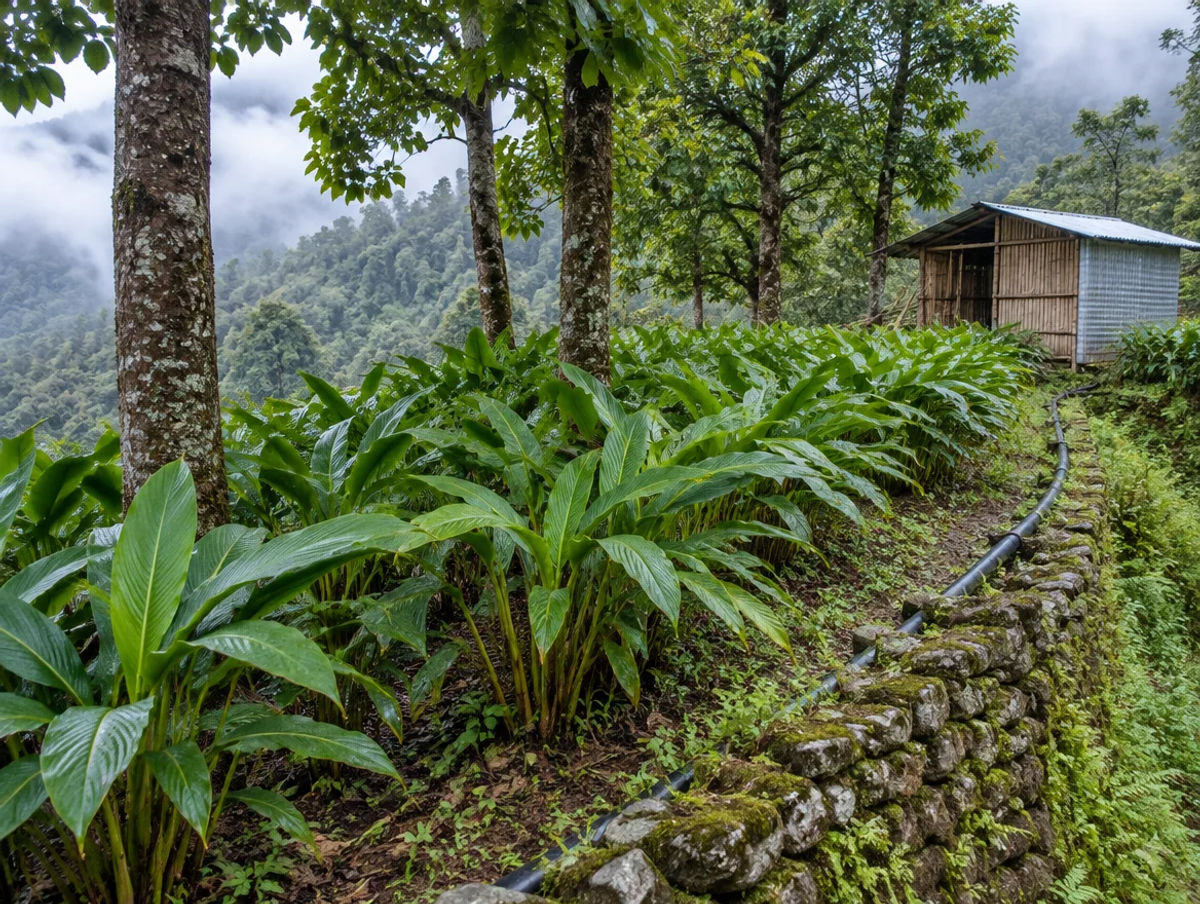
Farming here is terrace farming. Holdings are small and steep, built up over generations with stone walls, and the crops follow altitude: paddy and maize in the lower valleys, large cardamom in the shade of alder trees on the middle slopes, and vegetables, ginger and fruit wherever water and a road allow. The state is known for running its farms on organic lines. For a land buyer, though, the defining fact is legal, not agricultural. Land in Sikkim belongs to Sikkimese, and much of it to the Bhutia and Lepcha communities under rules that go back to 1917. People from elsewhere in India who want a foothold usually look at the plains of North Bengal instead; our West Bengal page covers that side of the border.
If you are Sikkimese, start with the parcha and the khazana receipt, the seller’s community and the subdivision’s notice process, and only then talk price. If you are not, read the legal block above before anything else.
- 6 districts
- Capital: Gangtok
- Article 371F
- Terrace farming
- Large cardamom
- Groundwater 5.85%
Market bands
Reported cost reference points — Sikkim
No official farmland price series is published for Sikkim. These are the official transaction costs.
| Item | Scope | Reported figure* | Source |
|---|---|---|---|
| Stamp duty | Sale deed, on the consideration | 1% | SDM Mangan[3] |
| Registration fee | Sale deed, on the consideration | 4% | SDM Mangan[3] |
| Who pays | Stamp duty and fee | Seller, per the SDM Mangan procedure | SDM Mangan[3] |
| Farmland price series | State or district level | None published | Not published |
*No newspaper or official source publishes a farmland price series for Sikkim, and with a closed pool of eligible buyers, prices vary sharply between a roadside plot near Gangtok and a terrace in a remote valley. Ask the Sub-Registrar what value the deed will be assessed on, and compare recent registered sales in the same block before agreeing a figure. A low price offered to a buyer from outside the state is a warning, not a bargain: it usually means the sale cannot lawfully be completed.
Transaction costs
Stamp duty & registration in Sikkim
1%
Stamp duty
On the consideration in a sale deed, per the SDM Mangan procedure
4%
Registration fee
On the consideration, paid by challan
1 month
Objection period
Notices go to family, panchayat, neighbours and lenders before registration
The official statement of rates is the sale-deed procedure published by the Sub-Divisional Magistrate, Mangan: a registration fee of 4% and stamp duty of 1% of the consideration, both paid by the seller by challan (SDM Mangan[3]). Ask the Sub-Registrar before you sign whether different rates apply to buyers from different communities, and whether the split between buyer and seller can be changed by agreement. The process takes about a month and a day because of the objection period: notices go to the seller’s family members, the gram panchayat, the owners of the boundary plots and any bank or institution with a charge on the land, and each is asked for a no-objection. Applications are now made through the Land Revenue and Disaster Management Department’s online registration portal, which handles the application, document upload and payment and needs one visit for photographs and documents (Sikkim registration portal[4]).
Connectivity
How Sikkim connects: road, rail and air
NH-10 along the Teesta, Bagdogra and Pakyong airports, and the railway coming to Rangpo
🚗 By road
✈️ By air
🚆 By rail
🏞️ Where demand comes from
Land demand in Sikkim is local and concentrated. Gangtok and its ridge, the Rangpo and Singtam belt along NH-10, Namchi and Jorethang in the south, and Pakyong around the airport are where Sikkimese families and businesses buy. Homestays have spread through the villages as tourism has grown, and the industrial and pharmaceutical units of the Rangpo–Singtam belt draw workers. Rail at Rangpo is the change most likely to move land values in the next few years.
Growth catalysts
Upcoming infrastructure & developments
Status as of November 2026, with the date and source of the latest public update for each project
01Rail line
Under construction
03Catalysts
Agriculture & terrain
Soil, crops & water across Sikkim
Warm valleys, terraced middle hills and the high north
Lower valleys
The warm valleys of the Teesta and Rangit around Rangpo, Singtam, Melli and Jorethang sit at a few hundred metres. Paddy, maize, ginger and orange orchards are grown here, and this belt carries most of the state’s roads, industry and new rail.
- Paddy, maize, ginger
- Teesta and Rangit valleys
- Closest to the plains
Middle hills
Between roughly 1,000 and 2,000 metres, around Gangtok, Pakyong, Namchi, Ravangla and Gyalshing, the slopes are terraced for maize, vegetables and large cardamom grown under alder shade. Homestays and small farms mix, and roads decide what a plot is worth.
- Large cardamom under shade
- Terraces and stone walls
- Homestay belt
High north
Mangan district reaches the high valleys of Lachen, Lachung and the Tibetan border. Dzongu, set aside for the Lepcha community, lies here. Farming is limited to the lower valleys, and much of the land is forest, protected or restricted.
- Short growing season
- Lepcha reserve at Dzongu
- Restricted border areas
Groundwater
Groundwater is barely used in Sikkim. The Central Ground Water Board put the stage of extraction at 5.85% in its 2024 assessment, with all 40 assessment units rated safe (CGWB, 2024[5]). Farms depend on springs, streams and rain rather than borewells, and springs that dry up in the lean months are the real water risk. Ask the neighbours where water comes from in March and April, and whether the source is shared.
Land use
Most of Sikkim is forest, alpine land or slopes too steep to farm, so the cultivable area is a thin band of terraces along the valleys and middle slopes. Holdings are small and often split among heirs, and a level plot with a road is scarce. Expect a farm to be a few terraces, not a field.
Crops
Large cardamom is the signature cash crop of the middle hills, grown under shade trees; ginger, turmeric, orange, maize, paddy and off-season vegetables matter too. Sikkim promotes organic farming across the state, so check whether a plot is under an organic certification scheme and what that means for inputs if you plan to farm it.
At a glance
Sikkim’s districts side by side
| District (former name) | Subdivisions | Terrain and access | Note |
|---|---|---|---|
| Gangtok (East Sikkim) | Gangtok, Rabdang | Capital ridge and its valleys; NH-10 | Highest demand; urban and peri-urban land |
| Mangan (North Sikkim) | Mangan, Kabi, Dzongu, Chungthang | High valleys; landslide-prone roads | Dzongu Lepcha area; border restrictions |
| Namchi (South Sikkim) | Namchi, Jorethang, Ravangla, Yangang | Southern hills; Rangit valley | Jorethang trade belt; tourism around Namchi and Ravangla |
| Gyalshing (West Sikkim) | Gyalshing, Dentam, Yuksom | Western hills towards Kangchenjunga | Pelling and Yuksom homestay belt |
| Pakyong (new) | Pakyong, Rongli, Rangpo | Eastern hills; Rangpo on NH-10 | Airport; Rangpo railhead under construction |
| Soreng (new) | Soreng, Mangalbarey | South-western hills | New district headquarters at Soreng |
Subdivisions are as reported when the districts were notified in December 2021 (India Today NE[7]). No newspaper or official source publishes a farmland price series for these districts. Pages for each district follow; until then, see the .
Farmland India view
Why buyers look at Sikkim
A closed land market, a railway on the way and a strong tourism economy
A closed market, by design
Sikkim’s rules keep land with Sikkimese owners, and that is the first thing any investor has to accept. For eligible buyers, the small pool of buyers keeps transactions slow and prices local; for everyone else, there is no lawful way in through an ordinary purchase.
Rail is the big change
The Sevoke–Rangpo line, expected around the end of 2027, will put Sikkim on the railway map for the first time. Rangpo, Singtam and the NH-10 corridor are where the effect will show first.
Tourism drives the villages
Homestays and small hotels have spread from Gangtok to Pelling, Yuksom, Ravangla and the northern valleys. A Sikkimese family with land on a good road in these belts has options beyond farming.
Clean water, steep land
Groundwater is almost untouched and rainfall is high, but terraces are small and slopes are unstable. Value rests on road access, a reliable spring and a slope that has held through past monsoons.
Paperwork is local
Registration runs through the SDM of each subdivision, with a month-long objection period and notices to family and neighbours. That slows a deal down but also brings disputes to the surface before money changes hands.
Confirm the parcha, the khazana receipt, the seller’s community, your own eligibility and the objection notices before you pay anything.
STRAIGHT TALK
Risks & challenges in Sikkim
What can undo a land purchase in Sikkim
You may not be eligible
Most Indians from outside Sikkim cannot buy land there in the ordinary way. Check your own eligibility, and the COI requirement, before you look at a single plot.
Bhutia and Lepcha land
Under Revenue Order No. 1[1], land of Bhutia and Lepcha owners can pass to others only with sanction. A deal that ignores this can be challenged, however the deed was drafted.
Workarounds
Benami purchases in a Sikkimese person’s name, long leases and power-of-attorney deals are the usual ways people try to get round the rules. All of them carry the risk of losing both the land and the money.
Landslides and slope failure
Steep, wet slopes fail in the monsoon, and roads can be cut for weeks. Look at the plot after heavy rain, ask about past slides, and be wary of fresh cutting below or above it.
Family objections
Notices go to the seller’s family before registration. Land shared among heirs, or a family member who has not agreed, will stop the deal at that stage, so settle it first.
Forest and restricted areas
Much of the north is forest, protected or near the border, and parts of Mangan, including Dzongu, are reserved. Check the land class in the parcha and any area restrictions with the SDM.
Records on the ground
Terraces are small and boundaries follow stone walls and streams. Have the plot measured and matched to the record by the revenue staff before you rely on the area in the deed.
Airport and rail promises
Pakyong flights were suspended in 2026 and the railway is not yet open. Pay for what exists today, not for timelines that have slipped before.
Who to contact
Local revenue & registration offices
Land administration in Sikkim runs through the Land Revenue and Disaster Management Department in Gangtok and the six district administrations. For any plot, start with the revenue staff of the subdivision, who keep the parcha and collect the khazana. The Sub-Divisional Magistrate is the Sub-Registrar for sale deeds and issues the notices to family, panchayat, neighbours and lenders; the District Collector is the Registrar and handles special cases. Applications for registration are made on the department’s online registration portal (registry.sikkim.gov.in). Each district’s website (for example mangan.nic.in) lists its subdivisions and officers.
KEEP EXPLORING
Districts & guides in Sikkim
COMMON QUESTIONS
Frequently asked questions
Everything buyers, NRIs and investors ask before their first reviewed farmland purchase in Sikkim.
Visit full wiki01 of 04
Can a person from outside Sikkim buy land in Sikkim?
In general, no. Sikkim kept its old land laws under Article 371F, and sale deeds are registered for buyers who hold a Sikkim Certificate of Identification (COI). Limited exceptions, such as land for industrial units, have been reported, so take advice from a Sikkim lawyer before planning anything.
02 of 04
What is Revenue Order No. 1?
An order of 17 May 1917 that bars Bhutias and Lepchas from selling, mortgaging or sub-letting their land to anyone other than a Bhutia or Lepcha without sanction. The Sikkim High Court held in April 2026 that it remains protected under Article 371F(k).
03 of 04
What are the stamp duty and registration fee in Sikkim?
The SDM, Mangan lists stamp duty of 1% and a registration fee of 4% of the consideration on a sale deed, paid by the seller. Confirm the current rates with the Sub-Registrar before you sign.
04 of 04
Can NRIs buy farmland in Sikkim?
No. Under RBI rules NRIs and OCIs cannot acquire agricultural land, a farmhouse or plantation property anywhere in India except by inheritance, in addition to Sikkim’s own restrictions.
Transparency
Sources and references
Law and courts
- [1]Sikkim High Court: Puspa Mishra v State of Sikkim, WP(C) 45/2020 (6 Apr 2026) — hcs.gov.in
- [2]RBI: Master Direction on acquisition and transfer of immovable property by NRIs and OCIs — rbi.org.in
Government
- [3]SDM Mangan: registration of sale deeds — mangan.nic.in
- [4]Land Revenue and Disaster Management Department: Sikkim registration portal — registry.sikkim.gov.in
- [5]CGWB: Dynamic Ground Water Resources of Sikkim, 2024 — cgwb.gov.in
News
- [6]The Quint: states where outsiders still cannot buy land (29 Oct 2020) — thequint.com
- [7]India Today NE: Sikkim gets two new districts, remaining four renamed (22 Dec 2021) — indiatodayne.in
- [8]ThePrint (PTI): Sevoke–Rangpo railway readiness review (6 Mar 2026) — theprint.in
- [9]India Today NE: Pakyong airport advisory committee on resuming flights (22 Apr 2026) — indiatodayne.in
Further reading
Data-currency note: sources were read in November 2026. Fees, rules and infrastructure timelines change often; check the linked source and the relevant office before relying on any figure.
For developers
Ready to explore Sikkim farmland?
Browse reviewed projects and individual land parcels across Sikkim — or if you own land here, list it with platform review and reach serious buyers.