
District guide
Buying Land in Darjeeling
Hill tea estates and the Siliguri plains under one district: leasehold tea land, GTA records, a Rs 1,560 crore Bagdogra terminal and real landslide risk.
3,149 sq km
Area before the Kalimpong split (WB profile)
18.5 lakh
Population 2011 (same district)
Rs 1,560 crore
Bagdogra new terminal (AAI)
14
Tea gardens lacking leases, Dec 2024
*Indicative range across districts and land types. Stamp duty, registration and conversion charges are additional. Local measurement units vary — every listing states the unit it is priced in. Not a valuation or an offer.
District land record — Darjeeling
Rev. 2026 · Farmland India desk
State
West Bengal
Sub-divisions
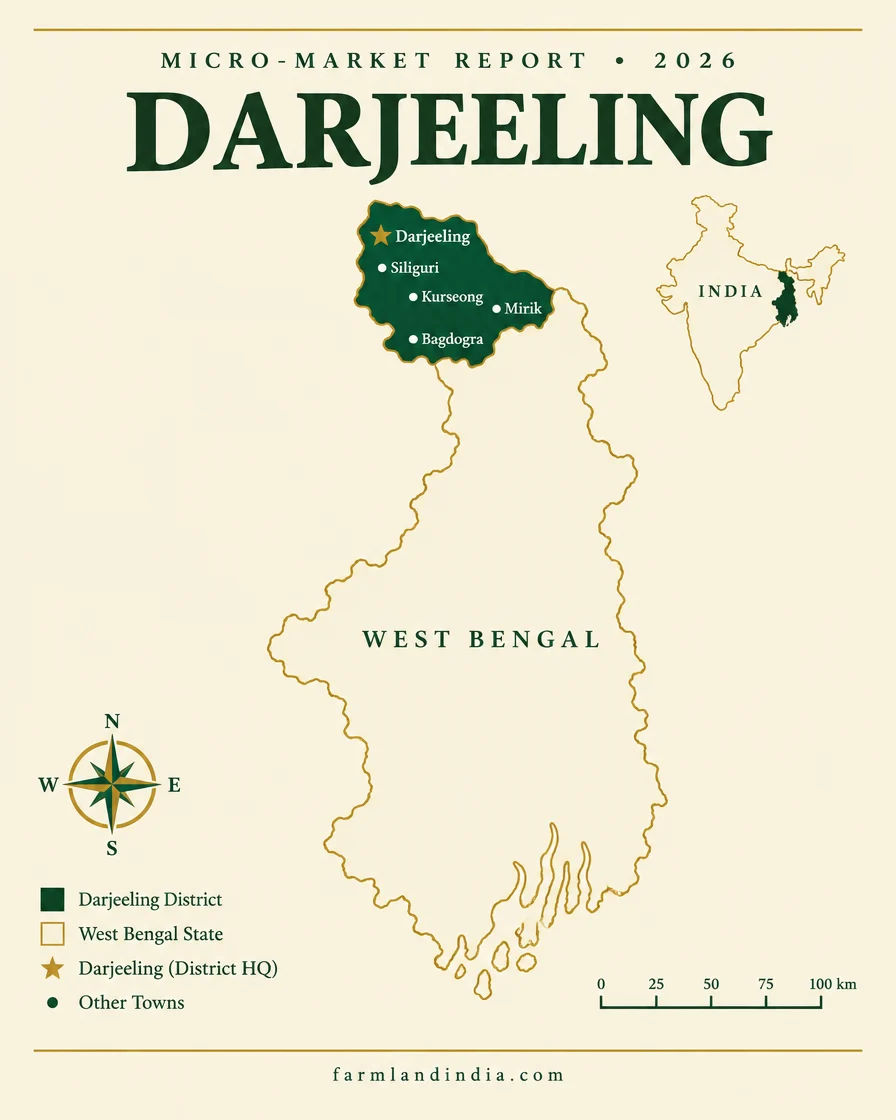
Darjeeling Sadar, Kurseong, Mirik and Siliguri; the WB profile’s 2011 figures count four sub-divisions, 12 blocks and four municipalities for the district before Kalimpong was split off (WB government profile[1])
Key markets
Siliguri · Matigara and Bagdogra · Kurseong · Darjeeling town · Mirik · Naxalbari
Demand anchors
Bagdogra airport new terminal, about Rs 1,560 crore, due March 2027 (Swarajya, Feb 2025[7]) · tea-garden lease regularisation drive (Millennium Post[8])
Rail
New Jalpaiguri and Siliguri Junction are the main rail heads; the Darjeeling Himalayan Railway climbs the hills
Size and population
3,149 sq km and 18,46,823 people at the 2011 Census, for the district as it stood before the 2017 Kalimpong split, so present Darjeeling is smaller (WB government profile[1])
Pricing unit
Asking prices are usually quoted per katha, bigha or decimal in the plains and per cottah or decimal in hill towns.
Local units
One acre is 100 decimals (satak). Katha and bigha vary by area; use the area printed in the khatian
Land records
Banglarbhumi[4]: khatian, plot (dag) and mutation (namjari); hill records may sit with the BL+LRO or GTA
Land law is state law. These rules are maintained on the West Bengal page and apply to every district within it.
Darjeeling — land purchase legal rules
West Bengal has no rule, in the Act text we reviewed, that limits farmland purchases to farmers. What controls a purchase is the family ceiling in Chapter IIB of the 1955 Land Reforms Act, the Collector’s permission to change land use, pre-emption claims by co-sharers and neighbours, bargadar rights that stay with the plot, and a land policy the new state government says it will rewrite. The points below summarise the law as published. Confirm each against the current gazette text and a local advocate before you pay a token amount.
Who can buy agricultural land: The statutes reviewed contain no provision in the Land Reforms Act, 1955 that limits purchases of agricultural land to agriculturists, unlike Gujarat. A non-farmer can buy, but the sale must stay inside the ceiling, must survive any pre-emption claim under Section 8 (co-sharer raiyats (রায়ত), bargadars and adjoining raiyats may apply to take a transferred share by depositing the price), and must pass the registration check that the intended use fits the land’s recorded class and Sections 4B, 4C, 4E and 49.
Ceiling limits: Chapter IIB (Sections 14J to 14Z) caps what a raiyat may own, counted in standard hectares. For a family of two to five members the limit is 5 standard hectares of irrigated land (12.35 acres) or 7 of non-irrigated land (17.30 acres); larger families get more, up to 7 and 9.8; any other raiyat, including a company, is capped at 7 and 9.8 (Bengal Chamber of Commerce land handbook, undated). Section 14M is the operative provision. Barga land is outside the ceiling, and tea gardens, mills and factories may hold extra land the state considers necessary. A bill published in February 2023 would add townships to the Section 14Y exemptions (PRS Legislative Research).
Conversion to non-farm use: Section 4C requires the Collector’s permission before a raiyat changes the area, character or use of land, and Section 4D makes a breach an offence punishable by up to three years in prison, a fine, or both, on a complaint by the Collector or an authorised officer (India Code). On the Malda district administration page (undated), the Block office (BL&LRO) decides up to 10 decimals, the Sub-Divisional office (SDL&LRO) from 11 to 99 decimals and the District office (DL&LRO) from 1 acre. In rural areas that page lists Rs 20 per decimal (Rs 2,000 an acre) to convert agricultural land to homestead use and Rs 50 per decimal (Rs 5,000 an acre) for industrial or commercial use.
Urban agglomerations and the Kolkata belt: Section 4E makes a transfer of agricultural land or an orchard inside a designated urban agglomeration invalid without the Collector’s written order, and the registering authority may not register it without that order (India Code). Land inside the Kolkata Metropolitan Area is also subject to the planning rules of KMDA, a statutory authority under the Urban Development and Municipal Affairs Department. Ask for any Section 4E order and the land-use certificate with the title papers.
Mutation and the record of rights: A registered deed does not update the khatian by itself. The Malda page states that land registered at a District Sub-Registrar or Additional District Sub-Registrar office is mutated automatically, and mutation can also be applied for on Banglarbhumi or at the BL&LRO; processing fees are waived for agricultural land that stays in agriculture, on a self-declaration (notification of 11 June 2018). The 2023 bill would also remove time limits for correcting the published record under Section 51A (PRS). Our Banglarbhumi guide shows how to read the khatian and check mutation.
Bargadars (sharecroppers): Operation Barga recorded about 15.2 lakh bargadars (বর্গাদার). A barga right is inheritable, cannot be sold or transferred, and attaches to the plot rather than to ongoing farming, so a buyer takes the bargadar on as a virtual co-holder (Swarajya, 4 September 2026). Check the record of rights for a barga entry and get a written statement from the BL&LRO before you pay.
Scheduled Tribe land: Section 14C limits how a Scheduled Tribe raiyat may transfer land. A sale to someone outside the community needs the Revenue Officer’s prior written permission, given only if no Scheduled Tribe buyer will pay the fair market price and the sale serves a listed purpose (India Code). Trace the ownership history of the plot, and if any past owner was a Scheduled Tribe raiyat, ask for the Section 14C permission.
Vested and ceiling-surplus land: Ceiling-surplus land vests in the state and is distributed to landless, Scheduled Caste and Scheduled Tribe households (handbook). Such plots may carry transfer restrictions and are not ordinary market land. Ask for the allotment order and the khatian type, and look for a vested (khas) entry on Banglarbhumi.
Tea garden land: Tea estates in the Dooars, Terai and Darjeeling stand on leasehold land. The tea tourism policy lets planters use 15% of a garden, up to 150 acres, for non-tea projects (PTI via Devdiscourse, 31 October 2019), and a March 2025 notification said no freehold settlement will be granted for tea land under cultivation (The Statesman). A lessee has no freehold title to pass on, so treat any offer of a “tea garden plot” as a lease question, not a sale.
Darjeeling hills and the GTA: The Darjeeling, Kalimpong and Kurseong subdivisions, plus specified mouzas in Siliguri, sit under the Gorkhaland Territorial Administration, created by a 2011 Act (Home and Hill Affairs Department). The department page does not list land powers, so confirm with the BL&LRO or the GTA secretariat at Darjeeling which office keeps the record and which rules apply to a hill plot before you pay.
Policy in flux, 2026: The government that took office this year has announced direct purchase of land for industry (11 July 2026), land pooling (17 August 2026) and a land bank from unused public land, and says it will review the Urban Land (Ceiling and Regulation) Act, 1976 (The Hans India, Telangana Today, The Statesman). The Finance Minister has said land laws will be rationalised, without naming sections (Business Today, 21 August 2026). Check again before signing for any notified change to the Chapter IIB ceiling.
Documents to ask for: Before paying, ask for the latest khatian copy and plot information from Banglarbhumi, the mouza map, registered title deeds going back as far as they exist (ideally 30 years), the mutation record, up-to-date land revenue receipts, a written statement from the BL&LRO on barga and vested land, an encumbrance search at the registration office, and any Section 4C or 4E orders.
NRI and OCI buyers: Under the RBI Master Direction on immovable property, NRIs and OCIs may not buy agricultural land, a farmhouse or plantation property. They can inherit it or receive it as a gift from a resident relative, and may sell it only to a resident Indian citizen. Land lawfully converted to non-agricultural use is treated differently, so check the conversion order against the exact plot. Our NRI guide covers the options.
- No farmer-only rule found
- Ceiling: Section 14M
- Conversion: Section 4C
- Bargadar rights
- ST land: Section 14C
- Tea land is leasehold
- NRI agri: barred (RBI)
- Records via Banglarbhumi
Darjeeling — district-specific notes
The West Bengal state page applies to Darjeeling, including its tea-garden and GTA notes. These points are specific to the district.
⚠ Tea estates in Darjeeling stand on leasehold land. A March 2025 notification said no freehold settlement will be granted for tea land under cultivation (The Statesman[10]), and the tea tourism policy lets planters use up to 15% of a garden, capped at 150 acres, for other projects (PTI via Devdiscourse[11]). A lessee has no freehold title to sell.
⚠ In December 2024 the Land and Land Reforms department asked district magistrates to regularise or grant long-term leases to tea gardens; in Darjeeling, 14 gardens lacked leases and four had not renewed for years (Millennium Post, 1 Jan 2025[8]). Ask for the lease deed and the latest renewal before you pay for any garden-edge plot.
⚠ Workers’ homestead land is contested. The state’s five-decimal grant was rejected by the GTA, which wants full rights over the land workers actually hold; a state order of 2 November 2023 sent a survey of tea-garden land in Darjeeling and Kalimpong (The Statesman[9]). Do not buy land in a garden settlement without the BL+LRO’s written confirmation.
⚠ The Darjeeling, Kurseong and Mirik hills fall under the Gorkhaland Territorial Administration (Home and Hill Affairs Department[3]). The department page does not list land powers, so ask which office keeps the record before paying.
⚠ Slopes slide. More than 20 people died in rain-triggered landslides across Darjeeling district in October 2025 (AIR News, 5 Oct 2025[12]). A plot that looks stable in dry weather may sit on an unrecorded slide path.
Read the full West Bengal land buying guide for the ceiling, conversion, land records and NRI rules.
- Tea-garden leasehold
- GTA hill area
- Landslide and slope risk
- Siliguri plain land
- Policy under review
District overview
Darjeeling — a hill-and-plain district: tea slopes, a Himalayan railway and the Siliguri gateway
Darjeeling district has four sub-divisions: Darjeeling Sadar, Kurseong and Mirik in the hills, and Siliguri on the plain (WB government profile[1]). The 2011 Census, which predates the 2017 Kalimpong split, counted 18,46,823 people in 3,149 sq km, so the present district is smaller than those figures suggest.
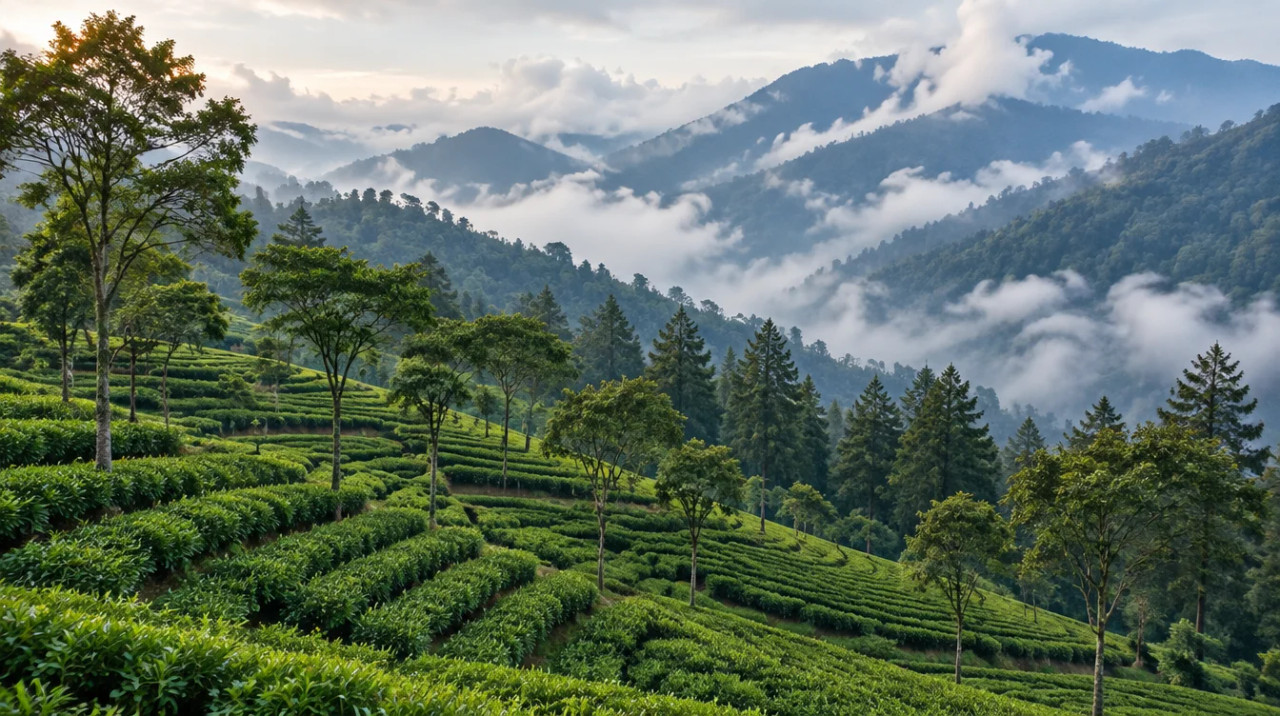
The hills grow Darjeeling tea on leasehold estates, and much of the remaining hill land is forest, small terraces and town plots. The Siliguri plain is a different market: the city is the gateway to north-east India and Sikkim, and the Bagdogra terminal expansion is its biggest civil project, about Rs 1,560 crore, 10 times the size of the old terminal and due by March 2027 (Swarajya, 16 Feb 2025[7]).
Siliguri also appears as the northern end of the planned Kharagpur–Siliguri economic corridor; the March 2026 foundation stone covered the 231 km Kharagpur–Moregram section only (PIB[13]). Treat any agent claim of a finished highway to Siliguri as unproven until a dated notification is shown.
Tea land is the dominant legal issue. The state is pushing to regularise or grant long-term leases to tea gardens, and in Darjeeling 14 gardens lacked leases and four had not renewed them as of the December 2024 directive (Millennium Post[8]). The GTA has rejected the state’s five-decimal homestead grant and wants fuller land rights for workers (The Statesman[9]).
Climate risk is high: more than 20 deaths were reported in rain-triggered landslides across the district in October 2025 (AIR News[12]). The CGWB’s 2024 assessment also lists nitrate above 45 mg/L in places (CGWB, 2024[2]).
For a buyer, Darjeeling is two markets: the Siliguri plain with airport, rail and trade demand and fairly ordinary West Bengal land rules, and the hills where leasehold, GTA record questions and slope risk dominate.
- Siliguri
- Bagdogra
- Kurseong
- Darjeeling town
- Mirik
- Naxalbari
Transaction costs
Stamp duty & registration in Darjeeling
5% / 6%
Stamp duty, rural / urban
Registration Directorate presentation, undated; confirm current rate
+1%
Extra duty where market value exceeds Rs 1 crore
Same presentation; confirm before you budget
1%
Registration fee
Same presentation, which carries no date
Darjeeling follows the state structure. The Registration Directorate presentation, undated, gives 5% in gram panchayat areas, 6% in municipal and notified areas, plus 1% above Rs 1 crore, and a 1% registration fee (Directorate presentation[6]). Plots in Siliguri, Darjeeling, Kurseong and Mirik fall in the urban band, and the plains villages in the rural band. The rate is as published by the Directorate, so confirm it with the sub-registrar. Hill plots may be on lease or in special records, so confirm what you are actually registering. See our stamp duty guide.
Know the belt
What is moving prices in Darjeeling
Reported airport and tea-land developments; no listing-site prices are used.
Siliguri, Matigara and Bagdogra
Gateway city and airport belt
The Bagdogra terminal expansion, about Rs 1,560 crore with 10 million passengers a year of capacity, is due by March 2027 (Swarajya[7]). Demand around the city is for housing, warehouse and hospitality land.
Check: whether the plot is inside any airport height or approach zone and the municipal boundary.
Kurseong and the lower hills
Tea estate and hill-town market
Kurseong sits between the plain and Darjeeling town, among tea estates. Lease status matters more than price here, as 14 Darjeeling gardens lacked leases at the December 2024 directive (Millennium Post[8]).
Check: whether the land is freehold, lease or garden settlement land.
Darjeeling town and Mirik
Tourism hill towns
These are tourist-led hill markets where buildings are on steep slopes. Rain-triggered landslides killed more than 20 people across the district in October 2025 (AIR News[12]).
Check: slope stability, drainage and the nearest recorded slide.
Naxalbari and the plains tea-and-paddy belt
Plains agricultural belt
North of Siliguri the plain has paddy, tea and small holdings, and the same lease and workers’ land questions arise next to gardens. The CGWB lists nitrate above 45 mg/L in places (CGWB, 2024[2]).
Check: garden boundaries and groundwater quality.
Asking prices
No official farmland price series is published for Darjeeling. Ask the sub-registrar for recent registered sale values in the village you are looking at. Government land value and registered deeds in the same mouza are the best reference; treat agent quotes as asking prices.
Connectivity
How Darjeeling connects — road, rail and air
Siliguri is the transport hub; the hills depend on a few ghat roads and the heritage railway.
🚗 By road
✈️ By air
🚆 By rail
Check the live route before you travel. Hill road conditions change after each monsoon.
Growth catalysts
Upcoming infrastructure & developments
Dated, projects only; status is shown on each card.
00Open
04Catalysts
Agriculture & terrain
Soil, crops & water in Darjeeling
Tea on the hill slopes, paddy and vegetables on terraces and the plains, and slope and water-quality risk to check.
Crops
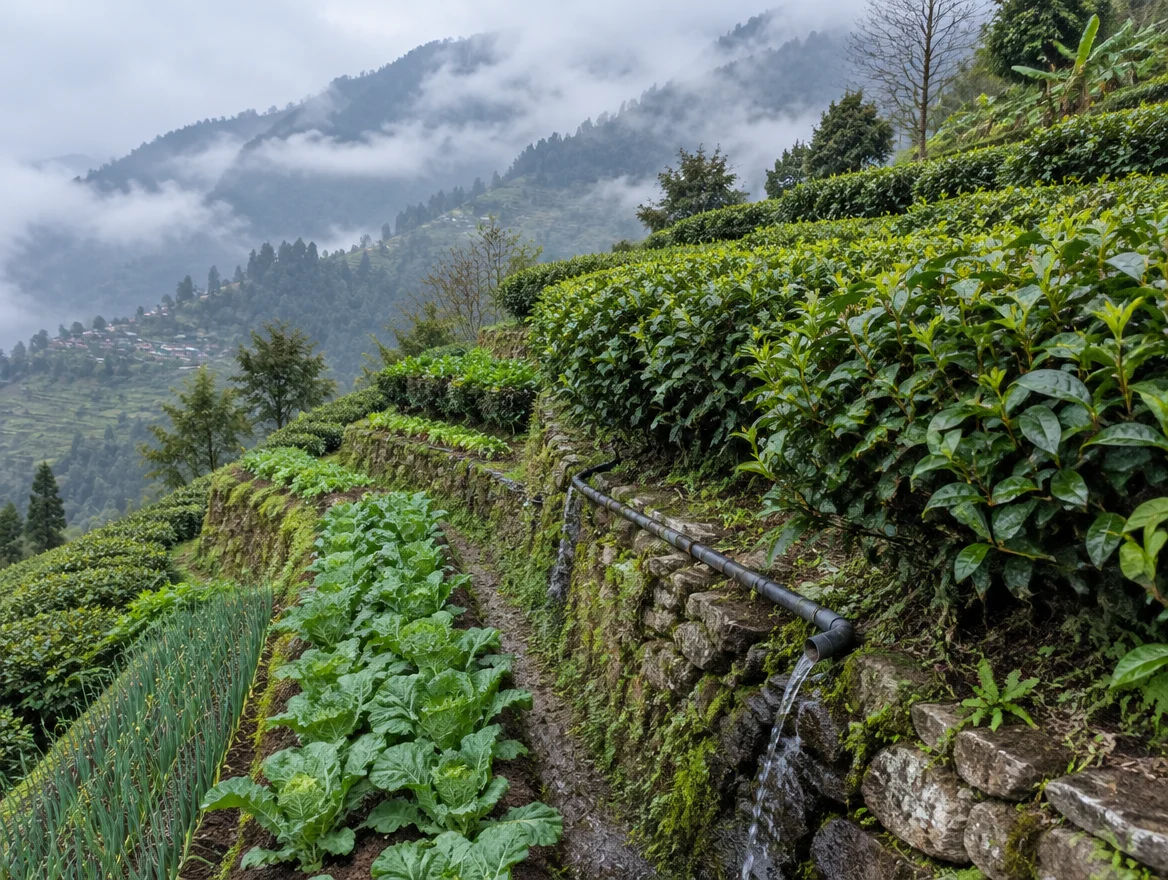
Darjeeling tea is the signature crop of the hills, with cardamom, ginger, oranges, maize and vegetables on terraces, and paddy, jute and tea on the plain.
- Tea
- Terrace vegetables
- Paddy (plain)
- Maize
Soils and terrain
Hill soils are acidic and shallow on steep slopes; the Terai plain below has alluvial soil. Slope and drainage decide whether a plot can be cultivated.
- Steep hill slopes
- Terraced fields
- Terai alluvium
Water
The CGWB’s 2024 assessment lists nitrate above 45 mg/L in places in Darjeeling (CGWB, 2024[2]). Hill plots often depend on springs and piped water, which fail in dry spells.
- Springs
- Tubewells (plain)
- Piped supply
Leasehold tea land
Garden land is leasehold, with only limited non-tea use allowed under the tea tourism policy (PTI via Devdiscourse[11]). It is not available as ordinary farmland.
Landslide season
The monsoon months bring slides. More than 20 deaths were reported in October 2025 (AIR News[12]).
At a glance
Darjeeling vs. nearby districts
| District | Land and water | What links it to Darjeeling |
|---|---|---|
| Kalimpong (east, hills) | Hill and tea land under the GTA | Split from Darjeeling in 2017; tea-garden worker land survey covers both districts (The Statesman[9]) |
| Jalpaiguri (south-east) | Terai plain, tea | Siliguri belt and tea-lease issues cross the boundary (Millennium Post[8]) |
| Uttar Dinajpur (south) | Plain, tea in Islampur | 36 gardens lacked valid leases at the same directive (Millennium Post[8]) |
No price series is available for these districts, so the table compares land type and links only. Compare registered deeds rather than asking prices.
Farmland India view
Why investors look at Darjeeling
Five reasoned points for Darjeeling, each tied to a source on this page.
Siliguri is the real market
The Bagdogra terminal and Siliguri’s role as a trade gateway drive demand (Swarajya[7]); hill plots are a different product.
Tea land is not freehold
The state said no freehold settlement for tea land under cultivation (The Statesman[10]). Lease status decides what a garden-edge buyer actually owns.
Policy is moving
The December 2024 lease directive and the GTA’s rejection of the five-decimal grant show land rules still in flux (Millennium Post[8]; The Statesman[9]).
Climate risk is part of the price
More than 20 deaths in October 2025 landslides (AIR News[12]) mean slope and drainage surveys are not optional for hill land.
Tourism edge in the hills
Darjeeling town and Mirik have steady tourist demand, but building rules and slopes limit supply; check municipal rules.
Lease and zoning checks matter more than price
Because tea land is leasehold and hill building is restricted, a cheaper plot can be worth less than it looks. Pay for a lawyer’s lease and zoning review before the token amount.
Confirm khatian, mutation, zoning and acquisition status directly — these are not certified by Farmland India’s review.
STRAIGHT TALK
Risks & challenges in Darjeeling
District-specific risks. Read the state page for the general West Bengal risks on ceiling, conversion and records.
Leasehold tea land
A lessee cannot pass freehold title, and settlement for cultivated tea land has been ruled out (The Statesman[10]). Do not pay for a garden plot without the lease deed.
Workers’ homestead disputes
The five-decimal grant is contested and a survey is under way (The Statesman[9]). Land inside garden settlements may have unsettled claims.
Landslides and slope failure
More than 20 deaths in October 2025 (AIR News[12]). Check slope, drainage and geological advice.
GTA and record confusion
Which office keeps the record and what rules apply is not listed on the department page (Home and Hill Affairs[3]). Confirm in writing.
Forest and reserve land
Much hill land is forest or reserved; confirm the recorded class on Banglarbhumi[4] and with the forest division.
Seismic and flood exposure
North Bengal and Sikkim are seismically active and the Teesta and Balason flood. Ask about flood and quake-resistant construction rules.
Water quality and supply
Nitrate above 45 mg/L has been recorded in places (CGWB, 2024[2]), and hill springs can dry up.
Thin resale for hill plots
Hill land sells slowly and buyers rely on tourism or retirement demand; the Siliguri plain is liquid by comparison. Plan the hold period by sub-area, not for the district.
Building and zoning rules
Municipal and development-authority rules in Siliguri, Darjeeling and Kurseong restrict height, setbacks and use. A plot that is legal to buy may not be legal to build on, so ask for the zoning and building plan rules in writing.
Who to contact
Local revenue & planning offices
The district administration sits at Darjeeling; check the district portal for sub-divisional offices at Darjeeling, Kurseong, Mirik and Siliguri. Mutation and record work go through the Block Land and Land Reforms Officer (BL+LRO) and Banglarbhumi[4]; hill records may involve the Gorkhaland Territorial Administration[3]. Conversion needs the Collector’s permission under Section 4C. Registration is at the sub-registrar office covering your mouza, with e-services at the West Bengal registration portal[5]. For building rules inside Siliguri, ask the municipal corporation and the Siliguri Jalpaiguri Development Authority; for forest land, ask the divisional forest office.
KEEP EXPLORING
Explore more areas
Other districts in West Bengal
- Alipurduar
- Bankura
- Birbhum
- Cooch Behar
- Dakshin Dinajpur (south Dinajpur)
- Hooghly
- Howrah
- Jalpaiguri
- Jhargram
- Kalimpong
- Kolkata
- Malda
- Murshidabad
- Nadia
- North 24 Parganas
- Paschim Bardhaman
- Paschim Medinipur (west Midnapore)
- Purba Bardhaman
- Purba Medinipur (east Midnapore)
- Purulia
- South 24 Parganas
- Uttar Dinajpur (north Dinajpur)
COMMON QUESTIONS
Frequently asked questions
Everything buyers, NRIs and investors ask before their first reviewed farmland purchase in Darjeeling.
Visit full wiki01 of 04
Can I buy tea garden land in Darjeeling?
Tea estates stand on leasehold land, so a lessee has no freehold title to sell. A March 2025 notification said no freehold settlement would be granted for tea land under cultivation. Treat any tea-garden plot offer as a lease question.
02 of 04
Who keeps land records in the Darjeeling hills?
The hill sub-divisions sit under the Gorkhaland Territorial Administration. The Home and Hill Affairs page does not list land powers, so ask the BL+LRO or the GTA secretariat which office keeps the record and which rules apply.
03 of 04
What are the stamp duty and registration charges?
A Registration Directorate presentation with no date gives 5% in gram panchayat areas, 6% in municipal and notified areas, 1% extra above Rs 1 crore and a 1% registration fee. Confirm the current rate with the sub-registrar.
04 of 04
How serious is landslide risk for hill plots?
Serious. More than 20 deaths were reported in rain-triggered landslides across Darjeeling district in October 2025. Check slope, drainage, the nearest recorded slide and any geological assessment before buying a hill plot.
Transparency
Sources and references
Government
- [1]West Bengal government: Darjeeling district profile — wb.gov.in
- [2]CGWB: Dynamic Ground Water Resources, West Bengal 2024 — cgwb.gov.in
- [3]Home and Hill Affairs Department: Gorkhaland Territorial Administration — home.wb.gov.in
- [4]Banglarbhumi, land records — banglarbhumi.gov.in
Law and land records
- [5]Registration portal, West Bengal — wbregistration.gov.in
- [6]Registration Directorate presentation (undated) — cdnbbsr.s3waas.gov.in
News
- [7]Swarajya: Bagdogra airport new terminal, 16 Feb 2025 — swarajyamag.com
- [8]Millennium Post: tea garden lease regularisation, 1 Jan 2025 — millenniumpost.in
- [9]The Statesman: GTA rejects five-decimal land grant — thestatesman.com
- [10]The Statesman: tea turmoil, state amends tea tourism policy — thestatesman.com
- [11]PTI via Devdiscourse: construction on 15% of tea garden land, 31 Oct 2019 — devdiscourse.com
- [12]AIR News: lives lost in Darjeeling landslides, 5 Oct 2025 — newsonair.gov.in
Further reading
- Banglarbhumi guide
- Stamp duty in West Bengal
- Can NRIs buy agricultural land in India?
- [13]pmindia.gov.in: PIB — pmindia.gov.in
Data-currency note: sources were read in November 2026. Project status, government rates and land rules change often; check the linked source and the relevant office before relying on any figure.
For developers
Ready to explore Darjeeling farmland?
Browse reviewed projects and individual land parcels across Darjeeling — or if you own land here, list it with platform review and reach serious buyers.