
District guide
Buying Land in Dakshin Dinajpur (South Dinajpur)
A rice, potato and jute district on the Bangladesh border: Balurghat–Hili rail, a planned Balurghat airport, the Hili land port and tubewell-irrigated plains.
2,162 sq km
Area (state export-hub profile)
16.76 lakh
Population (Census 2011)
1,848 mm
Normal annual rainfall (ICAR-CRIDA)
176%
Cropping intensity (ICAR-CRIDA)
*Indicative range across districts and land types. Stamp duty, registration and conversion charges are additional. Local measurement units vary — every listing states the unit it is priced in. Not a valuation or an offer.
District land record — Dakshin Dinajpur (south Dinajpur)
Rev. 2026 · Farmland India desk
State
West Bengal
Sub-divisions
Two sub-divisions, Balurghat and Gangarampur (Buniadpur), eight blocks (Balurghat, Gangarampur, Tapan, Kumarganj, Harirampur, Kushmandi, Hili and Banshihari) and three municipalities (state export-hub profile[3]); headquarters Balurghat
Key markets
Balurghat · Gangarampur · Buniadpur · Tapan · Hili · Harirampur
Demand anchors
Balurghat–Hili new rail line, Rs 1,181 crore (Millennium Post, Sep 2025[7]) · Balurghat airport plan (Construction World, Oct 2026[8]) · Hili land port (state export-hub profile[3])
Rail
The 87 km Eklakhi–Balurghat broad-gauge branch, commissioned in 2004, joins the Howrah–New Jalpaiguri main line (state export-hub profile[3])
Size and population
2,162 sq km and 16.76 lakh people at the 2011 Census, 85.9% rural (state export-hub profile[3])
Pricing unit
Local units
Bengal measures land in decimal (one-hundredth of an acre, 435.6 sq ft), katha and bigha; katha and bigha vary by area, so convert to acres or sq ft on the deed.
Land records portal
Banglarbhumi[5] for khatian, plot (dag) details and mutation status; see our Banglarbhumi guide
Land law is state law. These rules are maintained on the West Bengal page and apply to every district within it.
Dakshin Dinajpur (south Dinajpur) — land purchase legal rules
West Bengal has no rule, in the Act text we reviewed, that limits farmland purchases to farmers. What controls a purchase is the family ceiling in Chapter IIB of the 1955 Land Reforms Act, the Collector’s permission to change land use, pre-emption claims by co-sharers and neighbours, bargadar rights that stay with the plot, and a land policy the new state government says it will rewrite. The points below summarise the law as published. Confirm each against the current gazette text and a local advocate before you pay a token amount.
Who can buy agricultural land: The statutes reviewed contain no provision in the Land Reforms Act, 1955 that limits purchases of agricultural land to agriculturists, unlike Gujarat. A non-farmer can buy, but the sale must stay inside the ceiling, must survive any pre-emption claim under Section 8 (co-sharer raiyats (রায়ত), bargadars and adjoining raiyats may apply to take a transferred share by depositing the price), and must pass the registration check that the intended use fits the land’s recorded class and Sections 4B, 4C, 4E and 49.
Ceiling limits: Chapter IIB (Sections 14J to 14Z) caps what a raiyat may own, counted in standard hectares. For a family of two to five members the limit is 5 standard hectares of irrigated land (12.35 acres) or 7 of non-irrigated land (17.30 acres); larger families get more, up to 7 and 9.8; any other raiyat, including a company, is capped at 7 and 9.8 (Bengal Chamber of Commerce land handbook, undated). Section 14M is the operative provision. Barga land is outside the ceiling, and tea gardens, mills and factories may hold extra land the state considers necessary. A bill published in February 2023 would add townships to the Section 14Y exemptions (PRS Legislative Research).
Conversion to non-farm use: Section 4C requires the Collector’s permission before a raiyat changes the area, character or use of land, and Section 4D makes a breach an offence punishable by up to three years in prison, a fine, or both, on a complaint by the Collector or an authorised officer (India Code). On the Malda district administration page (undated), the Block office (BL&LRO) decides up to 10 decimals, the Sub-Divisional office (SDL&LRO) from 11 to 99 decimals and the District office (DL&LRO) from 1 acre. In rural areas that page lists Rs 20 per decimal (Rs 2,000 an acre) to convert agricultural land to homestead use and Rs 50 per decimal (Rs 5,000 an acre) for industrial or commercial use.
Urban agglomerations and the Kolkata belt: Section 4E makes a transfer of agricultural land or an orchard inside a designated urban agglomeration invalid without the Collector’s written order, and the registering authority may not register it without that order (India Code). Land inside the Kolkata Metropolitan Area is also subject to the planning rules of KMDA, a statutory authority under the Urban Development and Municipal Affairs Department. Ask for any Section 4E order and the land-use certificate with the title papers.
Mutation and the record of rights: A registered deed does not update the khatian by itself. The Malda page states that land registered at a District Sub-Registrar or Additional District Sub-Registrar office is mutated automatically, and mutation can also be applied for on Banglarbhumi or at the BL&LRO; processing fees are waived for agricultural land that stays in agriculture, on a self-declaration (notification of 11 June 2018). The 2023 bill would also remove time limits for correcting the published record under Section 51A (PRS). Our Banglarbhumi guide shows how to read the khatian and check mutation.
Bargadars (sharecroppers): Operation Barga recorded about 15.2 lakh bargadars (বর্গাদার). A barga right is inheritable, cannot be sold or transferred, and attaches to the plot rather than to ongoing farming, so a buyer takes the bargadar on as a virtual co-holder (Swarajya, 4 September 2026). Check the record of rights for a barga entry and get a written statement from the BL&LRO before you pay.
Scheduled Tribe land: Section 14C limits how a Scheduled Tribe raiyat may transfer land. A sale to someone outside the community needs the Revenue Officer’s prior written permission, given only if no Scheduled Tribe buyer will pay the fair market price and the sale serves a listed purpose (India Code). Trace the ownership history of the plot, and if any past owner was a Scheduled Tribe raiyat, ask for the Section 14C permission.
Vested and ceiling-surplus land: Ceiling-surplus land vests in the state and is distributed to landless, Scheduled Caste and Scheduled Tribe households (handbook). Such plots may carry transfer restrictions and are not ordinary market land. Ask for the allotment order and the khatian type, and look for a vested (khas) entry on Banglarbhumi.
Tea garden land: Tea estates in the Dooars, Terai and Darjeeling stand on leasehold land. The tea tourism policy lets planters use 15% of a garden, up to 150 acres, for non-tea projects (PTI via Devdiscourse, 31 October 2019), and a March 2025 notification said no freehold settlement will be granted for tea land under cultivation (The Statesman). A lessee has no freehold title to pass on, so treat any offer of a “tea garden plot” as a lease question, not a sale.
Darjeeling hills and the GTA: The Darjeeling, Kalimpong and Kurseong subdivisions, plus specified mouzas in Siliguri, sit under the Gorkhaland Territorial Administration, created by a 2011 Act (Home and Hill Affairs Department). The department page does not list land powers, so confirm with the BL&LRO or the GTA secretariat at Darjeeling which office keeps the record and which rules apply to a hill plot before you pay.
Policy in flux, 2026: The government that took office this year has announced direct purchase of land for industry (11 July 2026), land pooling (17 August 2026) and a land bank from unused public land, and says it will review the Urban Land (Ceiling and Regulation) Act, 1976 (The Hans India, Telangana Today, The Statesman). The Finance Minister has said land laws will be rationalised, without naming sections (Business Today, 21 August 2026). Check again before signing for any notified change to the Chapter IIB ceiling.
Documents to ask for: Before paying, ask for the latest khatian copy and plot information from Banglarbhumi, the mouza map, registered title deeds going back as far as they exist (ideally 30 years), the mutation record, up-to-date land revenue receipts, a written statement from the BL&LRO on barga and vested land, an encumbrance search at the registration office, and any Section 4C or 4E orders.
NRI and OCI buyers: Under the RBI Master Direction on immovable property, NRIs and OCIs may not buy agricultural land, a farmhouse or plantation property. They can inherit it or receive it as a gift from a resident relative, and may sell it only to a resident Indian citizen. Land lawfully converted to non-agricultural use is treated differently, so check the conversion order against the exact plot. Our NRI guide covers the options.
- No farmer-only rule found
- Ceiling: Section 14M
- Conversion: Section 4C
- Bargadar rights
- ST land: Section 14C
- Tea land is leasehold
- NRI agri: barred (RBI)
- Records via Banglarbhumi
Dakshin Dinajpur (south Dinajpur) — district-specific notes
The West Bengal state page applies to Dakshin Dinajpur in full: the ceiling in Chapter IIB of the Land Reforms Act, conversion under Sections 4C and 4D, bargadar rights and the NRI bar. These five points are specific to the district.
⚠ The district has a long border with Bangladesh, and Hili is an international check post and land port (state export-hub profile[3]). Plots close to the border can carry movement and construction limits that do not appear on the khatian. Ask the BL&LRO and the border-guarding force in writing before you buy near the fence.
⚠ Three infrastructure projects need land: the Balurghat–Hili rail line, where officials said acquisition was complete in September 2025 (Millennium Post[7]); the Balurghat airport, where about 150 more acres are needed for larger aircraft and the district administration has been asked to acquire them (Construction World, 1 Oct 2026[8]); and the approved Itahar–Buniadpur rail line (EastMojo[9]). Ask whether a notice covers your plot before paying an advance.
⚠ ICAR-CRIDA lists floods and drought as occasional hazards (ICAR-CRIDA[4]). Plots near river channels such as the Atrai, Tangon and Jamuna (state export-hub profile[3]) can be waterlogged, so visit in the monsoon and ask neighbours about the highest water level.
⚠ Scheduled Tribe raiyats may sell only with the Revenue Officer’s prior permission under Section 14C (India Code[1]). Trace the plot’s ownership history and ask for the permission if any past owner was a Scheduled Tribe raiyat.
⚠ Land that an agent markets as “near the airport” or “near Hili” is not necessarily inside any plan. The airport land is still being acquired and the Hili land port was recorded in the state profile as having 80 acres identified for development as of September 2021 (state export-hub profile[3]). Ask for the plan or notice, not the sketch.
Read the full West Bengal land buying guide for the ceiling, conversion, survey and NRI rules.
- Bangladesh border
- Airport and rail acquisition
- Flood-plain land
- Tribal land
- Hili land port
District overview
Dakshin Dinajpur (south Dinajpur) — a rice-and-potato border district waiting for its rail and air links
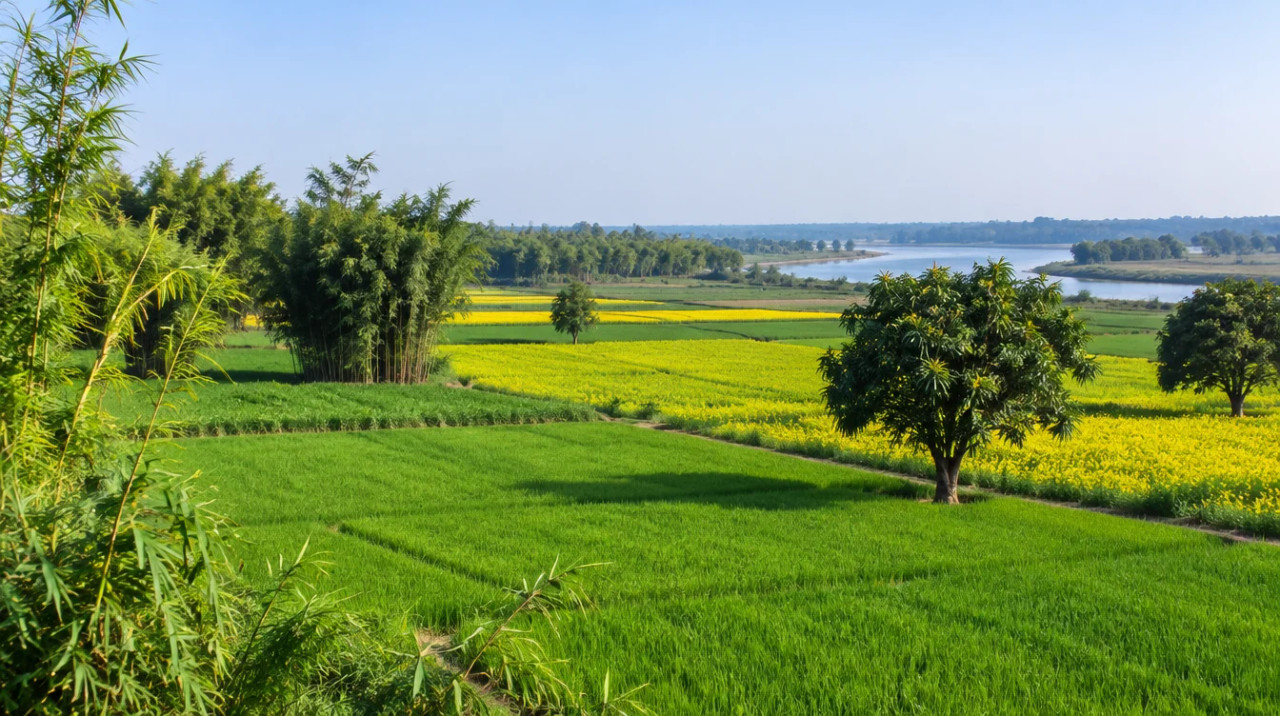
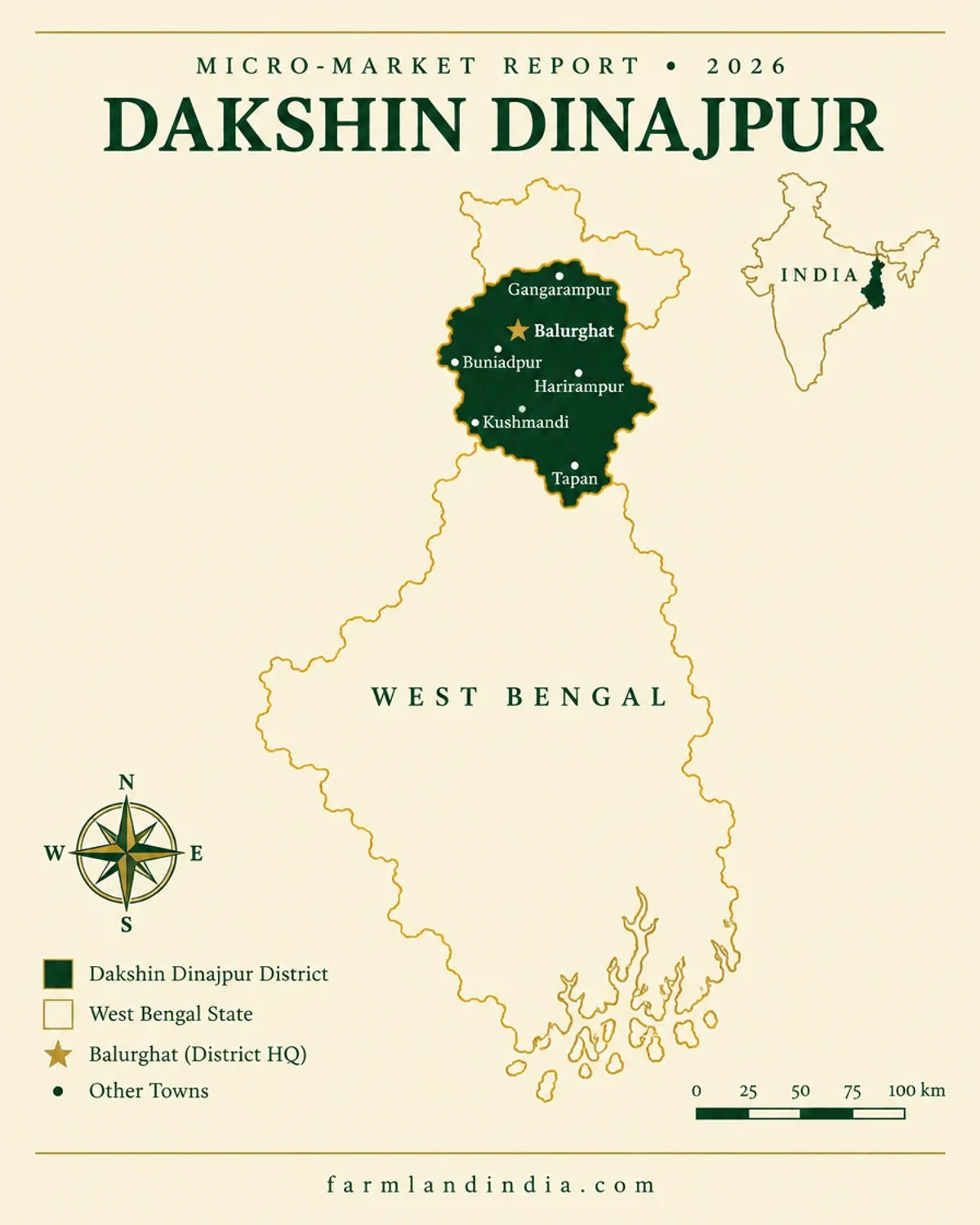
Dakshin Dinajpur (South Dinajpur) covers 2,162 sq km and had 16.76 lakh people at the 2011 Census, 85.9% of them rural. It has two sub-divisions, Balurghat and Gangarampur, eight blocks and three municipalities, with Balurghat as headquarters (state export-hub profile[3]). It is a flat alluvial district in north Bengal, bordered by Bangladesh along its east and south.
The economy is farming and agro-processing. Rice is about 54% of cropped area, with potato, jute and wheat the other staples, and the state profile says 97.4% of the district’s exports in 2024-25 were agricultural, with parboiled rice about 65% (state export-hub profile[3]). ICAR-CRIDA records rice on about 240,000 ha and a cropping intensity of 176% (ICAR-CRIDA[4]).
Connectivity is the story. Today the district has no functioning airport, and the nearest, Bagdogra, is about 231 km away (state export-hub profile[3]). A 29 km Balurghat–Hili rail line sanctioned at Rs 1,181 crore has completed land acquisition (Millennium Post, 3 Sep 2025[7]), and a Balurghat airport is expected to become operational within a year of an October 2026 report (Construction World[8]). Both are works in progress.
Buyers are mainly local families, traders linked to the Hili border and small investors from Siliguri and Kolkata. Read the legal notes above, then price any plot against the assessed value and deeds registered in the same mouza.
- Balurghat
- Gangarampur
- Buniadpur
- Tapan
- Hili
- Harirampur
Transaction costs
Stamp duty & registration in Dakshin Dinajpur (south Dinajpur)
5%
Rural (gram panchayat) areas
Per the Registration Directorate presentation, undated
6%
Urban areas (corporation, municipality, notified area)
Plus 1% where market value exceeds Rs 1 crore
1%
Registration fee
Same presentation; confirm the current rate
The Directorate of Registration and Stamp Revenue gives these rates in an undated presentation hosted on a government site, so treat them as published figures and confirm the current rate with the sub-registrar before you budget (state guide). Duty is charged on market value, not only on the price written in the deed. Pay through the registration portal[6], and ask the registering office for the assessed value of your plot before the deed is drafted.
Know the belt
What is moving prices in Dakshin Dinajpur (south Dinajpur)
Reported rail, airport and border-trade developments; no listing-site prices are used.
Balurghat
District headquarters, airport and rail
Balurghat is the headquarters and the terminus of the Eklakhi branch line, and the planned site of the district airport, with a 19-seater service planned first (Construction World[8]). The airport still needs about 150 more acres for 72-seater aircraft.
Check: whether the plot is in the airport acquisition area and what the railway or district office says about it.
Hili and the border belt
Land port trade corridor
Hili handles exports such as onion, wheat, rice and maize but faces road and infrastructure problems, and its highway link on the Bangladesh side was reported in February 2026 as delayed to June 2027 (state export-hub profile[3]; Financial Express, 9 Feb 2026[10]). The Balurghat–Hili line ends here. Demand is for storage and agro-processing land.
Check: border distance, road access in the monsoon and any restriction on the plot.
Gangarampur and Buniadpur
Second sub-division, new rail line
Gangarampur is the second sub-division headquarters and Buniadpur a municipality; the Itahar–Buniadpur line (27.095 km, Rs 287.94 crore) was approved in January 2026 (EastMojo[9]). It is a farm and market belt.
Check: acquisition notices and the khatian class of roadside plots.
Asking prices
Agent asking prices are not sales. No official farmland price series is published for Dakshin Dinajpur (south Dinajpur). Ask the sub-registrar for recent registered sale values in the village you are looking at. Use the assessed market value from the registering office, deeds registered in the same mouza and a Banglarbhumi khatian check as your references.
Connectivity
How Dakshin Dinajpur (south Dinajpur) connects — road, rail and air
One highway and a branch railway today; a new rail line and an airport are both pending.
🚗 By road
✈️ By air
🚆 By rail
Check the live route before you travel. Dates here are press reports, and the sources show repeated delays.
Growth catalysts
Upcoming infrastructure & developments
Each item shows its status and a dated source. Dates are targets reported by the press.
01Open
04Catalysts
Agriculture & terrain
Soil, crops & water in Dakshin Dinajpur (south Dinajpur)
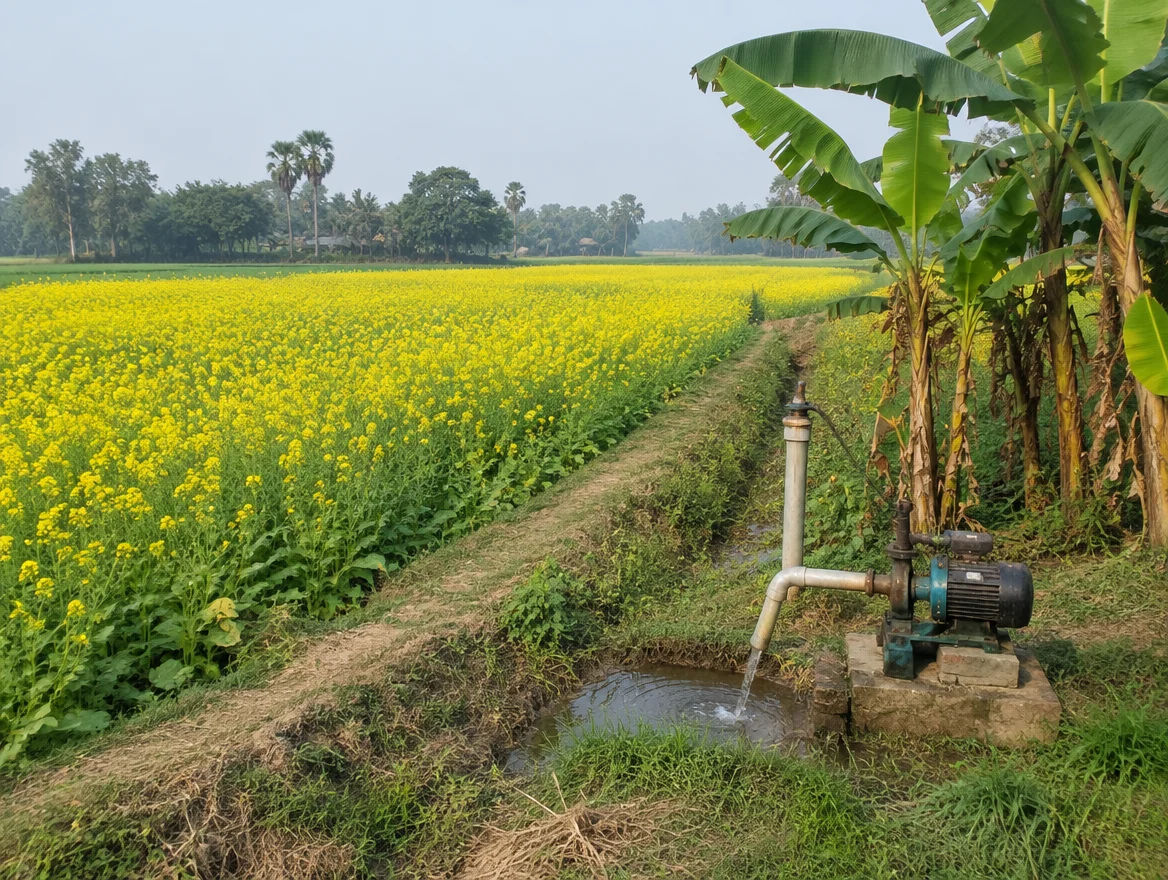
Rice, potato, wheat, mustard and jute on clay loam and loam, irrigated mostly from tubewells, with no canal irrigation.
Crops
ICAR-CRIDA gives rice on about 240,300 ha (kharif 163,100, summer 66,800), wheat 23,950 ha, jute 18,720 ha, mustard 18,660 ha and potato 16,660 ha (ICAR-CRIDA[4]). The state profile puts district production at about 686,000 t of rice, 555,000 t of potato and 279,000 t of jute (state export-hub profile[3]).
- Rice
- Potato
- Jute
- Wheat and mustard
Soils
Very deep clay loam covers about 24.5% of the area, deep clay 19.3%, deep loam 13.5%, sandy soil 12% and sandy loam 9.8% (ICAR-CRIDA[4]). The plan places the district in the Old Alluvial zone.
- Clay loam
- Clay
- Loam
- Sandy loam
Fruit and vegetables
Mango and banana are the leading fruits, with brinjal about 6,600 ha and cabbage 4,000 ha (ICAR-CRIDA[4]; state export-hub profile[3]).
- Mango
- Banana
- Brinjal
- Cabbage
Water and irrigation
Shallow tubewells, about 25,095 of them, irrigate roughly 58% of the irrigated area, with lift schemes at 24%, tanks 11% and deep tubewells 6%; the plan shows no canals (ICAR-CRIDA[4]). All blocks are classed safe for groundwater and no water-quality problem is reported.
Rainfall and hazards
Normal rainfall is about 1,848 mm, 1,550 mm of it in the June to September monsoon (ICAR-CRIDA[4]). Flood and drought are listed as occasional hazards, and pests such as potato late blight and rice stem borer recur.
At a glance
Dakshin Dinajpur vs. nearby districts
| District | Land and water | What links it to Dakshin Dinajpur |
|---|---|---|
| Uttar Dinajpur (north) | Alluvial plain, jute and rice | Itahar–Buniadpur rail line would link the two Dinajpurs ([EastMojo](https://eastmojo.com/northeast-news/2026/01/31/railway-approves-six-line-projects-in-nfr-region)) |
| Malda (south) | Plain with mango belts | Gazole–Itahar line approved in the same Jan 2026 package ([EastMojo](https://eastmojo.com/northeast-news/2026/01/31/railway-approves-six-line-projects-in-nfr-region)) |
| Bangladesh (east and south) | Cross-border market | Hili land port links to Hili on the other side ([state export-hub profile](https://silpasathi.wb.gov.in/export-hub/viewdocuments/deap/pdf/dakshin-dinajpur)) |
No price series is available for these districts, so the table compares land type and links only. Facts are from the sources linked in each row. Compare assessed values and registered deeds rather than asking prices.
Farmland India view
Why investors look at Dakshin Dinajpur (south Dinajpur)
Five reasoned points for Dakshin Dinajpur, each tied to a source on this page.
Two connectivity gaps could close
Balurghat has no airport and a single branch railway, but a rail line and an airport are both in motion (Millennium Post[7]; Construction World[8]). Wait for acquisition and tender milestones before paying for either.
The border is both asset and constraint
Hili gives the district an export outlet, with 97.4% of exports agricultural (state export-hub profile[3]), but border land can carry restrictions. Ask first.
Groundwater is classed safe
All blocks are safe and no quality problem was reported (ICAR-CRIDA[4]). That is a plus against districts with arsenic or fluoride, though the data are old.
Stable, productive farmland
Cropping intensity of 176% and a spread of crops give steady farm income (ICAR-CRIDA[4]). Fragmented holdings still make title work heavy.
Promises slip
The state profile and Bangladesh-side reports both show delays at Hili (Financial Express[10]). Pay for what exists, not for a date.
Confirm khatian, mutation, zoning and acquisition status directly — these are not certified by Farmland India’s review.
STRAIGHT TALK
Risks & challenges in Dakshin Dinajpur (south Dinajpur)
District-specific risks. Read the state page for the general West Bengal risks on ceiling, conversion and records.
Floods and drought, both occasional
ICAR-CRIDA lists both as occasional hazards (ICAR-CRIDA[4]). Low plots near river channels can stay wet. Visit in the monsoon.
Acquisition for airport and rail
The airport needs about 150 more acres (Construction World[8]) and rail lines are under construction or approved (Millennium Post[7]; EastMojo[9]). Ask the district land acquisition office before paying an advance.
Border-area limits
Land near the Bangladesh border may carry restrictions that are not on the khatian. Ask the BL&LRO and the border outpost in writing.
Scheduled Tribe land
A sale by a Scheduled Tribe raiyat to an outsider needs the Revenue Officer’s prior permission under Section 14C (India Code[1]). Trace the ownership history.
Bargadar entries
A recorded sharecropper’s right attaches to the plot, passes to heirs and cannot be sold (state page). Get a written statement from the BL&LRO on barga and vested land.
Policy in flux
The 2026 state government has announced land pooling and a land bank.state page). Check again before signing.
Thin resale market
Outside Balurghat and Gangarampur, buyers are few, so allow for a slow resale.
Mismatched records
Old khatian entries and unmutated inheritance are common. Match the plot (dag) number on Banglarbhumi[5] with a physical survey before you pay.
Who to contact
Local revenue & planning offices
District offices are listed on the district administration’s website. Mutation and khatian work go through the Block Land and Land Reforms Office (BL&LRO) and Banglarbhumi[5]. Conversion of land use needs the Collector’s permission under Section 4C. Registration is at the District or Additional District Sub-Registrar office covering your mouza, with fees paid on the registration portal[6]. For land in Balurghat, Gangarampur or Buniadpur municipal areas, ask the municipality about building rules.
COMMON QUESTIONS
Frequently asked questions
Everything buyers, NRIs and investors ask before their first reviewed farmland purchase in Dakshin Dinajpur (south Dinajpur).
Visit full wiki01 of 04
What are the stamp duty and registration charges for land in Dakshin Dinajpur?
The Registration Directorate’s undated presentation gives 5% stamp duty in gram panchayat areas, 6% in urban areas plus 1% where market value exceeds Rs 1 crore, and a 1% registration fee. Confirm the current rate with the sub-registrar before you budget.
02 of 04
Is the Balurghat airport operating?
Not yet. A report of 1 October 2026 said it was expected to become operational within a year after handover to the civil aviation ministry, with about 150 more acres needed for larger aircraft. Treat the date as a target.
03 of 04
What is the Balurghat–Hili rail line?
A 29 km new line sanctioned at Rs 1,181 crore with three stations. A September 2025 report said land acquisition was complete and the first 13.8 km, Balurghat to Kamarpara, was expected within a year; no date was given for the rest.
04 of 04
Can an NRI buy farmland in Dakshin Dinajpur?
No. Under the RBI Master Direction, NRIs and OCIs cannot buy agricultural land, a farmhouse or plantation land. They can inherit it or receive it as a gift from a resident relative.
Transparency
Sources and references
Law and courts
- [1]West Bengal Land Reforms Act, 1955 (India Code) — indiacode.nic.in
- [2]RBI Master Direction on acquisition and transfer of immovable property — rbi.org.in
Government
- [3]West Bengal state export-hub profile: Dakshin Dinajpur — silpasathi.wb.gov.in
- [4]ICAR-CRIDA: Agriculture Contingency Plan, Dakshin Dinajpur — icar-crida.res.in
- [5]Banglarbhumi, land records — banglarbhumi.gov.in
- [6]West Bengal registration portal — wbregistration.gov.in
News
- [7]Millennium Post: Balurghat–Hili rail project, 3 Sep 2025 — millenniumpost.in
- [8]Construction World: Balurghat airport, 1 Oct 2026 — constructionworld.in
- [9]EastMojo: Railway Board approves six line projects, 31 Jan 2026 — eastmojo.com
- [10]Financial Express (Bangladesh): Hili land port highway upgrade, 9 Feb 2026 — today.thefinancialexpress.com.bd
Further reading
Data-currency note: sources were read in November 2026. Project status, circle rates and land rules change often; check the linked source and the relevant office before relying on any figure.
For developers
Ready to explore Dakshin Dinajpur (south Dinajpur) farmland?
Browse reviewed projects and individual land parcels across Dakshin Dinajpur (south Dinajpur) — or if you own land here, list it with platform review and reach serious buyers.