Controlled Area vs Urbanisable Area in Haryana: What You Can Build (2026)
What a Haryana controlled area is under the 1963 Act, what an urbanisable zone is in a development plan, and how to check which applies to your plot.
In Haryana listings, "controlled area" and "urbanisable area" are often used as if they were the same. They are not. One is a legal status under a state Act; the other is a zone label in a development plan. This guide shows what the Act says about building and change of land use, and how to check your plot.
Two terms, two different jobs
Haryana land listings use "controlled area" and "urbanisable area" as if they meant the same thing. They do not. A controlled area is a legal status created by a notification under a state Act. An urbanisable area is a zoning label that appears inside a development plan. A parcel can be in a controlled area and carry any of several land-use labels in the plan, and the label decides what a buyer can realistically do with it.
This guide explains each term, what the statute says about building and change of land use (CLU, bhoomi upyog parivartan), and the questions to ask before you pay a token. It is a guide to reading the papers, not legal advice. Our Haryana CLU process page covers the application steps.
What a controlled area is under the 1963 Act
The law is the Punjab Scheduled Roads and Controlled Areas Restriction of Unregulated Development Act, 1963 (Punjab Act 41 of 1963), as it applies in Haryana. We read the Haryana-applied text on the PRS Legislative Research site. The scan has some garbled characters, so check wording against the gazette before relying on it. What we could read:
- Section 2(5) defines a controlled area as an area declared under section 4 to be a controlled area.
- Section 4 lets the Government declare, by notification, a controlled area within eight kilometres of a town boundary, or within two kilometres of an industrial or housing estate, a public institution or an ancient monument. The declaration is published in newspapers.
- Section 5 requires the Director (Town and Country Planning) to prepare plans for the controlled area within three months of the declaration. The plans can cover the development of a site into a township or colony and restrictions on using a site for purposes other than putting up buildings. After objections, the Government finalises and gazettes the plans (section 5(7)).
- Section 6 bars building, excavation and access works unless they follow the section 5 plans and the Director has given prior permission. A proviso says no permission is needed for a building used for "agricultural purposes or purposes subservient to agriculture".
- Section 7(1) says land in a controlled area cannot be used for a purpose other than its use on the date of the section 4 notification without the Director's permission and payment of conversion charges.
Our own legal library records the same structure: section 6 requires the Director's previous permission for building and section 7(1) is the CLU provision. The Act also covers scheduled roads: no building within a stated distance of a scheduled road, and the library notes a larger distance for bypass or expressway roads after a 2004 amendment. We could not re-open the amendment text, so ask the Town and Country Planning office for the current distance for the road you are near. See land near highways and setback rules.
What "urbanisable area" means
The text of the 1963 Act we read does not use the term "urbanisable area". It appears in Haryana development plans, where land is zoned. In broad terms, the urbanisable zone is the land a plan earmarks for city growth: sectors for housing, commerce, industry, roads and open space. Land outside it is typically zoned agricultural or conservation. The exact zone names and the permitted uses in each zone are set by the particular plan and its zoning regulations.
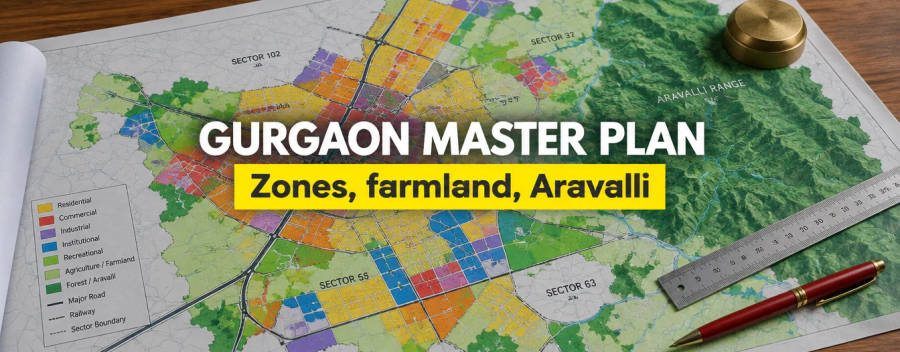
The Gurugram-Manesar Development Plan 2031 is a good example of the link between the two ideas. Its notification, as we read it in a third-party copy, was issued under section 5(7) of the 1963 Act, so the plan is a controlled-area plan. It then divides land into residential, commercial, industrial and other categories and marks an agricultural zone and a Natural Conservation Zone for the Aravalli ranges. Hectares and permitted uses for the agricultural and conservation zones are not in the figures we could read. For the plan itself see our Gurugram master plan page and, for Faridabad, the Faridabad page.
The shorthand for a buyer: "controlled area" answers the question "do I need the Director's permission?" "Urbanisable area" answers "will a city ever be allowed here?"
Side by side
| Point | Controlled area | Urbanisable area |
|---|---|---|
| What it is | A legal status declared by notification | A zoning label inside a development plan |
| Where it comes from | Section 4 of the 1963 Act | The notified development plan and its zoning regulations |
| What it controls | Building, excavation and change of land use need the Director's permission (sections 6 and 7) | Which uses the plan treats as planned for urban growth |
| Agriculture | Agricultural buildings are excused from section 6 permission by the proviso | Usually zoned out of this label; see the plan |
| Who to ask | Director, Town and Country Planning, and the district town planner | The same office, with the zoning plan sheet |
The colony licence is a separate law
Even inside the urbanisable zone, selling plots is regulated by the Haryana Development and Regulation of Urban Areas Act, 1975. Our library records that section 3 requires an owner who wants to convert land into a colony to apply to the Director for a licence, and section 7 bars anyone, including a property dealer, from transferring or advertising plots or taking money for them without one. Section 10 provides for imprisonment of up to three years. We read this text on the PRS site. So a CLU on a plot is not the same as a colony licence. See our guide to CLU for a farmhouse versus CLU for plotting.
The same Act separates a legitimate colony from the unapproved plotting that many buyers meet near the controlled-area edge. Our page on how to spot unapproved colonies lists the signs.
Farmhouses and the agricultural zone
A common question is whether a farmhouse is allowed on land outside the urbanisable zone. A 2021 Tribune report on Haryana's eco-friendly farmhouse policy described a one-acre minimum, an agricultural-zone location beyond 500 metres of the urbanisable zone, and a need for CLU. We read that report; we did not open the policy PDF itself, so treat those figures as reported and unconfirmed. The current rules and fees must be confirmed with the Town and Country Planning office. Our Haryana farmhouse rules page sets out what we could confirm, and the agricultural zone guide explains the zone label.
The agriculture proviso is narrow
Section 6 excuses buildings used for agriculture or purposes subservient to agriculture from the Director's permission. It does not turn a weekend home or a banquet lawn into an agricultural building. Ask the planning office in writing before you assume the proviso covers your plan.
How to check a specific parcel
- Get the khasra number from the jamabandi. Our khasra and khatauni guide shows how to read it.
- Ask the district town planner whether the village is inside a section 4 controlled area. Ask for the notification number and date.
- Get the zoning or development plan sheet for the sector or village and match the khasra to a zone: urbanisable, agricultural or conservation.
- Ask whether any CLU, licence or permission exists for the parcel, and who holds it. A CLU belongs to a named applicant for a named use.
- Check for a scheduled road, bypass or expressway nearby and the setback that applies.
- Check the Aravalli question: is the village under a Punjab Land Preservation Act notification? See our PLPA guide.
- Check for acquisition. A plan is not an acquisition notice, and land may have separate awards.
What we could not confirm
We did not open the Haryana gazette notification for any individual controlled area, so we cannot list which villages are covered today. We did not confirm the current scheduled-road distances or the current CLU fee schedule. We could not confirm how the plan documents define "urbanisable zone" word for word, because the Gurugram plan we read was a third-party copy of the 2012 notification. We did not read the 2021 policy on farmhouses. Please use the planning office for each of these.
Frequently Asked Questions
What is a controlled area in Haryana?
What is the distance in section 4?
Is urbanisable area the same as controlled area?
Do I need permission to build a house on agricultural land in a controlled area?
What does section 7 say about change of land use?
Does CLU allow me to sell plots?
Where do I find the development plan?
Can a plan be only a draft?
Are farmhouses allowed in agricultural zone?
Does Farmland India give a legal opinion on a plot?
Sources
- Punjab Scheduled Roads and Controlled Areas Restriction of Unregulated Development Act, 1963, Haryana text (PRS Legislative Research)
- Haryana Development and Regulation of Urban Areas Act, 1975 (PRS Legislative Research)
- The Tribune: Haryana okays eco-friendly farmhouses near urban areas (21 Sep 2021)