
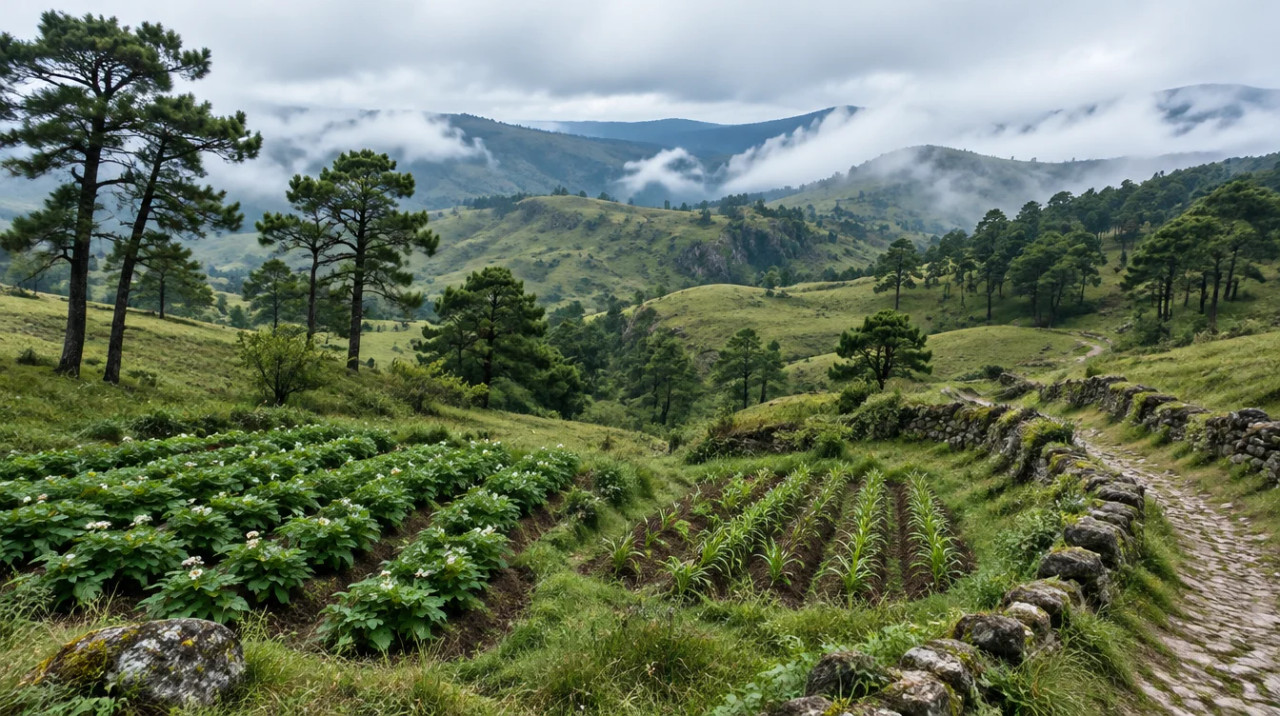
State guide
Buying Land in Meghalaya
Who can buy land in Meghalaya under the 1971 Transfer of Land Act, Sixth Schedule councils, clan land, fees and the twelve districts.
12
Districts
Sanction needed
Non-tribal buyers
3,074 mm
Normal rainfall
4.60%
Groundwater extraction (2024)
State land record — Meghalaya
Rev. 2026 · Farmland India desk
Regions
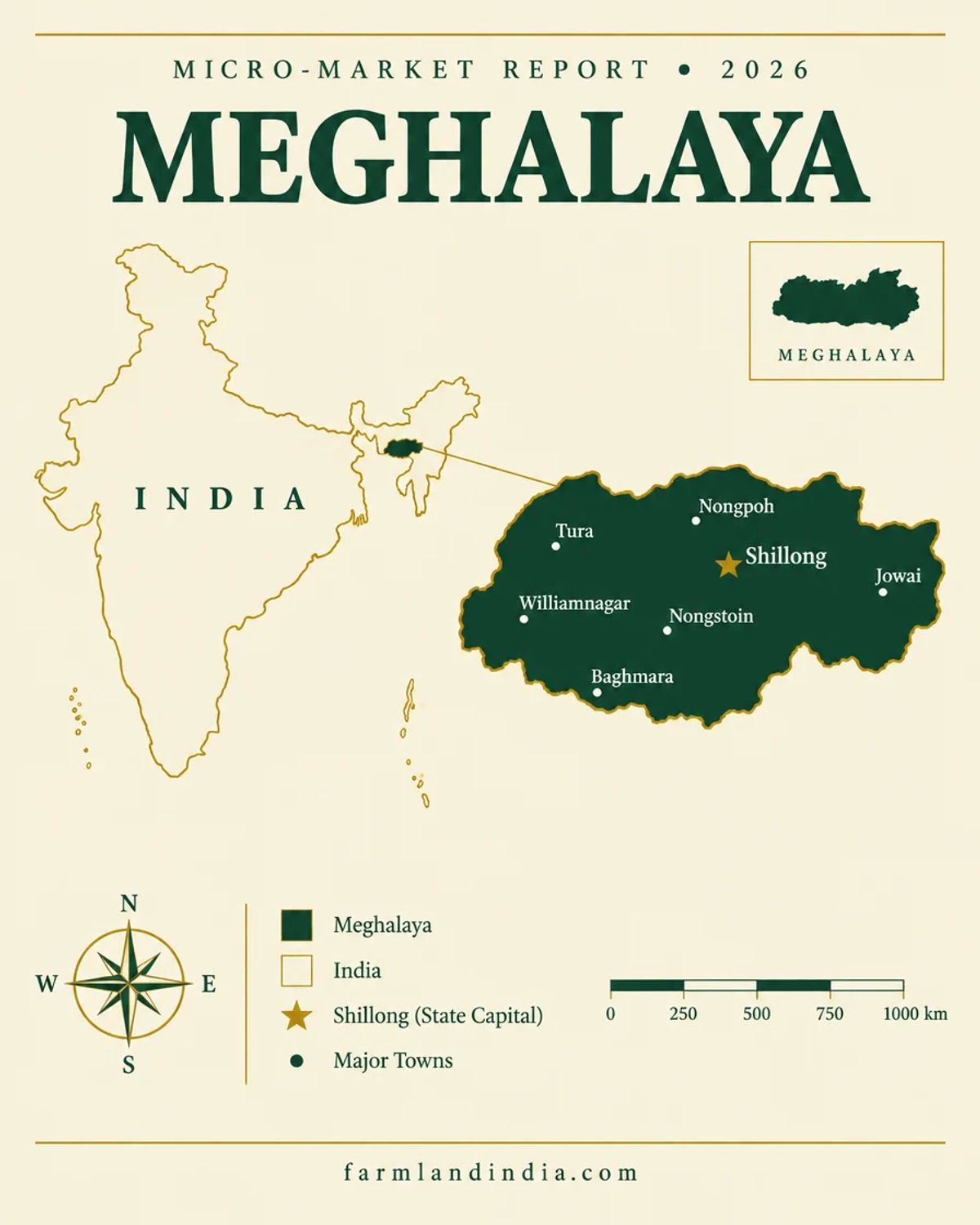
Twelve districts in three hill regions: the Khasi Hills (East, West, South West and Eastern West Khasi Hills, and Ri Bhoi), the Jaintia Hills (West and East) and the Garo Hills (East, West, North, South and South West)
Area and rain
About 22,429 sq km; normal rainfall about 3,074 mm a year (CGWB)
Who can buy
Transfers from a tribal to a non-tribal, and between non-tribals, need the prior sanction of the competent authority under the Meghalaya Transfer of Land (Regulation) Act, 1971
Competent authority
Deputy Commissioners and Sub-Divisional Officers, with appeal to the Board of Revenue
Sixth Schedule
Most of the state is under autonomous district councils for the Khasi, Jaintia and Garo Hills, alongside traditional village and clan institutions
Registration fee
Rs 26 for the first Rs 1,000 of value, then Rs 15 for every further Rs 1,000, as fixed in June 2011 (CAG)
Stamp duty
Indian Stamp Act, 1899 as amended for Meghalaya in 1993; ask the Sub-Registrar for the rate on a sale of land
Groundwater
4.60% stage of extraction in 2024; all 40 assessment units safe (CGWB)
Meghalaya — land purchase legal rules
Meghalaya is a tribal-majority hill state where land is governed by a mix of state law, Sixth Schedule district councils and the customary institutions of the Khasi, Jaintia and Garo communities. Its key statute for a buyer is the Meghalaya Transfer of Land (Regulation) Act, 1971, which puts every sale to a non-tribal behind official sanction. What follows describes the rules as the Act and the government state them; it is not legal advice, and any purchase needs a local lawyer, the Deputy Commissioner’s office and, in most places, the village and district council authorities. This block applies to every district page in the state.
The 1971 Act: Section 3 of the Meghalaya Transfer of Land (Regulation) Act, 1971 says no land in Meghalaya shall be transferred by a tribal to a non-tribal, or by a non-tribal to another non-tribal, except with the previous sanction of the competent authority. A transfer made without sanction is not enforceable in any court. Put simply, a buyer who is not a member of a Scheduled Tribe of the state generally cannot buy land in Meghalaya without the government’s prior sanction, whoever the seller is.
Who decides: The state’s Revenue and Disaster Management Department names Deputy Commissioners and Sub-Divisional Officers as the competent authorities, and notes that the Act’s bar applies except in certain listed areas (Revenue and Disaster Management Department). A person refused sanction can appeal to the Board of Revenue within sixty days.
What is weighed: Section 4 tells the authority to consider whether the non-tribal already holds other land in Meghalaya, whether a tribal buyer is willing to take the land at market value, whether the non-tribal’s work in the area requires them to live there, and whether the transfer is likely to promote the economic interests of the Scheduled Tribes in the area. Refusals must be in writing with reasons.
Exceptions: The Act does not apply to mortgages to notified banks, co-operative societies and credit institutions (a sale to a non-tribal on default still needs sanction), to letting a building on rent, or to transfers to the government or a district council. A 1991 amendment allows transfers for public religious worship, burial and cremation grounds, and schemes that promote tribal education or industry.
District councils and customary land: Most of the state falls under Sixth Schedule autonomous district councils for the Khasi, Jaintia and Garo Hills. Land is held under customary tenure through families, clans and village communities, and traditional heads often play a part in sale deeds. In 2018 the Khasi Hills council warned traditional heads who were charging about 10% of the sale value to execute sale deeds, after complaints mostly from Ri Bhoi (NE Now, 7 December 2018). Community and clan land cannot be treated as an individual’s land to sell.
Records: The Meghalaya Land Survey and Records Preparation Act, 1980 provides for a cadastral survey and records showing who occupies or holds land, and a 1991 amendment let the district councils carry out the scheme. Ask the Deputy Commissioner’s office and the district council what record exists for the plot.
Registration and duty: Deeds are registered by District Registrars and Sub-Registrars. The registration fee was fixed in June 2011 at Rs 26 for a value up to Rs 1,000 plus Rs 15 for each further Rs 1,000 (CAG audit report, state revenues to March 2023). Stamp duty is charged under the Indian Stamp Act as amended for Meghalaya in 1993; ask the Sub-Registrar for the current rate on a sale of land.
NRI and OCI buyers: Under the RBI Master Direction on immovable property, NRIs and OCIs may not acquire agricultural land, a farmhouse or plantation property in India except by inheritance. Our NRI guide covers the options.
- Transfer of Land (Regulation) Act, 1971
- Sanction for non-tribal buyers
- DC or SDO decides
- Appeal: Board of Revenue
- Sixth Schedule councils
- Clan and community land
- Registration fee about 1.5%
- NRIs: inheritance only
State overview
Meghalaya — the Khasi, Jaintia and Garo Hills
Meghalaya, “the abode of clouds”, is a plateau state of rolling uplands, deep gorges and some of the wettest places on earth, bounded by Assam to the north and east and Bangladesh to the south. It covers about 22,429 sq km, had about 29.7 lakh people at the 2011 Census, and has a normal rainfall of about 3,074 mm, with Cherrapunji and Mawsynram in East Khasi Hills among the rainiest places in the world (CGWB, 2024[4]). About two-thirds of the land is hilly. The state has twelve districts in three regions: the Khasi Hills around Shillong, the Jaintia Hills to the east and the Garo Hills to the west. The newest, Eastern West Khasi Hills, with its headquarters at Mairang, was carved from West Khasi Hills and inaugurated on 10 November 2021 (Chief Minister’s Office, Meghalaya[6]).
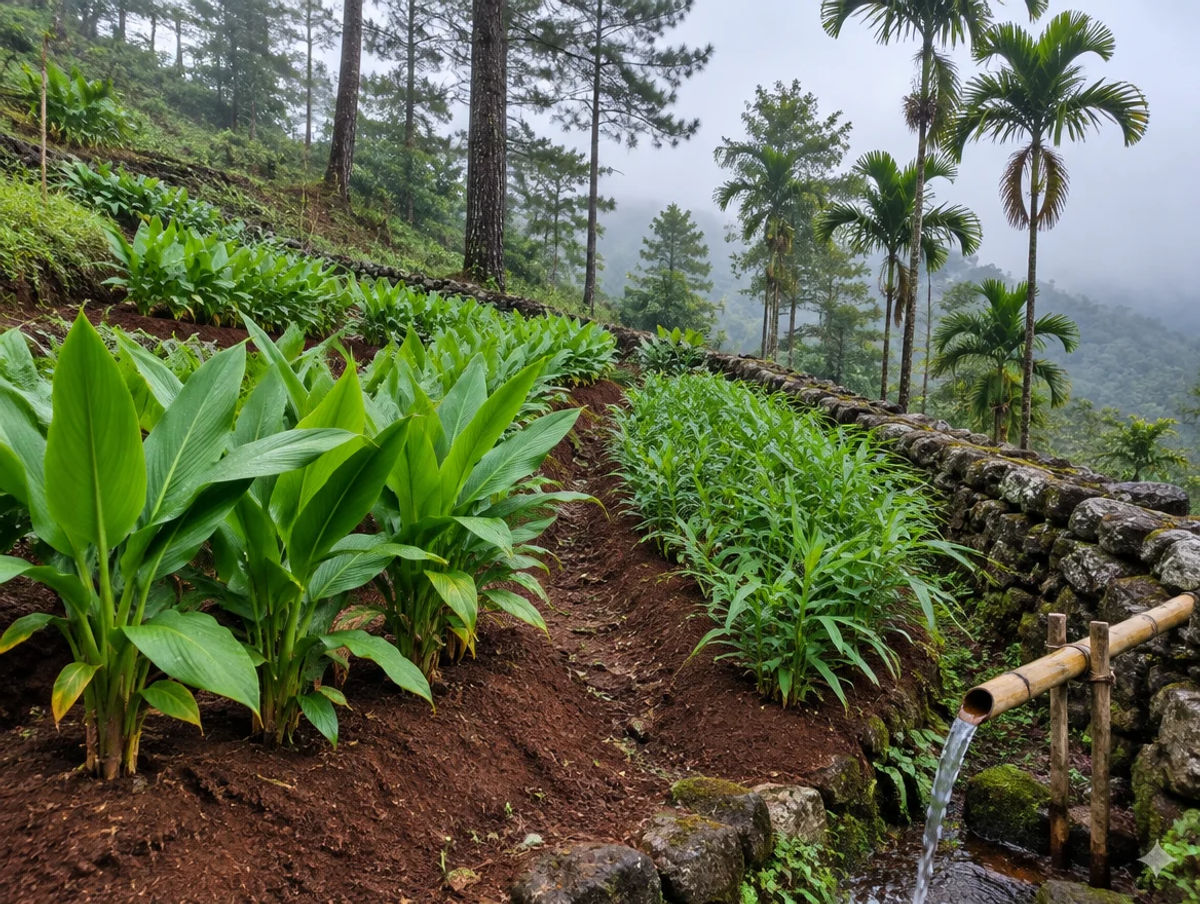
About four in five people depend on farming. The uplands grow potato, ginger, turmeric, pineapple, areca and vegetables on terraces and slopes, and paddy fills the valleys and the plains along the Assam and Bangladesh borders. Land is held through families, clans and villages under customary law, and most of the state lies under Sixth Schedule district councils. For buyers from outside, the deciding fact is the 1971 Act: any sale to a non-tribal, even by a non-tribal owner, needs the government’s prior sanction. Buyers looking at the wider region can compare the rules on our Assam page.
Start any purchase with your own eligibility and the sanction, then the plot’s customary status, the village and council papers, and only then the price.
- 12 districts
- Capital: Shillong
- 3,074 mm rainfall
- Customary land
- Sixth Schedule
- Groundwater 4.60%
Market bands
Reported cost reference points — Meghalaya
No official farmland price series is published for Meghalaya. These are the transaction rules and costs.
| Item | Scope | Reported figure* | Source |
|---|---|---|---|
| Registration fee | Sale deed, on the value | Rs 26 up to Rs 1,000, then Rs 15 per further Rs 1,000 (about 1.5%) | CAG, state revenues to March 2023[5] |
| Stamp duty | Sale of land | Ask the Sub-Registrar | Rate from the Sub-Registrar |
| Sanction for non-tribal buyer | Any transfer to a non-tribal | Prior sanction of the DC or SDO required | Meghalaya Transfer of Land (Regulation) Act, 1971[1] |
| Farmland price series | State or district level | None published | Not published |
*No newspaper or official source publishes a farmland price series for Meghalaya’s districts. Land changes hands mostly within tribal communities, often through traditional institutions, and prices depend heavily on road access and proximity to Shillong, Tura or Jowai. Charges levied by village authorities on sale deeds have been reported in the past, so ask for every fee in writing. Compare registered sales in the same locality before agreeing a figure.
Transaction costs
Stamp duty & registration in Meghalaya
Sanction
Needed for non-tribals
Every transfer to a non-tribal needs the DC or SDO’s prior sanction
~1.5%
Registration fee
Rs 15 per Rs 1,000 of value above the first Rs 1,000, fixed in 2011
60 days
Appeal window
To the Board of Revenue after a refusal
The registration fee in Meghalaya was fixed in June 2011 at Rs 26 for a value up to Rs 1,000 and Rs 15 for every further Rs 1,000, which works out to about 1.5% on a larger deed (CAG audit report[5]). Stamp duty is levied under the Indian Stamp Act, 1899 and the Indian Stamp (Meghalaya Amendment) Act, 1993. Ask the Sub-Registrar for the current rate on a sale of land before you budget. The bigger cost question is often outside the registration office: village authorities and traditional heads may charge for executing or witnessing a sale deed, and the Khasi Hills Autonomous District Council has warned against excessive charges (NE Now, December 2018[7]). For a non-tribal buyer, the sanction under the 1971 Act must be in hand before registration; without it the transfer cannot be enforced in court.
Connectivity
How Meghalaya connects: road, rail and air
The Guwahati–Shillong road, NH-6 to Silchar, Guwahati and Shillong airports, and one railhead in the Garo Hills
🚗 By road
✈️ By air
🚆 By rail
🌲 Where demand comes from
Land demand centres on Shillong and its fringe, the Guwahati–Shillong road through Ri Bhoi and the industrial area at Byrnihat on the Assam border, Jowai in the Jaintia Hills and Tura in the Garo Hills. Most buyers are local tribal families and businesses. The new Shillong–Silchar corridor is the project most likely to change land values in the east of the state.
Growth catalysts
Upcoming infrastructure & developments
Status as of November 2026, with the date and source of the latest public update for each project
01Expressway
Approved
03Catalysts
Agriculture & terrain
Soil, crops & water across Meghalaya
Potato and pine on the plateau, turmeric in the Jaintia Hills, cashew and paddy in the Garo Hills
Khasi Hills
The Shillong plateau and the hills around it, across East, West, South West and Eastern West Khasi Hills and Ri Bhoi, grow potato, vegetables, ginger, pineapple and broom grass, with pine forest on the uplands. Ri Bhoi’s lower slopes towards Assam are warmer and suit pineapple and areca.
- Potato, vegetables, ginger
- Pine uplands
- Closest to Shillong
Jaintia Hills
West and East Jaintia Hills, around Jowai and Khliehriat, are known for turmeric, areca and paddy in the valleys, and for coal and limestone. Coal mining has affected land and water in places.
- Turmeric, areca, paddy
- Coal and limestone
- Mining scars
Garo Hills
The western Garo Hills, around Tura, Williamnagar and Baghmara, are lower and warmer, with paddy on the plains along Assam and Bangladesh, cashew, areca, rubber and jhum (shifting cultivation) in the hills.
- Paddy, cashew, areca
- Rubber and jhum
- Lower and warmer
Groundwater
Groundwater is scarcely used in Meghalaya. The Central Ground Water Board put the stage of extraction at 4.60% in 2024, with all 40 assessment units (39 blocks and Greater Shillong) safe, an extractable resource of 1.53 billion cubic metres and extraction of about 0.07 billion (CGWB, 2024[4]). Springs and streams supply most farms. The irony of the wettest state is dry winters on the plateau: check where water comes from between December and March.
Land use
About 64% of the state is hilly, with rolling hill ranges, tablelands and narrow ravines, and about four in five people depend on agriculture. Holdings are shaped by customary tenure, so a plot may be family, clan or community land, and the difference matters more than its size.
Crops
The state’s mix runs from potato and vegetables on the Shillong plateau to turmeric in the Jaintia Hills and cashew and areca in the Garo Hills, with pineapple, ginger and oranges on the slopes and paddy in the valleys. Heavy rain means erosion and leaching on cleared slopes; terraces and tree crops hold up better than open fields.
At a glance
Meghalaya’s districts side by side
| District (headquarters) | Region | Main land use | Note |
|---|---|---|---|
| East Khasi Hills (Shillong) | Khasi Hills | Urban fringe, potato, vegetables | Capital; Shillong–Silchar corridor starts nearby |
| Ri Bhoi (Nongpoh) | Khasi Hills | Pineapple, areca, industry at Byrnihat | On the Guwahati–Shillong road |
| West Khasi Hills (Nongstoin) | Khasi Hills | Upland farming, forest | Large, thinly populated |
| Eastern West Khasi Hills (Mairang) | Khasi Hills | Upland farming | New district, November 2021 |
| South West Khasi Hills (Mawkyrwat) | Khasi Hills | Hill farming, forest | Bangladesh border |
| West Jaintia Hills (Jowai) | Jaintia Hills | Paddy, turmeric, areca | On the Shillong–Silchar corridor |
| East Jaintia Hills (Khliehriat) | Jaintia Hills | Coal, limestone, areca | Mining-affected land |
| West Garo Hills (Tura) | Garo Hills | Paddy, cashew, areca | Largest town of the Garo Hills |
| East Garo Hills (Williamnagar) | Garo Hills | Paddy, jhum, rubber | Central Garo Hills |
| North Garo Hills (Resubelpara) | Garo Hills | Paddy, rubber | Mendipathar railhead |
| South Garo Hills (Baghmara) | Garo Hills | Forest, jhum | Bangladesh border |
| South West Garo Hills (Ampati) | Garo Hills | Paddy on the plains | Bangladesh and Assam borders |
Headquarters are the usual district seats. No newspaper or official source publishes a farmland price series for these districts, and the sanction requirement for non-tribal buyers applies across the state. See the .
Farmland India view
Why buyers look at Meghalaya
A closed market for outsiders, a new corridor east of Shillong and land shaped by custom
A market for insiders
The 1971 Act makes every sale to a non-tribal depend on official sanction, weighed against the interests of the local tribes. For outsiders that means Meghalaya is generally not a place to buy land; for eligible buyers, it keeps the market local and slow.
Shillong and the new road
Shillong’s fringe and the Ri Bhoi corridor to Guwahati carry most demand. The Shillong–Silchar corridor, approved in 2025, could open the Jaintia Hills further once construction starts.
Customary land needs care
Family, clan and community land each follow different rules, and traditional heads are part of most transactions. The right papers come from the village, the council and the government together.
Water and climate
Rainfall is among the highest in the world and groundwater is barely tapped, but slopes erode and winter is dry. Terraced land with a reliable spring is worth more than open slope.
Mining and forest
Coal and limestone in the Jaintia and Garo Hills have damaged land and water in places, and forest covers much of the rest. Check what lies upstream and next door before buying.
Confirm your eligibility, the sanction under the 1971 Act, the customary status of the land and the village and council papers before you pay anything.
STRAIGHT TALK
Risks & challenges in Meghalaya
What can undo a land purchase in Meghalaya
You may need sanction
Any transfer to a non-tribal, even from a non-tribal seller, needs the DC or SDO’s prior sanction under the 1971 Act[1]. Without it, the transfer cannot be enforced in court.
Clan and community land
Land held by a clan or a village community is not an individual’s to sell. Get written consent from the right institution and check the council’s view.
Fees outside the office
Village authorities have been reported charging large commissions to execute sale deeds. Agree every fee in writing and pay only against receipts.
Benami and informal deals
Purchases in a tribal person’s name, long leases and power-of-attorney deals are common workarounds. All can be undone and none should be relied on.
Thin records
Boundaries often rest on customary papers and memory, so have the plot surveyed and the neighbours sign off.
Mining-affected land
Parts of the Jaintia and Garo Hills carry coal and limestone mining. Check for acid drainage, subsidence and pending cases before buying near mines.
Landslides and erosion
Heavy rain on steep slopes causes slides and gullies. Visit in the monsoon and look at the drainage above the plot.
Projects that stall
Rail into the Khasi and Jaintia Hills has stalled for years. Pay for the road that exists, not for a promised line.
Who to contact
Local revenue & registration offices
Land administration in Meghalaya runs through the Revenue and Disaster Management Department in Shillong, twelve Deputy Commissioners and their Sub-Divisional Officers, who are the competent authorities for sanction under the 1971 Act. Appeals go to the Board of Revenue. The Khasi Hills, Jaintia Hills and Garo Hills Autonomous District Councils administer land matters in their areas under the Sixth Schedule, and village heads and traditional institutions take part in most transfers. Deeds are registered at the District Registrar and Sub-Registrar offices. Each district’s official website lists its officers.
KEEP EXPLORING
Districts & guides in Meghalaya
COMMON QUESTIONS
Frequently asked questions
Everything buyers, NRIs and investors ask before their first reviewed farmland purchase in Meghalaya.
Visit full wiki01 of 04
Can a non-tribal buy land in Meghalaya?
Only with the prior sanction of the competent authority, the Deputy Commissioner or Sub-Divisional Officer, under the Meghalaya Transfer of Land (Regulation) Act, 1971. The rule covers sales by tribals and by non-tribals to any non-tribal, and a transfer without sanction cannot be enforced in court.
02 of 04
What does the authority consider before granting sanction?
Whether the buyer already holds land in Meghalaya, whether a tribal buyer is willing to pay market value, whether the buyer’s work requires them to live there, and whether the sale would promote the economic interests of the local Scheduled Tribes.
03 of 04
What is the registration fee in Meghalaya?
Rs 26 for a value up to Rs 1,000 and Rs 15 for each further Rs 1,000, about 1.5%, as fixed in June 2011. Ask the Sub-Registrar for the stamp duty rate.
04 of 04
Can NRIs buy farmland in Meghalaya?
No. Under RBI rules NRIs and OCIs cannot acquire agricultural land, a farmhouse or plantation property anywhere in India except by inheritance.
Transparency
Sources and references
Law and courts
- [1]Meghalaya Transfer of Land (Regulation) Act, 1971 (FAO legal database copy) — faolex.fao.org
- [2]RBI: Master Direction on acquisition and transfer of immovable property by NRIs and OCIs — rbi.org.in
Government
- [3]Government of Meghalaya: Revenue and Disaster Management Department — meghalaya.gov.in
- [4]CGWB: Dynamic Ground Water Resources of Meghalaya, 2024 — cgwb.gov.in
- [5]CAG: Audit Report on State Revenues, Meghalaya, year ended March 2023, Stamps and Registration — cag.gov.in
- [6]Chief Minister’s Office: Meghalaya’s 12th district inaugurated at Mairang (Nov 2021) — cm.meghalaya.gov.in
News
- [7]NE Now: KHADC warns village heads over commission on land sale deeds (7 Dec 2018) — nenow.in
- [8]Business Today: Cabinet approves Shillong–Silchar greenfield corridor (30 Apr 2025) — businesstoday.in
- [9]The Assam Tribune: Meghalaya rail project stalled, Centre seeks Rs 209 crore refund (5 Mar 2025) — assamtribune.com
Further reading
Data-currency note: sources were read in November 2026. Fees, rules and infrastructure timelines change often; check the linked source and the relevant office before relying on any figure.
For developers
Ready to explore Meghalaya farmland?
Browse reviewed projects and individual land parcels across Meghalaya — or if you own land here, list it with platform review and reach serious buyers.