
District guide
Buying Land in East Jaintia Hills
A mining and limestone district with Khliehriat as headquarters: a coal ban order, a cement plant hearing and the Shillong–Silchar corridor.
2
Blocks (district portal)
31 Jul 2012
Created (district portal)
Rs 1,800 crore
Shree Cement project (reported)
166.80 km
Corridor length (Cabinet)
*Indicative range across districts and land types. Stamp duty, registration and conversion charges are additional. Local measurement units vary — every listing states the unit it is priced in. Not a valuation or an offer.
District land record — East Jaintia Hills
Rev. 2026 · Farmland India desk
State
Meghalaya
District headquarters
Khliehriat
Formation
31 July 2012, when the old Jaintia Hills district was split into East and West Jaintia Hills
Blocks
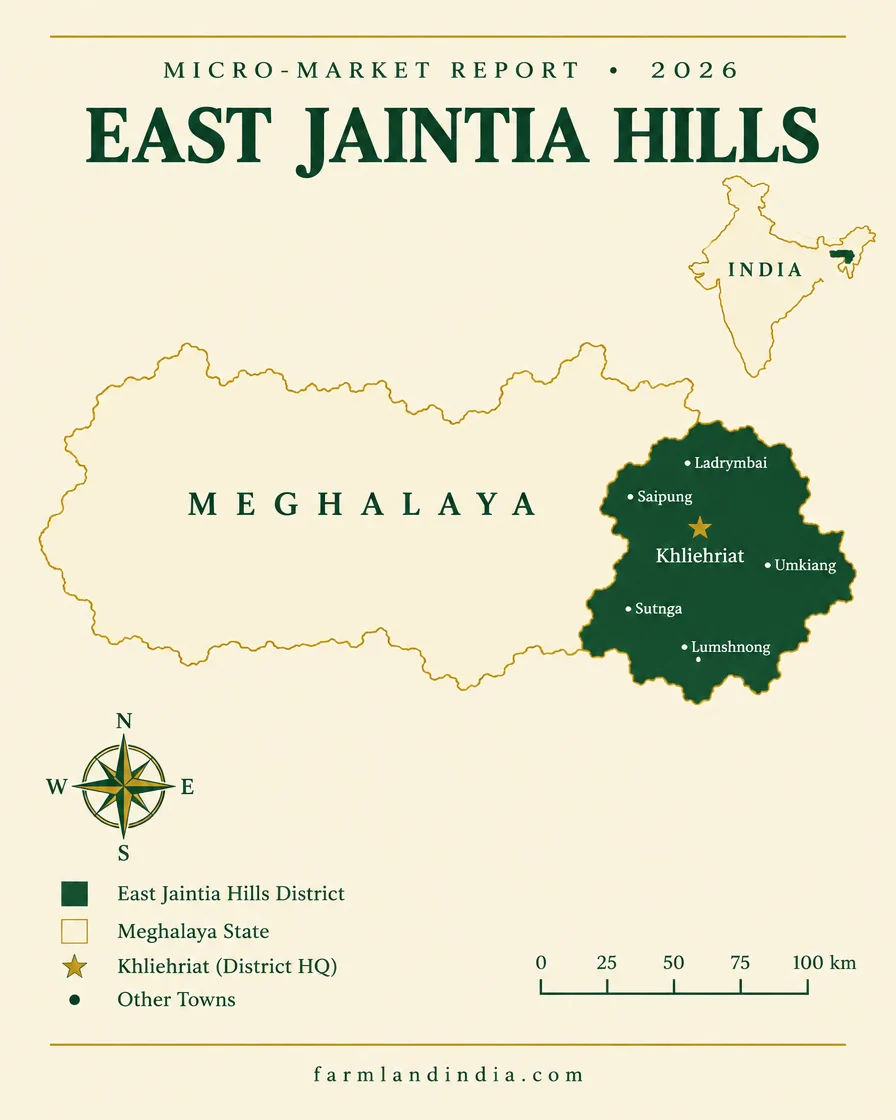
Two: Saipung and Khliehriat (district portal[5])
Key markets
Khliehriat · Saipung · Ladrymbai · Umkiang · Lumshnong
Land law
Transfers need prior sanction under the 1971 Act (Act text[1])
Mining
Illegal coal mining banned in the Thangsko area from February 2026 (India Today NE[6])
Pricing unit
No official farmland price series is published for East Jaintia Hills. Ask the sub-registrar for recent registered sale values in the village you are looking at.
Records
Village records and cadastral survey are patchy; see the legal note below
Land law is state law. These rules are maintained on the Meghalaya page and apply to every district within it.
East Jaintia Hills — land purchase legal rules
Meghalaya is a tribal-majority hill state where land is governed by a mix of state law, Sixth Schedule district councils and the customary institutions of the Khasi, Jaintia and Garo communities. Its key statute for a buyer is the Meghalaya Transfer of Land (Regulation) Act, 1971, which puts every sale to a non-tribal behind official sanction. What follows describes the rules as the Act and the government state them; it is not legal advice, and any purchase needs a local lawyer, the Deputy Commissioner’s office and, in most places, the village and district council authorities. This block applies to every district page in the state.
The 1971 Act: Section 3 of the Meghalaya Transfer of Land (Regulation) Act, 1971 says no land in Meghalaya shall be transferred by a tribal to a non-tribal, or by a non-tribal to another non-tribal, except with the previous sanction of the competent authority. A transfer made without sanction is not enforceable in any court. Put simply, a buyer who is not a member of a Scheduled Tribe of the state generally cannot buy land in Meghalaya without the government’s prior sanction, whoever the seller is.
Who decides: The state’s Revenue and Disaster Management Department names Deputy Commissioners and Sub-Divisional Officers as the competent authorities, and notes that the Act’s bar applies except in certain listed areas (Revenue and Disaster Management Department). A person refused sanction can appeal to the Board of Revenue within sixty days.
What is weighed: Section 4 tells the authority to consider whether the non-tribal already holds other land in Meghalaya, whether a tribal buyer is willing to take the land at market value, whether the non-tribal’s work in the area requires them to live there, and whether the transfer is likely to promote the economic interests of the Scheduled Tribes in the area. Refusals must be in writing with reasons.
Exceptions: The Act does not apply to mortgages to notified banks, co-operative societies and credit institutions (a sale to a non-tribal on default still needs sanction), to letting a building on rent, or to transfers to the government or a district council. A 1991 amendment allows transfers for public religious worship, burial and cremation grounds, and schemes that promote tribal education or industry.
District councils and customary land: Most of the state falls under Sixth Schedule autonomous district councils for the Khasi, Jaintia and Garo Hills. Land is held under customary tenure through families, clans and village communities, and traditional heads often play a part in sale deeds. In 2018 the Khasi Hills council warned traditional heads who were charging about 10% of the sale value to execute sale deeds, after complaints mostly from Ri Bhoi (NE Now, 7 December 2018). Community and clan land cannot be treated as an individual’s land to sell.
Records: The Meghalaya Land Survey and Records Preparation Act, 1980 provides for a cadastral survey and records showing who occupies or holds land, and a 1991 amendment let the district councils carry out the scheme. Ask the Deputy Commissioner’s office and the district council what record exists for the plot.
Registration and duty: Deeds are registered by District Registrars and Sub-Registrars. The registration fee was fixed in June 2011 at Rs 26 for a value up to Rs 1,000 plus Rs 15 for each further Rs 1,000 (CAG audit report, state revenues to March 2023). Stamp duty is charged under the Indian Stamp Act as amended for Meghalaya in 1993; ask the Sub-Registrar for the current rate on a sale of land.
NRI and OCI buyers: Under the RBI Master Direction on immovable property, NRIs and OCIs may not acquire agricultural land, a farmhouse or plantation property in India except by inheritance. Our NRI guide covers the options.
- Transfer of Land (Regulation) Act, 1971
- Sanction for non-tribal buyers
- DC or SDO decides
- Appeal: Board of Revenue
- Sixth Schedule councils
- Clan and community land
- Registration fee about 1.5%
- NRIs: inheritance only
East Jaintia Hills — district-specific notes
The Meghalaya state page covers the 1971 Act and the district councils. For East Jaintia Hills, three points matter most.
⚠ Mining shapes land here. On 7 February 2026 the District Magistrate imposed a full ban on illegal coal mining in the Thangsko area, ordered seizure of vehicles and machinery, and barred gatherings of more than five people at or around the sites, acting on the Meghalaya High Court’s instruction to take firm action (India Today NE, 8 Feb 2026[6]). Land with pits, spoil heaps or an open mining history needs a written clearance and a physical inspection before you pay anything.
⚠ Large industrial proposals can run into landowner opposition. At the environmental public hearing for Shree Cement’s Rs 1,800 crore integrated cement plant and limestone mining project, held at Lum Syrman under Elaka Nongkhlieh on 31 July 2026, landowners and farmers from Lum Syrman and Shnongrim opposed the project and alleged that police kept them away (UNI, 31 Jul 2026[7]). The outcome was not available to us. A plot near a proposed plant or mine may be worth more or less, and either way it is not a safe farmland assumption.
⚠ Section 3 of the Meghalaya Transfer of Land (Regulation) Act, 1971 bars a transfer of land from a tribal to a non-tribal, or from one non-tribal to another, without the previous sanction of the competent authority; a transfer made in breach cannot be enforced in court (Act text[1]). Deputy Commissioners and Sub-Divisional Officers act as competent authorities (Revenue and Disaster Management Department[2]). Section 4 asks whether the buyer already holds land in Meghalaya and whether a tribal is willing to take the land at market value, and section 5 gives 60 days to appeal to the Board of Revenue. Keep any payment refundable until the authority has acted on East Jaintia Hills.
The Meghalaya Land Survey and Records Preparation Act, 1980 provides for cadastral survey, and a 1991 amendment lets the district councils carry it out. NRIs and OCIs cannot acquire agricultural land, a farmhouse or plantation land except by inheritance; see our NRI guide and the Meghalaya land buying guide.
- Sanction needed to sell outside the tribe
- Coal and limestone land
- Public hearings
- Clan and community land
District overview
East Jaintia Hills — a mining, limestone and hill-farm district
East Jaintia Hills was created on 31 July 2012 when the former Jaintia Hills district was divided into East and West Jaintia Hills, with its headquarters at Khliehriat (district portal[5]). The portal names only two blocks, Saipung and Khliehriat, and does not state an area or population.
Most of what a buyer needs to know about this district is about what lies under the surface. East Jaintia Hills is Meghalaya’s coal-and-limestone belt, and the news from the past year is about enforcement and objections rather than growth: an illegal-mining crackdown in Thangsko in February 2026 and a contested environmental hearing for a cement project in July 2026.
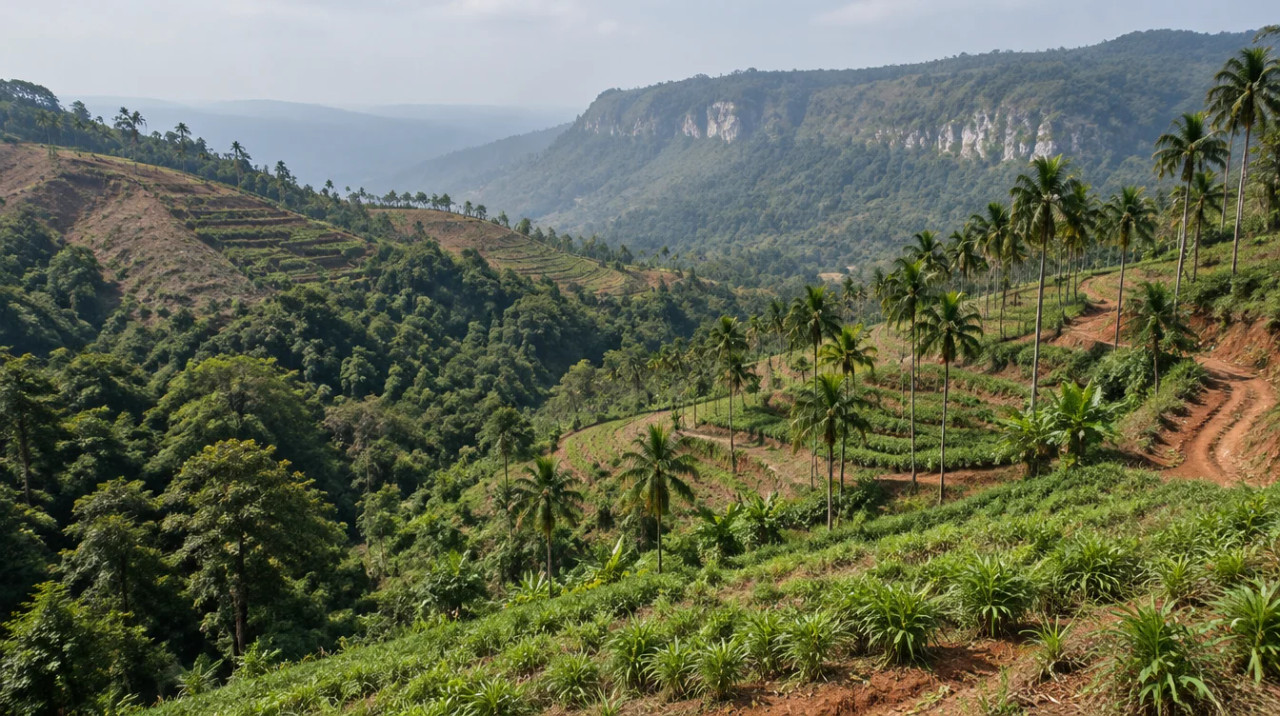
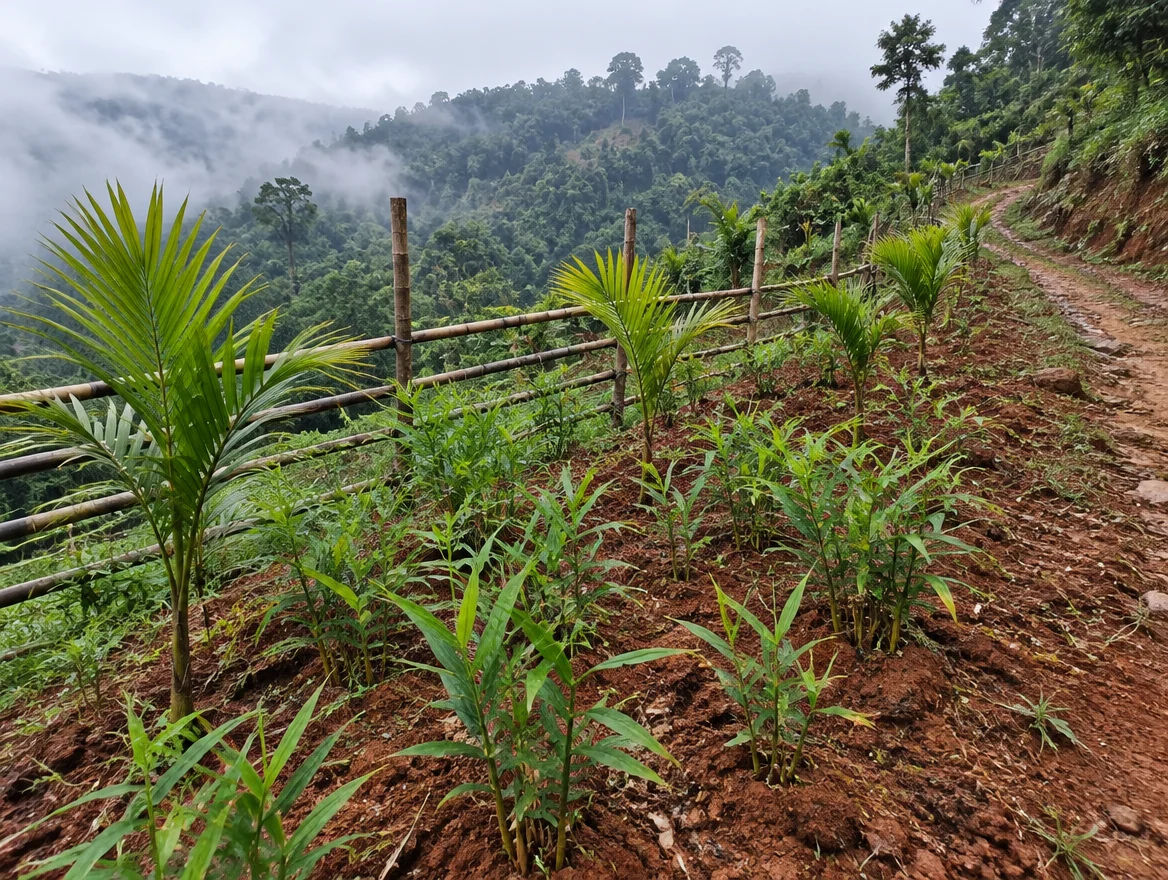
Some of the district’s land is still farm and forest land: terraced slopes of ginger and areca on red soil, with community woodland above.
If your interest is a small farm or a retreat plot, favour land that has no mining history, is a clear distance from any proposed plant, and sits on a road that stays open in the rains. If your interest is industrial or mining land, the 1971 Act’s sanction rule still applies and the legal risk is much higher than for farmland.
The Shillong–Silchar corridor runs through the district (Cabinet, April 2025), which may eventually improve access for the border-side markets.
- Khliehriat
- Saipung
- Ladrymbai
- Lumshnong
Transaction costs
Stamp duty & registration in East Jaintia Hills
Registration fee
About 1.5% of value
Rs 26 up to Rs 1,000, then Rs 15 per further Rs 1,000, fixed June 2011 (CAG audit)
Stamp duty
Indian Stamp Act 1899 as amended for Meghalaya in 1993.
Sanction
Prior approval
Required for tribal-to-non-tribal and non-tribal-to-non-tribal transfers under section 3 of the 1971 Act
The CAG’s audit of state revenues records the registration fee as Rs 26 up to Rs 1,000 and Rs 15 for each further Rs 1,000, fixed in June 2011, roughly 1.5% of value (CAG audit report, year ended March 2023[4]). Stamp duty is levied under the Indian Stamp Act, 1899 as amended for Meghalaya in 1993. Ask the sub-registrar for a written computation before you agree a price. Section 11 of the 1971 Act exempts some transfers, such as loans from notified banks, letting buildings on rent and transfers to the Government or a District Council (Act text[1]).
Know the belt
What is moving prices in East Jaintia Hills
Four places worth knowing, by what drives them and what to check.
Khliehriat
District headquarters market
The Deputy Commissioner’s office and administration are here, so small commercial and house plots follow the offices.
Check: whether the plot is on traditional land and its road access
Saipung
Second block
The other block named on the district portal; land is mostly hill smallholdings.
Check: who the village authority is and whether the plot has mining history
Thangsko area
Coal-mining ban area
The area where the district ordered a full ban on illegal coal mining in February 2026. A plot here is a legal risk until proven otherwise.
Check: written clearance, ground inspection and a lawyer’s opinion
Lum Syrman and Shnongrim
Proposed cement-plant area
Villages where landowners and farmers opposed a Rs 1,800 crore cement plant and limestone mining project in July 2026.
Check: the status of the project and the land the company needs
Asking prices
Treat any agent figure as an opening ask until it is matched with a registered deed.
Connectivity
How East Jaintia Hills connects — road, rail and air
Road is the lifeline; the corridor is approved and rail is not available.
🚗 By road
✈️ By air
🚆 By rail
The corridor’s cost is Rs 22,864 crore, with 144.80 km in Meghalaya (Business Today[8]).
Growth catalysts
Upcoming infrastructure & developments
Statuses and sources are listed per project; dates are as reported.
00Open
02Catalysts
Agriculture & terrain
Soil, crops & water in East Jaintia Hills
Hill farming beside mining and limestone.
Land and water
Meghalaya’s normal rainfall is about 3,074 mm a year and roughly 64% of the state is hilly; groundwater extraction was 4.60% in 2024, with all 40 assessment units classed Safe (CGWB, 2024[3]
- State normal rainfall: about 3,074 mm
- State groundwater extraction: 4.60% (2024)
- Mining may affect local water quality; test before drilling
Typical crops
Ginger and areca on hill terraces are typical of the area.
Mining and farmland
Open pits, spoil and acidic run-off can damage soil and streams. Walk the whole plot and the downhill neighbour’s land before buying.
At a glance
East Jaintia Hills vs. nearby districts
| District | Land and water | What links it to East Jaintia Hills |
|---|---|---|
| West Jaintia Hills | Created from the same 2012 split, with Jowai as headquarters | Same corridor; turmeric and smallholding market |
| East Khasi Hills | Shillong’s district, a separate market | Same corridor; much higher capital premium |
| Ri Bhoi | North side towards Assam | Same sanction rule; closer to Byrnihat’s industrial area |
The neighbours are listed from the district portal’s split note and the corridor alignment.
Farmland India view
Why investors look at East Jaintia Hills
Five reasoned points for East Jaintia Hills, each tied to a source on this page.
The story is regulation, not prices
In the past year the district has been in the news for a coal mining ban and a contested cement plant hearing, so the key risk is legal, not a price swing.
The corridor is the upside
The Shillong–Silchar corridor (Business Today[8]) passes through the district; wait for a published alignment.
Farmland needs a clean history
Prefer plots with no mining history, clear access and a village authority that confirms ownership in writing.
Sanction decides timing
The 1971 Act makes sanction the first gate for a non-tribal buyer.
Confirm the land record, mutation, zoning and acquisition status directly — these are not certified by Farmland India’s review.
STRAIGHT TALK
Risks & challenges in East Jaintia Hills
District-specific risks. Read the Meghalaya state page for the general risks on ceiling, conversion and records.
Illegal mining and seizure
The district can seize vehicles and machinery linked to illegal mining. Do not buy land that is part of an active or recent mining operation.
Project opposition
Landowner opposition to the cement project shows how contested large land requirements can be.
Thin official data
Do not rely on seller numbers without a source.
Sanction refused or delayed
A sale without sanction cannot be enforced in court. Keep payments refundable until the authority has acted.
Records and boundaries
Cadastral survey is incomplete across the state, so get a surveyor’s site map and mark the boundaries before registration.
Who to contact
Local revenue & planning offices
East Jaintia Hills is administered from Khliehriat by the Deputy Commissioner, who acts as District Magistrate and as competent authority under the 1971 Act. The district portal names two blocks, Saipung and Khliehriat (district portal[5]). The Jaintia Hills Autonomous District Council covers customary matters. Deeds are registered at the sub-registrar’s office; ask for a written computation of duty and fee, and meet the village headman and dorbar for any traditional land.
COMMON QUESTIONS
Frequently asked questions
Everything buyers, NRIs and investors ask before their first reviewed farmland purchase in East Jaintia Hills.
Visit full wiki01 of 04
Can an outsider buy land in East Jaintia Hills?
Only with sanction. Under the Meghalaya Transfer of Land (Regulation) Act, 1971, a transfer from a tribal to a non-tribal, or between non-tribals, needs the previous sanction of the competent authority, and a transfer made without it cannot be enforced in court. Confirm the route with the Deputy Commissioner’s office and a local lawyer before paying.
02 of 04
Is mining land safe to buy in East Jaintia Hills?
Be very careful. In February 2026 the district ordered a full ban on illegal coal mining in the Thangsko area after the Meghalaya High Court asked for firm action, with vehicles and machinery liable to seizure. Land with old or illegal pits can carry legal and safety problems.
03 of 04
What is the Shree Cement project?
Shree Cement’s proposed Rs 1,800 crore integrated cement plant and limestone mine in the district had its environmental public hearing at Lum Syrman on 31 July 2026; landowners and farmers from Lum Syrman and Shnongrim opposed it.
04 of 04
Is there a price guide for land here?
No official farmland price series is published for East Jaintia Hills. Ask the sub-registrar for recent registered sale values in the village you are looking at. Ask for recent registered deeds in the same locality and compare them with the asking price.
Transparency
Sources and references
Law and courts
- [1]Meghalaya Transfer of Land (Regulation) Act, 1971 — faolex.fao.org
Government
- [2]Meghalaya Revenue and Disaster Management Department — meghalaya.gov.in
- [3]CGWB: Dynamic Ground Water Resources of Meghalaya, 2024 — cgwb.gov.in
- [4]CAG: state revenues audit report, year ended March 2023 — cag.gov.in
- [5]East Jaintia Hills district portal — eastjaintiahills.gov.in
News
- [6]India Today NE: East Jaintia Hills bans illegal coal mining, 8 Feb 2026 — indiatodayne.in
- [7]UNI: Shree Cement public hearing, 31 Jul 2026 — uniindia.com
- [8]Business Today: Shillong–Silchar corridor, 30 Apr 2025 — businesstoday.in
Data-currency note: sources were read in November 2026. Project status, the benchmark valuation and land rules change often; check the linked source and the relevant office before relying on any figure.
For developers
Ready to explore East Jaintia Hills farmland?
Browse reviewed projects and individual land parcels across East Jaintia Hills — or if you own land here, list it with platform review and reach serious buyers.