
District guide
Buying Land in Eastern West Khasi Hills
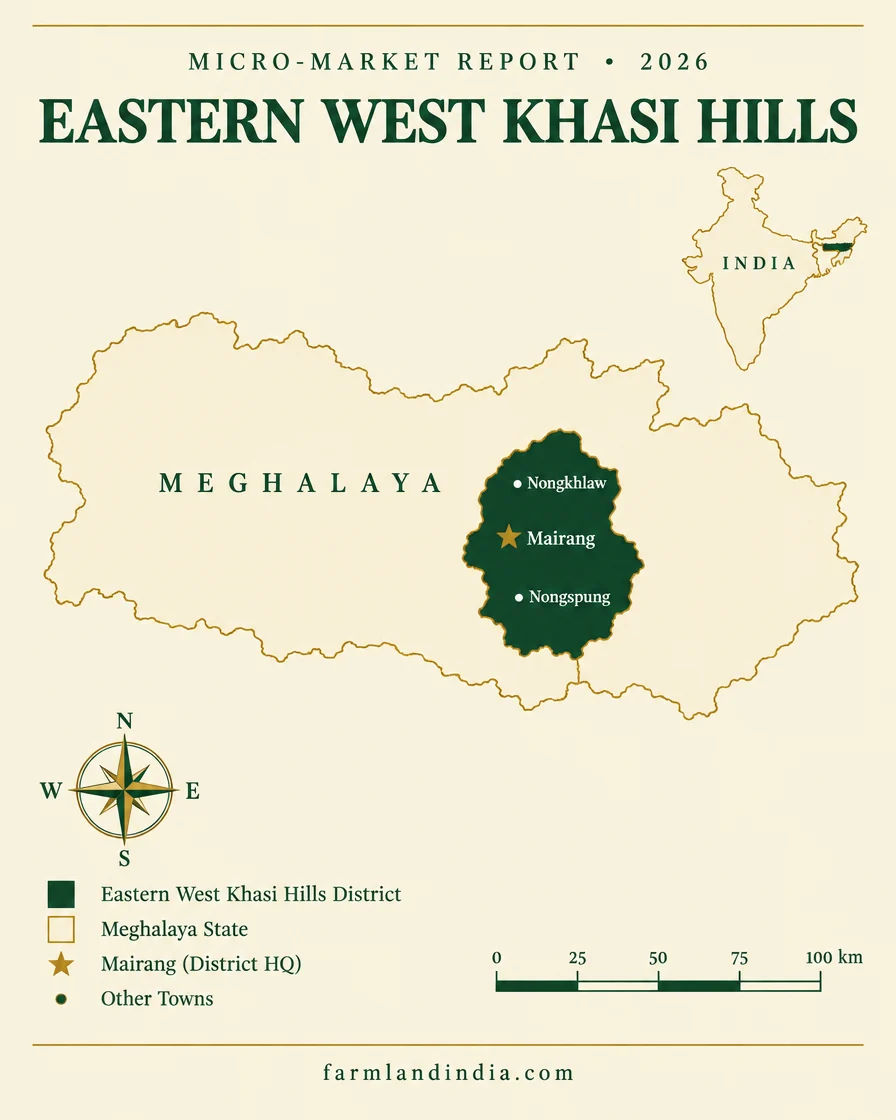
Meghalaya’s newest district, inaugurated at Mairang in November 2021, with two blocks and little published data.
10 Nov 2021
Inaugurated (CM office)
2
Blocks (CM office)
1976
Sub-division since (CM office)
3,074 mm
State normal rainfall (CGWB)
District land record — Eastern West Khasi Hills
Rev. 2026 · Farmland India desk
State
Meghalaya
District headquarters
Mairang
Formation
Inaugurated 10 November 2021 as the state’s 12th district, carved from West Khasi Hills (CM office[5])
Blocks
Two: Mairang and Mawthadraishan
Sub-division history
Mairang became a civil sub-division on 10 November 1976
Land law
Transfers need prior sanction under the 1971 Act (Act text[1])
Pricing unit
No official farmland price series is published; quote any land per acre or per sq yd and confirm the area on the ground
Records
Village records and cadastral survey are patchy; see the legal note below
Area and population
Not stated in the source; not quoted here
Land law is state law. These rules are maintained on the Meghalaya page and apply to every district within it.
Eastern West Khasi Hills — land purchase legal rules
Meghalaya is a tribal-majority hill state where land is governed by a mix of state law, Sixth Schedule district councils and the customary institutions of the Khasi, Jaintia and Garo communities. Its key statute for a buyer is the Meghalaya Transfer of Land (Regulation) Act, 1971, which puts every sale to a non-tribal behind official sanction. What follows describes the rules as the Act and the government state them; it is not legal advice, and any purchase needs a local lawyer, the Deputy Commissioner’s office and, in most places, the village and district council authorities. This block applies to every district page in the state.
The 1971 Act: Section 3 of the Meghalaya Transfer of Land (Regulation) Act, 1971 says no land in Meghalaya shall be transferred by a tribal to a non-tribal, or by a non-tribal to another non-tribal, except with the previous sanction of the competent authority. A transfer made without sanction is not enforceable in any court. Put simply, a buyer who is not a member of a Scheduled Tribe of the state generally cannot buy land in Meghalaya without the government’s prior sanction, whoever the seller is.
Who decides: The state’s Revenue and Disaster Management Department names Deputy Commissioners and Sub-Divisional Officers as the competent authorities, and notes that the Act’s bar applies except in certain listed areas (Revenue and Disaster Management Department). A person refused sanction can appeal to the Board of Revenue within sixty days.
What is weighed: Section 4 tells the authority to consider whether the non-tribal already holds other land in Meghalaya, whether a tribal buyer is willing to take the land at market value, whether the non-tribal’s work in the area requires them to live there, and whether the transfer is likely to promote the economic interests of the Scheduled Tribes in the area. Refusals must be in writing with reasons.
Exceptions: The Act does not apply to mortgages to notified banks, co-operative societies and credit institutions (a sale to a non-tribal on default still needs sanction), to letting a building on rent, or to transfers to the government or a district council. A 1991 amendment allows transfers for public religious worship, burial and cremation grounds, and schemes that promote tribal education or industry.
District councils and customary land: Most of the state falls under Sixth Schedule autonomous district councils for the Khasi, Jaintia and Garo Hills. Land is held under customary tenure through families, clans and village communities, and traditional heads often play a part in sale deeds. In 2018 the Khasi Hills council warned traditional heads who were charging about 10% of the sale value to execute sale deeds, after complaints mostly from Ri Bhoi (NE Now, 7 December 2018). Community and clan land cannot be treated as an individual’s land to sell.
Records: The Meghalaya Land Survey and Records Preparation Act, 1980 provides for a cadastral survey and records showing who occupies or holds land, and a 1991 amendment let the district councils carry out the scheme. Ask the Deputy Commissioner’s office and the district council what record exists for the plot.
Registration and duty: Deeds are registered by District Registrars and Sub-Registrars. The registration fee was fixed in June 2011 at Rs 26 for a value up to Rs 1,000 plus Rs 15 for each further Rs 1,000 (CAG audit report, state revenues to March 2023). Stamp duty is charged under the Indian Stamp Act as amended for Meghalaya in 1993; ask the Sub-Registrar for the current rate on a sale of land.
NRI and OCI buyers: Under the RBI Master Direction on immovable property, NRIs and OCIs may not acquire agricultural land, a farmhouse or plantation property in India except by inheritance. Our NRI guide covers the options.
- Transfer of Land (Regulation) Act, 1971
- Sanction for non-tribal buyers
- DC or SDO decides
- Appeal: Board of Revenue
- Sixth Schedule councils
- Clan and community land
- Registration fee about 1.5%
- NRIs: inheritance only
Eastern West Khasi Hills — district-specific notes
The Meghalaya state page covers the 1971 Act and the district councils. For Eastern West Khasi Hills, three points matter most.
⚠ Much land in the Khasi Hills is held by clans, villages or the traditional Hima (chiefdom) rather than by one registered owner; the 2025 Saitsohpen decision in East Khasi Hills, which gave 128 acres to the Elaka of Hima Sohra, shows how large claims are settled (ThePrint, 30 Sep 2025). Establish who holds the land, and who can sign, before you pay.
⚠ The Khasi Hills Autonomous District Council warned in 2018 that some traditional heads were charging about 10% of the sale value to execute sale deeds, a complaint it linked mainly to Ri Bhoi (NE Now, 7 Dec 2018[7]). Ask for any charge in writing, with a receipt.
⚠ Section 3 of the Meghalaya Transfer of Land (Regulation) Act, 1971 bars a transfer of land from a tribal to a non-tribal, or from one non-tribal to another, without the previous sanction of the competent authority; a transfer made in breach cannot be enforced in court (Act text[1]). Deputy Commissioners and Sub-Divisional Officers act as competent authorities (Revenue and Disaster Management Department[2]). Section 4 asks whether the buyer already holds land in Meghalaya and whether a tribal is willing to take the land at market value, and section 5 gives 60 days to appeal to the Board of Revenue. Keep any payment refundable until the authority has acted on Eastern West Khasi Hills.
The Meghalaya Land Survey and Records Preparation Act, 1980 provides for cadastral survey, and a 1991 amendment lets the district councils carry it out. NRIs and OCIs cannot acquire agricultural land, a farmhouse or plantation land except by inheritance; see our NRI guide and the Meghalaya land buying guide.
- Sanction needed to sell outside the tribe
- Clan and community land
- Thin survey records
- Village charges
District overview
Eastern West Khasi Hills — the state’s newest district
Eastern West Khasi Hills is Meghalaya’s 12th district, inaugurated by Chief Minister Conrad Sangma at Mairang on 10 November 2021. It was carved from West Khasi Hills, and the name was chosen to link it to its parent; Mairang had been a civil sub-division since 10 November 1976 (CM office[5]).
The CM’s office names two community and rural development blocks, Mairang and Mawthadraishan, but gives no area or population. Because the district is new, older documents describing West Khasi Hills may cover this area under the old name.
For a land buyer this is a quiet interior market. That does not make it a bad place to look at land, but it does mean every number has to come from the seller’s paperwork and the local authority, not from public data.
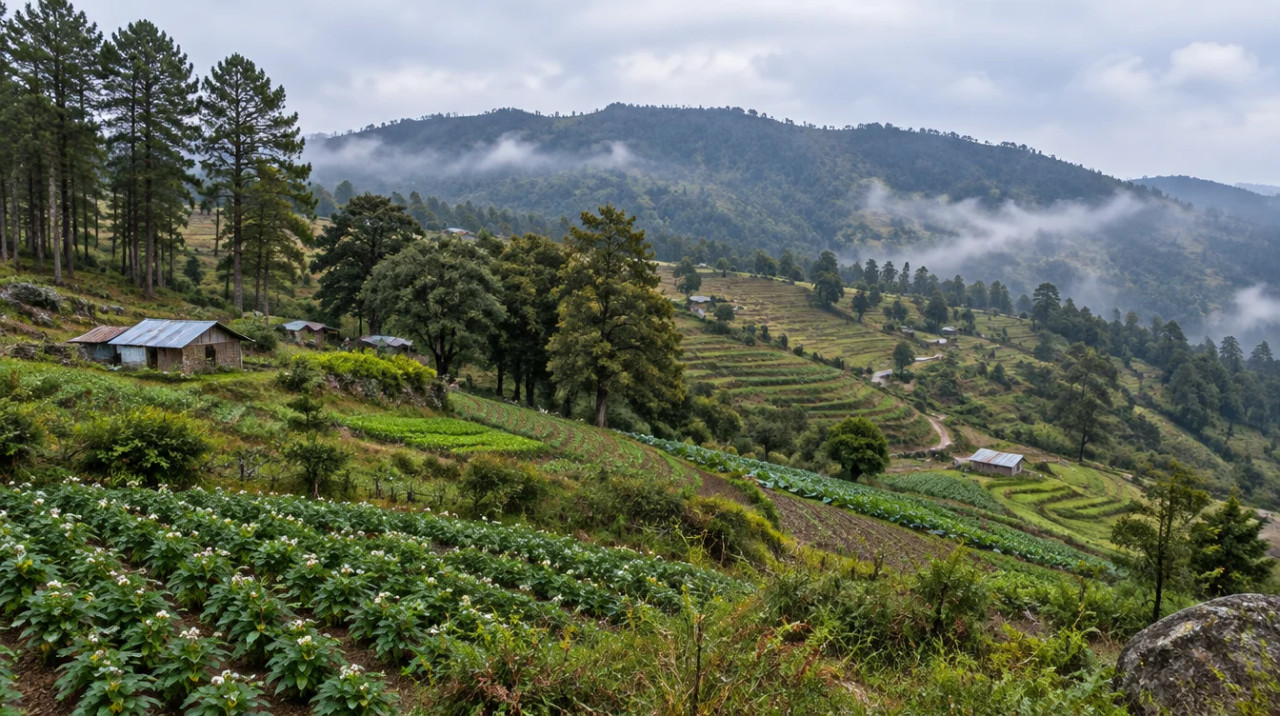
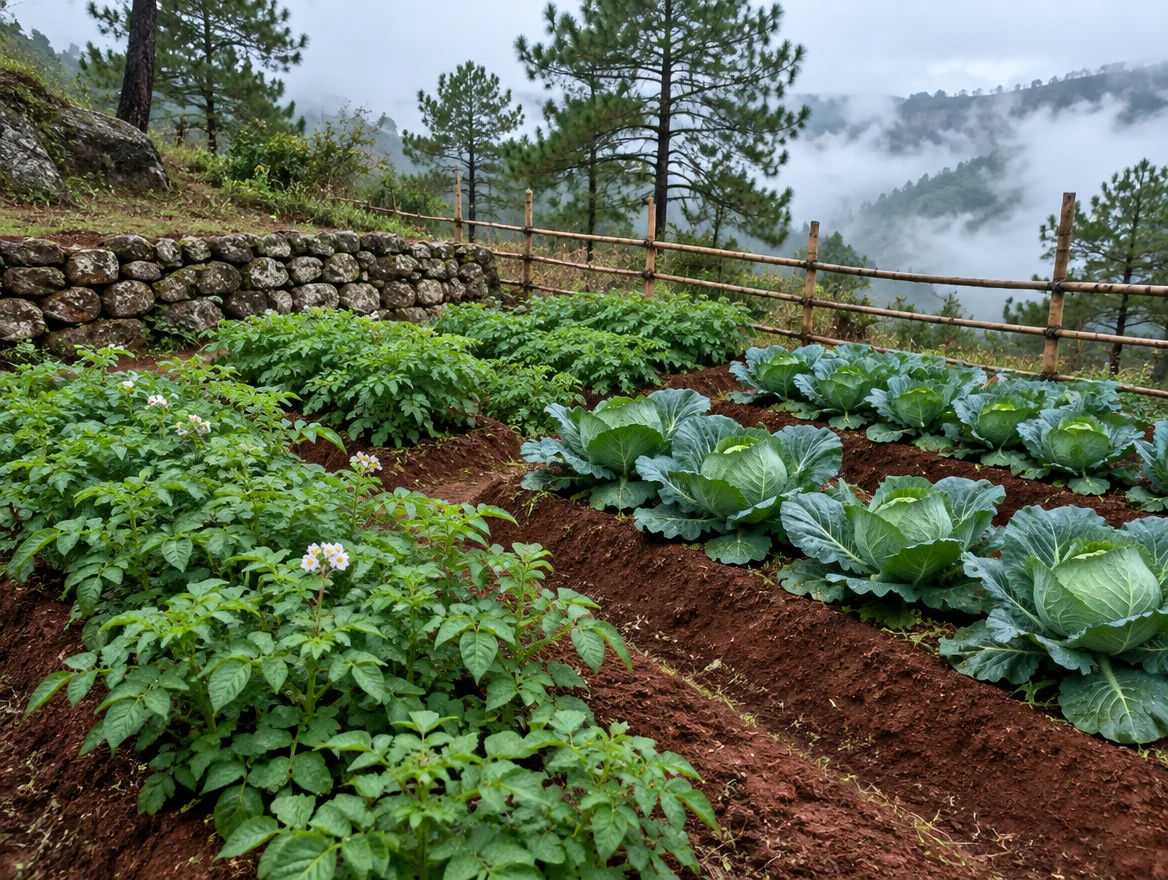
The terrain is high Khasi plateau and hill land, where potatoes, vegetables and fruit are typical.
The sanction rule of the 1971 Act applies to transfers from tribals to non-tribals and between non-tribals, and a lot of the land belongs to clans or villages, so allow time for the village and the Deputy Commissioner’s office.
- Mairang
- Nongkhlaw
- Nongspung
Transaction costs
Stamp duty & registration in Eastern West Khasi Hills
Registration fee
About 1.5% of value
Rs 26 up to Rs 1,000, then Rs 15 per further Rs 1,000, fixed June 2011 (CAG audit)
Stamp duty
Indian Stamp Act 1899 as amended for Meghalaya in 1993.
Sanction
Prior approval
Required for tribal-to-non-tribal and non-tribal-to-non-tribal transfers under section 3 of the 1971 Act
The CAG’s audit of state revenues records the registration fee as Rs 26 up to Rs 1,000 and Rs 15 for each further Rs 1,000, fixed in June 2011, roughly 1.5% of value (CAG audit report, year ended March 2023[4]). Stamp duty is levied under the Indian Stamp Act, 1899 as amended for Meghalaya in 1993. Ask the sub-registrar for a written computation before you agree a price. Section 11 of the 1971 Act exempts some transfers, such as loans from notified banks, letting buildings on rent and transfers to the Government or a District Council (Act text[1]).
Know the belt
What is moving prices in Eastern West Khasi Hills
Three places worth knowing, by what drives them and what to check.
Mairang
District headquarters
The administrative centre, where the district’s offices were set up after 2021; plots near the town follow the offices.
Check: the holder’s right to sell and the village authority’s written position
Mawthadraishan
Second block
The other block named by the CM’s office; interior land with fewer roads.
Check: road access in the rains and boundary markers
Nongkhlaw and Nongspung
Smaller places
Villages and small markets around the headquarters.
Check: who holds the land and how it is documented
Asking prices
Treat any agent figure as an opening ask until it is matched with a registered deed.
Connectivity
How Eastern West Khasi Hills connects — road, rail and air
No rail or airport project was found.
🚗 By road
✈️ By air
🚆 By rail
Growth catalysts
Upcoming infrastructure & developments
No project could be confirmed for this district.
00Open
01Catalysts
Agriculture & terrain
Soil, crops & water in Eastern West Khasi Hills
Hill farming.
Land and water
Meghalaya’s normal rainfall is about 3,074 mm a year and roughly 64% of the state is hilly; groundwater extraction was 4.60% in 2024, with all 40 assessment units classed Safe (CGWB, 2024[3]).
- State normal rainfall: about 3,074 mm
- State groundwater extraction: 4.60% (2024)
- High plateau and hill terrain
Typical crops
Potatoes, ginger, turmeric, areca and fruit are typical of Khasi Hills terraces. None is given.
Forest and community land
A good deal of land is community forest or sacred grove. Check that a plot is not within a forest the village manages.
At a glance
Eastern West Khasi Hills vs. nearby districts
| District | Land and water | What links it to Eastern West Khasi Hills |
|---|---|---|
| West Khasi Hills | Parent district; Nongstoin | Same council; the old district’s data may include this area |
| East Khasi Hills | Shillong’s district | The capital market is the main demand centre nearby |
| South West Khasi Hills | South-west; Mawkyrwat | Also a Khasi Hills district with a thin data trail |
The neighbours are listed from the CM office’s formation note and the district geography. No official farmland price series is published.
Farmland India view
Why investors look at Eastern West Khasi Hills
Five reasoned points for Eastern West Khasi Hills, each tied to a source on this page.
A quiet interior market
There is no price series and no confirmed major project, so demand is local and thin.
New offices help
The 2021 district upgrade (CM office[5]) brought administration closer, which can make sanction and records easier to reach.
Documentation is the value
Because much land is clan or community held, plots with clear papers keep their value.
Sanction decides timing
The 1971 Act makes sanction the first gate for a non-tribal buyer.
Confirm the land record, mutation, zoning and acquisition status directly — these are not certified by Farmland India’s review.
STRAIGHT TALK
Risks & challenges in Eastern West Khasi Hills
District-specific risks. Read the Meghalaya state page for the general risks on ceiling, conversion and records.
Unclear ownership
Clan, community and chiefdom land is common; ask who holds and who can sell.
Informal charges
The district council has warned about commissions to execute deeds; ask for a receipt.
Thin official data
Do not rely on seller numbers without a source.
Sanction refused or delayed
A sale without sanction cannot be enforced in court. Keep payments refundable until the authority has acted.
Records and boundaries
Cadastral survey is incomplete across the state, so get a surveyor’s site map and mark the boundaries before registration.
Who to contact
Local revenue & planning offices
Eastern West Khasi Hills is administered from Mairang by the Deputy Commissioner, who acts as competent authority under the 1971 Act. The two blocks are Mairang and Mawthadraishan (CM office[5]). The Khasi Hills Autonomous District Council covers customary matters. Deeds are registered at the sub-registrar’s office; ask for the written fee and duty computation, and meet the village headman and dorbar for any traditional land.
COMMON QUESTIONS
Frequently asked questions
Everything buyers, NRIs and investors ask before their first reviewed farmland purchase in Eastern West Khasi Hills.
Visit full wiki01 of 04
Can an outsider buy land in Eastern West Khasi Hills?
Only with sanction. Under the Meghalaya Transfer of Land (Regulation) Act, 1971, a transfer from a tribal to a non-tribal, or between non-tribals, needs the previous sanction of the competent authority, and a transfer made without it cannot be enforced in court. Confirm the route with the Deputy Commissioner’s office and a local lawyer before paying.
02 of 04
What is Eastern West Khasi Hills?
Meghalaya’s 12th district, inaugurated at Mairang on 10 November 2021 and carved from West Khasi Hills. Mairang became a civil sub-division in 1976 and was upgraded to a district 45 years later.
03 of 04
Which blocks does it have?
The Chief Minister’s office names two community and rural development blocks, Mairang and Mawthadraishan.
04 of 04
Is there a price guide for land here?
No official farmland price series is published. Ask for recent registered deeds in the same locality and compare them with the asking price.
Transparency
Sources and references
Law and courts
- [1]Meghalaya Transfer of Land (Regulation) Act, 1971 — faolex.fao.org
Government
- [2]Meghalaya Revenue and Disaster Management Department — meghalaya.gov.in
- [3]CGWB: Dynamic Ground Water Resources of Meghalaya, 2024 — cgwb.gov.in
- [4]CAG: state revenues audit report, year ended March 2023 — cag.gov.in
- [5]Meghalaya CM office: inauguration of the 12th district at Mairang — cm.meghalaya.gov.in
News
- [6]ThePrint: Meghalaya cabinet decisions, 30 Sep 2025 — theprint.in
- [7]NE Now: KHADC warns village heads over sale-deed commissions, 7 Dec 2018 — nenow.in
Project status, the benchmark valuation and land rules change often; check the linked source and the relevant office before relying on any figure.
For developers
Ready to explore Eastern West Khasi Hills farmland?
Browse reviewed projects and individual land parcels across Eastern West Khasi Hills — or if you own land here, list it with platform review and reach serious buyers.