
District guide
Buying Land in West Khasi Hills
Nongstoin’s district on its 50th year: ginger and turmeric hills, road projects around the headquarters and the 1971 sanction rule.
1976
District formed (district portal)
1,30,323
Electors (district portal)
3
Assembly seats (district portal)
Rs 498 crore
Road projects cited (reported)
*Indicative range across districts and land types. Stamp duty, registration and conversion charges are additional. Local measurement units vary — every listing states the unit it is priced in. Not a valuation or an offer.
District land record — West Khasi Hills
Rev. 2026 · Farmland India desk
State
Meghalaya
District headquarters
Nongstoin
Formation
1976; the district marked 50 years in 2026 (district portal[5])
Blocks named
Nongstoin and Mawshynrut
Electors
1,30,323 (district portal; not a population figure)
Land law
Transfers need prior sanction under the 1971 Act (Act text[1])
Pricing unit
No official farmland price series is published; quote any land per acre or per sq yd and confirm the area on the ground
Records
Village records and cadastral survey are patchy; see the legal note below
Area and population
Not stated on the district portal; not quoted here
Land law is state law. These rules are maintained on the Meghalaya page and apply to every district within it.
West Khasi Hills — land purchase legal rules
Meghalaya is a tribal-majority hill state where land is governed by a mix of state law, Sixth Schedule district councils and the customary institutions of the Khasi, Jaintia and Garo communities. Its key statute for a buyer is the Meghalaya Transfer of Land (Regulation) Act, 1971, which puts every sale to a non-tribal behind official sanction. What follows describes the rules as the Act and the government state them; it is not legal advice, and any purchase needs a local lawyer, the Deputy Commissioner’s office and, in most places, the village and district council authorities. This block applies to every district page in the state.
The 1971 Act: Section 3 of the Meghalaya Transfer of Land (Regulation) Act, 1971 says no land in Meghalaya shall be transferred by a tribal to a non-tribal, or by a non-tribal to another non-tribal, except with the previous sanction of the competent authority. A transfer made without sanction is not enforceable in any court. Put simply, a buyer who is not a member of a Scheduled Tribe of the state generally cannot buy land in Meghalaya without the government’s prior sanction, whoever the seller is.
Who decides: The state’s Revenue and Disaster Management Department names Deputy Commissioners and Sub-Divisional Officers as the competent authorities, and notes that the Act’s bar applies except in certain listed areas (Revenue and Disaster Management Department). A person refused sanction can appeal to the Board of Revenue within sixty days.
What is weighed: Section 4 tells the authority to consider whether the non-tribal already holds other land in Meghalaya, whether a tribal buyer is willing to take the land at market value, whether the non-tribal’s work in the area requires them to live there, and whether the transfer is likely to promote the economic interests of the Scheduled Tribes in the area. Refusals must be in writing with reasons.
Exceptions: The Act does not apply to mortgages to notified banks, co-operative societies and credit institutions (a sale to a non-tribal on default still needs sanction), to letting a building on rent, or to transfers to the government or a district council. A 1991 amendment allows transfers for public religious worship, burial and cremation grounds, and schemes that promote tribal education or industry.
District councils and customary land: Most of the state falls under Sixth Schedule autonomous district councils for the Khasi, Jaintia and Garo Hills. Land is held under customary tenure through families, clans and village communities, and traditional heads often play a part in sale deeds. In 2018 the Khasi Hills council warned traditional heads who were charging about 10% of the sale value to execute sale deeds, after complaints mostly from Ri Bhoi (NE Now, 7 December 2018). Community and clan land cannot be treated as an individual’s land to sell.
Records: The Meghalaya Land Survey and Records Preparation Act, 1980 provides for a cadastral survey and records showing who occupies or holds land, and a 1991 amendment let the district councils carry out the scheme. Ask the Deputy Commissioner’s office and the district council what record exists for the plot.
Registration and duty: Deeds are registered by District Registrars and Sub-Registrars. The registration fee was fixed in June 2011 at Rs 26 for a value up to Rs 1,000 plus Rs 15 for each further Rs 1,000 (CAG audit report, state revenues to March 2023). Stamp duty is charged under the Indian Stamp Act as amended for Meghalaya in 1993; ask the Sub-Registrar for the current rate on a sale of land.
NRI and OCI buyers: Under the RBI Master Direction on immovable property, NRIs and OCIs may not acquire agricultural land, a farmhouse or plantation property in India except by inheritance. Our NRI guide covers the options.
- Transfer of Land (Regulation) Act, 1971
- Sanction for non-tribal buyers
- DC or SDO decides
- Appeal: Board of Revenue
- Sixth Schedule councils
- Clan and community land
- Registration fee about 1.5%
- NRIs: inheritance only
West Khasi Hills — district-specific notes
The Meghalaya state page covers the 1971 Act and the district councils. For West Khasi Hills, three points matter most.
⚠ Much land in the Khasi Hills is held by clans, villages or the traditional Hima (chiefdom) rather than by one registered owner; the 2025 Saitsohpen decision in East Khasi Hills, which gave 128 acres to the Elaka of Hima Sohra, shows how large claims are settled (ThePrint, 30 Sep 2025). Establish who holds the land, and who can sign, before you pay.
⚠ The Khasi Hills Autonomous District Council warned in 2018 that some traditional heads were charging about 10% of the sale value to execute sale deeds, a complaint it linked mainly to Ri Bhoi (NE Now, 7 Dec 2018[7]). Ask for any charge in writing, with a receipt.
⚠ Section 3 of the Meghalaya Transfer of Land (Regulation) Act, 1971 bars a transfer of land from a tribal to a non-tribal, or from one non-tribal to another, without the previous sanction of the competent authority; a transfer made in breach cannot be enforced in court (Act text[1]). Deputy Commissioners and Sub-Divisional Officers act as competent authorities (Revenue and Disaster Management Department[2]). Section 4 asks whether the buyer already holds land in Meghalaya and whether a tribal is willing to take the land at market value, and section 5 gives 60 days to appeal to the Board of Revenue. Keep any payment refundable until the authority has acted on West Khasi Hills.
The Meghalaya Land Survey and Records Preparation Act, 1980 provides for cadastral survey, and a 1991 amendment lets the district councils carry it out. NRIs and OCIs cannot acquire agricultural land, a farmhouse or plantation land except by inheritance; see our NRI guide and the Meghalaya land buying guide.
- Sanction needed to sell outside the tribe
- Clan and community land
- Thin survey records
- Village charges
District overview
West Khasi Hills — Nongstoin and the western Khasi hills
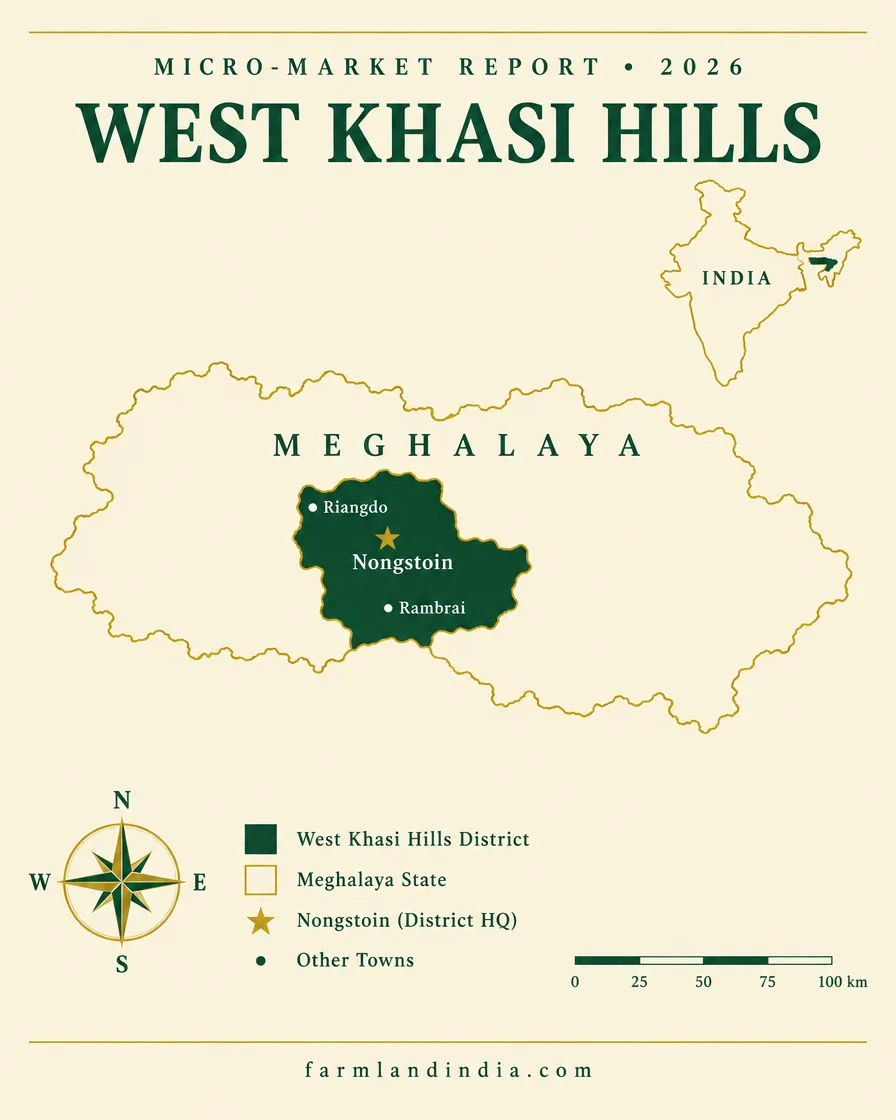
West Khasi Hills has Nongstoin as its headquarters and dates from 1976; the district marks its 50th anniversary in 2026. The portal names Nongstoin and Mawshynrut blocks and three assembly constituencies, Nongstoin, Rambrai Jyrngam and Mawshynrut, but gives no area or population, only 1,30,323 electors (district portal[5]).
The district shrank in 2021, when its eastern part became Eastern West Khasi Hills with Mairang as headquarters. Older documents that describe West Khasi Hills may therefore cover more land than the district has today.
The Chief Minister cited about Rs 498 crore of road projects around Nongstoin when the district marked its 50 years (Syllad, 2026[8])
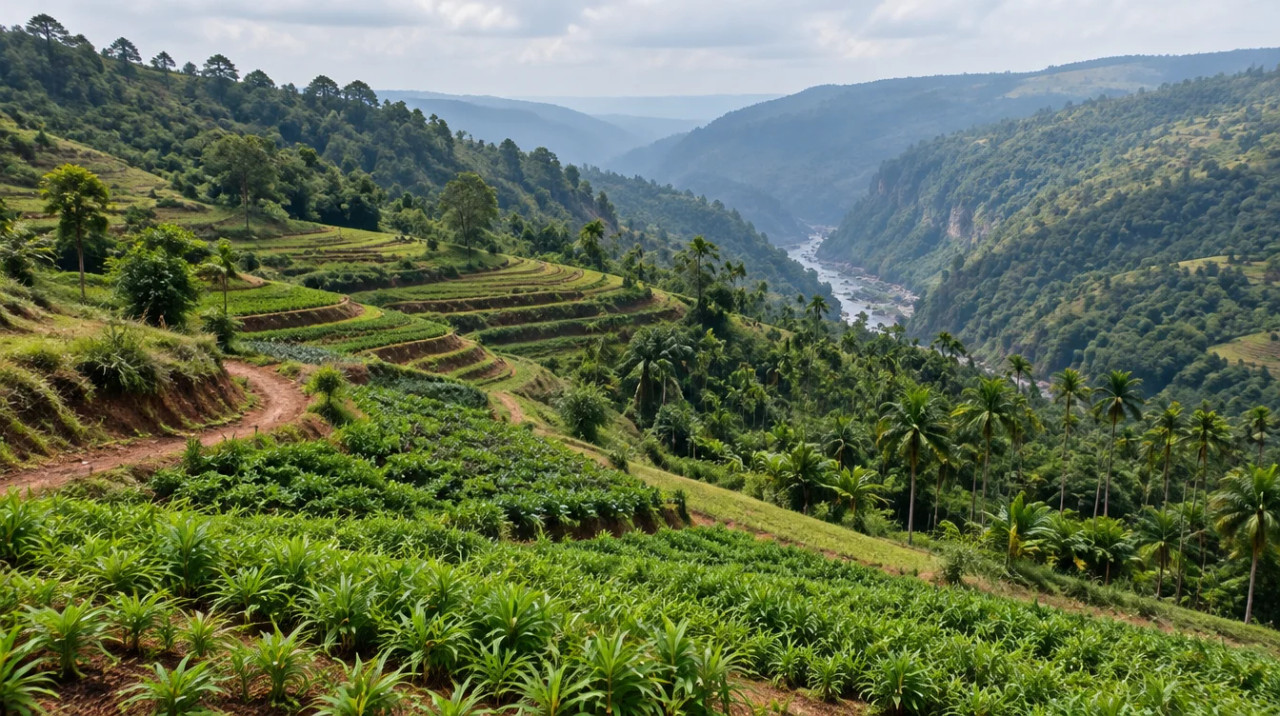
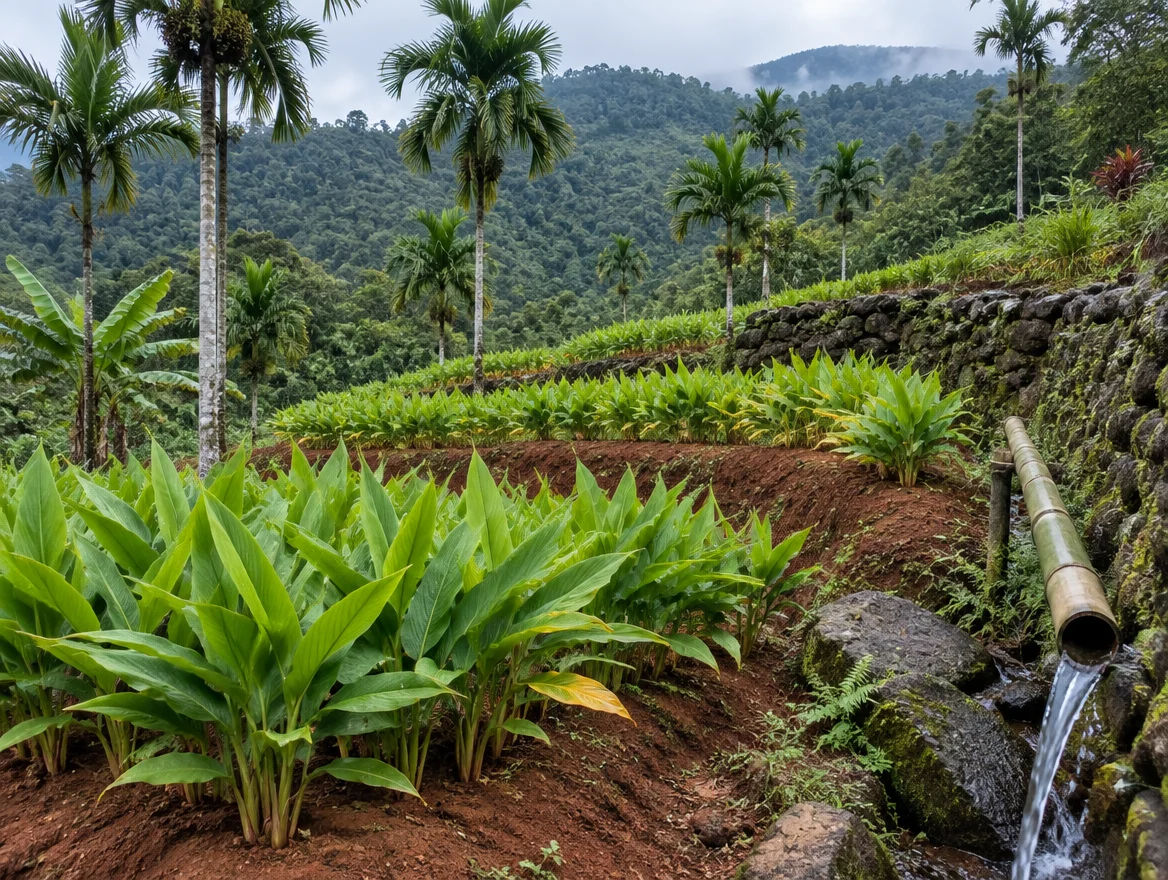
The land is hill and gorge country, where terraced ginger, turmeric, vegetables and areca are typical.
For a buyer the route is the same as elsewhere in the Khasi Hills: find the real holder of the land, get a surveyor’s map, apply for sanction, and then discuss price.
- Nongstoin
- Mawshynrut
- Riangdo
- Rambrai
Transaction costs
Stamp duty & registration in West Khasi Hills
Registration fee
About 1.5% of value
Rs 26 up to Rs 1,000, then Rs 15 per further Rs 1,000, fixed June 2011 (CAG audit)
Stamp duty
Indian Stamp Act 1899 as amended for Meghalaya in 1993.
Sanction
Prior approval
Required for tribal-to-non-tribal and non-tribal-to-non-tribal transfers under section 3 of the 1971 Act
The CAG’s audit of state revenues records the registration fee as Rs 26 up to Rs 1,000 and Rs 15 for each further Rs 1,000, fixed in June 2011, roughly 1.5% of value (CAG audit report, year ended March 2023[4]). Stamp duty is levied under the Indian Stamp Act, 1899 as amended for Meghalaya in 1993. Ask the sub-registrar for a written computation before you agree a price. Section 11 of the 1971 Act exempts some transfers, such as loans from notified banks, letting buildings on rent and transfers to the Government or a District Council (Act text[1]).
Know the belt
What is moving prices in West Khasi Hills
Three places worth knowing, by what drives them and what to check.
Nongstoin
District headquarters
The Deputy Commissioner’s office, block offices and the local market are here; plots near town are for houses and shops.
Check: the holder’s right to sell and road access
Mawshynrut
Second named block
Interior land towards the Garo Hills side of the district.
Check: road access and boundary markers
Riangdo and Rambrai
Smaller places
Villages around the district with farm and forest land.
Check: who holds the land and whether it is community forest
Asking prices
Treat any agent figure as an opening ask until it is matched with a registered deed.
Connectivity
How West Khasi Hills connects — road, rail and air
🚗 By road
✈️ By air
🚆 By rail
Growth catalysts
Upcoming infrastructure & developments
No project could be confirmed in detail.
00Open
01Catalysts
Agriculture & terrain
Soil, crops & water in West Khasi Hills
Hill farming.
Land and water
Meghalaya’s normal rainfall is about 3,074 mm a year and roughly 64% of the state is hilly; groundwater extraction was 4.60% in 2024, with all 40 assessment units classed Safe (CGWB, 2024[3]).
- State normal rainfall: about 3,074 mm
- State groundwater extraction: 4.60% (2024)
- Hills and river gorges
Typical crops
Potatoes, ginger, turmeric, areca and fruit are typical of Khasi Hills terraces. None is given.
Forest and community land
A good deal of land is community forest or sacred grove. Check that a plot is not within a forest the village manages.
At a glance
West Khasi Hills vs. nearby districts
| District | Land and water | What links it to West Khasi Hills |
|---|---|---|
| Eastern West Khasi Hills | East; Mairang | Carved from West Khasi Hills in 2021 |
| East Khasi Hills | Shillong’s district | The main demand centre for the Khasi Hills |
| South West Khasi Hills | South; Mawkyrwat | Also a Khasi Hills district with a thin data trail |
The neighbours are listed from the 2021 split and the district geography. No official farmland price series is published.
Farmland India view
Why investors look at West Khasi Hills
Five reasoned points for West Khasi Hills, each tied to a source on this page.
A long-hold interior market
There is no price series and no confirmed major project, so demand is local.
Documentation is the value
Plots with clear papers keep their value where much land is clan or community held.
Sanction decides timing
The 1971 Act makes sanction the first gate for a non-tribal buyer.
Confirm the land record, mutation, zoning and acquisition status directly — these are not certified by Farmland India’s review.
STRAIGHT TALK
Risks & challenges in West Khasi Hills
District-specific risks. Read the Meghalaya state page for the general risks on ceiling, conversion and records.
Unclear ownership
Clan, community and chiefdom land is common; ask who holds and who can sell.
Informal charges
The district council has warned about commissions to execute deeds; ask for a receipt.
Old boundaries
Documents from before 2021 may describe a larger West Khasi Hills; confirm the plot’s current district.
Sanction refused or delayed
A sale without sanction cannot be enforced in court. Keep payments refundable until the authority has acted.
Records and boundaries
Cadastral survey is incomplete across the state, so get a surveyor’s site map and mark the boundaries before registration.
Who to contact
Local revenue & planning offices
West Khasi Hills is administered from Nongstoin by the Deputy Commissioner and Additional Deputy Commissioners, with Block Development Offices at Nongstoin and Mawshynrut (district portal[5]). The Khasi Hills Autonomous District Council covers customary matters. Deeds are registered at the sub-registrar’s office; ask for the written fee and duty computation, and meet the village headman and dorbar for any traditional land.
COMMON QUESTIONS
Frequently asked questions
Everything buyers, NRIs and investors ask before their first reviewed farmland purchase in West Khasi Hills.
Visit full wiki01 of 04
Can an outsider buy land in West Khasi Hills?
Only with sanction. Under the Meghalaya Transfer of Land (Regulation) Act, 1971, a transfer from a tribal to a non-tribal, or between non-tribals, needs the previous sanction of the competent authority, and a transfer made without it cannot be enforced in court. Confirm the route with the Deputy Commissioner’s office and a local lawyer before paying.
02 of 04
What is West Khasi Hills known for?
Nongstoin is the district headquarters and the district marked 50 years in 2026. Do not buy on a yield promise.
03 of 04
Which blocks does it have?
The district portal names Nongstoin and Mawshynrut blocks; others were not listed. Mairang was split off in 2021 as Eastern West Khasi Hills.
04 of 04
Is there a price guide for land here?
No official farmland price series is published. Ask for recent registered deeds in the same locality and compare them with the asking price.
Transparency
Sources and references
Law and courts
- [1]Meghalaya Transfer of Land (Regulation) Act, 1971 — faolex.fao.org
Government
- [2]Meghalaya Revenue and Disaster Management Department — meghalaya.gov.in
- [3]CGWB: Dynamic Ground Water Resources of Meghalaya, 2024 — cgwb.gov.in
- [4]CAG: state revenues audit report, year ended March 2023 — cag.gov.in
- [5]West Khasi Hills district portal — westkhasihills.gov.in
News
- [6]ThePrint: Meghalaya cabinet decisions, 30 Sep 2025 — theprint.in
- [7]NE Now: KHADC warns village heads over sale-deed commissions, 7 Dec 2018 — nenow.in
- [8]Syllad: road projects around Nongstoin, 2026 — syllad.com
Project status, the benchmark valuation and land rules change often; check the linked source and the relevant office before relying on any figure.
For developers
Ready to explore West Khasi Hills farmland?
Browse reviewed projects and individual land parcels across West Khasi Hills — or if you own land here, list it with platform review and reach serious buyers.