
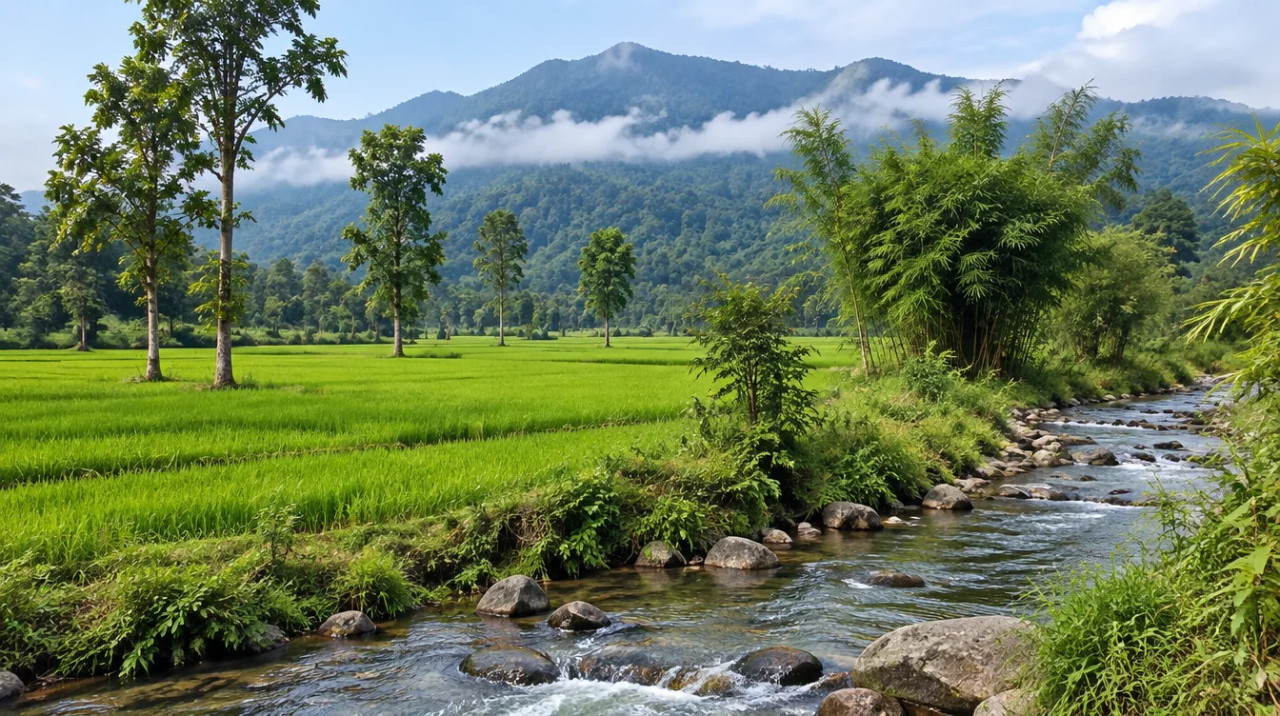
District guide
Buying Land in Baksa
A Bodoland Territorial Region district on the Bhutan foothills: Mushalpur headquarters, 687 villages, heavy rain and strict belt and block rules.
687
Revenue villages (district portal)
4
Revenue circles (district portal)
2,094 mm
Normal annual rainfall (ICAR-CRIDA)
138,000 ha
Rice area (ICAR-CRIDA, 2015-16)
District land record — Baksa
Rev. 2026 · Farmland India desk
State
Assam
Revenue structure
Two sub-divisions (Mushalpur Sadar and Salbari Civil), four revenue circles, five development blocks and 687 revenue villages, per the district portal[2].
Key markets
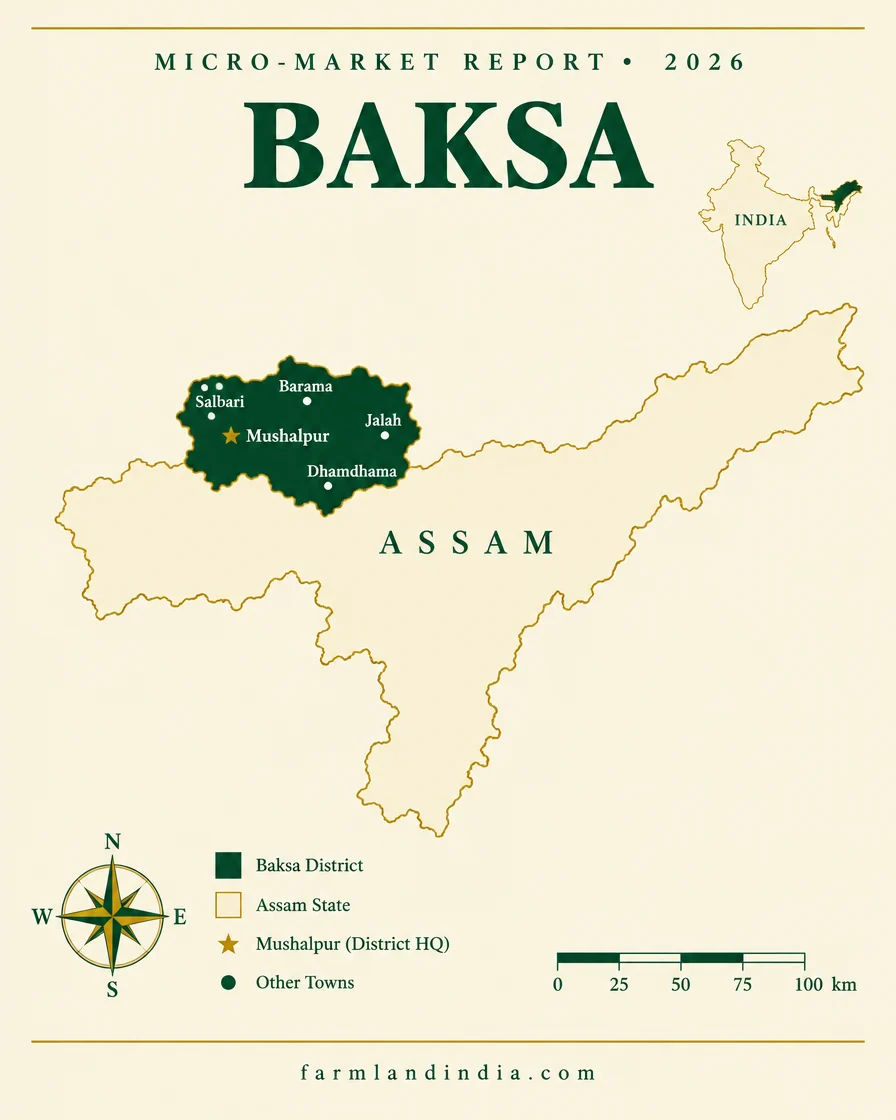
Mushalpur · Salbari · Barama · Jalah · Dhamdhama
Demand anchors
District headquarters at Mushalpur · Pagladiya bridge and BTC road works · Mushalpur sports complex · rice, areca and spice trade
Regional status
Bodoland Territorial Region (BTR), under the Bodoland Territorial Council (district portal[2])
Size and population
The portal gives about 2,400 sq km and 9.54 lakh people at the 2011 Census; it is not clear whether these exclude Tamulpur, which was split off, so check before quoting
Pricing unit
No official farmland price series is published for Baksa. Ask the sub-registrar for recent registered sale values in the village you are looking at.
Local units
Records use bigha, katha and lessa (1 bigha = 5 katha; 1 katha = 20 lessa; one Assam bigha is about 14,400 sq ft, roughly a third of an acre)
Land records portal
ILRMS at ilrms.assam.gov.in for the jamabandi, Bhunaksha for maps, Basundhara for mutation; see our Assam land records guide
Land law is state law. These rules are maintained on the Assam page and apply to every district within it.
Baksa — land purchase legal rules
Assam’s land law rests on the Assam Land and Revenue Regulation of 1886, layered with protections that are stronger than in most states: tribal belts and blocks in the plains, autonomous councils with their own land laws in the hills and in Bodoland, and a 2015 Act that controls the conversion of farmland. Most land outside these areas can be sold to any Indian buyer. This block applies to every district page in the state.
Who can buy: Assam has no farmer-only rule. An Indian citizen can buy agricultural land held on a periodic patta (myadi patta, the settled holding with transferable rights) from an owner who is free to sell. Three things narrow that: the tribal belts and blocks of the plains, the Sixth Schedule council areas in the hills and in Bodoland, and land held only on an annual patta (eksonia patta), which carries no right to sell.
Tribal belts and blocks: Chapter X of the Assam Land and Revenue Regulation, 1886, added in 1947, lets the state notify belts and blocks in which only "protected classes" may hold land. The classes notified on 5 December 1947 were plains tribes, hill tribes, tea garden tribes, Santhals, Scheduled Castes and Nepali cultivator-graziers; Nepalis were taken off the list in 1969 and the indigenous Koch-Rajbongshis of the old Goalpara district were added in 1985. There are 46 such areas, 14 belts and 32 blocks, covering about 16.76 lakh hectares (Revenue department study of the belts and blocks). Section 164 restricts transfer by sale, mortgage, lease or agreement inside them, so a buyer outside the protected classes generally cannot acquire land there.
Sixth Schedule areas: Three autonomous councils make their own land laws under the Sixth Schedule: the Bodoland Territorial Council (Kokrajhar, Chirang, Baksa, Udalguri and Tamulpur), the Karbi Anglong Autonomous Council (Karbi Anglong and West Karbi Anglong) and the Dima Hasao Autonomous Council. In the Karbi hills the Karbi Anglong District (Land and Revenue) Act, 1979 applies. Inside Bodoland the classes allowed to buy in belt and block land are still those notified under the 1886 Regulation, and the 2003 Bodo accord says council laws will not take away land rights held by other citizens when the council began (The Sentinel, 28 January 2021). Ask the council’s land revenue office before negotiating.
Farmland to other uses: Under the Assam Agricultural Land (Regulation of Reclassification and Transfer for Non-Agricultural Purpose) Act, 2015, agricultural land cannot be used or transferred for a non-farm purpose without reclassification and the Deputy Commissioner’s permission; above 50 bighas, and for land cultivated in the last ten years, the government’s approval is also needed. The premium is 10% of the minimum zonal value for reclassification and 15% for reclassification with transfer (Revenue department guidance). A home of up to two storeys on up to one bigha needs no permission. Sixth Schedule districts, municipal areas, tea land and notified industrial zones are outside the Act.
Ceiling: The Assam Fixation of Ceiling on Land Holdings Act, 1956 caps how much land a family may hold. A 1972 government resolution records the limit being cut to 50 bighas (Revenue department land policy compilation); the Act has been amended several times since, most recently for tea garden labour lines, so confirm the current limit before assembling a large holding.
Inter-religion transfers: On 27 August 2025 the state cabinet approved a standard operating procedure for land transfers between persons of different religions. Under it the proposal goes to the Deputy Commissioner, then to the Revenue department and the police Special Branch, which reports on whether the transfer is fraudulent or coerced, the source of funds and any security concern; the Deputy Commissioner then decides (The Assam Tribune, 27 August 2025). Transfers between persons of the same religion are not covered.
Tea estates: Tea land sits outside the 2015 reclassification Act and under the ceiling law’s special provisions. In November 2025 the Assembly amended the ceiling Act to settle land in the labour lines of 825 tea estates with tea garden workers (All India Radio, 28 November 2025), and a 2026 bill proposes letting estates lease up to 5% of garden land to third parties for ancillary uses (The Sentinel, 29 July 2026). Do not buy a part of an estate without checking both.
Stamp duty and fees: Since the Indian Stamp (Assam Amendment) Act, 2021 a sale deed carries 3% stamp duty for a male buyer, 2% for joint registration with a woman and 1% for a woman buying alone. Registration fees follow the same 3, 2 and 1% pattern from 22 September 2022, and a 1% municipal surcharge applies inside municipal limits (CAG audit report, 2025).
NRI and OCI buyers: Under the RBI Master Direction on immovable property, NRIs and OCIs may not acquire agricultural land, a farmhouse or a plantation in India except by inheritance. Our NRI guide covers the options.
- No farmer-only rule
- Tribal belts and blocks
- Protected classes only
- Sixth Schedule councils
- Reclassification Act, 2015
- Inter-religion SOP, 2025
- Women: 1% stamp duty
- NRIs: inheritance only
Baksa — district-specific notes
Baksa is one of the strictest land-law districts in Assam for outside buyers. The notes below sit on top of the state-level legal block above.
⚠ Bodoland Territorial Region (BTR) district, under the Bodoland Territorial Council (BTC), a Sixth Schedule body. The Sentinel noted in 2021 that classes eligible to buy belt and block land are those notified under the 1886 Regulation, that the BTC has not notified new classes, and that a 2003 accord clause protects land rights held by citizens at its commencement (Sentinel Assam editorial, 2021[4]). A BTC statement from 2018 said non-tribals cannot buy land in tribal belts and blocks under the accord (NE Now, 26 Feb 2018[5]). Treat both as background; ask the Deputy Commissioner and circle office what applies to the specific village today.
⚠ BTC has its own land legislation process. On 31 July 2025 the BTC Legislative Assembly passed the BTC Land and Revenue Regulation (Application, Adoption and Modification) Bill, 2025, described as allowing selective adoption of Assam's land and revenue rules for the region, with safeguards against land alienation in tribal belts and blocks (India Today NE, 31 Jul 2025[6]). Check which rules are in force.
⚠ The Assam 2015 reclassification Act does not extend to Sixth Schedule districts (section 1(2)). A conversion route that works elsewhere in Assam may not apply here, and the BTC's own rules or premium rates govern. Ask the BTC revenue office and the Deputy Commissioner for the written procedure.
⚠ Belt and block status matters more than anywhere else. Chapter X of the 1886 Regulation restricts sale, mortgage, lease and agreement to non-protected classes, and Sentinel reported about 3.85 lakh bighas of belt and block land in the BTR as encroached by non-protected people (Sentinel Assam editorial, 2021[4]). Verify the belt or block status of the village and the buyer's eligibility before paying any advance.
⚠ Confirm the record of rights and the type of patta. Read the jamabandi (record of rights) and chitha (field index by dag number), check the seller's name after mutation, and see whether the patta is periodic (myadi, transferable) or annual (eksonia, not heritable or transferable).
NRI and OCI buyers should read can NRIs buy agricultural land in India first. For the 2015 reclassification Act, the ceiling law and the inter-religion transfer procedure, read the Assam land buying guide.
- Bodoland Territorial Region
- Tribal belts and blocks
- BTC land rules
- Reclassification Act excluded
- Record of rights
District overview
Baksa — A BTR district on the Bhutan foothills
Baksa is a north-bank district of lower Assam with its headquarters at Mushalpur. The district portal lists two sub-divisions (Mushalpur Sadar and Salbari Civil), four revenue circles, five development blocks and 687 revenue villages, and places Baksa within the Bodoland Territorial Autonomous District formed under the 2003 BTC accord (district portal[2]).
The ICAR-CRIDA contingency plan shows how wet and rice-dominated the district is: normal annual rainfall of 2,093.7 mm, with 1,685 mm in the south-west monsoon, and 138,000 ha under rice in 2015–16 including kharif rainfed, rabi and summer crops (ICAR-CRIDA[3]). It also lists mustard, lentil, potato, vegetables, areca nut, coconut, turmeric and ginger.
Infrastructure announcements are mostly BTC and state projects. In October 2023 the Chief Minister laid the foundation of a Rs 43 crore district sports complex at Mushalpur, unveiled a Rs 30 crore bridge over the Pagladiya on the Barama–Dhamdhama–Tamulpur road, and announced Rs 25 crore for a new district commissioner's office (NE News, 6 Oct 2023[7]).
Buyers are mostly local farmers, Bodo and other families of the BTR, and small traders. Because eligibility is restricted by belt, block and BTC rules, outside buyers are rare and the market is thin.
Read the Assam guide for the statewide rules, then use this page for the district specifics. Browse reviewed land through the Baksa listings below, and confirm eligibility in writing before paying an advance.
- Bodoland Territorial Region
- Headquarters Mushalpur
- 687 villages
- Rice and areca
- Pagladiya bridge
- Sixth Schedule rules
Transaction costs
Stamp duty & registration in Baksa
Stamp duty
Conveyance of land
1% for a woman buyer alone, 2% joint with a woman, 3% for a man or other buyer (Assam amendment of 2021, per the CAG report to March 2024)
Registration fee
Same 1 / 2 / 3% pattern
Effective 22 September 2022; the male rate was 2% earlier ([CAG audit report 2025](https://cag.gov.in/uploads/download_audit_report/2025/Chapter-VI-069a1724c0cdaa1.48254278.pdf))
Surcharge
1% in municipal areas
Applies to land in municipal areas; rural revenue villages are not covered, so check the municipal boundary
These rates are from the CAG audit report for the year ended March 2024 and later changes were not checked, so confirm the current figure with the sub-registrar before signing. Ask the Deputy Commissioner's land settlement branch for the current minimum zonal value of the revenue village and land class, since duty and the reclassification premium both depend on it. In the BTR, also ask whether BTC premium rates or fees apply to the transfer.
Know the belt
What is moving prices in Baksa
Four pockets that shape land interest in the district
Mushalpur
District headquarters
The headquarters town, where a new district sports complex and a planned district commissioner's office concentrate activity.
Check: belt and block status, buyer eligibility and the town boundary
Salbari and Jalah
Second sub-division
Salbari Civil sub-division towns with rice, areca and vegetable land.
Check: belt and block status, flood history and road access
Barama and Dhamdhama
Pagladiya road belt
Villages on the road to Tamulpur that crosses the Pagladiya bridge announced in 2023.
Check: bridge approach, river bank and acquisition notices
Foothill villages
Bhutan-side interior
Villages nearer the Bhutan foothills with forest edge, higher rainfall and fewer services.
Check: forest boundary, belt status and access roads in the rains
Asking prices
Transactions are limited by eligibility rules, so asking prices may not reflect what registered deeds show; compare any quote with registered deeds for the same revenue village and with the zonal value.
Connectivity
How Baksa connects — road, rail and air
Road, rail and air links for the district
🚗 By road
✈️ By air
🚆 By rail
Baksa is reached through its neighbours rather than from a main highway; confirm the road you will use and the plot's access before comparing distances.
Growth catalysts
Upcoming infrastructure & developments
Project status as reported, with the source and date for each
00Open
03Catalysts
Agriculture & terrain
Soil, crops & water in Baksa
Rice, mustard, areca and spices in a high-rainfall district
Crops
The ICAR-CRIDA plan uses 2015–16 data (ICAR-CRIDA[3]). Rice covers 138,000 ha (kharif rainfed 81,000 ha, rabi 42,500 ha, summer 7,500 ha), rapeseed-mustard 10,400 ha, areca nut 4,150 ha, coriander 1,869 ha, turmeric 1,400 ha and ginger 1,250 ha. Net sown area is 115,735 ha and cropping intensity 160.7%.
- Rice
- Mustard
- Areca nut
- Turmeric and ginger
Rainfall and soils
Normal annual rainfall is 2,093.7 mm over 122 rainy days. Soils are sandy loam, alluvial, clay loam and sandy. Irrigation figures in the plan are inconsistent.
Floods
Flood is the only regular contingency listed, with drought, cyclone and hailstorm occasional. The plan covers waterlogging and submergence of more than two days (ICAR-CRIDA[3]).
At a glance
Baksa vs. nearby districts
| District | Land and water | What links it to Baksa |
|---|---|---|
| Tamulpur (north-east) | BTR district on the Bhutan border | Carved from Baksa; both are BTR districts with the same land regime |
| Bajali and Nalbari (south) | Non-BTR plains with the general Assam land law | Reached through Baksa; the 2015 reclassification Act applies there |
| Udalguri (west) | BTR district with tea and Bhutan border | Another BTR district with the same belt and block rules |
Baksa is a controlled market. The same land that is open to a wider group of buyers in Nalbari or Bajali is restricted here, which tends to keep prices local.
Farmland India view
Why investors look at Baksa
Five reasoned points for Baksa, each tied to a source on this page.
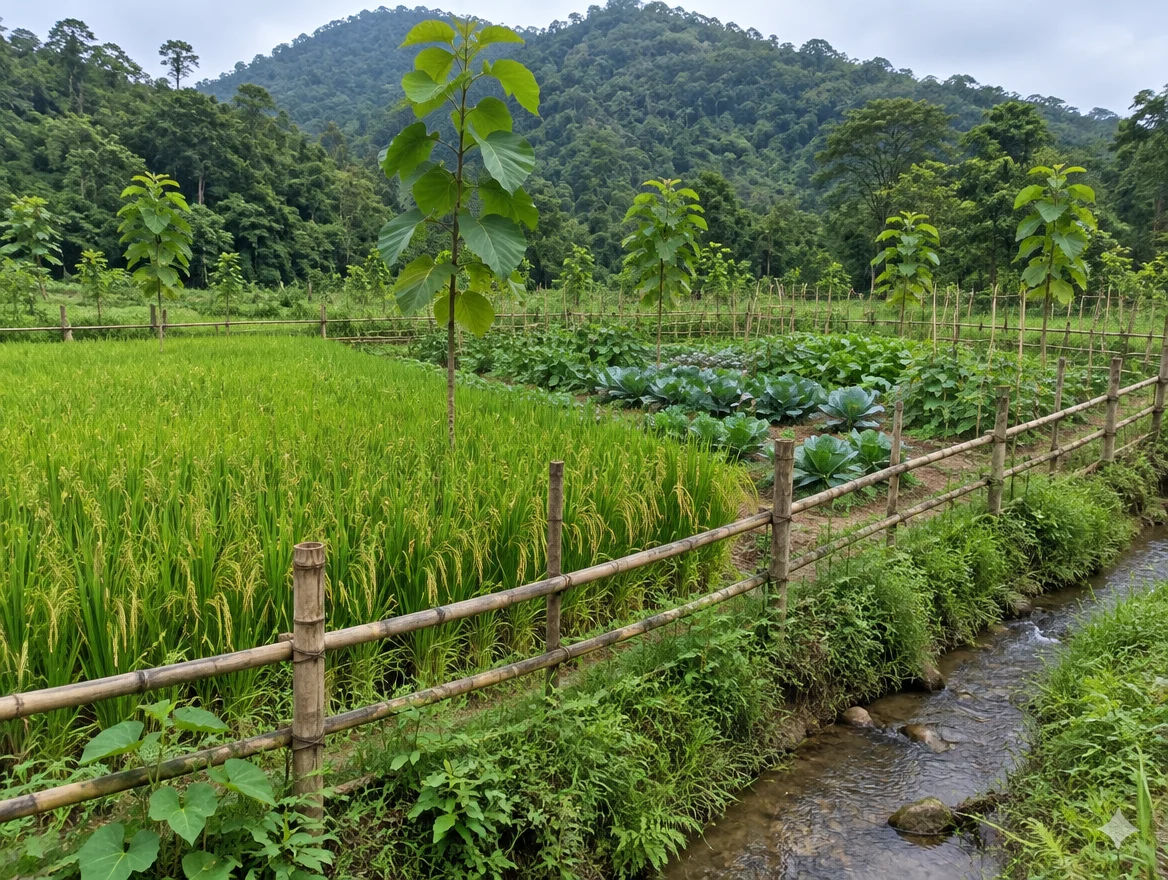
High-rainfall, high-output farmland
With more than 2,000 mm of rain and 160% cropping intensity, farm output per hectare is strong, which supports rural land value, though floods can wipe out a season.
District-level projects add services
The sports complex, new DC office and Pagladiya bridge are announced or started. Check progress before paying a premium for proximity.
Eligibility limits demand
In the BTR, belt and block rules restrict who may buy. That limits the buyer pool and can limit resale, which both lowers speculation and lowers liquidity.
BTC rule changes could move the market
The BTC passed a land and revenue bill in July 2025, and its assent was not reported. New procedures or premium rates could change the cost of transfer.
No price series, so use the zonal value
Use the minimum zonal value for the revenue village as the floor and compare registered deeds nearby.
Confirm the record of rights (jamabandi and chitha), mutation, zoning and acquisition status directly — these are not certified by Farmland India’s review.
STRAIGHT TALK
Risks & challenges in Baksa
District-specific risks. Read the Assam state page for the general risks on ceiling, conversion and records.
Eligibility and belt restrictions
Sale to non-protected classes is restricted in a belt or block. Do not pay any advance before the Deputy Commissioner or circle office confirms eligibility.
Encroachment and disputes
Press reports describe large areas of belt and block land in the BTR as encroached. Ask for the chitha, the possession history and any pending case.
Flooding
Flood is the regular contingency. Visit in the monsoon and ask about the past water level.
Boundary and record confusion
The Tamulpur split means older papers may name Baksa for Tamulpur land. Match the present circle, mouza and dag.
Rule changes in the BTR
The BTC passed a land and revenue bill in July 2025, and assent and notification were not reported. Check which rules are in force.
Thin market
With few transactions, a seller's price is harder to benchmark. Cross-check with registered deeds.
Who to contact
Local revenue & planning offices
Start at the Deputy Commissioner's office, Baksa, at Mushalpur, which runs the land settlement branch and the four revenue circle offices. In the BTR, also consult the BTC revenue and land department. Registration is at the sub-registrar office under the Inspector General of Registration, Assam. Online record services are at ILRMS, Bhunaksha and Basundhara; see the Assam land records guide.
KEEP EXPLORING
Explore more areas
Other districts in Assam
- Bajali
- Barpeta
- Biswanath
- Bongaigaon
- Cachar
- Charaideo
- Chirang
- Darrang
- Dhemaji
- Dhubri
- Dibrugarh
- Goalpara
- Golaghat
- Hailakandi
- Hojai
- Jorhat
- Kamrup
- Kamrup Metropolitan
- Karbi Anglong
- Kokrajhar
- Lakhimpur
- Majuli
- Marigaon
- Nagaon
- Nalbari
- North Cachar Hills
- Sivasagar
- Sonitpur
- South Salmara-Mankachar
- Sribhumi (karimganj)
- Tamulpur
- Tinsukia
- Udalguri
- West Karbi Anglong
COMMON QUESTIONS
Frequently asked questions
Everything buyers, NRIs and investors ask before their first reviewed farmland purchase in Baksa.
Visit full wiki01 of 04
Is Baksa in the Bodoland Territorial Region?
Yes. Baksa is one of the four original districts of the Bodoland Territorial Region (Kokrajhar, Chirang, Baksa and Udalguri), under the Bodoland Territorial Council. Land is governed by Assam law as modified or replaced by BTC rules, so confirm what applies to a village with the Deputy Commissioner.
02 of 04
Can anyone buy land in Baksa?
Not necessarily. In the BTR, tribal belts and blocks restrict transfers to non-protected classes, and the 2015 Assam reclassification Act does not apply in Sixth Schedule districts. Eligibility depends on the buyer, the village and the BTC rules in force, so get written confirmation before paying an advance.
03 of 04
What is the relationship between Baksa and Tamulpur?
Tamulpur was carved out of Baksa in January 2022, merged back at the end of 2022 and restored as a separate district from 1 January 2024. Older papers may name Baksa for land now in Tamulpur, so match the present circle and mouza.
04 of 04
Is flooding a concern in Baksa?
Yes. The ICAR contingency plan lists flood as the only regular contingency for the district, with transient waterlogging and submergence of more than two days. Visit a plot in the monsoon and ask about past water levels.
Transparency
Sources and references
Law and courts
Government
- [2]Baksa district portal: district at a glance — baksa.assam.gov.in
- [3]ICAR-CRIDA: Agriculture contingency plan, Baksa — icar-crida.res.in
News
- [4]Sentinel Assam: Land alienation in BTR (editorial), 2021 — sentinelassam.com
- [5]NE Now: No new rule framed per BTC accord, 26 Feb 2018 — nenow.in
- [6]India Today NE: BTC passes land and revenue bill, 31 Jul 2025 — indiatodayne.in
- [7]NE News: BTR receives infrastructure boost, 6 Oct 2023 — nenews.in
- [8]Sentinel Assam: New terminal at LGBI Airport operational — sentinelassam.com
Data-currency note: sources were read in November 2026. Project status, the benchmark valuation and land rules change often; check the linked source and the relevant office before relying on any figure.
For developers
Ready to explore Baksa farmland?
Browse reviewed projects and individual land parcels across Baksa — or if you own land here, list it with platform review and reach serious buyers.