
District guide
Buying Land in West Karbi Anglong
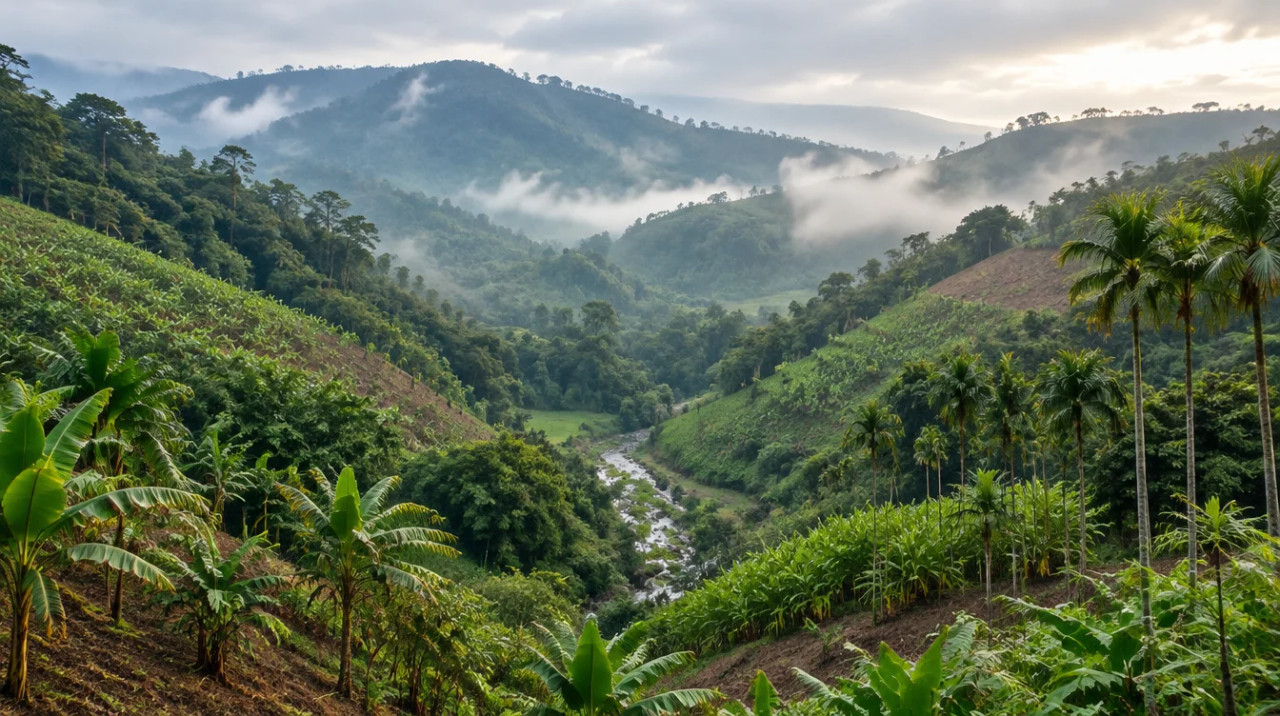
A Sixth Schedule hill district around Hamren where the council sets land rules and grazing reserves and forest diversion are the live issues.
300,320
Population, 2011 (district site)
Sixth Schedule, KAAC
Land law
900 MW
Tharakhunchi pumped storage (in principle)
3
Municipality boards (district site)
District land record — West Karbi Anglong
Rev. 2026 · Farmland India desk
State
Assam (Sixth Schedule district, Karbi Anglong Autonomous Council)
Formation and division
District headquartered at Hamren, formed in 2016 from the Hamren sub-division of Karbi Anglong and still part of the Karbi Anglong Autonomous Council (district glance[3])
Key markets
Hamren, Dongkamokam, Baithalangso and Kheroni
Demand anchors
Council and district offices at Hamren, the highway villages, and forest-edge farming
Rail
Ask Northeast Frontier Railway for the nearest station and services.
Size and population
About 3 lakh people (300,320 in 2011), with one revenue circle (Donka), four development blocks (Amri, Chinthong, Rongkhang, Socheng), nine mouzas and three municipality boards (Hamren, Dongkamokam, Baithalangso) (district site[4]). Area is not stated there
Pricing unit
Quote and compare land per acre or per sq yd if a sale is permitted at all. Local talk is in bigha and katha, so convert before comparing
Local units
Records and sellers use bigha, katha and lessa: 1 bigha is 5 katha and 1 katha is 20 lessa, and an Assam bigha is about 14,400 sq ft, roughly one-third of an acre. Convert every offer to acres or sq yd before comparing; this page does not price land per bigha
Land records portal
Land revenue in Karbi Anglong is administered by the district autonomous council, not by the state’s district revenue office. Ask the KAAC revenue department how records are kept and issued; for how the state system works, see the. Assam land records guide
Land law is state law. These rules are maintained on the Assam page and apply to every district within it.
West Karbi Anglong — land purchase legal rules
Assam’s land law rests on the Assam Land and Revenue Regulation of 1886, layered with protections that are stronger than in most states: tribal belts and blocks in the plains, autonomous councils with their own land laws in the hills and in Bodoland, and a 2015 Act that controls the conversion of farmland. Most land outside these areas can be sold to any Indian buyer. This block applies to every district page in the state.
Who can buy: Assam has no farmer-only rule. An Indian citizen can buy agricultural land held on a periodic patta (myadi patta, the settled holding with transferable rights) from an owner who is free to sell. Three things narrow that: the tribal belts and blocks of the plains, the Sixth Schedule council areas in the hills and in Bodoland, and land held only on an annual patta (eksonia patta), which carries no right to sell.
Tribal belts and blocks: Chapter X of the Assam Land and Revenue Regulation, 1886, added in 1947, lets the state notify belts and blocks in which only "protected classes" may hold land. The classes notified on 5 December 1947 were plains tribes, hill tribes, tea garden tribes, Santhals, Scheduled Castes and Nepali cultivator-graziers; Nepalis were taken off the list in 1969 and the indigenous Koch-Rajbongshis of the old Goalpara district were added in 1985. There are 46 such areas, 14 belts and 32 blocks, covering about 16.76 lakh hectares (Revenue department study of the belts and blocks). Section 164 restricts transfer by sale, mortgage, lease or agreement inside them, so a buyer outside the protected classes generally cannot acquire land there.
Sixth Schedule areas: Three autonomous councils make their own land laws under the Sixth Schedule: the Bodoland Territorial Council (Kokrajhar, Chirang, Baksa, Udalguri and Tamulpur), the Karbi Anglong Autonomous Council (Karbi Anglong and West Karbi Anglong) and the Dima Hasao Autonomous Council. In the Karbi hills the Karbi Anglong District (Land and Revenue) Act, 1979 applies. Inside Bodoland the classes allowed to buy in belt and block land are still those notified under the 1886 Regulation, and the 2003 Bodo accord says council laws will not take away land rights held by other citizens when the council began (The Sentinel, 28 January 2021). Ask the council’s land revenue office before negotiating.
Farmland to other uses: Under the Assam Agricultural Land (Regulation of Reclassification and Transfer for Non-Agricultural Purpose) Act, 2015, agricultural land cannot be used or transferred for a non-farm purpose without reclassification and the Deputy Commissioner’s permission; above 50 bighas, and for land cultivated in the last ten years, the government’s approval is also needed. The premium is 10% of the minimum zonal value for reclassification and 15% for reclassification with transfer (Revenue department guidance). A home of up to two storeys on up to one bigha needs no permission. Sixth Schedule districts, municipal areas, tea land and notified industrial zones are outside the Act.
Ceiling: The Assam Fixation of Ceiling on Land Holdings Act, 1956 caps how much land a family may hold. A 1972 government resolution records the limit being cut to 50 bighas (Revenue department land policy compilation); the Act has been amended several times since, most recently for tea garden labour lines, so confirm the current limit before assembling a large holding.
Inter-religion transfers: On 27 August 2025 the state cabinet approved a standard operating procedure for land transfers between persons of different religions. Under it the proposal goes to the Deputy Commissioner, then to the Revenue department and the police Special Branch, which reports on whether the transfer is fraudulent or coerced, the source of funds and any security concern; the Deputy Commissioner then decides (The Assam Tribune, 27 August 2025). Transfers between persons of the same religion are not covered.
Tea estates: Tea land sits outside the 2015 reclassification Act and under the ceiling law’s special provisions. In November 2025 the Assembly amended the ceiling Act to settle land in the labour lines of 825 tea estates with tea garden workers (All India Radio, 28 November 2025), and a 2026 bill proposes letting estates lease up to 5% of garden land to third parties for ancillary uses (The Sentinel, 29 July 2026). Do not buy a part of an estate without checking both.
Stamp duty and fees: Since the Indian Stamp (Assam Amendment) Act, 2021 a sale deed carries 3% stamp duty for a male buyer, 2% for joint registration with a woman and 1% for a woman buying alone. Registration fees follow the same 3, 2 and 1% pattern from 22 September 2022, and a 1% municipal surcharge applies inside municipal limits (CAG audit report, 2025).
NRI and OCI buyers: Under the RBI Master Direction on immovable property, NRIs and OCIs may not acquire agricultural land, a farmhouse or a plantation in India except by inheritance. Our NRI guide covers the options.
- No farmer-only rule
- Tribal belts and blocks
- Protected classes only
- Sixth Schedule councils
- Reclassification Act, 2015
- Inter-religion SOP, 2025
- Women: 1% stamp duty
- NRIs: inheritance only
West Karbi Anglong — district-specific notes
The Assam state page sets out the law that applies to the plains. West Karbi Anglong is a Sixth Schedule district, and the rules below come first.
⚠ West Karbi Anglong is part of the Karbi Anglong Autonomous Council, which regulates land revenue under the Mikir Hills (Land and Revenue) Act, 1953, the Karbi Anglong District (Land and Revenue) Act, 1979 and the 1981 Rules (Revenue department[5]). The 2015 reclassification Act (text[1]) does not extend to Sixth Schedule districts.
⚠ The council’s revenue department authorised the Rong Asar, the Karbi village headmen, in April 2025 to issue no-objection certificates for sales and gifts of land between individuals, with family transfers and inheritance exempt (The Assam Tribune[9]). The report mentions a West Karbi Anglong committee of the headmen’s body. Ask the council in writing.
⚠ In December 2025 protests over professional and village grazing reserves in this district and Karbi Anglong turned violent: Deccan Herald reported two deaths, at least 45 injured including 38 police personnel, internet suspension and prohibitory orders, with the demand focused on removing settlers from grazing reserve land (Deccan Herald[10]). The council later announced eviction notices from 30 December (Nagaland Post[11]). A buyer should treat any grazing reserve land as unavailable.
⚠ After tripartite talks on 26 December 2025 between the state government, the council and Karbi representatives, the government committed to cancel trading licences held by non-tribals, to fence vacant reserves and to clear disputed and departmental land, according to the council’s announcement as reported by Nagaland Post[11]. That is a statement of intent reported at the time, not a change in the law. If you are a non-tribal buyer or trader, check the current position with the council before relying on any licence or permission.
⚠ Forest land is also being diverted for the 900 MW Tharakhunchi pumped storage project; see the infrastructure section below. Land held as forest, reserve or community land is not the same as individually owned patta land, even if it looks cultivated.
NRI and OCI buyers should read can NRIs buy agricultural land in India: under the RBI Master Direction an NRI or OCI cannot buy agricultural land, a farmhouse or plantation land except by inheritance.
- Sixth Schedule
- KAAC land laws
- Grazing reserves
- December 2025 unrest
District overview
West Karbi Anglong — a Sixth Schedule hill district around Hamren, where grazing reserves and forest diversion are the live land issues
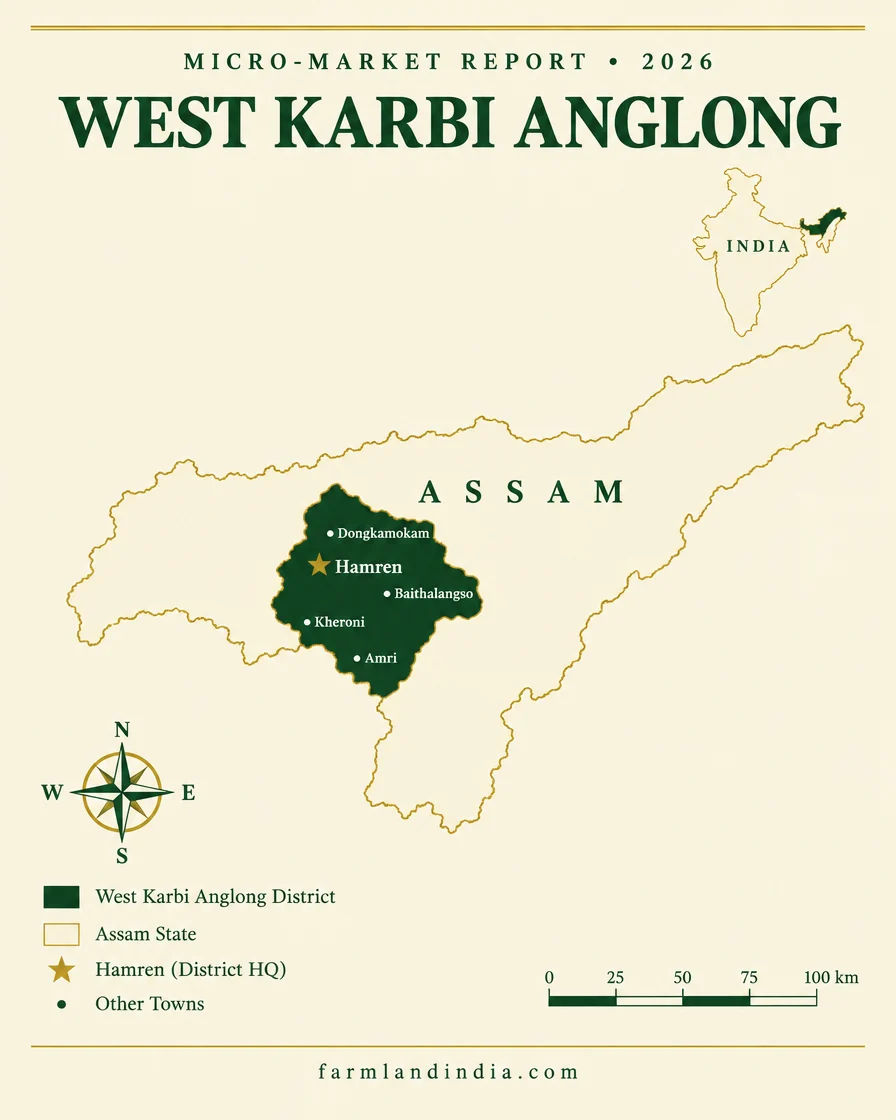
West Karbi Anglong is a hill district in central-west Assam, formed in 2016 from the Hamren sub-division of Karbi Anglong. Hamren is the headquarters. The district site gives a 2011 population of 300,320, of which 282,505 is rural, so this is a mostly rural and small-town district.
The administrative units are one revenue circle, Donka, four development blocks (Amri, Chinthong, Rongkhang and Socheng), nine mouzas, four police stations and three municipality boards at Hamren, Dongkamokam and Baithalangso (district site[4]). There is one assembly constituency, Baithalangso, reserved for Scheduled Tribes.
The December 2025 unrest shows that land questions are sensitive, so a buyer from outside the district should expect to be asked who they are and why they want the land.
Why it matters: the district hosts the 900 MW Tharakhunchi pumped storage proposal, which received in-principle forest approval in January 2026 (NE Now[12]), and it was the centre of the grazing-reserve unrest in December 2025. Both are about who holds and uses land.
What to check first: whether any sale to you is permitted, the council NOC, and whether the plot is patta land, grazing reserve or forest.
- Hamren
- Dongkamokam
- Baithalangso
- Kheroni
- Amri
- Sixth Schedule
Transaction costs
Stamp duty & registration in West Karbi Anglong
1%
Stamp duty, woman solely (CAG)
on conveyance
2%
Stamp duty, joint with woman (CAG)
on conveyance
3%
Stamp duty, men and others (CAG)
on conveyance
The Comptroller and Auditor General’s state revenue audit reports stamp duty on conveyance of 1% for a woman buyer, 2% for a joint deed with a woman and 3% for others, and the same pattern for the registration fee (CAG report[2]). Those are state-wide rates. Ask the council revenue department and the sub-registrar before agreeing a price.
Know the belt
What is moving prices in West Karbi Anglong
Land-use notes for each belt; no listing-site prices are used
Hamren
District HQ and municipality board
Hamren is the administrative centre and a municipality board town. Land near the offices is the most developed in the district, but it is still subject to council rules and the Rong Asar NOC.
Check: the council NOC, the municipal limit and the land class of the plot
Dongkamokam and Baithalangso
Municipality board towns
These are the other two municipality board towns, and Baithalangso is the assembly constituency name. Local trade and roadside plots are the main market.
Check: the road access, the patta type and the council position
Kheroni and the grazing-reserve belt
Centre of the December 2025 unrest
Kheroni, where shops were burned during the protests, sits in the area where the grazing reserve dispute is concentrated. Land categories and occupation are contested here.
Check: whether the plot is on a professional or village grazing reserve, and any eviction notice
Tharakhunchi and Donka
Forest edge and project site
The Tharakhunchi pumped storage project is near Tharakhunchi village in the Donka sub-division, within a project area of 308 hectares, of which 79.37 ha of reserved forest is sought for diversion. Land around it is exposed to acquisition and to forest-boundary questions.
Check: the forest boundary and any project notice
Asking prices
No official farmland price series is published for West Karbi Anglong. Ask the sub-registrar for recent registered sale values in the village you are looking at A price quoted from outside the district is not a guide to what a council NOC would allow.
Connectivity
How West Karbi Anglong connects — road, rail and air
Hill roads; check every access route
🚗 By road
🚆 By rail and air
West Karbi Anglong has fewer published access details than the plains districts. Treat that as a reason to visit and ask rather than a gap to fill with assumptions. When you visit, travel in daylight, tell the local headman or council office why you are there and keep a record of who you spoke to.
Growth catalysts
Upcoming infrastructure & developments
One proposed power project, in principle only
00Open
01Catalysts
Agriculture & terrain
Soil, crops & water in West Karbi Anglong
Hill rice, maize, ginger and oranges on forested slopes
Crops and land use
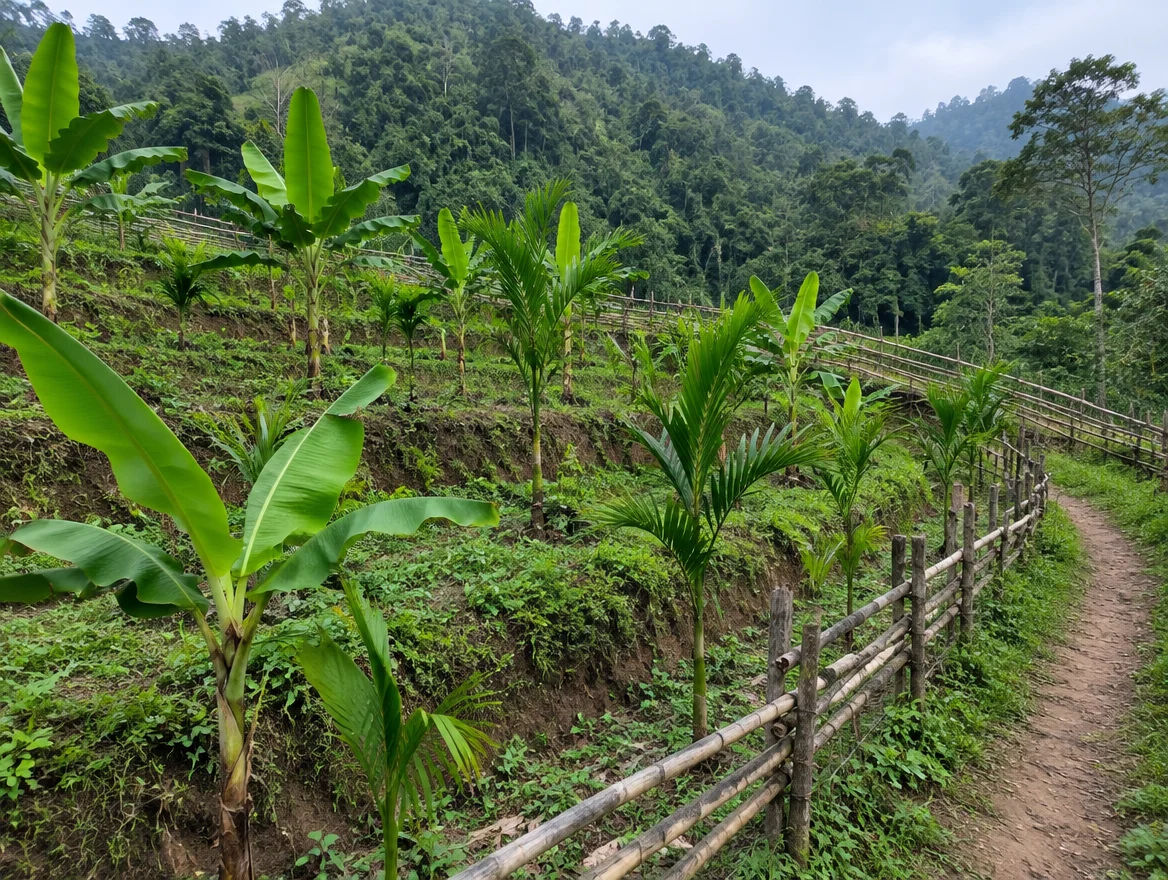
The ICAR-CRIDA plan was written for the undivided Karbi Anglong district, which includes this area. It reports normal rainfall of 1,205 mm, about 501,000 ha of forest and about 133,600 ha of rice, almost all rain-fed, with ginger, pineapple, banana and orange as the main hill horticulture (ICAR-CRIDA[6]). For West Karbi Anglong alone, the state statistics directorate lists 57,105 ha of rice in its 2021-22 table (Directorate of Economics and Statistics[7]).
- Rain-fed rice
- Ginger and pineapple
- Orange and banana
- Maize and mustard
Groundwater
The CRIDA plan classes all 11 blocks of the undivided district as safe, and the 2024 state assessment found only one semi-critical block in Assam, in Guwahati (CGWB[8]). Springs and streams matter more than wells in the hills.
Hazards
The Karbi Anglong plan places that district in earthquake zone V, and the two were one district until 2016, so ask for local hazard information for the plot and expect landslides on slopes.
What this means for a buyer
Hill farming here is mostly rain-fed rice, ginger and fruit on small plots on slopes. That is livelihood land for families who have held it for generations. A buyer who wants a farm should be realistic about what is on offer: much of the land is either not for sale to outsiders or is forest and reserve land that cannot be sold at all.
At a glance
West Karbi Anglong vs. nearby districts
| District | Land and water | What links it to West Karbi Anglong |
|---|---|---|
| Karbi Anglong (east) | Larger Sixth Schedule hill district with Diphu as HQ | Same council and the same land laws |
| Hojai (north) | Plains district under the general Assam land law | The 2015 Act can apply there |
| Dima Hasao (south) | Sixth Schedule hill district with its own council | Separate council and revenue rules |
| Nagaon (north) | Plains district with Kopili and Kolong floodplain | General Assam land law |
The key divide is between Sixth Schedule land under council law and plains land under the state law. West Karbi Anglong is on the council side.
Farmland India view
Why investors look at West Karbi Anglong
Five reasoned points for West Karbi Anglong, each tied to a source on this page.
Start with the council, not the seller
Ask the council revenue department whether the transaction is permitted before you discuss price.
Keep away from grazing reserves and forest
The December 2025 unrest and the eviction notices show the risk for anyone on reserve land.
Watch the pumped storage decision
The Tharakhunchi project is approved in principle only. Final approval, acquisition and compensation are separate steps.
Consider the plains for a farm purchase
Hojai and Nagaon offer Assam farm land under the general law, with state records and the 2015 Act.
Do not buy on a seller’s word alone
Ask the headman, the council office and the district administration the same question and compare the answers in writing. If they differ, do not pay.
Confirm the jamabandi (record of rights), khasra number, mutation, zoning and acquisition status directly — these are not certified by Farmland India’s review.
STRAIGHT TALK
Risks & challenges in West Karbi Anglong
District-specific risks. Read the Assam state page for the general risks on ceiling, conversion and records.
Permission and consent
Sales need a council-sanctioned process and a Rong Asar NOC. Get written confirmation of every consent.
Grazing reserves and eviction
Eviction notices on grazing reserves were announced from 30 December 2025. A buyer of reserve land can lose both land and money.
Policy statements versus law
The December 2025 commitments on trading licences and reserves are statements reported at the time. Rules in the Sixth Schedule areas are being discussed between the state, the council and community bodies, so a position that holds in November may not hold in March.
Security and disturbances
Prohibitory orders and an internet suspension were imposed during the December 2025 unrest. Check current conditions before you travel or commit.
Forest diversion and projects
Reserved forest is being sought for diversion for the Tharakhunchi project. Forest boundaries and project notices matter more than the title alone.
Slopes and earthquakes
The region is in a high seismic zone, and hill slopes can slide in heavy rain.
Records
Ask for the council’s record, a village-headman statement and a survey sketch.
Who to contact
Local revenue & planning offices
The Karbi Anglong Autonomous Council’s revenue department administers land revenue; the district administration is at Hamren; the circle office is at Donka; the sub-registrar registers deeds. Ask the council in writing about permitted transfers, the Rong Asar NOC and the form of land record issued. Keep copies of every reply.
KEEP EXPLORING
Explore more areas
Other districts in Assam
- Bajali
- Baksa
- Barpeta
- Biswanath
- Bongaigaon
- Cachar
- Charaideo
- Chirang
- Darrang
- Dhemaji
- Dhubri
- Dibrugarh
- Goalpara
- Golaghat
- Hailakandi
- Hojai
- Jorhat
- Kamrup
- Kamrup Metropolitan
- Karbi Anglong
- Kokrajhar
- Lakhimpur
- Majuli
- Marigaon
- Nagaon
- Nalbari
- North Cachar Hills
- Sivasagar
- Sonitpur
- South Salmara-Mankachar
- Sribhumi (karimganj)
- Tamulpur
- Tinsukia
- Udalguri
COMMON QUESTIONS
Frequently asked questions
Everything buyers, NRIs and investors ask before their first reviewed farmland purchase in West Karbi Anglong.
Visit full wiki01 of 04
Is West Karbi Anglong a Sixth Schedule district?
Yes. It is part of the Karbi Anglong Autonomous Council, which regulates land revenue under its own Acts, and the 2015 reclassification Act does not extend to Sixth Schedule districts.
02 of 04
Can an outsider buy land in West Karbi Anglong?
Sales between individuals need a no-objection certificate from the Rong Asar, the village headman, under a 2025 council order. Ask the council in writing before paying anything.
03 of 04
What happened in West Karbi Anglong in December 2025?
Protests over professional and village grazing reserves turned violent around Kheroni, with two deaths reported and internet suspended. The council then announced eviction notices from 30 December 2025. Avoid land that may be grazing reserve.
04 of 04
What is the Tharakhunchi project?
It is a 900 MW pumped storage project near Tharakhunchi village that received in-principle forest approval in January 2026, with 79.37 ha of reserved forest sought. Final approval is pending.
Transparency
Sources and references
Law and courts
- [1]Assam Agricultural Land (Regulation of Reclassification and Transfer for Non-Agricultural Purpose) Act, 2015 — faolex.fao.org
- [2]CAG: Audit Report on State Revenues (Assam), year ended March 2024, Chapter VI, 2025 — cag.gov.in
Government
- [3]Karbi Anglong District Administration: District at a glance — karbianglong.assam.gov.in
- [4]West Karbi Anglong District Administration: District facts (headquarters, blocks, population) — westkarbianglong.assam.gov.in
- [5]Revenue and Disaster Management Department: Land administration in protected belts and blocks in Assam — dlrar.assam.gov.in
- [6]ICAR-CRIDA: Agriculture Contingency Plan for Karbi Anglong — icar-crida.res.in
- [7]Directorate of Economics and Statistics, Assam: Estimates of area, production and yield of principal crops, 2019-20 to 2022-23 — des.assam.gov.in
- [8]CGWB: Dynamic Ground Water Resources of Assam, 2024 — cgwb.gov.in
News
- [9]The Assam Tribune: Village headmen granted authority to oversee land transfers in Karbi Anglong, 7 April 2025 — assamtribune.com
- [10]Deccan Herald: Explained, what triggered protests in Assam’s Karbi Anglong and what are the demands, December 2025 — deccanherald.com
- [11]Nagaland Post: KAAC announces eviction drive in Karbi Anglong land dispute, 29 December 2025 — nagalandpost.com
- [12]NE Now: Despite opposition, forest panel clears two pumped storage projects in Assam’s Karbi Anglong, January 2026 — nenow.in
Data-currency note: Sources reviewed in November 2026. Project status, the benchmark valuation and land rules change often; check the linked source and the relevant office before relying on any figure.
For developers
Ready to explore West Karbi Anglong farmland?
Browse reviewed projects and individual land parcels across West Karbi Anglong — or if you own land here, list it with platform review and reach serious buyers.