
District guide
Buying Land in Sivasagar
The Ahom-era capital district of Upper Assam: tea and paddy plains, ONGC’s Assam headquarters at Nazira and a four-lane highway to Dibrugarh still unfinished.
1,598.85 sq km
District area
82 / 516
Panchayats / revenue villages
1% / 2% / 3%
Stamp duty on conveyance
Rs 118.2 crore
Rang Ghar project (reported)
*Indicative range across districts and land types. Stamp duty, registration and conversion charges are additional. Local measurement units vary — every listing states the unit it is priced in. Not a valuation or an offer.
District land record — Sivasagar
Rev. 2026 · Farmland India desk
State
Assam (Upper Assam); district headquarters at Sivasagar, about 363 km east of Guwahati (district at a glance[2])
Sub-divisions and circles
Two sub-divisions, Sivasagar Sadar and Nazira; four revenue circles and five development blocks; 82 panchayats and 516 revenue villages (district at a glance[2])
Key markets
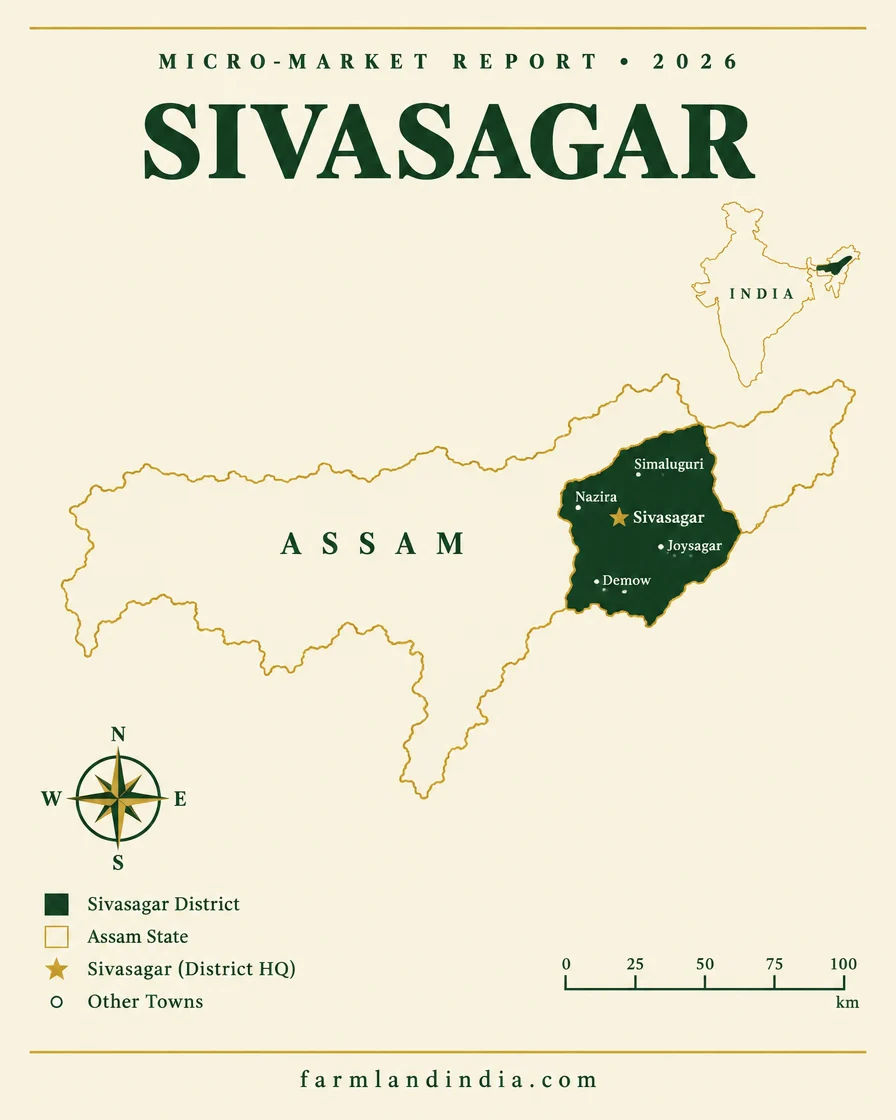
Sivasagar town · Nazira · Joysagar · Simaluguri
Demand anchors
The Ahom heritage circuit (Sivasagar Tank, Joysagar, Rang Ghar), ONGC’s Assam Asset headquarters in Nazira sub-division and tea (district at a glance[2])
Air and rail
Rowriah (Jorhat) airport is given as 55–60 km away and Mohanbari (Dibrugarh) as about 80 km; the nearest railhead is Simaluguri, 16 km (district at a glance[2])
Boundary change
Charaideo district was carved out of the eastern part of Sivasagar in 2016, so older figures describe a larger district (Charaideo district page[8])
Pricing unit
No newspaper or official price series was found for Sivasagar farmland. Ask the circle office for the zonal value and compare registered deeds, always per acre
Local units
Records use the bigha (about 14,400 sq ft), katha and lessa. Convert every quote to acres before comparing plots
Land records portal
ILRMS jamabandi and Bhunaksha maps. See our Assam land records guide
Land law is state law. These rules are maintained on the Assam page and apply to every district within it.
Sivasagar — land purchase legal rules
Assam’s land law rests on the Assam Land and Revenue Regulation of 1886, layered with protections that are stronger than in most states: tribal belts and blocks in the plains, autonomous councils with their own land laws in the hills and in Bodoland, and a 2015 Act that controls the conversion of farmland. Most land outside these areas can be sold to any Indian buyer. This block applies to every district page in the state.
Who can buy: Assam has no farmer-only rule. An Indian citizen can buy agricultural land held on a periodic patta (myadi patta, the settled holding with transferable rights) from an owner who is free to sell. Three things narrow that: the tribal belts and blocks of the plains, the Sixth Schedule council areas in the hills and in Bodoland, and land held only on an annual patta (eksonia patta), which carries no right to sell.
Tribal belts and blocks: Chapter X of the Assam Land and Revenue Regulation, 1886, added in 1947, lets the state notify belts and blocks in which only "protected classes" may hold land. The classes notified on 5 December 1947 were plains tribes, hill tribes, tea garden tribes, Santhals, Scheduled Castes and Nepali cultivator-graziers; Nepalis were taken off the list in 1969 and the indigenous Koch-Rajbongshis of the old Goalpara district were added in 1985. There are 46 such areas, 14 belts and 32 blocks, covering about 16.76 lakh hectares (Revenue department study of the belts and blocks). Section 164 restricts transfer by sale, mortgage, lease or agreement inside them, so a buyer outside the protected classes generally cannot acquire land there.
Sixth Schedule areas: Three autonomous councils make their own land laws under the Sixth Schedule: the Bodoland Territorial Council (Kokrajhar, Chirang, Baksa, Udalguri and Tamulpur), the Karbi Anglong Autonomous Council (Karbi Anglong and West Karbi Anglong) and the Dima Hasao Autonomous Council. In the Karbi hills the Karbi Anglong District (Land and Revenue) Act, 1979 applies. Inside Bodoland the classes allowed to buy in belt and block land are still those notified under the 1886 Regulation, and the 2003 Bodo accord says council laws will not take away land rights held by other citizens when the council began (The Sentinel, 28 January 2021). Ask the council’s land revenue office before negotiating.
Farmland to other uses: Under the Assam Agricultural Land (Regulation of Reclassification and Transfer for Non-Agricultural Purpose) Act, 2015, agricultural land cannot be used or transferred for a non-farm purpose without reclassification and the Deputy Commissioner’s permission; above 50 bighas, and for land cultivated in the last ten years, the government’s approval is also needed. The premium is 10% of the minimum zonal value for reclassification and 15% for reclassification with transfer (Revenue department guidance). A home of up to two storeys on up to one bigha needs no permission. Sixth Schedule districts, municipal areas, tea land and notified industrial zones are outside the Act.
Ceiling: The Assam Fixation of Ceiling on Land Holdings Act, 1956 caps how much land a family may hold. A 1972 government resolution records the limit being cut to 50 bighas (Revenue department land policy compilation); the Act has been amended several times since, most recently for tea garden labour lines, so confirm the current limit before assembling a large holding.
Inter-religion transfers: On 27 August 2025 the state cabinet approved a standard operating procedure for land transfers between persons of different religions. Under it the proposal goes to the Deputy Commissioner, then to the Revenue department and the police Special Branch, which reports on whether the transfer is fraudulent or coerced, the source of funds and any security concern; the Deputy Commissioner then decides (The Assam Tribune, 27 August 2025). Transfers between persons of the same religion are not covered.
Tea estates: Tea land sits outside the 2015 reclassification Act and under the ceiling law’s special provisions. In November 2025 the Assembly amended the ceiling Act to settle land in the labour lines of 825 tea estates with tea garden workers (All India Radio, 28 November 2025), and a 2026 bill proposes letting estates lease up to 5% of garden land to third parties for ancillary uses (The Sentinel, 29 July 2026). Do not buy a part of an estate without checking both.
Stamp duty and fees: Since the Indian Stamp (Assam Amendment) Act, 2021 a sale deed carries 3% stamp duty for a male buyer, 2% for joint registration with a woman and 1% for a woman buying alone. Registration fees follow the same 3, 2 and 1% pattern from 22 September 2022, and a 1% municipal surcharge applies inside municipal limits (CAG audit report, 2025).
NRI and OCI buyers: Under the RBI Master Direction on immovable property, NRIs and OCIs may not acquire agricultural land, a farmhouse or a plantation in India except by inheritance. Our NRI guide covers the options.
- No farmer-only rule
- Tribal belts and blocks
- Protected classes only
- Sixth Schedule councils
- Reclassification Act, 2015
- Inter-religion SOP, 2025
- Women: 1% stamp duty
- NRIs: inheritance only
Sivasagar — district-specific notes
Sivasagar is a tea, oil and heritage district where land changes hands as farm plots on the Brahmaputra plain. The state section above covers general law; these are the district-level points to settle before you pay an advance.
⚠ Sivasagar is not a Sixth Schedule district. The councils with Sixth Schedule powers are Karbi Anglong, West Karbi Anglong, Dima Hasao and the Bodoland districts, and Sivasagar is not among them. The 2015 Act requires reclassification and the Deputy Commissioner’s permission before farmland is used or transferred for a non-agricultural purpose, and its text excludes municipal areas and tea land (Act of 2015[1]).
⚠ Tribal belts and blocks may touch the district. Chapter X of the 1886 Regulation protects notified classes inside 46 belts and blocks across Assam, and section 164 restricts sale, mortgage and lease in them (Revenue Department study[5]). Ask the circle office whether the village is notified and whether the buyer’s class may buy there.
⚠ Tea estate land follows its own rules. The Assembly passed the Ceiling (Amendment) Bill on 28 November 2025 to settle labour-line land with tea workers (All India Radio[7]). Estate land is excluded from the 2015 Act, so a plot sold “out of a garden” needs the estate’s written position and the revenue record.
⚠ Inter-religion land transfers have a procedure. A cabinet SOP of August 2025 sends a proposal for a transfer between persons of different religions to the Deputy Commissioner, with the Special Branch looking at the source of funds and coercion before the Deputy Commissioner decides (The Assam Tribune[12]). Transfers within the same religion are not covered.
⚠ Land near heritage sites can be acquired. The state has planned to acquire 78 bigha adjacent to Rang Ghar for the beautification project (The Sentinel[11]). Before buying near any listed monument or planned project, ask the circle office whether the khatian number is in an acquisition notification.
Before paying an advance in Sivasagar, get the jamabandi and the chitha for the dag, the Bhunaksha map, the circle office’s statement on belt or block status and tea-estate boundaries, any acquisition notice, and the sub-registrar’s stamp-duty calculation.
- Not a Sixth Schedule district
- Tea estate land
- Belt and block check
- Acquisition near heritage sites
- Inter-religion transfer SOP
District overview
Sivasagar — the Ahom capital district, with tea, oil and an unfinished highway
The town of Sivasagar, formerly called Rangpur, was the Ahom capital for over 600 years, and the district page counts more than 350 ancient monuments (district at a glance[2]). The district lies about 363 km east of Guwahati, with the Brahmaputra along the northern side, the Janji river forming the western boundary with Jorhat and the Desang touching the boundary with Dibrugarh.
The district covers 1,598.85 sq km, with two sub-divisions (Sivasagar Sadar and Nazira), four revenue circles, five development blocks, 82 panchayats and 516 revenue villages. The profile gives a population of 692,435. Charaideo was carved out of its eastern part in 2016, so older figures in other reports may describe the bigger pre-split district.
Land buyers here are mostly local families, tea and oil-sector employees, and professionals returning to town. ONGC’s Assam Asset headquarters sits in the Nazira sub-division, which gives that side steady demand for house plots and rentals. The heritage circuit around Sivasagar Tank, Joysagar and Rang Ghar draws visitors, but the government’s beautification works are not a reason to expect a price rise on any particular plot.
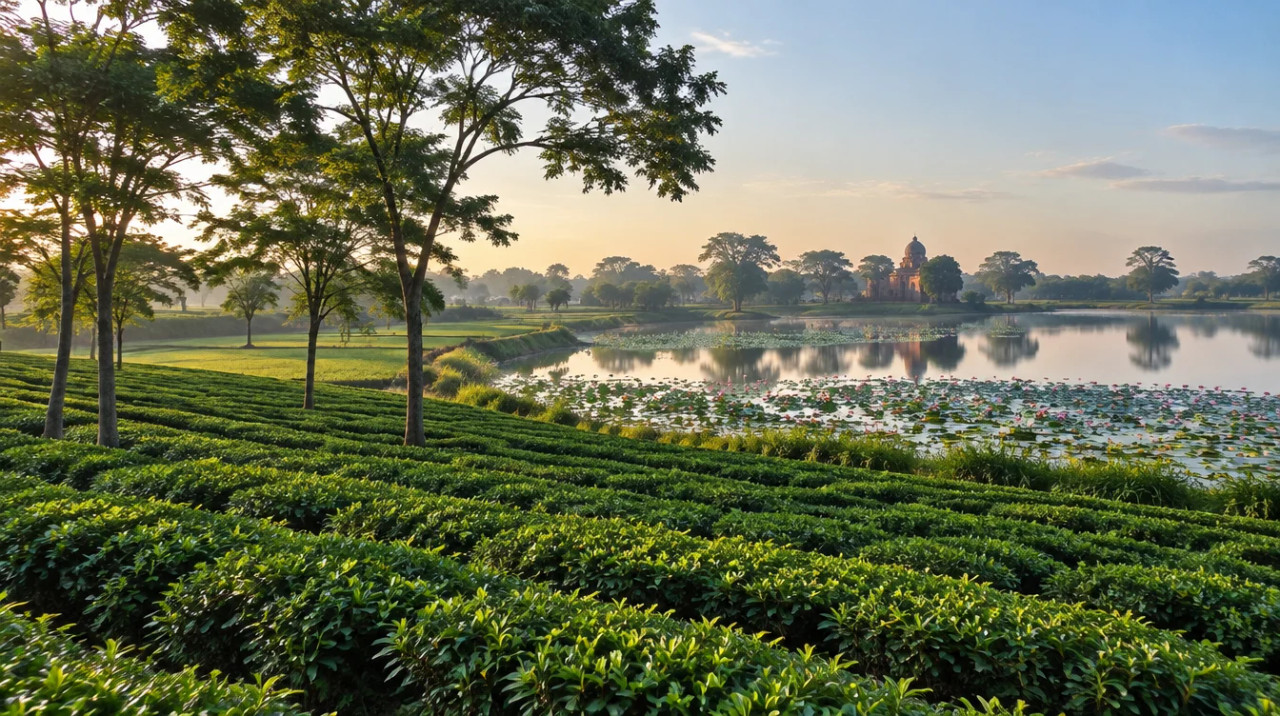
Outside the towns the landscape is the Upper Brahmaputra plain: winter rice, mustard and tea estates, with old-alluvial fine-loamy soil dominant. The highway to Jorhat and Dibrugarh carries most of the traffic, and the nearest rail station is Simaluguri.
A buyer who wants a farm base should shortlist by revenue circle and read the record first. Whichever circle you choose, ask whether any part of the plot sits inside a tea estate boundary, whether the village is in a notified belt or block, and whether an acquisition notice covers it.
Ask first: which revenue circle and village is the plot in, is it inside or next to a tea estate, what is its record class on the jamabandi, and does the seller hold a periodic (myadi) patta.
- Sivasagar town
- Nazira
- Joysagar
- Simaluguri
- Rang Ghar
- Tea belt
Transaction costs
Stamp duty & registration in Sivasagar
1%
Woman buyer (sole)
Stamp duty on a conveyance for a woman buying in her own name; registration fee follows the same slab since 22 September 2022 (CAG audit report[4])
2%
Joint with a woman
Joint purchase with a woman as co-buyer pays 2% stamp duty and 2% registration fee, as recorded by the audit (CAG audit report[4])
3%
Male or other buyer
A male buyer or another legal person pays 3% stamp duty and 3% registration fee (CAG audit report[4])
Land inside a municipal area also carries a 1% municipal surcharge on the consideration (CAG audit report[4]). These figures come from the audit for the year ended March 2024; Ask the Sivasagar sub-registrar to calculate the amount on the draft deed and say which value the duty will be charged on. Zonal values differ by village, so get the figure for your own village in writing.
Know the circle
What is moving land prices in Sivasagar
Where lawful, farmable or buildable land is found in Sivasagar; no listing-site prices are used.
Sivasagar town
District seat
The headquarters town has the tank, the temples and the district offices. Land inside the town is mostly small plots, often built on or under a municipal board, which affects the surcharge and whether the 2015 farmland law applies.
Check: whether the plot is inside municipal limits, the zonal value for the ward and any heritage or acquisition restriction.
Nazira sub-division
ONGC side
Nazira is a sub-division, and ONGC’s Assam Asset headquarters is in it (district at a glance[2]). Demand is tied to oil-sector employment.
Check: tea-estate boundaries, any ONGC installation or pipeline route near the plot, and the plot’s record class.
Joysagar and the heritage side
Heritage circuit
Joysagar Tank lies about 5 km from the town and covers over 318 acres (district at a glance[2]). Rang Ghar sits nearby, where the state has planned to acquire 78 bigha for the beautification project (The Sentinel[11]).
Check: whether the khatian is in any acquisition notice or heritage buffer before paying.
Simaluguri side
Railhead
Simaluguri is the nearest railhead, 16 km from the district headquarters (district at a glance[2]). Land near the station is bought mainly for access to trains.
Check: the road to the plot in the monsoon and the distance to the station by the actual road.
Janji and Dikhow river belts
River-side land
The Janji forms the western boundary with Jorhat, and the Dikhow and Darika are other named rivers (district at a glance[2]). Land on river banks is cheaper to hold but exposed to floods.
Check: the flood history of the nearest bank and the circle office’s record of changes in the channel.
Connectivity
How Sivasagar connects — road, rail and air
A highway corridor, a railhead 16 km away and airports in neighbouring districts; drive times are not given because they change.
🚗 By road
✈️ By air
🚆 By rail
Drive times are not given because they change with the monsoon and the highway works. Check each leg before you commit to a plot.
Growth catalysts
Upcoming infrastructure & developments
Status labels reflect sources read in November 2026. Government-announced timelines are not guarantees.
03Open
03Catalysts
Agriculture & terrain
Soil, crops & water in Sivasagar
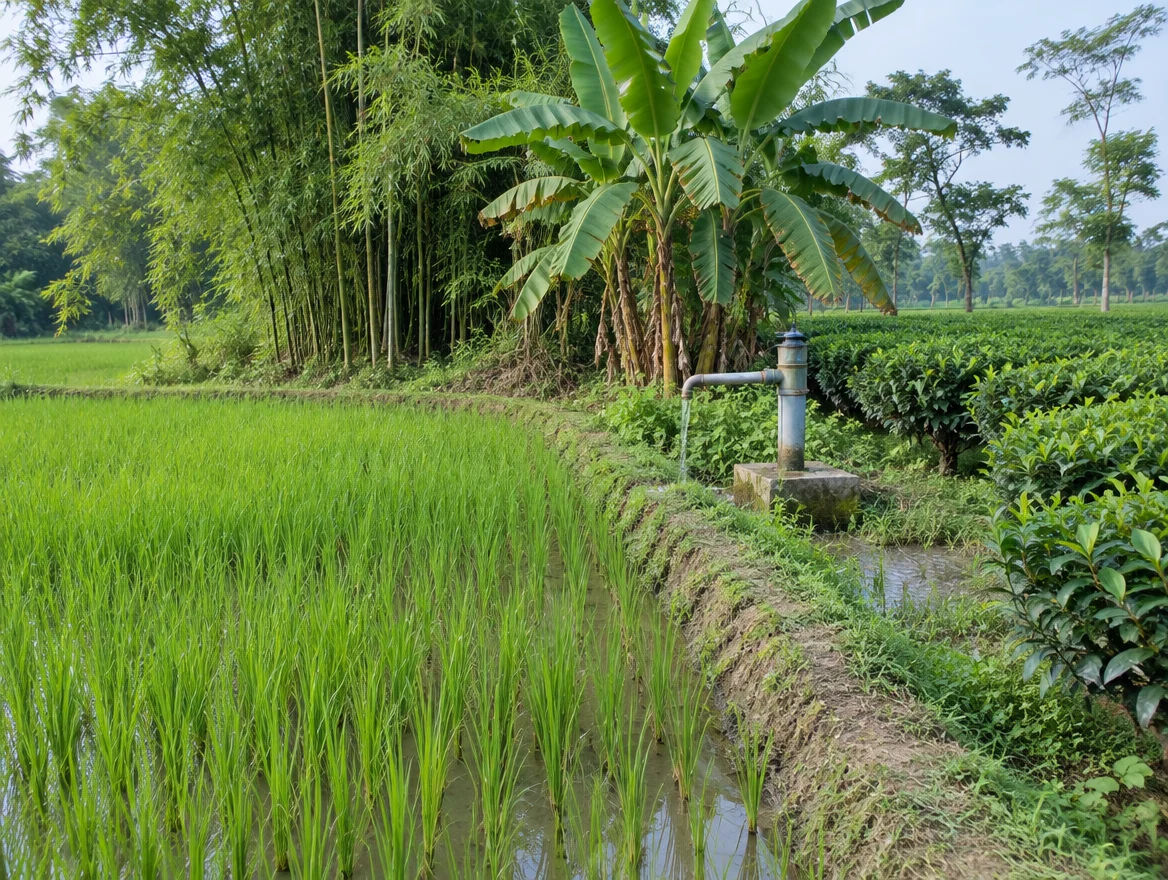
Rain-fed winter rice on old alluvium, with areca and banana near homesteads and tea on better-drained land.
Crops
The ICAR-CRIDA plan lists winter rice on 106.7 thousand ha, the dominant crop, with areca nut (3.2 thousand ha), banana (1.9 thousand ha), winter vegetables and potato (ICAR-CRIDA[3]). The plan covers the pre-2016 district, before Charaideo was carved out.
- Winter rice, 106.7 thousand ha
- Areca nut, 3.2 thousand ha
- Banana, 1.9 thousand ha
- Potato, 0.9 thousand ha
Soils
Fine-loamy old alluvium (Inceptisol) covers about 58% of the area in the plan, and recent alluvium (Entisol) in several textures covers most of the rest (ICAR-CRIDA[3]).
- Fine-loamy Inceptisol, 58%
- Fine Entisol, 15%
- Fine-loamy Entisol, 13%
- Coarse-loamy Entisol, 9%
Tea and estates
Tea estates are a major land use in Upper Assam. The Sivasagar district page does not give an estate count, so ask the circle office for the estate map. Estate land is excluded from the 2015 reclassification law.
- Estate land outside the 2015 Act
- Labour-line settlement under way
- Estate boundary check
Water and irrigation
The plan shows net irrigated area of only 3.874 thousand ha against 106.871 thousand ha rain-fed, so most farms depend on the monsoon (ICAR-CRIDA[3]). The state-level groundwater assessment of December 2024 found 244 of 245 blocks safe.
Rivers and floods
The Brahmaputra flows along the northern side, the Janji forms the western boundary and the Desang, Dikhow and Darika drain the district (district at a glance[2]). The ICAR plan lists floods as not experienced, but statewide 39.58% of Assam’s area is flood-prone (Water Resources Department[6]); check each village’s history with the circle office.
At a glance
Sivasagar vs. nearby districts
| District | Land and water | What links it to Sivasagar |
|---|---|---|
| Jorhat (west) | Tea and paddy plains | The Janji river forms the boundary; the two districts share the national highway corridor (district at a glance[2]) |
| Charaideo (east) | Moidam heritage and tea | Carved out of eastern Sivasagar in 2016 (Charaideo district page[8]) |
| Dibrugarh (further east) | Tea, oil and river plain | The Desang touches the boundary; the four-lane highway between Jorhat and Dibrugarh is 143 km (The Sentinel[9]) |
| Majuli (north) | River island | Across the Brahmaputra; reached through Jorhat today |
No newspaper or official price series was found for these districts at village level, so compare registered deeds and the government zonal value, quoted per acre.
Farmland India view
Why investors look at Sivasagar
A heritage, oil and tea district where record checks matter more than headline projects.
Heritage and oil give two different demand bases
The Ahom monuments bring visitors and ONGC’s Assam Asset headquarters brings employment in Nazira sub-division. The two do not overlap much, so choose a side before you shortlist plots.
Public projects are still unfinished
The Jorhat–Dibrugarh highway has repeatedly slipped, and Rang Ghar was first to be executed in 2022 and was later reported to take shape by about March 2026. Plan on what is open today.
Small markets mean thin liquidity
No official farmland price series is published for Sivasagar. Ask the sub-registrar for recent registered sale values in the village you are looking at Buy for use or a long hold.
Tea and acquisition notices complicate the map
Estate land, labour-line settlement and acquisition near heritage sites make a record check essential. Ordinary farm plots outside those zones are simpler.
River exposure matters on the edges
Land towards the Brahmaputra, Janji or Desang is exposed to floods. Distance from the river and flood history matter more than distance from the road.
Confirm the jamabandi, the circle office’s belt and block statement, tea-estate boundaries, any acquisition notice and the zonal value before you pay anything, and quote every price per acre. NRIs and OCI holders should read [[/wiki/nri-investment-fema/can-nris-buy-agricultural-land-in-india|our guide to farmland rules for NRIs]] first.
STRAIGHT TALK
Risks & challenges in Sivasagar
The points that cause most disputes in Sivasagar, from tea boundaries to acquisition notices.
Tea estate boundaries and labour lines
The 2025 law on labour-line settlement (All India Radio[7]) and the exclusion of tea land from the 2015 Act mean a plot next to a garden can carry a claim that is not obvious on the ground. Ask for the estate boundary on the Bhunaksha map.
Acquisition near heritage and oil sites
The state has planned to acquire 78 bigha near Rang Ghar (The Sentinel[11]), and oil installations sit in the Nazira side. Ask whether the khatian number is in a notification.
Belt and block status not published
Chapter X protections apply in notified belts and blocks across 46 areas of the state (Revenue Department study[5]). Get the circle office’s status letter in writing before you pay.
Flood-prone edges
The ICAR plan lists floods as not experienced for the district as a whole, but statewide 39.58% of Assam’s area is flood-prone (Water Resources Department[6]). Check the village history.
Delayed infrastructure
The Jorhat–Dibrugarh highway missed several target dates (The Sentinel[9]) and the Rang Ghar project was first to be executed in 2022 (The Sentinel[11]). Do not pay a premium for access or amenities that have not opened.
Who to contact
Local revenue & planning offices
The Deputy Commissioner’s office at Sivasagar runs the district, with sub-divisional offices at Sivasagar and Nazira. The four revenue circles handle mutation, partition and jamabandi copies, and the circle officer can tell you whether a village falls in a tribal belt or block. Deeds are registered at the sub-registrar office of the Registration Department, and the reclassification route for non-agricultural use goes through the Deputy Commissioner. Records are online on the ILRMS, Bhunaksha and Basundhara portals; see our Assam land records guide.
KEEP EXPLORING
Explore more areas
Other districts in Assam
- Bajali
- Baksa
- Barpeta
- Biswanath
- Bongaigaon
- Cachar
- Charaideo
- Chirang
- Darrang
- Dhemaji
- Dhubri
- Dibrugarh
- Goalpara
- Golaghat
- Hailakandi
- Hojai
- Jorhat
- Kamrup
- Kamrup Metropolitan
- Karbi Anglong
- Kokrajhar
- Lakhimpur
- Majuli
- Marigaon
- Nagaon
- Nalbari
- North Cachar Hills
- Sonitpur
- South Salmara-Mankachar
- Sribhumi (karimganj)
- Tamulpur
- Tinsukia
- Udalguri
- West Karbi Anglong
COMMON QUESTIONS
Frequently asked questions
Everything buyers, NRIs and investors ask before their first reviewed farmland purchase in Sivasagar.
Visit full wiki01 of 04
Is Sivasagar the same as Sibsagar?
Yes. The official spelling is Sivasagar; the older form Sibsagar is still used in some records and in the web address of this page. The town was formerly called Rangpur, according to the district page.
02 of 04
Can I buy tea estate land in Sivasagar?
Tea land is treated separately in Assam. The 2015 reclassification law excludes tea land, and the ceiling law is being amended for estates, so a plot offered “inside a garden” needs the estate’s written position and the revenue circle’s record.
03 of 04
Is Sivasagar a Sixth Schedule district?
No. Sivasagar is not one of the Sixth Schedule districts. Parts of the district may still lie in a notified tribal belt or block, so ask the revenue circle office to confirm the status of the village.
04 of 04
What stamp duty applies when I register land in Sivasagar?
The CAG audit records 1% for a woman buyer, 2% for joint names with a woman and 3% for a male or other buyer, plus a 1% municipal surcharge in municipal areas. Confirm the current rate with the sub-registrar.
Transparency
Sources and references
Law and courts
- [1]Assam Agricultural Land (Regulation of Reclassification and Transfer for Non-Agricultural Purpose) Act, 2015 — faolex.fao.org
Government
- [2]Sivasagar district administration: district at a glance — sivasagar.assam.gov.in
- [3]ICAR-CRIDA: Agriculture contingency plan, Sivasagar district (undated) — icar-crida.res.in
- [4]CAG: Audit Report on State Revenues (Assam), year ended March 2024, Chapter VI, 2025 — cag.gov.in
- [5]Assam Revenue Department: study of tribal belts and blocks under the Assam Land and Revenue Regulation, 1886 — rhac.assam.gov.in
- [6]Water Resources Department, Assam: flood and erosion profile — waterresources.assam.gov.in
- [7]All India Radio: Assam Assembly passes land ceiling amendment to benefit tea garden workers, 28 November 2025 — newsonair.gov.in
- [8]Charaideo district administration: district at a glance — charaideo.assam.gov.in
News
- [9]The Sentinel: NHIDCL sets new target for Jorhat–Dibrugarh national highway, 9 April 2025 — sentinelassam.com
- [10]The Hills Times: CM reviews progress of Rs 118.2 crore Rang Ghar beautification project, 30 June 2025 — thehillstimes.in
- [11]The Sentinel: CM inspects progress of Sivasagar beautification project, 2 May 2022 — sentinelassam.com
- [12]The Assam Tribune: Cabinet’s new SOP empowers DCs to vet inter-religion land transfers, August 2025 — assamtribune.com
For developers
Ready to explore Sivasagar farmland?
Browse reviewed projects and individual land parcels across Sivasagar — or if you own land here, list it with platform review and reach serious buyers.