
State guide
Buying Land in Chhattisgarh
Tribal land rules under Section 165(6), Scheduled Areas, the 5-decimal rule and new guideline rates: what to check before buying land in Chhattisgarh.
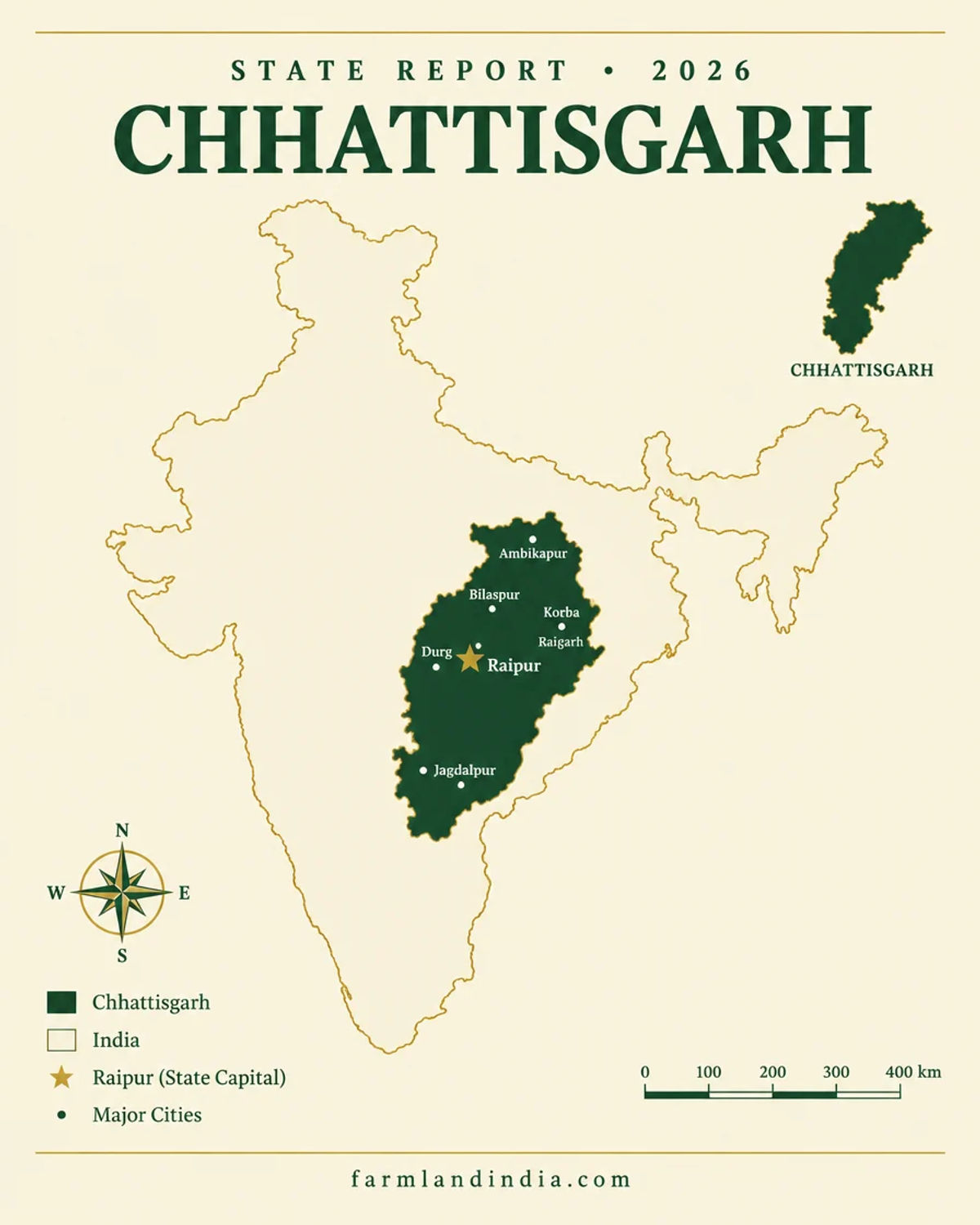
33
Districts
About 135,191 sq km
Area
44.21%
Forest cover
47.32%
Groundwater extraction (2024)
State land record — Chhattisgarh
Rev. 2026 · Farmland India desk
Regions
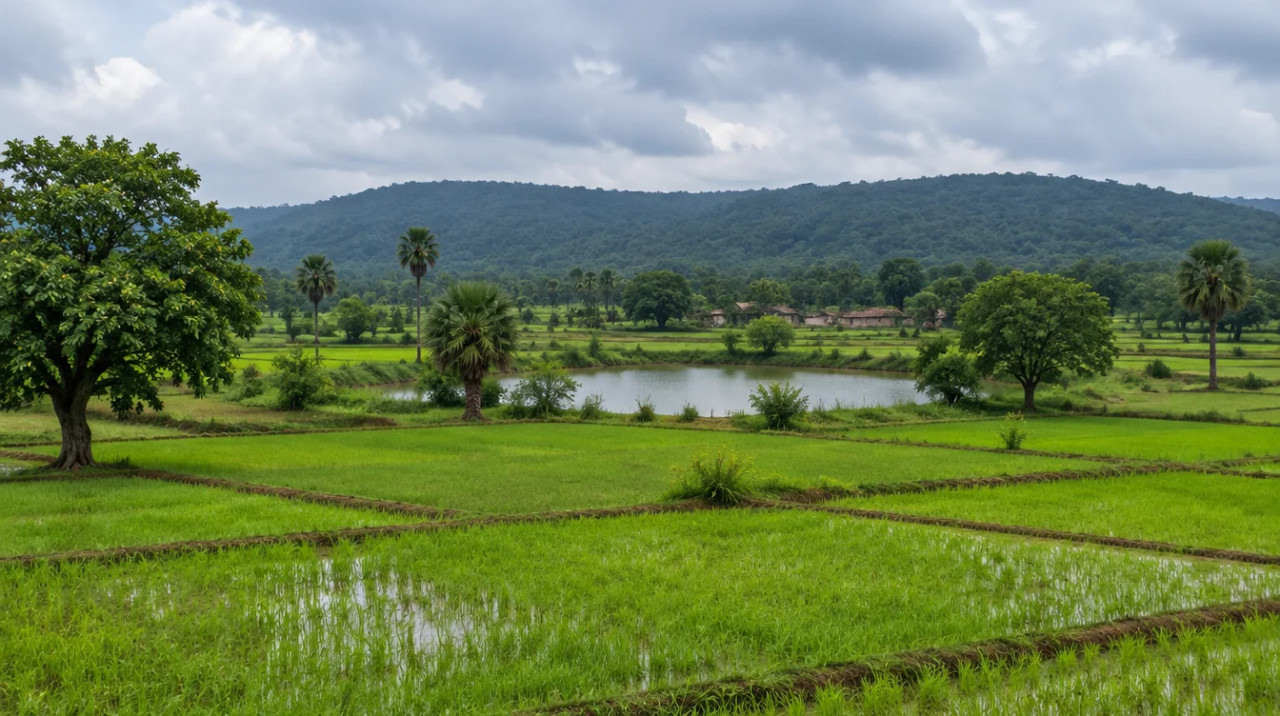
Five revenue divisions: Raipur, Durg, Bilaspur, Surguja and Bastar. The rice-growing Chhattisgarh plain sits in the middle, between the forested Surguja and Jashpur hills in the north and the Bastar plateau in the south.
Total districts
33, after the 2022 round of new districts (Sakti, Sarangarh-Bilaigarh, Khairagarh-Chhuikhadan-Gandai, Mohla-Manpur-Ambagarh Chowki and Manendragarh-Chirmiri-Bharatpur)
Area and forest
About 135,191 sq km, of which 44.21% is forest (Ministry of Food Processing Industries state profile[3])
Groundwater extraction
47.32% in 2024; of 146 blocks, 120 safe, 21 semi-critical, 5 critical and none over-exploited (CGWB)
Land records
B-1 (the bhumiswami’s holding extract), Khasra (P-II, the plot register) and the village map (bhu-naksha) on Bhuiyan; see our Bhuiyan guide
Governing law
Chhattisgarh Land Revenue Code, 1959 (the Madhya Pradesh Code as it applies to Chhattisgarh), with Section 165(6) protecting tribal land; Fifth Schedule areas under the 2003 Order; PESA Rules, 2022
Stamp duty (conveyance)
Base rate: check the current rate with the sub-registrar. The 12% cess on duty was abolished in 2025
Registration
Deeds through NGDRS at the sub-registrar office, with online appointments, e-payment and automatic mutation into Bhuiyan after registration since May 2025
Chhattisgarh — land purchase legal rules
Chhattisgarh’s land law is built on the Land Revenue Code it inherited from Madhya Pradesh. Most farmland can be sold to any Indian buyer, but land held by tribal bhumiswamis is protected, much of the north and south of the state lies in Fifth Schedule areas, and recent reforms have changed how deeds are registered and land is valued. This block applies to every district page in the state.
Who can buy: Chhattisgarh has no farmer-only rule. An Indian citizen who is not a farmer can buy agricultural land held by a bhumiswami (the Code’s word for an owner-occupant with full transfer rights) as long as the seller is free to sell. The restriction runs through the seller: land held by a member of a notified aboriginal tribe is protected, and in large parts of the state it cannot be bought by anyone outside the tribe.
Section 165(6) of the Code: Under Section 165(6) of the Chhattisgarh Land Revenue Code, 1959, the bhumiswami rights of a member of a tribe declared an aboriginal tribe (i) in areas notified as predominantly tribal, cannot be transferred to a non-tribal by sale or otherwise, and (ii) elsewhere, can be transferred to a non-tribal only with the written permission, with reasons recorded, of a revenue officer not below the rank of Collector. The Chhattisgarh High Court restated the rule in June 2026 (Vijay v State of Chhattisgarh, WPC 2351/2023, 18 June 2026).
Void sales and reversion: A transfer made in breach of Section 165 can be set aside under Section 170, and Sections 170-A and 170-B provide for setting aside certain transfers and for the reversion of tribal land that was transferred by fraud. A registered deed, payment of the full price or years of possession do not protect a buyer whose seller was a tribal bhumiswami without the required permission.
Scheduled Areas: Under the Fifth Schedule, the Scheduled Areas (States of Chhattisgarh, Jharkhand and Madhya Pradesh) Order, 2003 (GSR 114(E), 20 February 2003) declares the whole of the then Surguja, Koria, Bastar, Dantewada, Kanker, Korba and Jashpur districts Scheduled Area. Districts carved from them since, such as Balrampur-Ramanujganj, Surajpur, Manendragarh-Chirmiri-Bharatpur, Kondagaon, Narayanpur, Bijapur and Sukma, inherit that status. Parts of other districts are also covered: in old Bilaspur the Marwahi, Gaurela-1 and Gaurela-2 tribal development blocks and the Kota revenue inspector circle; in Raigarh the Dharamjaigarh, Gharghoda, Tamnar, Lailunga and Kharsia blocks; the Dondi block of old Durg (now Balod); Chowki, Manpur and Mohla of old Rajnandgaon; Gariaband, Mainpur and Chhura of old Raipur (now Gariaband district); and Nagri (Sihawa) in Dhamtari. District boundaries have moved since 2003, so confirm the village’s status at the tehsil before you negotiate.
PESA and gram sabhas: Chhattisgarh notified its rules under the Panchayats (Extension to Scheduled Areas) Act on 8 August 2022. In Scheduled Areas the gram sabha has powers that include preventing the alienation of land, and half of its members must be from Scheduled Tribes (Drishti, 10 August 2022). In practice, expect the village to know about, and have a say in, any sale to an outsider.
The 5-decimal rule: The Chhattisgarh Land Revenue Code (Amendment) Act, 2025 bars the registration of rural agricultural plots smaller than 5 decimals (about 2,178 sq ft), to stop the illegal plotting of farmland into small house sites. The same amendment adds geo-referenced maps under Section 107(5) (Indian Masterminds, 26 September 2025). A seller offering a tiny farmland plot in a village is offering something the sub-registrar will refuse to register.
Registration and mutation: Since 3 May 2025 deeds are drafted and registered through NGDRS, with integrated fee payment, e-appointments, home registration with video KYC, online deed search by name or khasra number and certified copies. Once a sale deed is registered, the mutation is now made automatically in the Bhuiyan land records (NIC, May 2025). Check that the new owner’s name actually appears in the B-1 and khasra within a few weeks.
Women buyers: On 15 April 2026 the cabinet halved the registration fee on land registered in a woman’s name, and gave serving soldiers, ex-servicemen and their widows a once-in-a-lifetime 25% stamp duty concession on purchases up to Rs 25 lakh (ThePrint (PTI), 15 April 2026). The 12% cess that had been levied on stamp duty on transfers was abolished in the 2025 budget (Amar Ujala, 3 March 2025).
Guideline rates: Duty is charged on the higher of the deed price and the Collector’s guideline rate. The state raised guideline rates sharply on 20 November 2025, by 400 to 500% in some pockets, then partly rolled the increase back in January 2026 in Raipur and Raigarh, capping rural land without plotting at about double its pre-November 2025 level (The Hitavada, 31 January 2026). Check the rate for the exact village on the day you register.
NRI and OCI buyers: Under the RBI Master Direction on immovable property, NRIs and OCIs may not acquire agricultural land, a farmhouse or a plantation in India except by inheritance. Our NRI guide covers the options.
- No farmer-only rule
- Section 165(6): tribal land
- Collector’s permission
- Scheduled Areas: 2003 Order
- PESA Rules, 2022
- No plots under 5 decimals
- Auto-mutation since May 2025
- NRIs: inheritance only
State overview
Chhattisgarh — from the rice plain to the Bastar plateau
Chhattisgarh was carved out of eastern Madhya Pradesh on 1 November 2000. It covers about 135,191 sq km and had about 2.55 crore people at the 2011 Census, and 44.21% of its area is forest (Ministry of Food Processing Industries[3]). The state falls into three natural belts. The northern hills of Surguja, Jashpur and Korea are forested and largely tribal; the central Chhattisgarh plain around Raipur, Durg, Bilaspur and Janjgir-Champa is open, flat paddy country fed by the Mahanadi and its tributaries; and the Bastar plateau in the south is a world of sal forest, tribal villages and iron ore. Its 33 districts sit in five divisions, and it borders Madhya Pradesh, Uttar Pradesh, Jharkhand, Odisha, Telangana, Maharashtra and Andhra Pradesh.
The central plain is the rice bowl of India in the most literal sense: paddy is the principal crop on almost every holding, and Chhattisgarh ranks third in the country for kharif rice area. It is also an industrial state. The Bhilai steel plant, the coal and power complex around Korba, the sponge-iron and power belt around Raigarh and the cement plants of Baloda Bazar-Bhatapara and Durg drive land demand well beyond the cities. Land buyers fall into a few groups: Raipur, Durg and Bhilai families looking for farm plots and weekend land on the highways out of the capital; industrial and warehousing buyers along the Raipur–Bilaspur and Raipur–Durg roads; and investors watching the new economic corridors, above all the Raipur–Visakhapatnam road due around December 2026 (Tribune (ANI), December 2025[10]). Buyers who know the eastern states can compare the rules here with our Odisha page.
Title comes first. Large parts of the state are Fifth Schedule areas, and land held by a tribal bhumiswami cannot pass to an outsider without the Collector’s permission, or at all in notified tribal areas. A safe purchase starts with the B-1 and khasra on Bhuiyan, the seller’s community and the village’s status, and only then moves to price and roads.
- 33 districts
- 5 divisions
- Capital: Raipur
- Rice bowl of India
- 44% forest
- Land Revenue Code, 1959
Market bands
Reported cost reference points — Chhattisgarh
No official farmland price series is published for Chhattisgarh. These are the official cost reference points a buyer will meet; actual prices come from registered deeds in the village.
| Item | Scope | Reported figure* | Source |
|---|---|---|---|
| Stamp duty | Conveyance (sale deed) | Base rate: check at the sub-registrar | No official schedule published |
| Cess on stamp duty | Transfers of immovable property | 12% cess abolished in the 2025 budget | Amar Ujala, 3 March 2025 |
| Women buyers | Registration fee on land registered in a woman’s name | 50% cut (cabinet, 15 April 2026) | ThePrint (PTI), 15 April 2026[7] |
| Soldiers and widows | Once-in-a-lifetime purchase up to Rs 25 lakh | 25% stamp duty concession | ThePrint (PTI), 15 April 2026[7] |
| Guideline rates | Rural land without plotting, Raipur and Raigarh | Capped at about double the pre-November 2025 level after the January 2026 rollback | The Hitavada, 31 January 2026[8] |
| Farmland price series | State or district level | None published | Not published |
*No newspaper or official source publishes a farmland price series for Chhattisgarh’s districts. Duty is charged on the higher of the deed price and the Collector’s guideline rate for the village, and those rates moved sharply in November 2025 and again in January 2026. Ask the sub-registrar for the current guideline rate for the exact khasra, and compare registered deeds in the same village before agreeing a price. In Scheduled Areas and on land held by tribal bhumiswamis, a price well below the village level usually means the land cannot lawfully be sold to you.
Transaction costs
Stamp duty & registration in Chhattisgarh
50%
Registration fee cut
On land registered in a woman’s name, approved April 2026
25%
Stamp duty concession
Once in a lifetime for soldiers, ex-servicemen and widows, up to Rs 25 lakh
0%
Cess on duty
The 12% cess on stamp duty was abolished in 2025
For the base stamp duty and registration fee on a sale deed, ask the sub-registrar or check the fee calculator in NGDRS on the day you register. The 2025 budget abolished the 12% cess that had been charged on top of stamp duty on transfers of immovable property. On 15 April 2026 the cabinet halved the registration fee on land registered in a woman’s name, a decision the government put at about Rs 153 crore in revenue, and gave serving soldiers, ex-servicemen and their widows a 25% stamp duty concession on one purchase of up to Rs 25 lakh in their lifetime (ThePrint (PTI), 15 April 2026[7]). Families now often register farmland jointly or wholly in a woman’s name for this reason; make sure that choice also suits inheritance and any future loan. The base on which duty is charged changed too: the Collector guideline rates were raised steeply in November 2025 and partly rolled back in January 2026 (The Hitavada, 31 January 2026[8]), so two plots in neighbouring villages can carry very different duty. Deeds are prepared, paid for and registered through NGDRS at the sub-registrar office, and mutation into Bhuiyan now follows automatically (NIC, May 2025[6]).
Connectivity
How Chhattisgarh connects: road, rail and air
The Raipur highway hub, four airports, the Howrah–Mumbai main line and the coal-belt railways
🚗 By road
✈️ By air
🚆 By rail
🏭 Industrial belts
Outside the cities, land demand follows industry. Bhilai and Durg form the steel belt; Korba is the state’s coal and power hub; Raigarh and Janjgir-Champa carry power plants, sponge iron and steel; Baloda Bazar-Bhatapara is cement country; and Dantewada and Kanker hold iron ore that feeds Bhilai. Railway projects worth over Rs 51,000 crore are under way, including new lines meant to carry coal and ore out faster (The Hitavada, 13 July 2026[13]). For farmland buyers the better signal is a good road just outside these belts, where land is still farmed and not inside a mining lease or an acquisition notification.
Growth catalysts
Upcoming infrastructure & developments
Status as of November 2026, with the date and source of the latest public update for each project
03Highway corridors
Two under construction, one announced
08Catalysts
Agriculture & terrain
Soil, crops & water across Chhattisgarh
Paddy on the plain, rain-fed hills in the north and the Bastar plateau in the south
The Chhattisgarh plain
Raipur, Durg, Bilaspur, Janjgir-Champa, Mahasamund, Dhamtari, Bemetara, Mungeli and Baloda Bazar-Bhatapara form the open, flat heart of the state. Paddy is grown almost everywhere in the kharif season, with chickpea, lathyrus and wheat after it where water allows. The Mahanadi canals from the Ravishankar Sagar dam at Gangrel and the Hasdeo-Bango system give this belt most of the state’s irrigation, and it is where the bulk of farmland sales take place.
- Kharif paddy, then chickpea, lathyrus or wheat
- Canal irrigation from the Mahanadi and Hasdeo
- Mostly outside Scheduled Areas
The northern hills
Surguja, Surajpur, Balrampur-Ramanujganj, Jashpur, Korea and Manendragarh-Chirmiri-Bharatpur are hilly, forested and largely rain-fed, with paddy in the valleys and maize, pulses and some fruit and tea on the Jashpur uplands. Coal underlies much of the area. Almost all of it is Scheduled Area, so tribal land cannot be sold to outsiders.
- Rain-fed paddy and maize
- Coalfields and forest
- Wholly Scheduled Area
The Bastar plateau
Bastar, Kondagaon, Kanker, Narayanpur, Dantewada, Bijapur and Sukma are dominated by sal forest and small tribal holdings. Upland paddy, millets and minor forest produce such as tendu leaves and mahua matter more than in the plain, and iron ore is mined at Bailadila. Farmland markets here are thin and nearly all land is protected tribal land.
- Upland paddy and millets
- Forest produce
- Wholly Scheduled Area
Groundwater
Groundwater is not a statewide problem yet. The Central Ground Water Board put Chhattisgarh’s stage of extraction at 47.32% in its 2024 assessment, with 120 of 146 blocks safe, 21 semi-critical, 5 critical and none over-exploited (CGWB, 2024[5]). The pressure is local, around the cities and in blocks where summer paddy is grown on borewells. Much of the state sits on hard rock, so yields vary from plot to plot; test a borewell before you buy, and ask about water in May, not in August.
Land use
Net sown area was about 46.79 lakh hectares in 2018-19, and only about 30% of the cropped area could be irrigated (Chhattisgarh ENVIS centre[4]). Named projects include the Mahanadi (Ravishankar Sagar), Hasdeo-Bango and Kodar schemes. About four in five people depend on farming, so holdings are small and a consolidated block usually means buying from several families.
Crops
Paddy covered about 38.93 lakh hectares in the 2023-24 kharif season, third in India. Horticulture is growing: in 2023-24 the state produced about 24.3 lakh tonnes of fruit, led by banana, mango and papaya, and about 67.9 lakh tonnes of vegetables, led by tomato, brinjal and potato. Land near Raipur, Durg and Bilaspur with assured water is increasingly bought for vegetables and orchards rather than paddy.
At a glance
Chhattisgarh’s divisions side by side
| Division | Price series | Water and irrigation | Note |
|---|---|---|---|
| Raipur (Raipur, Mahasamund, Dhamtari, Gariaband, Baloda Bazar-Bhatapara) | None published* | Mahanadi canals; flat paddy land | Capital region and Nava Raipur; Raipur–Visakhapatnam corridor; Gariaband and parts of Dhamtari are Scheduled Area |
| Durg (Durg, Balod, Bemetara, Rajnandgaon, Kabirdham, Khairagarh-Chhuikhadan-Gandai, Mohla-Manpur-Ambagarh Chowki) | None published* | Canal and borewell irrigation; heavier use near Bhilai | Steel belt; Jabalpur–Raipur upgrade; Mohla-Manpur and parts of Balod are Scheduled Area |
| Bilaspur (Bilaspur, Mungeli, Korba, Janjgir-Champa, Raigarh, Gaurela-Pendra-Marwahi, Sakti, Sarangarh-Bilaigarh) | None published* | Hasdeo-Bango canals in the plain; hard rock in the north | Coal, power and rail; Raipur–Dhanbad corridor; Korba wholly and parts of Bilaspur and Raigarh Scheduled Area |
| Surguja (Surguja, Surajpur, Balrampur-Ramanujganj, Jashpur, Korea, Manendragarh-Chirmiri-Bharatpur) | None published* | Rain-fed hills | Wholly Scheduled Area; Ambikapur airport; coalfields |
| Bastar (Bastar, Kondagaon, Kanker, Narayanpur, Dantewada, Bijapur, Sukma) | None published* | Rain-fed plateau; forest | Wholly Scheduled Area; iron ore; Raoghat rail |
*No newspaper or official source publishes a farmland price series for these divisions. Scheduled Area notes follow the 2003 Order and districts carved since; confirm each village at the tehsil. Buyers weighing Chhattisgarh against a neighbour can compare its single Land Revenue Code with the two tenancy Acts on our Jharkhand page.

Farmland India view
Why investors look at Chhattisgarh
A capital region in the making, new corridors and records that are easier to check
The capital region is getting a plan
Raipur, Durg-Bhilai and Nava Raipur now sit under one State Capital Region authority, which is preparing a development and investment plan and studying a metro. That is the strongest long-run demand signal in the state. Until the regional plan and its zoning are published, though, a plot’s value still rests on its own road access and land use, not on the label.
Roads to the ports and the coalfields
The Raipur–Visakhapatnam corridor, due around December 2026, gives the plain a direct route to the sea, and the Raipur–Dhanbad corridor is being built package by package through Bilaspur, Korba, Raigarh and Jashpur. Gains usually land near interchanges and junction towns. Buy on a notified alignment, not a sketch, and check whether the village is Scheduled Area before paying a corridor premium.
Cleaner paperwork than most states
Bhuiyan records, NGDRS registration with online deed search and automatic mutation since May 2025 make it easier to trace a plot’s history from a distance than in many neighbouring states. The 5-decimal rule also cuts off the worst of the illegal farmland plotting. None of this replaces a visit to the patwari and the tehsil, but it shortens the checks.
Water holds up, for now
With about 82% of blocks rated safe in 2024 and canals across much of the plain, Chhattisgarh does not carry the groundwater stress of north-west India. Land under a canal command or with a reliable borewell, close to Raipur, Durg or Bilaspur, suits vegetables, orchards and dairy as well as paddy.
Costs can move quickly
Guideline rates jumped in November 2025 and were partly rolled back two months later, and women buyers now pay half the registration fee. Budget on the guideline rate in force on the day you register, and decide early whose name the land will be registered in.
Confirm the B-1, the khasra, the seller’s community, the village’s Scheduled Area status and the guideline rate before you pay a token amount.
STRAIGHT TALK
Risks & challenges in Chhattisgarh
What can undo a land purchase in Chhattisgarh
Tribal land
Land of a tribal bhumiswami cannot go to a non-tribal in notified tribal areas, and elsewhere only with the Collector’s written permission under Section 165(6) of the Land Revenue Code[1]. Sales in breach can be set aside, and land taken by fraud reverts to the tribal owner, however long ago the deed was registered.
Scheduled Areas
The north and south of the state, and pockets of Bilaspur, Raigarh, Balod, Gariaband, Dhamtari and Mohla-Manpur, are Fifth Schedule areas under the 2003 Order[2]. District boundaries have changed since, so confirm the village’s status at the tehsil, and expect the gram sabha to have a voice under PESA.
Benami and informal deals
Purchases in the name of a tribal intermediary, long leases, power-of-attorney sales and “agreements” with tribal owners are the usual ways around the law, and all of them can be undone. Walk away from any deal that depends on one.
Illegal plotting
Rural farmland cut into house plots without diversion or layout approval is a common trap around Raipur, Bilaspur and Durg. Plots under 5 decimals cannot now be registered at all (Indian Masterminds, September 2025[9]), and a larger plot in an unapproved colony can still be refused services or demolished.
Government, forest and Nazul land
Land recorded as government land, chhote-bade jhad ka jungle (scrub forest), forest or Nazul cannot be bought from a private seller, even where it has been occupied for years. Read the land-class entry in the khasra and match the plot on the bhu-naksha.
Mining and acquisition
Around Korba, Raigarh, Surguja and Dantewada, land can lie inside a coal or ore block or be notified for a mine, a power plant, a railway or a highway. Ask the tehsil whether the village falls under any acquisition notification before paying.
Records that do not match
Partition and inheritance often leave the B-1, the khasra and the ground out of step, and automatic mutation only works if the deed itself is right. Get the plot measured on the ground by the patwari and match it to the map, as our Bhuiyan guide explains.
Changing rates
Guideline rates rose steeply in November 2025 and were partly rolled back in January 2026; concessions for women and soldiers arrived in 2026. Recheck the rate, the duty and the fee at the sub-registrar on the day of registration.
Who to contact
Local revenue & registration offices
Land administration in Chhattisgarh runs through the Revenue and Disaster Management Department in Nava Raipur, five divisional commissioners and 33 district Collectors. For any plot, start with the patwari of the halka (the village record keeper), who maintains the khasra and B-1 and can show the plot on the village map; the Revenue Inspector supervises a group of halkas. The Tehsildar and Naib Tehsildar decide mutation, partition and demarcation disputes at the tehsil, and the Sub-Divisional Officer (Revenue) hears appeals and handles diversion of farmland to other uses under Section 172 of the Code. The Collector is the authority who grants or refuses permission to transfer tribal land under Section 165(6). Deeds are registered at the sub-registrar office through NGDRS. Records can be viewed on Bhuiyan (bhuiyan.cg.nic.in), and each district’s NIC website lists its tehsils and officers.
KEEP EXPLORING
Districts & guides in Chhattisgarh
Districts
- Balod
- Baloda Bazar-Bhatapara
- Balrampur-Ramanujganj
- Bastar
- Bemetara
- Bijapur
- Bilaspur
- Dantewada
- Dhamtari
- Durg
- Gariaband
- Gaurela-Pendra-Marwahi
- Janjgir-Champa
- Jashpur
- Kabirdham (kawardha)
- Kanker
- Khairagarh-Chhuikhadan-Gandai
- Kondagaon
- Korba
- Koriya
- Mahasamund
- Manendragarh-Chirmiri-Bharatpur
- Mohla-Manpur-Ambagarh Chowki
- Mungeli
- Narayanpur
- Raigarh
- Raipur
- Rajnandgaon
- Sarangarh-Bilaigarh
- Shakti
- Sukma
- Surajpur
- Surguja
COMMON QUESTIONS
Frequently asked questions
Everything buyers, NRIs and investors ask before their first reviewed farmland purchase in Chhattisgarh.
Visit full wiki01 of 04
Can a non-tribal buy agricultural land in Chhattisgarh?
Yes, from a seller who is free to sell. Under Section 165(6) of the Land Revenue Code, land of a tribal bhumiswami cannot be transferred to a non-tribal in notified tribal areas, and elsewhere only with the written permission of a revenue officer not below the rank of Collector. Check the seller’s community and the village’s Scheduled Area status before paying anything.
02 of 04
What is the smallest farm plot that can be registered in Chhattisgarh?
Since the Land Revenue Code (Amendment) Act, 2025, rural agricultural plots smaller than 5 decimals (about 2,178 sq ft) cannot be registered. The rule targets illegal plotting of farmland into house sites.
03 of 04
Do women pay less to register land in Chhattisgarh?
Yes. The cabinet halved the registration fee on land registered in a woman’s name on 15 April 2026. Stamp duty is still charged on the higher of the deed price and the Collector’s guideline rate, so confirm the current figures with the sub-registrar.
04 of 04
Can NRIs buy farmland in Chhattisgarh?
No. Under RBI rules, NRIs and OCIs cannot acquire agricultural land, a farmhouse or plantation land in India except by inheritance. They can buy non-agricultural land, such as a plot with approved residential use.
Transparency
Sources and references
Law and courts
- [1]Chhattisgarh Land Revenue Code, 1959 (PRS copy) — prsindia.org
- [2]Scheduled Areas (States of Chhattisgarh, Jharkhand and Madhya Pradesh) Order, 2003 — latestlaws.com
Government
- [3]Ministry of Food Processing Industries: Chhattisgarh state profile — mofpi.gov.in
- [4]Chhattisgarh ENVIS centre: agriculture — chtenvis.nic.in
- [5]CGWB: Dynamic Ground Water Resources of Chhattisgarh, 2024 — cgwb.gov.in
- [6]NIC: ten NGDRS services launched in Chhattisgarh (May 2025) — informaticsweb.nic.in
News
- [7]ThePrint (PTI): cabinet halves land registration fees for women (15 Apr 2026) — theprint.in
- [8]The Hitavada: government rolls back steep land rate hike in Raipur and Raigarh (31 Jan 2026) — thehitavada.com
- [9]Indian Masterminds: Land Revenue Code amendment bans illegal plotting (26 Sep 2025) — indianmasterminds.com
- [10]Tribune (ANI): Raipur–Visakhapatnam economic corridor (7 Dec 2025) — tribuneindia.com
- [11]The Hitavada: Rs 3,147 crore highway project (23 Apr 2026) — thehitavada.com
- [12]ThePrint (PTI): first meeting of the State Capital Region authority (11 Mar 2026) — theprint.in
- [13]The Hitavada: railway projects in Chhattisgarh (13 Jul 2026) — thehitavada.com
- [14]Lokmat Times (IANS): Ambikapur flights and Bilaspur night operations (30 Mar 2026) — lokmattimes.com
- [15]The Hitavada: Jabalpur–Raipur six-lane upgrade (13 Aug 2026) — thehitavada.com
Further reading
Data-currency note: sources were read in November 2026. Fees, guideline rates and infrastructure timelines change often; check the linked source and the relevant office before relying on any figure.
For developers
Ready to explore Chhattisgarh farmland?
Browse reviewed projects and individual land parcels across Chhattisgarh — or if you own land here, list it with platform review and reach serious buyers.