
District guide
Buying Land in Raipur
The state capital district: Nava Raipur (Atal Nagar), three corridors, canal-fed paddy land and guideline rates that were raised steeply, then rolled back.
239 sq km
Nava Raipur planned area
About 2× pre-Nov 2025
Guideline rate cap after rollback
465 km, Rs 16,482 crore
Raipur–Visakhapatnam corridor
36.7%
Groundwater extraction (old Raipur)
*Indicative range across districts and land types. Stamp duty, registration and conversion charges are additional. Local measurement units vary — every listing states the unit it is priced in. Not a valuation or an offer.
District land record — Raipur
Rev. 2026 · Farmland India desk
State
Chhattisgarh (Raipur division), state capital
Blocks
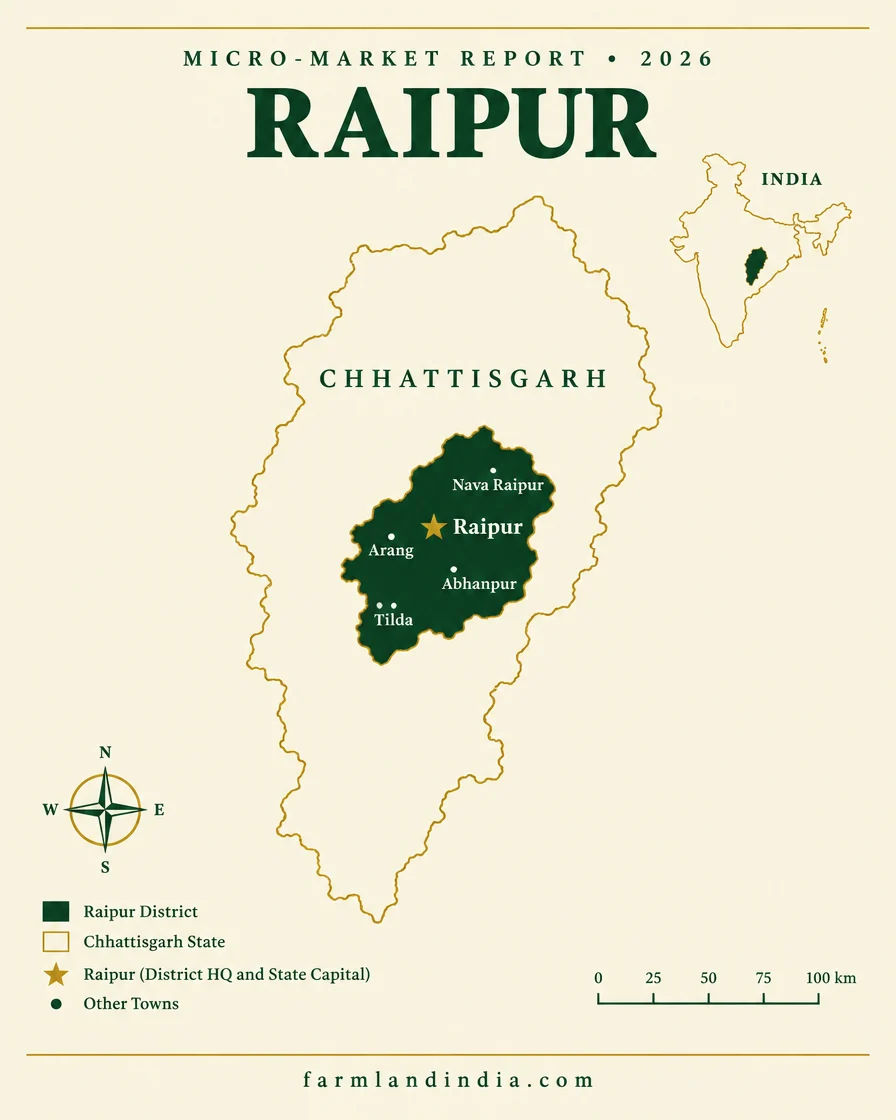
Four rural blocks: Abhanpur, Arang, Dharsiwa and Tilda, plus the city; Balodabazar and Gariaband blocks in the old district now belong to other districts (CGWB[2])
Key markets
Nava Raipur (Atal Nagar) · Dharsiwa · Arang · Abhanpur · Tilda-Neora
Demand anchors
The state secretariat and institutions at Nava Raipur, IT and data-centre projects, industrial land and the capital’s housing demand (ThePrint, June 2025[5])
Rail
Kharsia–Nava Raipur–Parmalkasa line, 278 km and Rs 8,741 crore, under implementation (The Hitavada, 13 July 2026[8])
Nava Raipur
239 sq km planned with an 80 sq km core; official completion target 2031, with about 13,000 ha acquired and 10,000 ha pending (Down To Earth, March 2026[4])
Pricing unit
No newspaper or official price series was found. Guideline rates were raised and partly rolled back in 2025-26; ask the sub-registrar for the village rate and compare registered deeds, always per acre
Local units
Records show area in hectares and acres; villagers also say decimal (dismil). Convert every quote to acres before comparing plots
Land records portal
Bhuiyan for B-1, Khasra and maps. See our Bhuiyan guide
Land law is state law. These rules are maintained on the Chhattisgarh page and apply to every district within it.
Raipur — land purchase legal rules
Chhattisgarh’s land law is built on the Land Revenue Code it inherited from Madhya Pradesh. Most farmland can be sold to any Indian buyer, but land held by tribal bhumiswamis is protected, much of the north and south of the state lies in Fifth Schedule areas, and recent reforms have changed how deeds are registered and land is valued. This block applies to every district page in the state.
Who can buy: Chhattisgarh has no farmer-only rule. An Indian citizen who is not a farmer can buy agricultural land held by a bhumiswami (the Code’s word for an owner-occupant with full transfer rights) as long as the seller is free to sell. The restriction runs through the seller: land held by a member of a notified aboriginal tribe is protected, and in large parts of the state it cannot be bought by anyone outside the tribe.
Section 165(6) of the Code: Under Section 165(6) of the Chhattisgarh Land Revenue Code, 1959, the bhumiswami rights of a member of a tribe declared an aboriginal tribe (i) in areas notified as predominantly tribal, cannot be transferred to a non-tribal by sale or otherwise, and (ii) elsewhere, can be transferred to a non-tribal only with the written permission, with reasons recorded, of a revenue officer not below the rank of Collector. The Chhattisgarh High Court restated the rule in June 2026 (Vijay v State of Chhattisgarh, WPC 2351/2023, 18 June 2026).
Void sales and reversion: A transfer made in breach of Section 165 can be set aside under Section 170, and Sections 170-A and 170-B provide for setting aside certain transfers and for the reversion of tribal land that was transferred by fraud. A registered deed, payment of the full price or years of possession do not protect a buyer whose seller was a tribal bhumiswami without the required permission.
Scheduled Areas: Under the Fifth Schedule, the Scheduled Areas (States of Chhattisgarh, Jharkhand and Madhya Pradesh) Order, 2003 (GSR 114(E), 20 February 2003) declares the whole of the then Surguja, Koria, Bastar, Dantewada, Kanker, Korba and Jashpur districts Scheduled Area. Districts carved from them since, such as Balrampur-Ramanujganj, Surajpur, Manendragarh-Chirmiri-Bharatpur, Kondagaon, Narayanpur, Bijapur and Sukma, inherit that status. Parts of other districts are also covered: in old Bilaspur the Marwahi, Gaurela-1 and Gaurela-2 tribal development blocks and the Kota revenue inspector circle; in Raigarh the Dharamjaigarh, Gharghoda, Tamnar, Lailunga and Kharsia blocks; the Dondi block of old Durg (now Balod); Chowki, Manpur and Mohla of old Rajnandgaon; Gariaband, Mainpur and Chhura of old Raipur (now Gariaband district); and Nagri (Sihawa) in Dhamtari. District boundaries have moved since 2003, so confirm the village’s status at the tehsil before you negotiate.
PESA and gram sabhas: Chhattisgarh notified its rules under the Panchayats (Extension to Scheduled Areas) Act on 8 August 2022. In Scheduled Areas the gram sabha has powers that include preventing the alienation of land, and half of its members must be from Scheduled Tribes (Drishti, 10 August 2022). In practice, expect the village to know about, and have a say in, any sale to an outsider.
The 5-decimal rule: The Chhattisgarh Land Revenue Code (Amendment) Act, 2025 bars the registration of rural agricultural plots smaller than 5 decimals (about 2,178 sq ft), to stop the illegal plotting of farmland into small house sites. The same amendment adds geo-referenced maps under Section 107(5) (Indian Masterminds, 26 September 2025). A seller offering a tiny farmland plot in a village is offering something the sub-registrar will refuse to register.
Registration and mutation: Since 3 May 2025 deeds are drafted and registered through NGDRS, with integrated fee payment, e-appointments, home registration with video KYC, online deed search by name or khasra number and certified copies. Once a sale deed is registered, the mutation is now made automatically in the Bhuiyan land records (NIC, May 2025). Check that the new owner’s name actually appears in the B-1 and khasra within a few weeks.
Women buyers: On 15 April 2026 the cabinet halved the registration fee on land registered in a woman’s name, and gave serving soldiers, ex-servicemen and their widows a once-in-a-lifetime 25% stamp duty concession on purchases up to Rs 25 lakh (ThePrint (PTI), 15 April 2026). The 12% cess that had been levied on stamp duty on transfers was abolished in the 2025 budget (Amar Ujala, 3 March 2025).
Guideline rates: Duty is charged on the higher of the deed price and the Collector’s guideline rate. The state raised guideline rates sharply on 20 November 2025, by 400 to 500% in some pockets, then partly rolled the increase back in January 2026 in Raipur and Raigarh, capping rural land without plotting at about double its pre-November 2025 level (The Hitavada, 31 January 2026). Check the rate for the exact village on the day you register.
NRI and OCI buyers: Under the RBI Master Direction on immovable property, NRIs and OCIs may not acquire agricultural land, a farmhouse or a plantation in India except by inheritance. Our NRI guide covers the options.
- No farmer-only rule
- Section 165(6): tribal land
- Collector’s permission
- Scheduled Areas: 2003 Order
- PESA Rules, 2022
- No plots under 5 decimals
- Auto-mutation since May 2025
- NRIs: inheritance only
Raipur — district-specific notes
Raipur is the most active land market in Chhattisgarh and the one with the most paperwork traps. The state section above covers general law; these are the capital-district points.
⚠ Raipur is no longer a Scheduled Area district. The 2003 Order lists the Gariaband, Mainpur and Chhura blocks of the old Raipur district (Scheduled Areas Order 2003[1]); they now form Gariaband district. Section 165(6) of the Land Revenue Code still protects tribal landholders anywhere, so ask the tehsil for the owner’s category.
⚠ Nava Raipur villages carry sale restrictions. Land-sale restrictions covered 27 villages in the Nava Raipur plan and were cut to 14 after a state decision of 7 March 2022, while about 10,000 ha of planned acquisition was still pending in March 2026 (Down To Earth, 27 March 2026[4]). Ask the Atal Nagar authority and the tehsil whether the khasra number is notified before you pay.
⚠ Guideline rates are volatile. Rates in several pockets were raised by 400 to 500 percent on 20 November 2025, then partly rolled back in January 2026: rural land without plotting is capped at about double the earlier level and most urban zones are within double (The Hitavada, 31 January 2026[6]). Get the current rate in writing.
⚠ Plotted layouts around the capital. A 2025 amendment to the Land Revenue Code bars registration of rural plots below five decimals, about 2,178 sq ft (Indian Masterminds, 26 September 2025[12]). Layouts sold as “farm plots” on small lots are a legal risk.
⚠ “Converted” is a claim to check. Most farmland in the district is canal-fed paddy. Use for housing or business needs diversion by the SDM (revenue). Ask for the diversion order, not a agent’s word that a plot is converted.
Before paying an advance in Raipur, get the Bhuiyan B-1, the village map, the current guideline rate in writing, the notified status of the village from the Atal Nagar authority and the diversion order if the plot is not farmland.
- Not a Scheduled Area now
- Nava Raipur restrictions
- Guideline-rate swings
- 5-decimal rule
- Diversion
District overview
Raipur — a small coal-belt district between Ranchi and Hazaribagh, on two planned corridors
Raipur is the capital of Chhattisgarh and its largest land market, so it draws more search interest than any other district in the state. The district today is much smaller than the one described in older official documents, because Baloda Bazar and Gariaband were carved out of it. CGWB’s brochure still lists the four rural blocks that remain, Abhanpur, Arang, Dharsiwa and Tilda (CGWB[2]).
Nava Raipur (Atal Nagar), the planned capital city about 17 km from old Raipur, is the main land story. It covers 239 sq km, of which 80 sq km is the development core, and the state secretariat and many offices have moved there (ThePrint, June 2025[5]). It is also unfinished: the official completion target is 2031, about 13,000 ha has been acquired and about 10,000 ha is pending (Down To Earth, March 2026[4]).
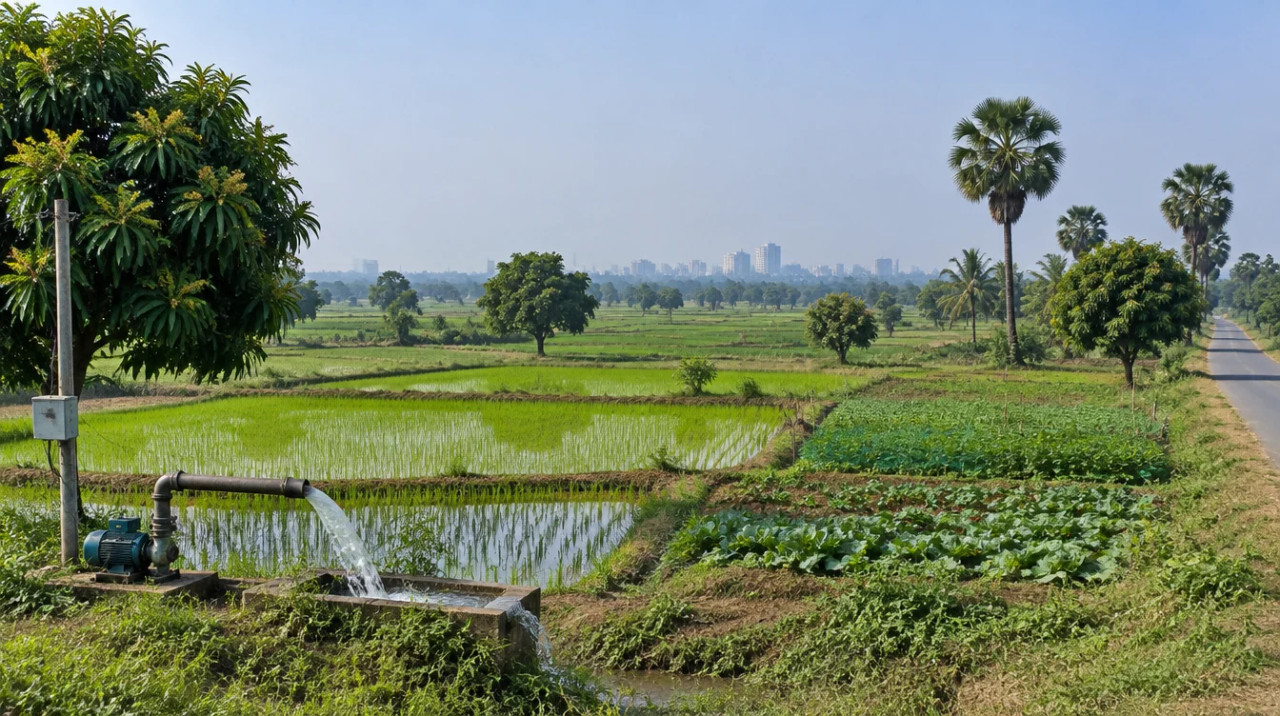
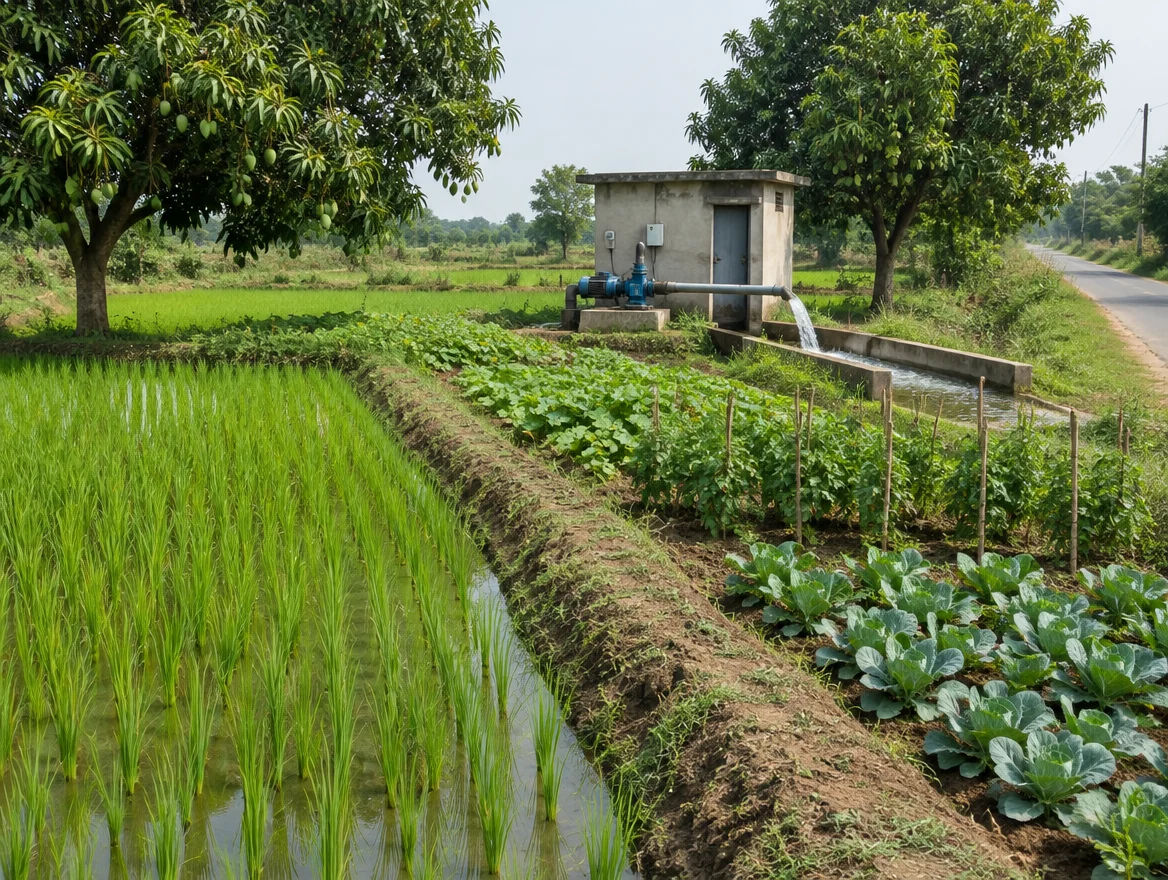
Beyond the city, this is canal-fed paddy country on the Mahanadi plain. Rivers such as the Kharun, Jonk, Pairi, Sondur and Shivnath drain the old district, annual normal rainfall is 1,319 mm and canals supplied about four-fifths of the irrigated area. That is why farm plots in Raipur are valued for water and access, not just soil.
Three highways and two rail projects meet here. NH-53 and NH-30 already run through it, the 465 km Raipur–Visakhapatnam corridor starts here with a December 2026 target (The Tribune, 7 December 2025[7]), and a 92 km six-lane bypass around Raipur has been in acquisition and tendering (NHAI tracker, July 2024[9]). Each of these has moved land prices in some villages and left others untouched.
Buyers fall into three groups: local families and traders, investors from the rest of the state and outside it, and NRIs and family offices attracted by the capital’s growth. The rules are the same for all: farm plots are cheaper per acre, but cannot be built on, while plotted land costs more and carries more legal risk. Know which one you are buying.
Ask first whether the village is inside the Nava Raipur notified area, a guideline-rate pocket that changed in 2025, or a plain farm village. Each has different risks.
- Nava Raipur
- Dharsiwa
- Arang
- Abhanpur
- Tilda-Neora
- Capital district
Transaction costs
Stamp duty & registration in Raipur
50%
Registration fee cut for women
Land registered in a woman’s name; cabinet decision of 15 April 2026, in effect by May 2026 (ThePrint, PTI[11])
About 2×
Rural guideline cap after rollback
Rural land without plotting capped at roughly double the pre-November 2025 level; most urban zones within double (The Hitavada, 31 January 2026[6])
No cess
12% cess on stamp duty abolished
Removed for transfers of immovable assets in the 2025 state budget (Amar Ujala, 3 March 2025[10])
Check the current rate on the registration department portal or at the sub-registrar. The 25% stamp duty concession for serving soldiers, ex-servicemen and widows applies once in a lifetime on purchases up to Rs 25 lakh. Since May 2025 the NGDRS system offers online deed generation, e-appointments, home registration with video KYC and automatic mutation into Bhuiyan after registration (NIC[3]). The biggest cost swing in Raipur is the guideline rate, which sets the value stamp duty is charged on: the 20 November 2025 revision raised it by 400 to 500 percent in some pockets, and the January 2026 rollback applied to Raipur and Raigarh. The report does not give zone-level figures for Nava Raipur, Arang or Abhanpur, so ask the sub-registrar for the exact village rate before you agree a price.
Know the belt
What is moving prices in Raipur
Where lawful, farmable or buildable land is found in Raipur; no listing-site prices are used.
Nava Raipur (Atal Nagar)
The planned capital
Land here is allotted by the authority rather than traded among farmers. Reports put 468 acres in private hands and 382 acres with government agencies, with about Rs 700 crore of land sold, 5,000 homes at 70% occupancy and IT and data-centre projects under way (ThePrint, June 2025[5]). Compensation to farmers was cited at about Rs 5.9 lakh per acre for irrigated land (Down To Earth, March 2026[4]), far below what buyers pay elsewhere.
Check: whether the village is in the notified area, the sale restriction and any pending court case.
Dharsiwa
Highest groundwater use in the old district
Dharsiwa had the highest groundwater development in the 2012-13 brochure, 68.22%, close to the 70% threshold for the safe category (CGWB[2]). That points to peri-urban pressure on wells. Farm plots here compete with industrial and housing use.
Check: bore depth and yield, diversion status and industrial land-use zoning.
Arang
Eastern block on NH-53
Arang is the eastern end of the proposed Durg–Raipur–Arang 92 km bypass and the start of the NH-53 stretch towards Mahasamund. CGWB recorded 35.51% groundwater development, comfortably safe. Land is mostly paddy with canal reach in places.
Check: proximity to the bypass alignment, canal outlet and owner’s category.
Abhanpur
Block on the NH-30 side
Abhanpur recorded 44.14% groundwater development. NH-30, which links Raipur with Dhamtari and the south, runs through the block, and highway frontage is the usual selling point. Roadside land is the easiest to sell and the hardest to value.
Check: frontage rules, service-road access and diversion status of roadside plots.
Tilda-Neora
Northern farming block
Tilda recorded 34.61% groundwater development, a comfortable level. It is a farming block where soil quality and canal reach explain most of the price difference between plots, with less speculative pressure than the capital side.
Check: canal outlet, soil type and public road access.
Raipur city and the ring-road fringe
City limits and the bypass
The 92 km six-lane NH-53 bypass, estimated at Rs 2,297 crore, was in acquisition and tendering as of July 2024 (NHAI project tracker[9]). Land along any ring road is where plotting and rumour concentrate, and the village-level rate is what decides the cost.
Check: a published alignment, acquisition notices and whether the plot is inside a municipal limit.
Connectivity
How Raipur connects — road, rail and air
Three highway corridors, a new rail line and the state’s main airport; drive times are not given because no source was found.
🚗 By road
✈️ By air
🚆 By rail
Drive times are not given because no source was found. Check road and rail access for the exact village before you commit.
Growth catalysts
Upcoming infrastructure & developments
Status labels reflect sources read in November 2026. Government-announced timelines are not guaranteed; items with a single or older source say so.
01Open
03Catalysts
Agriculture & terrain
Soil, crops & water in Raipur
Canal-fed paddy plains on the Mahanadi system, with vegetables near the city and groundwater stress on the peri-urban edge.
Crops
In the 2012-13 brochure paddy covered 2,90,469 ha of the old district, against 6,947 ha of wheat and 3,470 ha of pulses (CGWB[2]). The old district was a rice bowl on canal water; vegetables are grown near the city.
- Kharif paddy
- Vegetables near the city
- Wheat on small areas
- Pulses
Soils
Red gravelly and sandy Alfisols, shallow black Inceptisols and red-yellow lateritic Ultisols are the main types, with deeper black soils in places. Black soil holds water and cracks in the dry season.
- Red gravelly sandy soil
- Shallow and deep black soil
- Red-yellow lateritic soil
- Soil test before planting
Rivers
The Mahanadi basin dominates, with the Pairi, Sondur, Jonk, Kharun and Shivnath as tributaries.
- Kharun and Shivnath belts
- Jonk and Pairi valleys
- Canal commands
Water and irrigation
In 2012 the old district had 3,00,813 ha net irrigated, of which canals supplied 2,39,660 ha from 103 structures and tube or bore wells 52,735 ha. Groundwater development was 36.7% with every block safe, and block figures ran from 19.85% in Gariaband to 68.22% in Dharsiwa. Pre-monsoon depth to water averaged 7.1 m and post-monsoon 2.82 m.
Rainfall and holdings
Normal annual rainfall is 1,319 mm and the 2011 total was 1,323 mm (CGWB[2]). Canal supply is the reason most farms have an irrigated crop, so a plot outside a command area is a weaker farm even in this rice belt.
At a glance
Ramgarh vs. nearby districts
| District | Land and water | What links it to Raipur |
|---|---|---|
| Durg (west) | Industrial and farm land | Next to Raipur on the NH-53 corridor towards Bhilai |
| Baloda Bazar-Bhatapara (north-east) | Paddy and cement belt | Carved out of old Raipur district; the NH-53 and Arang side is common ground |
| Mahasamund (east) | Irrigated paddy | NH-53 corridor continues east; not a Scheduled Area |
| Dhamtari (south) | Paddy and forest edge | The Raipur–Visakhapatnam corridor passes through it |
| Gariaband (south-east) | Forest and tribal land | Its blocks were the scheduled part of old Raipur; tribal-land caution is higher |
No newspaper or official source gives a price series for Raipur or its neighbours, so this table compares law and land, not rates. Raipur’s special feature is the capital region plan and the volatility of its guideline rates.
Farmland India view
Why investors look at Raipur
Five reasoned points for Raipur, each tied to a source on this page.
Nava Raipur is a government city, not a free market
Land is allotted by the authority, about 10,000 ha of acquisition was pending in March 2026 and compensation disputes continue. Treat the capital as a long-term project, not a quick flip, and never buy inside a restricted village without the authority’s written clearance.
Guideline rates are the price signal that moved
They were raised by 400 to 500 percent in pockets in November 2025 and capped near double in January 2026. Stamp duty follows them, so check which rate applies on the date of registration.
Corridors create zones, not guarantees
The Raipur–Visakhapatnam corridor, the NH-53 bypass and the Kharsia–Parmalkasa rail line each have a status and a source on this page. Pay for the status, not for the headline.
Farm plots and plotted land are different assets
The five-decimal minimum for rural plots limits cheap subdivision. Farm plots are cheaper per acre but cannot be built on, while diversion turns a farm plot into something with different costs and risks.
Canals and diversion explain price differences
About four-fifths of irrigated land in the old district was canal-fed. A plot with a canal outlet and a clean diversion record is the safest purchase in the district.
Confirm Bhuiyan entries, mutation, the notified status of the village and the current guideline rate before you pay anything, and quote every price per acre. NRIs should read our guide to farmland rules for NRIs first.
STRAIGHT TALK
Risks & challenges in Raipur
District-specific risks. Read the state page for the general Chhattisgarh risks on tribal land, ceiling and records.
Nava Raipur restrictions and acquisition
Sale restrictions covered 27 villages and were cut to 14 in March 2022, and more than 6,000 farmers had filed petitions in the Bilaspur High Court since 2011 (Down To Earth, March 2026[4]). A plot in a notified village can carry a claim that a quick record check will miss.
Guideline-rate swings
The November 2025 hike and January 2026 rollback show how fast the registration base can change (The Hitavada, 31 January 2026[6]). A deal priced at one rate and registered at another changes the stamp duty.
Unfinished city
Nava Raipur’s official completion target is 2031 and some officials privately suggest later (Down To Earth[4]). Rail and bus links were thin in 2025 (ThePrint[5]).
Groundwater stress near the city
Dharsiwa block was at 68.22% in the CGWB brochure, near the safe limit (CGWB[2]). A new bore near the city competes with many existing ones.
Plotting and small-plot rules
Registration of rural plots below five decimals is barred (Indian Masterminds[12]). Plots sold as “layouts” without diversion are a legal risk.
Fraud and duplicate sales
The market is large enough to attract duplicate sales and forged documents. Check the Bhuiyan B-1, the NGDRS deed search for earlier deeds on the same khasra, and the mutation history.
Who to contact
Local revenue & planning offices
The Collector’s office at Raipur runs the district, with tehsil offices handling mutation, partition and Bhuiyan copies; the sub-registrar offices register deeds; the SDM (revenue) deals with diversion. The Atal Nagar authority (NRDA) handles land inside the Nava Raipur plan. Ask the tehsildar for a certified B-1 and the village map, and ask the authority for written confirmation if the village is anywhere near Nava Raipur.
KEEP EXPLORING
Explore more areas
Other districts in Chhattisgarh
- Balod
- Baloda Bazar-Bhatapara
- Balrampur-Ramanujganj
- Bastar
- Bemetara
- Bijapur
- Bilaspur
- Dantewada
- Dhamtari
- Durg
- Gariaband
- Gaurela-Pendra-Marwahi
- Janjgir-Champa
- Jashpur
- Kabirdham (kawardha)
- Kanker
- Khairagarh-Chhuikhadan-Gandai
- Kondagaon
- Korba
- Koriya
- Mahasamund
- Manendragarh-Chirmiri-Bharatpur
- Mohla-Manpur-Ambagarh Chowki
- Mungeli
- Narayanpur
- Raigarh
- Rajnandgaon
- Sarangarh-Bilaigarh
- Shakti
- Sukma
- Surajpur
- Surguja
COMMON QUESTIONS
Frequently asked questions
Everything buyers, NRIs and investors ask before their first reviewed farmland purchase in Raipur.
Visit full wiki01 of 04
Can I buy farmland near Nava Raipur?
Yes, but check the village first. Land-sale restrictions covered 27 villages in the Nava Raipur plan and were cut to 14 after a state decision of 7 March 2022, and about 10,000 ha of acquisition was still pending in March 2026. Ask the Atal Nagar authority and the tehsil whether your khasra number is notified.
02 of 04
Did Raipur land rates go up in 2025?
Guideline rates in several pockets were raised by 400 to 500 percent from 20 November 2025. In January 2026 the government capped rural land without plotting at about double the earlier level and brought most urban zones within double. Ask for the current rate for your village.
03 of 04
Is Raipur a Scheduled Area district?
Not now. The 2003 Order lists the Gariaband, Mainpur and Chhura blocks of old Raipur district, which now form Gariaband district. Check the village with the tehsil, and remember that Section 165(6) still protects tribal landholders.
04 of 04
Which corridors start at Raipur?
The 465 km six-lane Raipur–Visakhapatnam Economic Corridor (Rs 16,482 crore, target December 2026) starts here, and Raipur is the end of the Raipur–Dhanbad corridor and the hub of NH-53 and NH-30.
Transparency
Sources and references
Law and courts
- [1][1]Scheduled Areas (States of Chhattisgarh, Jharkhand and Madhya Pradesh) Order, 2003 — latestlaws.com — latestlaws.com
Government
- [2][2]CGWB: ground water information booklet, Raipur district, 2012-13 — cgwb.gov.in — cgwb.gov.in
- [3][3]NIC: ten NGDRS services launched in Chhattisgarh, May 2025 — informaticsweb.nic.in — informaticsweb.nic.in
News
- [4][4]Down To Earth: a capital built on waiting, Nava Raipur, 27 March 2026 — downtoearth.org.in — downtoearth.org.in
- [5][5]ThePrint: Nava Raipur is becoming the capital it was meant to be, 23 June 2025 — theprint.in — theprint.in
- [6][6]The Hitavada: government rolls back steep land rate hike in Raipur, Raigarh, 31 January 2026 — thehitavada.com — thehitavada.com
- [7][7]The Tribune (ANI): Raipur–Visakhapatnam economic corridor, 7 December 2025 — tribuneindia.com — tribuneindia.com
- [8][8]The Hitavada: railway projects in Chhattisgarh, 13 July 2026 — thehitavada.com — thehitavada.com
- [9][9]The Metro Rail Guy: Durg–Raipur–Arang expressway status, 6 July 2024 — themetrorailguy.com — themetrorailguy.com
- [10][10]Amar Ujala: 12% cess on stamp duty abolished, 3 March 2025 — amarujala.com — amarujala.com
- [11][11]ThePrint (PTI): cabinet halves land registration fees for women, 15 April 2026 — theprint.in — theprint.in
- [12][12]Indian Masterminds: Land Revenue Code amendment bans illegal plotting, 26 September 2025 — indianmasterminds.com — indianmasterminds.com
For developers
Ready to explore Raipur farmland?
Browse reviewed projects and individual land parcels across Raipur — or if you own land here, list it with platform review and reach serious buyers.