
District guide
Buying Land in Bilaspur
North Chhattisgarh’s railway-zone and High Court city: a Raipur–Dhanbad corridor link, a night-capable airport, canal and borewell rice plains and partly Scheduled Kota.
1,078 mm
Average annual rainfall (CGWB, 2013-18)
80.19%, semi-critical
Bilha block groundwater (CGWB, 2020)
About 646.8 acres
Bilaspur airport land (Dainik Jagran, Apr 2026)
About 384 km
Raipur–Dhanbad corridor, Chhattisgarh share (The Hitavada)
District land record — Bilaspur
Rev. 2026 · Farmland India desk
State
Chhattisgarh
Sub-divisions
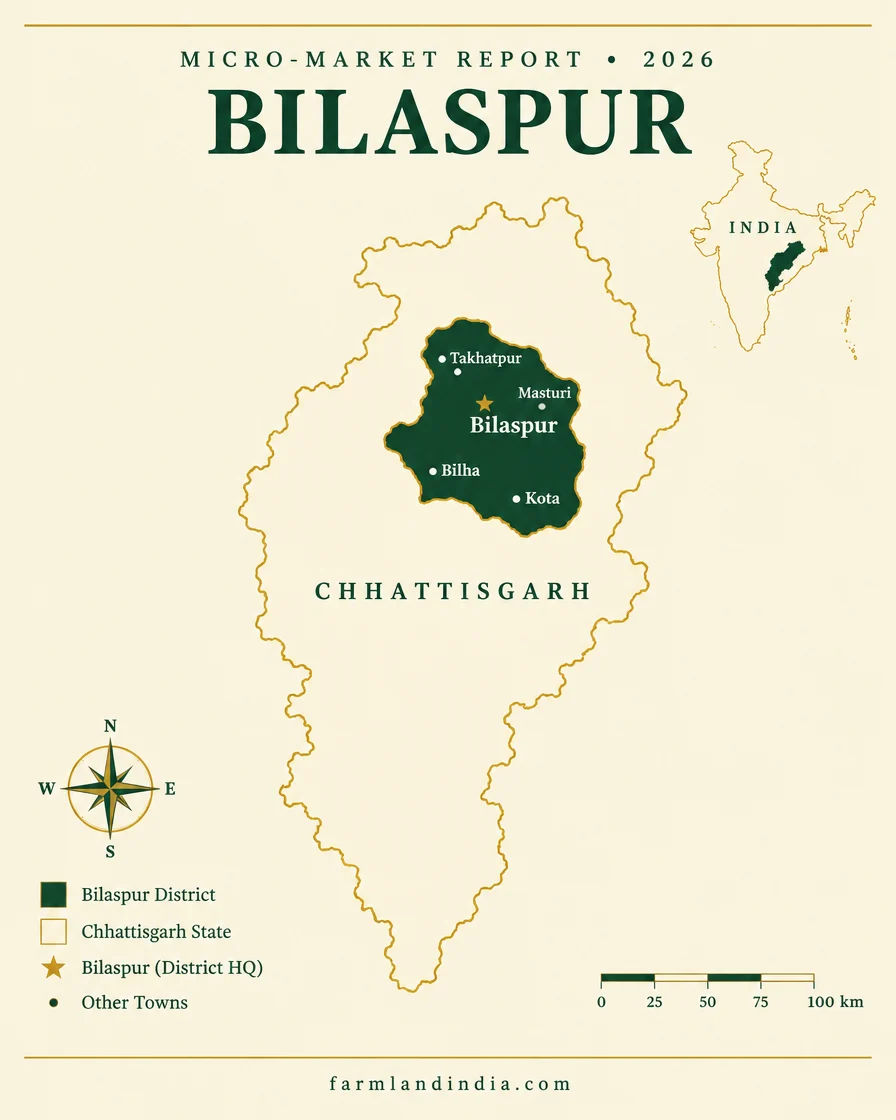
Blocks include Bilha, Kota, Masturi and Takhatpur, with Bilaspur city as district headquarters and the seat of the Chhattisgarh High Court (CGWB, 2020-21[4])
Key markets
Bilaspur city · Takhatpur · Masturi · Bilha · Kota · Ratanpur
Demand anchors
Bilaspur as railway-zone headquarters (South East Central Railway) and High Court city · airport night operations (Dainik Jagran, 22 Apr 2026[7]) · Raipur–Dhanbad Economic Corridor (The Hitavada, 23 Apr 2026[9]) · NTPC Sipat power plant
Rail
Bilaspur Junction is the zonal headquarters and a main-line station on the Mumbai–Howrah route
Size and population
The CGWB’s 2020-21 report covers an area that then included Marwahi, Pendra and Gaurela, with 19.6 lakh people at the 2011 Census; present-day Bilaspur is smaller (CGWB[4])
Pricing unit
Quote any land per acre and confirm the area on the B-1 and khasra.
Local units
Records give area in hectares; sale talk uses acre and decimal (dismil). Ask for the area in acres from the record of rights before comparing offers.
Land records portal
Bhuiyan (B-1 and khasra) at bhuiyan.cg.nic.in; see our Bhuiyan guide
Land law is state law. These rules are maintained on the Chhattisgarh page and apply to every district within it.
Bilaspur — land purchase legal rules
Chhattisgarh’s land law is built on the Land Revenue Code it inherited from Madhya Pradesh. Most farmland can be sold to any Indian buyer, but land held by tribal bhumiswamis is protected, much of the north and south of the state lies in Fifth Schedule areas, and recent reforms have changed how deeds are registered and land is valued. This block applies to every district page in the state.
Who can buy: Chhattisgarh has no farmer-only rule. An Indian citizen who is not a farmer can buy agricultural land held by a bhumiswami (the Code’s word for an owner-occupant with full transfer rights) as long as the seller is free to sell. The restriction runs through the seller: land held by a member of a notified aboriginal tribe is protected, and in large parts of the state it cannot be bought by anyone outside the tribe.
Section 165(6) of the Code: Under Section 165(6) of the Chhattisgarh Land Revenue Code, 1959, the bhumiswami rights of a member of a tribe declared an aboriginal tribe (i) in areas notified as predominantly tribal, cannot be transferred to a non-tribal by sale or otherwise, and (ii) elsewhere, can be transferred to a non-tribal only with the written permission, with reasons recorded, of a revenue officer not below the rank of Collector. The Chhattisgarh High Court restated the rule in June 2026 (Vijay v State of Chhattisgarh, WPC 2351/2023, 18 June 2026).
Void sales and reversion: A transfer made in breach of Section 165 can be set aside under Section 170, and Sections 170-A and 170-B provide for setting aside certain transfers and for the reversion of tribal land that was transferred by fraud. A registered deed, payment of the full price or years of possession do not protect a buyer whose seller was a tribal bhumiswami without the required permission.
Scheduled Areas: Under the Fifth Schedule, the Scheduled Areas (States of Chhattisgarh, Jharkhand and Madhya Pradesh) Order, 2003 (GSR 114(E), 20 February 2003) declares the whole of the then Surguja, Koria, Bastar, Dantewada, Kanker, Korba and Jashpur districts Scheduled Area. Districts carved from them since, such as Balrampur-Ramanujganj, Surajpur, Manendragarh-Chirmiri-Bharatpur, Kondagaon, Narayanpur, Bijapur and Sukma, inherit that status. Parts of other districts are also covered: in old Bilaspur the Marwahi, Gaurela-1 and Gaurela-2 tribal development blocks and the Kota revenue inspector circle; in Raigarh the Dharamjaigarh, Gharghoda, Tamnar, Lailunga and Kharsia blocks; the Dondi block of old Durg (now Balod); Chowki, Manpur and Mohla of old Rajnandgaon; Gariaband, Mainpur and Chhura of old Raipur (now Gariaband district); and Nagri (Sihawa) in Dhamtari. District boundaries have moved since 2003, so confirm the village’s status at the tehsil before you negotiate.
PESA and gram sabhas: Chhattisgarh notified its rules under the Panchayats (Extension to Scheduled Areas) Act on 8 August 2022. In Scheduled Areas the gram sabha has powers that include preventing the alienation of land, and half of its members must be from Scheduled Tribes (Drishti, 10 August 2022). In practice, expect the village to know about, and have a say in, any sale to an outsider.
The 5-decimal rule: The Chhattisgarh Land Revenue Code (Amendment) Act, 2025 bars the registration of rural agricultural plots smaller than 5 decimals (about 2,178 sq ft), to stop the illegal plotting of farmland into small house sites. The same amendment adds geo-referenced maps under Section 107(5) (Indian Masterminds, 26 September 2025). A seller offering a tiny farmland plot in a village is offering something the sub-registrar will refuse to register.
Registration and mutation: Since 3 May 2025 deeds are drafted and registered through NGDRS, with integrated fee payment, e-appointments, home registration with video KYC, online deed search by name or khasra number and certified copies. Once a sale deed is registered, the mutation is now made automatically in the Bhuiyan land records (NIC, May 2025). Check that the new owner’s name actually appears in the B-1 and khasra within a few weeks.
Women buyers: On 15 April 2026 the cabinet halved the registration fee on land registered in a woman’s name, and gave serving soldiers, ex-servicemen and their widows a once-in-a-lifetime 25% stamp duty concession on purchases up to Rs 25 lakh (ThePrint (PTI), 15 April 2026). The 12% cess that had been levied on stamp duty on transfers was abolished in the 2025 budget (Amar Ujala, 3 March 2025).
Guideline rates: Duty is charged on the higher of the deed price and the Collector’s guideline rate. The state raised guideline rates sharply on 20 November 2025, by 400 to 500% in some pockets, then partly rolled the increase back in January 2026 in Raipur and Raigarh, capping rural land without plotting at about double its pre-November 2025 level (The Hitavada, 31 January 2026). Check the rate for the exact village on the day you register.
NRI and OCI buyers: Under the RBI Master Direction on immovable property, NRIs and OCIs may not acquire agricultural land, a farmhouse or a plantation in India except by inheritance. Our NRI guide covers the options.
- No farmer-only rule
- Section 165(6): tribal land
- Collector’s permission
- Scheduled Areas: 2003 Order
- PESA Rules, 2022
- No plots under 5 decimals
- Auto-mutation since May 2025
- NRIs: inheritance only
Bilaspur — district-specific notes
The Chhattisgarh state page applies to Bilaspur in full: the tribal-land rule, NGDRS registration and the guideline-rate revisions. Bilaspur is a big, active market, and the checks that matter most are specific to its blocks. These five points are specific to the district.
⚠ The 2003 Scheduled Areas Order lists Bilaspur as partly covered, naming the Marwahi, Gaurela-1 and Gaurela-2 tribal-development blocks and the Kota revenue inspector circle (Scheduled Areas Order, 2003[2]). Marwahi and Gaurela now belong to Gaurela-Pendra-Marwahi district, but Kota remains in Bilaspur. Ask the tehsildar whether a Kota-side village is inside the notified area.
⚠ In notified tribal areas, section 165(6) of the Land Revenue Code bars a tribal holder from transferring land to a non-tribal; elsewhere a Collector’s written, reasoned permission is needed (Land Revenue Code, 1959[1]). Check the seller’s status entry in the B-1 on any parcel in Kota, Masturi or Takhatpur.
⚠ Since the 2025 amendment, rural agricultural plots smaller than 5 decimals cannot be registered (Indian Masterminds, 26 Sep 2025[3]). Small plotted layouts around Bilaspur city, Takhatpur and Masturi cannot be sold as farmland.
⚠ Groundwater is uneven. On the CGWB’s 2020 assessment Bilha was at 80.19% development (semi-critical), Takhatpur at 61.12%, Masturi at 39.13% and Kota at 29.99% (CGWB, 2020-21[4]). Ask for the current stage before you pay for irrigated land in Bilha.
⚠ Airport and corridor land is in play. About 646.8 acres are available for the airport, with a runway extension from about 1,498 m to about 2,800 m planned at about Rs 198 crore (Dainik Jagran, 7 Apr 2026[8]), and the Raipur–Dhanbad corridor links Bilaspur’s industry (The Hitavada[9]). Ask for alignments and notices before paying for land near either.
NRI and OCI buyers should read can NRIs buy agricultural land in India before shortlisting any farmland; the FEMA bar applies in every district.
- Kota partly Scheduled Area
- Tribal land rule
- Groundwater by block
- Plotting curbs
- Airport and corridor land
District overview
Bilaspur — north Chhattisgarh’s railway-zone and High Court city, with a corridor, an airport and a plain of irrigated rice
Bilaspur is one of the largest cities in Chhattisgarh and the commercial centre of the north of the state. It is the headquarters of the South East Central Railway zone and the seat of the Chhattisgarh High Court, which gives it a steady base of railway, legal and government demand. The district has blocks including Bilha, Kota, Masturi and Takhatpur, and the Seonath, Arpa and Maniari rivers drain it into the Mahanadi (CGWB, 2020-21[4]).
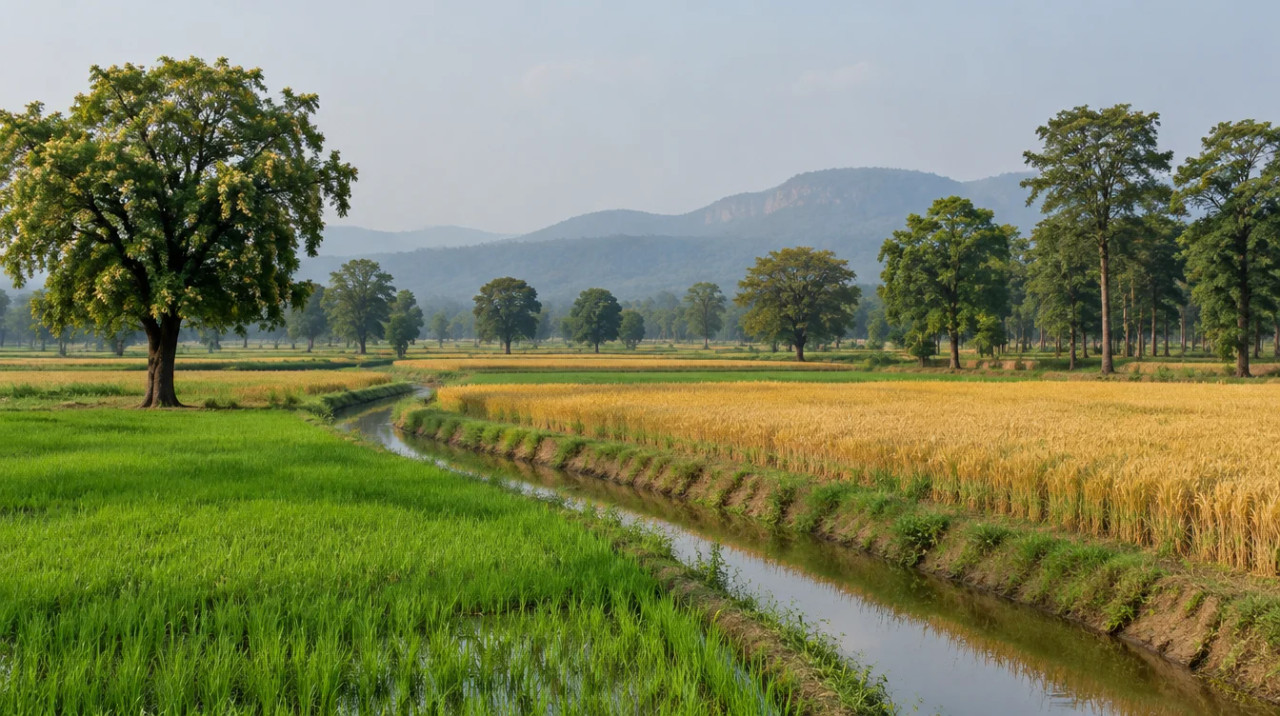
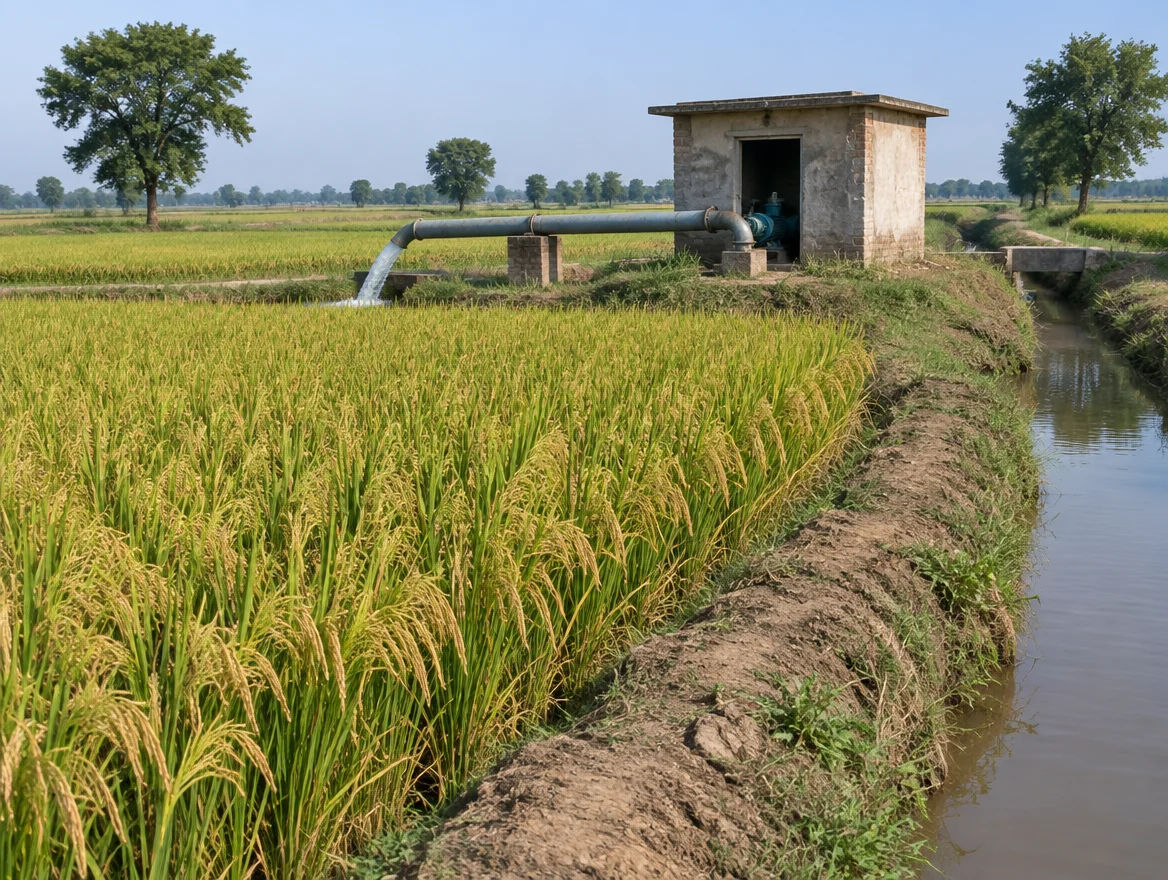
Farmland is a rice-and-wheat plain. The CGWB’s 2020-21 report, which covers an area that then included three blocks now in another district, gives average rainfall of about 1,078 mm, soils from black vertisols in the south to lateritic and red gravelly soils in the north, and a net irrigated area about half of the net sown area, with canals and borewells roughly equal (CGWB, 2020-21[4]). Treat these as district-level guides.
The infrastructure story has three parts. The airport received night-landing clearance on 6 February 2026, and Alliance Air began a once-weekly Sunday evening Bilaspur–Delhi flight on 3 May 2026 (Dainik Jagran, 22 Apr 2026[7]). The High Court has criticised the slow pace of development, which includes 646.8 acres of land and a planned runway extension (Dainik Jagran, 7 Apr 2026[8]). The Raipur–Dhanbad Economic Corridor, 627 km in all and about 384 km in Chhattisgarh, links Raipur, Bilaspur, Raigarh and Korba, with a Rs 3,147 crore package under construction in Jashpur (The Hitavada, 23 Apr 2026[9]). The Bilaspur stretch is not separately reported.
The market inside the district varies. Bilaspur city and its ring (Takhatpur, Masturi) are plotting and commercial markets under the 5-decimal rule and diversion rules. Ratanpur and the northern edge are temple-town and farm belts. Kota is partly Scheduled Area and needs the tribal-land checks.
Bilaspur competes with Raipur for investors: Raipur is bigger and dearer, Bilaspur has less spillover pressure but strong institutional demand. Mungeli, carved out of Bilaspur, and Korba to the north are the closest comparison markets.
The main buyer risks are the tribal-land rule in Kota, groundwater in Bilha, unauthorised layouts near the city, and the temptation to pay for the corridor and airport before alignments and flights are settled.
- Bilaspur city
- Takhatpur
- Masturi
- Kota
- Airport
- Raipur–Dhanbad corridor
Transaction costs
Stamp duty & registration in Bilaspur
Check
Base stamp duty and registration fee
Ask the sub-registrar for the current rate.
Abolished
12% cess on stamp duty
Removed for transfers of immovable property in the 2025 budget ([Amar Ujala, 3 Mar 2025](https://www.amarujala.com/chhattisgarh/chhattisgarh-budget-2025-decision-to-abolish-12-cess-for-stamp-duty-on-transfer-of-immovable-land-2025-03-03))
50% off
Registration fee for women
Cabinet decision of 15 Apr 2026, in effect from May 2026 ([ThePrint/PTI, 15 Apr 2026](https://theprint.in/india/chhattisgarh-cabinet-halves-land-registration-fees-for-women-to-promote-economic-empowerment/2905647/))
Chhattisgarh revised collector guideline rates steeply in November 2025 and partly rolled them back in January 2026, capping rural land without plotting at about double the pre-November 2025 level (The Hitavada, 31 Jan 2026[10]). Check the current guideline rate for your village at the sub-registrar before you agree a price. Registration now runs through the NGDRS portal, with auto-mutation into Bhuiyan after the deed is registered (NIC, May 2025[6]). The Land Revenue Code amendment of 2025 bars registration of rural agricultural plots smaller than 5 decimals (Indian Masterminds, 26 Sep 2025[3]). For Bilaspur, guideline rates differ sharply between city wards, the Takhatpur and Masturi belts and interior farmland.
Know the belt
What is moving prices in Bilaspur
Airport, corridor and planning reports from the press; no listing-site prices are used.
Bilaspur city
Zonal and judicial headquarters
The railway zone, High Court, universities and hospitals make a deep market for plots, apartments and commercial land. The airport’s night operations improve connectivity (Dainik Jagran[7]).
Check: master plan land use, diversion orders and authorised layout status.
Takhatpur and the Raipur road
Peri-urban fringe
The belt around Takhatpur and the Raipur road is where plotting and warehouse demand concentrates. Groundwater stage here is moderate at 61.12% (CGWB[4]).
Check: 5-decimal rule, diversion order and borewell record.
Masturi, Bilha and the Mahanadi plain
Irrigated rice belt
The plains are canal- and borewell-irrigated rice and wheat land. Bilha is already semi-critical at 80.19% development, while Masturi is at 39.13% (CGWB[4]).
Check: block groundwater stage, canal command and khasra history.
Kota and Ratanpur
Temple-town and Scheduled edge
Kota’s revenue inspector circle is partly Scheduled Area (Scheduled Areas Order[2]), and Ratanpur is a temple town with local trade. Safe groundwater at 29.99% in Kota (CGWB[4]) supports farming.
Check: village notification, seller’s tribal status and the B-1.
Asking prices
No official farmland price series is published for Bilaspur. Ask the sub-registrar for recent registered sale values in the village you are looking at Use the guideline rate for the village and compare it with recent registered deeds in the same village.
Connectivity
How Bilaspur connects — road, rail and air
Rail, road and a small airport; drive times are not given because no source was found.
🚗 By road
✈️ By air
🚆 By rail
No drive times are given because none was sourced. Flights are limited, so check current schedules.
Growth catalysts
Upcoming infrastructure & developments
Statuses and sources are listed for each item.
02Open
03Catalysts
Agriculture & terrain
Soil, crops & water in Bilaspur
A rice-and-wheat plain on black and lateritic soils, with canal and borewell irrigation and uneven groundwater.
Crops
The CGWB names paddy, wheat, vegetables and pulses as the principal crops, but its crop table is garbled so areas are not quoted. Net sown area in its study area is about 225,400 ha with about 28,400 ha double-cropped (CGWB, 2020-21[4]). The state buys paddy at Rs 3,100 a quintal in 2025-26 (Drishti IAS, 14 Oct 2025).
- Paddy
- Wheat
- Pulses
- Vegetables near the city
Soils
Black vertisols lie in the south and south-east, lateritic soils in the east and north, red gravelly alfisols in the north and centre, and shallow black soils on the western hill slopes (CGWB, 2020-21[4]).
Water and rainfall
Average annual rainfall is about 1,078 mm (2013-18), about 95% of it in the south-west monsoon. Block-level groundwater development is 80.19% in Bilha (semi-critical), 61.12% in Takhatpur, 39.13% in Masturi and 29.99% in Kota (safe). The report covers an area that then included other blocks, so use the block figures rather than district totals (CGWB, 2020-21[4]).
At a glance
Bilaspur vs. nearby districts
| District | Land and water | What links it to Bilaspur |
|---|---|---|
| Mungeli (south-west) | Plain carved out of Bilaspur | Shares the Seonath–Arpa plain; no separate corridor |
| Korba (north) | Coal and power district | Linked by the Raipur–Dhanbad corridor ([The Hitavada](https://thehitavada.com/Encyc/2026/4/23/rs-3147-cr-highway-project-set-to-transform-connectivity-in-cgarh.html)) |
| Janjgir-Champa (east) | Plain with industrial belt | Also on the rail and corridor network |
| Gaurela-Pendra-Marwahi (north-west) | Forest and Scheduled Area | Marwahi and Gaurela were part of Bilaspur in the 2003 Order ([Scheduled Areas Order](https://www.latestlaws.com/mobile/app/bare-acts/87220)) |
No price series is available for any of these districts, so the table compares land type and links only. Compare guideline rates and registered deeds rather than asking prices.
Farmland India view
Why investors look at Bilaspur
Five reasoned points for Bilaspur, each tied to a source on this page.
Institutional demand that is not speculative
The railway zone and High Court bring steady government, legal and rail-related demand for housing and commercial space. It is less volatile than a corridor story.
Air access is real but thin
Night-landing clearance and a weekly Delhi flight exist (Dainik Jagran[7]), while the High Court is pressing on expansion (Dainik Jagran[8]). Do not price in a hub.
A corridor with a Jashpur package first
The Raipur–Dhanbad corridor is under construction in Jashpur and links Bilaspur industrially (The Hitavada[9]). The Bilaspur stretch is not separately reported.
Irrigated rice land with block-level differences
Kota and Masturi have groundwater headroom; Bilha does not (CGWB[4]). Pick blocks with the water you need.
Unauthorised layouts are the main trap
Plotting curbs and diversion rules apply across the city fringe (Indian Masterminds[3]). Pay for land with a lawful layout and clean title.
Confirm the record of rights (B-1 and khasra), mutation, zoning and acquisition status directly — these are not certified by Farmland India’s review.
STRAIGHT TALK
Risks & challenges in Bilaspur
District-specific risks. Read the Chhattisgarh state page for the general risks on ceiling, conversion and records.
Tribal land in Kota
Kota’s revenue inspector circle is partly Scheduled Area (Scheduled Areas Order[2]), and section 165(6) bars tribal-to-non-tribal sale in notified areas. Confirm village status first.
Groundwater stress in Bilha
Bilha was at 80.19% development in the 2020 assessment (CGWB[4]). Ask for the current stage before paying for irrigated land.
Illegal plotting
Plots smaller than 5 decimals cannot be registered as rural agricultural land (Indian Masterminds[3]). Avoid small “farm plots” sold on a power of attorney.
Airport and corridor premiums
Both are slow: the High Court has criticised airport delays (Dainik Jagran[8]), and the corridor package under construction is in Jashpur (The Hitavada[9]). Do not pay for outcomes that are not yet in place.
Guideline-rate shifts
Rates were hiked and partly rolled back between November 2025 and January 2026 (The Hitavada[10]). Check the current rate before you agree a price.
Data on a changed district
The CGWB report covers an area that included Marwahi, Pendra and Gaurela (CGWB[4]). Use its block figures for Bilaspur’s current blocks only.
Joint family land
Unpartitioned joint land needs every co-sharer’s signature, including those who live away. A missing signature can void the sale years later.
Who to contact
Local revenue & planning offices
The Bilaspur Collectorate, tehsil offices (including Bilaspur, Takhatpur, Masturi, Bilha, Kota and Ratanpur) and the sub-registrar office for your village handle mutation, partition and registration; check the district page on the state portal for current offices. Land records are on Bhuiyan[5], and deeds are registered through NGDRS (NIC[6]). For tribal-land permissions, apply to the Collector. For airport land or corridor land, ask the district land acquisition officer.
KEEP EXPLORING
Explore more areas
Other districts in Chhattisgarh
- Balod
- Baloda Bazar-Bhatapara
- Balrampur-Ramanujganj
- Bastar
- Bemetara
- Bijapur
- Dantewada
- Dhamtari
- Durg
- Gariaband
- Gaurela-Pendra-Marwahi
- Janjgir-Champa
- Jashpur
- Kabirdham (kawardha)
- Kanker
- Khairagarh-Chhuikhadan-Gandai
- Kondagaon
- Korba
- Koriya
- Mahasamund
- Manendragarh-Chirmiri-Bharatpur
- Mohla-Manpur-Ambagarh Chowki
- Mungeli
- Narayanpur
- Raigarh
- Raipur
- Rajnandgaon
- Sarangarh-Bilaigarh
- Shakti
- Sukma
- Surajpur
- Surguja
COMMON QUESTIONS
Frequently asked questions
Everything buyers, NRIs and investors ask before their first reviewed farmland purchase in Bilaspur.
Visit full wiki01 of 04
Can an outsider buy farmland in Bilaspur?
Generally yes, but check the tribal rule. The 2003 Order lists Kota’s RI circle (and Marwahi and Gaurela, now in another district) as partly Scheduled Area, and section 165(6) of the Land Revenue Code bars tribal-to-non-tribal sale in notified areas. Confirm village status at the tehsil.
02 of 04
What are stamp duty and registration costs in Bilaspur?
The 12% cess was abolished in 2025 and the registration fee is halved for land registered in a woman’s name. Ask the sub-registrar for the current rate and the village guideline rate.
03 of 04
Does Bilaspur have flights?
Yes, limited ones. Alliance Air restarted a once-weekly Sunday evening Bilaspur–Delhi flight from 3 May 2026 after the airport received night-landing clearance on 6 February 2026, reported Dainik Jagran. The High Court has been scrutinising slow airport development.
04 of 04
Is groundwater a concern in Bilaspur?
In places. The CGWB’s 2020 assessment put Bilha at 80.19% development (semi-critical), Takhatpur at 61.12%, Masturi at 39.13% and Kota at 29.99% (safe). Check the block and the plot’s own well record.
Transparency
Sources and references
Law and courts
- [1]Chhattisgarh Land Revenue Code, 1959 (PRS) — prsindia.org
- [2]Scheduled Areas (Chhattisgarh, Jharkhand, MP) Order, 2003 — latestlaws.com
- [3]Indian Masterminds: Land Revenue Code amendment, 26 Sep 2025 — indianmasterminds.com
Government
- [4]CGWB: Ground Water Information Booklet, Bilaspur, 2020-21 — cgwb.gov.in
- [5]Bhuiyan, land records — bhuiyan.cg.nic.in
- [6]NIC: NGDRS reforms in Chhattisgarh, 2025 — informaticsweb.nic.in
News
- [7]Dainik Jagran English: Bilaspur–Delhi night flight, 22 Apr 2026 — english.dainikjagranmpcg.com
- [8]Dainik Jagran English: Bilaspur airport development faces High Court scrutiny, 7 Apr 2026 — english.dainikjagranmpcg.com
- [9]The Hitavada: Rs 3,147 cr highway project, 23 Apr 2026 — thehitavada.com
- [10]The Hitavada: guideline rate rollback, 31 Jan 2026 — thehitavada.com
Data-currency note: Sources reviewed in November 2026. Project status, the benchmark valuation and land rules change often; check the linked source and the relevant office before relying on any figure.
For developers
Ready to explore Bilaspur farmland?
Browse reviewed projects and individual land parcels across Bilaspur — or if you own land here, list it with platform review and reach serious buyers.