
District guide
Buying Land in Raigarh
A coal-belt district with scheduled blocks, paddy plains, new bypass roads and a guideline-rate rollback that applied here.
9
Blocks in CGWB brochure
About 2× pre-Nov 2025
Guideline cap after rollback
Rs 152.17 crore
Tamnar bypass
43.16%
Groundwater extraction
*Indicative range across districts and land types. Stamp duty, registration and conversion charges are additional. Local measurement units vary — every listing states the unit it is priced in. Not a valuation or an offer.
District land record — Raigarh
Rev. 2026 · Farmland India desk
State
Chhattisgarh
Blocks
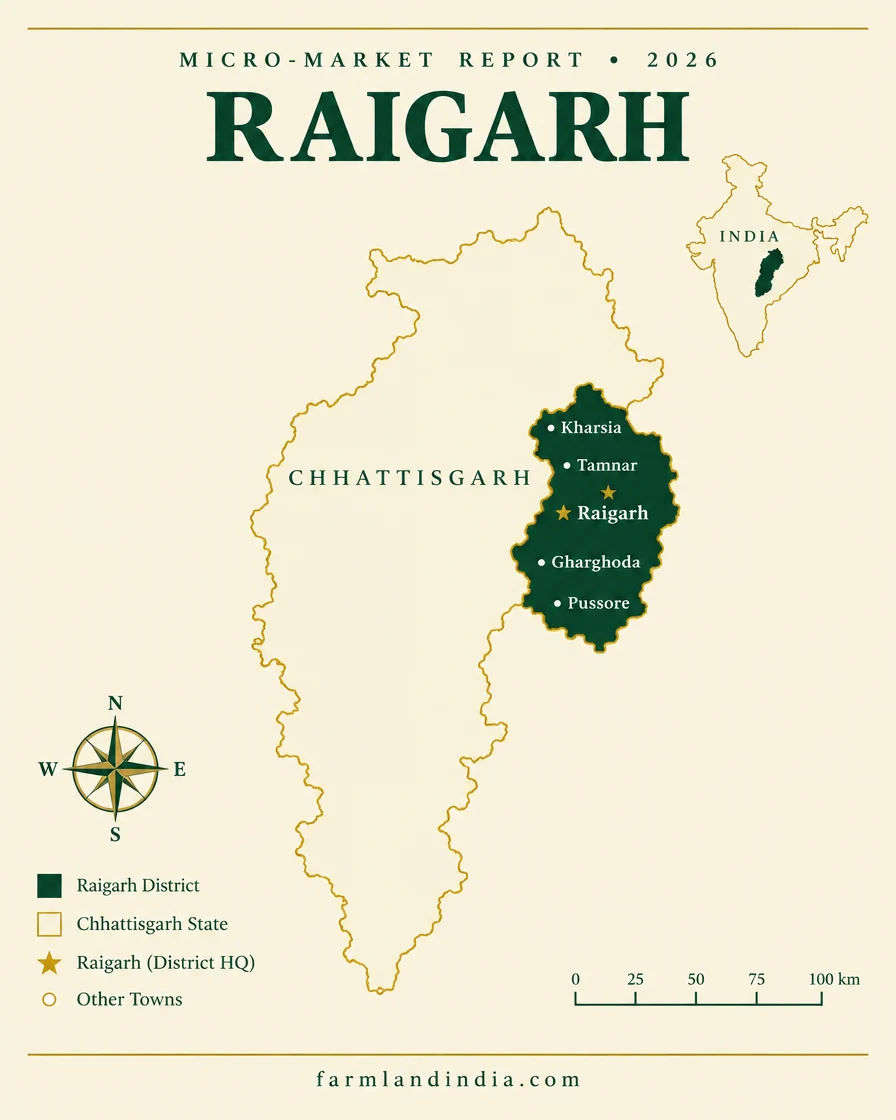
Nine blocks in the CGWB brochure, including Raigarh, Baramkela, Pussore, Kharsia, Tamnar, Gharghoda and Lailunga; the brochure uses older district boundaries (CGWB[2])
Key markets
Raigarh city fringe · Tamnar · Kharsia · Gharghoda · Pussore · Baramkela
Demand anchors
Coal-belt employment around Tamnar and Gharghoda, the Raipur–Dhanbad corridor and new bypass roads (The Hitavada, 23 April 2026[7])
Rail
Kharsia–Dharamjaigarh and Dharamjaigarh–Pathalgaon–Lohardaga lines are listed among current rail projects (The Hitavada, 13 July 2026[8])
Area and population
6,275 sq km and 14.94 lakh people in 2011 on the brochure’s boundaries (CGWB[2])
Pricing unit
No newspaper or official price series was found. Guideline rates were raised and partly rolled back; ask the sub-registrar for the village rate and compare registered deeds, always per acre
Local units
Records show hectares and acres; villagers also say decimal (dismil). Convert every quote to acres before comparing plots
Land records portal
Bhuiyan for B-1, Khasra and maps. See our Bhuiyan guide
Land law is state law. These rules are maintained on the Chhattisgarh page and apply to every district within it.
Raigarh — land purchase legal rules
Chhattisgarh’s land law is built on the Land Revenue Code it inherited from Madhya Pradesh. Most farmland can be sold to any Indian buyer, but land held by tribal bhumiswamis is protected, much of the north and south of the state lies in Fifth Schedule areas, and recent reforms have changed how deeds are registered and land is valued. This block applies to every district page in the state.
Who can buy: Chhattisgarh has no farmer-only rule. An Indian citizen who is not a farmer can buy agricultural land held by a bhumiswami (the Code’s word for an owner-occupant with full transfer rights) as long as the seller is free to sell. The restriction runs through the seller: land held by a member of a notified aboriginal tribe is protected, and in large parts of the state it cannot be bought by anyone outside the tribe.
Section 165(6) of the Code: Under Section 165(6) of the Chhattisgarh Land Revenue Code, 1959, the bhumiswami rights of a member of a tribe declared an aboriginal tribe (i) in areas notified as predominantly tribal, cannot be transferred to a non-tribal by sale or otherwise, and (ii) elsewhere, can be transferred to a non-tribal only with the written permission, with reasons recorded, of a revenue officer not below the rank of Collector. The Chhattisgarh High Court restated the rule in June 2026 (Vijay v State of Chhattisgarh, WPC 2351/2023, 18 June 2026).
Void sales and reversion: A transfer made in breach of Section 165 can be set aside under Section 170, and Sections 170-A and 170-B provide for setting aside certain transfers and for the reversion of tribal land that was transferred by fraud. A registered deed, payment of the full price or years of possession do not protect a buyer whose seller was a tribal bhumiswami without the required permission.
Scheduled Areas: Under the Fifth Schedule, the Scheduled Areas (States of Chhattisgarh, Jharkhand and Madhya Pradesh) Order, 2003 (GSR 114(E), 20 February 2003) declares the whole of the then Surguja, Koria, Bastar, Dantewada, Kanker, Korba and Jashpur districts Scheduled Area. Districts carved from them since, such as Balrampur-Ramanujganj, Surajpur, Manendragarh-Chirmiri-Bharatpur, Kondagaon, Narayanpur, Bijapur and Sukma, inherit that status. Parts of other districts are also covered: in old Bilaspur the Marwahi, Gaurela-1 and Gaurela-2 tribal development blocks and the Kota revenue inspector circle; in Raigarh the Dharamjaigarh, Gharghoda, Tamnar, Lailunga and Kharsia blocks; the Dondi block of old Durg (now Balod); Chowki, Manpur and Mohla of old Rajnandgaon; Gariaband, Mainpur and Chhura of old Raipur (now Gariaband district); and Nagri (Sihawa) in Dhamtari. District boundaries have moved since 2003, so confirm the village’s status at the tehsil before you negotiate.
PESA and gram sabhas: Chhattisgarh notified its rules under the Panchayats (Extension to Scheduled Areas) Act on 8 August 2022. In Scheduled Areas the gram sabha has powers that include preventing the alienation of land, and half of its members must be from Scheduled Tribes (Drishti, 10 August 2022). In practice, expect the village to know about, and have a say in, any sale to an outsider.
The 5-decimal rule: The Chhattisgarh Land Revenue Code (Amendment) Act, 2025 bars the registration of rural agricultural plots smaller than 5 decimals (about 2,178 sq ft), to stop the illegal plotting of farmland into small house sites. The same amendment adds geo-referenced maps under Section 107(5) (Indian Masterminds, 26 September 2025). A seller offering a tiny farmland plot in a village is offering something the sub-registrar will refuse to register.
Registration and mutation: Since 3 May 2025 deeds are drafted and registered through NGDRS, with integrated fee payment, e-appointments, home registration with video KYC, online deed search by name or khasra number and certified copies. Once a sale deed is registered, the mutation is now made automatically in the Bhuiyan land records (NIC, May 2025). Check that the new owner’s name actually appears in the B-1 and khasra within a few weeks.
Women buyers: On 15 April 2026 the cabinet halved the registration fee on land registered in a woman’s name, and gave serving soldiers, ex-servicemen and their widows a once-in-a-lifetime 25% stamp duty concession on purchases up to Rs 25 lakh (ThePrint (PTI), 15 April 2026). The 12% cess that had been levied on stamp duty on transfers was abolished in the 2025 budget (Amar Ujala, 3 March 2025).
Guideline rates: Duty is charged on the higher of the deed price and the Collector’s guideline rate. The state raised guideline rates sharply on 20 November 2025, by 400 to 500% in some pockets, then partly rolled the increase back in January 2026 in Raipur and Raigarh, capping rural land without plotting at about double its pre-November 2025 level (The Hitavada, 31 January 2026). Check the rate for the exact village on the day you register.
NRI and OCI buyers: Under the RBI Master Direction on immovable property, NRIs and OCIs may not acquire agricultural land, a farmhouse or a plantation in India except by inheritance. Our NRI guide covers the options.
- No farmer-only rule
- Section 165(6): tribal land
- Collector’s permission
- Scheduled Areas: 2003 Order
- PESA Rules, 2022
- No plots under 5 decimals
- Auto-mutation since May 2025
- NRIs: inheritance only
Raigarh — district-specific notes
Raigarh mixes scheduled and general blocks in one district, so the first legal question is where the village sits. The state section above covers general law; these are the district points.
⚠ Five blocks are listed in the Scheduled Areas Order. The 2003 Order lists the Dharamjaigarh, Gharghoda, Tamnar, Lailunga and Kharsia blocks of Raigarh (Scheduled Areas Order 2003[1]). In a notified tribal area, a tribal bhumiswami’s land cannot be sold to a non-tribal. Ask the tehsil for the village’s status; boundaries have changed since the Order.
⚠ Section 165(6) applies even outside scheduled blocks. Elsewhere, a transfer of tribal land to a non-tribal needs the written, reasoned permission of a revenue officer not below the Collector. Check the owner’s category in the B-1 record.
⚠ Guideline rates changed twice in six months. Rates were raised steeply on 20 November 2025 and partly rolled back in January 2026 in Raipur and Raigarh: rural land without plotting is capped at about double the earlier level and most urban zones are within double (The Hitavada, 31 January 2026[4]). Get the current rate in writing.
⚠ Small plots are barred. A 2025 amendment to the Land Revenue Code bars registration of rural plots below five decimals, about 2,178 sq ft (Indian Masterminds, 26 September 2025[11]). Plots sold as “farm lots” below that size are a legal risk.
⚠ Coal-belt land needs extra checks. The district’s geology is largely coal-bearing Gondwana rock (CGWB[2]). Ask whether any notice for acquisition or mining covers the khasra number before buying near the coal belt.
Before paying an advance in Raigarh, get the Bhuiyan B-1, the village map, the owner’s category, the scheduled-area status of the village and the current guideline rate in writing.
- Five scheduled blocks
- Section 165(6)
- Guideline-rate swings
- 5-decimal rule
- Coal-belt claims
District overview
Raigarh — a small coal-belt district between Ranchi and Hazaribagh, on two planned corridors
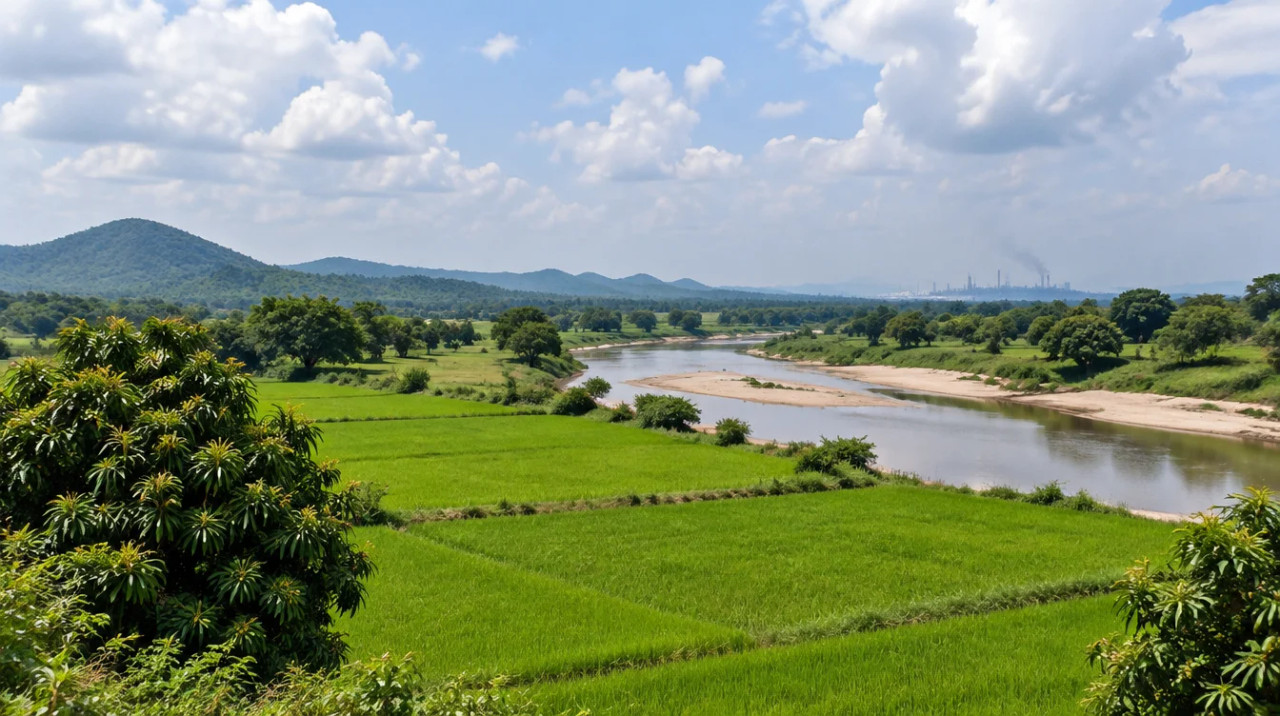
Raigarh sits in the east of Chhattisgarh and combines three things that rarely share one district: Scheduled Area blocks, a coal-bearing geology and canal-and-tubewell paddy land. CGWB’s brochure records 6,275 sq km, 1,438 villages and 14.94 lakh people in 2011, on boundaries that predate later district changes (CGWB[2]).
The land is mostly farmland. Rice covered 2,40,388 ha against a net sown area of 2,72,001 ha, and normal rainfall is about 1,240 mm. Around 33 percent of the area is forest, which matters because forest and tribal land are the two biggest legal limits on buying.
Because the brochure’s district is larger than the district of today, block figures here describe the land rather than the current administrative map. Use them for water, soil and crop patterns, and use the tehsil for the current list of villages.
Roads are the main reason for new attention. In April 2026 the state sanctioned a Tamnar four-lane bypass, a Raigarh city ring road and Kharsia Bypass No. 3 (Amar Ujala, 7 April 2026[6]), and Raigarh sits on the Raipur–Dhanbad corridor, a 627 km route of which about 384 km lies in Chhattisgarh (The Hitavada, 23 April 2026[7]).
The district was also named in the guideline-rate rollback of January 2026, one of only two districts mentioned in the headline of that report (The Hitavada, 31 January 2026[4]). That makes the registration base an active issue here, not a footnote.
Buyers fall into three groups: local families and traders, buyers from industry and the coal belt, and investors from outside the district. The rules are the same for all, but the risk is not: a village in a scheduled block and a village on the plain are different purchases.
Ask first whether the village is in a scheduled block, whether the owner is a tribal landholder and which guideline rate applies today.
- Raigarh city
- Tamnar
- Kharsia
- Gharghoda
- Pussore
- Baramkela
Transaction costs
Stamp duty & registration in Raigarh
50%
Registration fee cut for women
Land registered in a woman’s name; cabinet decision of 15 April 2026, in effect by May 2026 (ThePrint, PTI[10])
About 2×
Rural guideline cap after rollback
Rural land without plotting capped at roughly double the pre-November 2025 level; most urban zones within double (The Hitavada, 31 January 2026[4])
No cess
12% cess on stamp duty abolished
Removed for transfers of immovable assets in the 2025 state budget (Amar Ujala, 3 March 2025[9])
Check the current rate on the registration department portal or at the sub-registrar. The 25% stamp duty concession for serving soldiers, ex-servicemen and widows applies once in a lifetime on purchases up to Rs 25 lakh. Since May 2025 the NGDRS system offers online deed generation, e-appointments, home registration with video KYC and automatic mutation into Bhuiyan after registration (NIC[3]). In Raigarh the guideline rate is the number to watch: it sets the value stamp duty is charged on, and the November 2025 revision raised it by 400 to 500 percent in some pockets before the January 2026 rollback. The report does not name individual Raigarh blocks, so ask the sub-registrar for the exact rate of the village and the date it applies from.
Know the belt
What is moving prices in Raigarh
Where lawful, farmable land is found in Raigarh; no listing-site prices are used.
Raigarh city fringe
District headquarters
A city ring road costing Rs 70.47 crore was among the road works sanctioned in April 2026 (Amar Ujala, 7 April 2026[6]). The Raigarh block recorded 33.47% groundwater development in the CGWB brochure, a comfortable level (CGWB[2]). Land near any ring road attracts plotting and rumour.
Check: a published alignment, municipal limit and diversion status of any plot sold near the road.
Tamnar
Bypass and scheduled block
Tamnar is in the Scheduled Areas Order (2003 Order[1]) and gets a six-km four-lane bypass costing Rs 152.17 crore (The Hitavada, 9 April 2026[5]). Groundwater development here was only 26.17%. A bypass raises interest, but scheduled-area rules still bar sales of tribal land to non-tribals.
Check: village status, owner’s category and whether the bypass alignment touches the plot.
Kharsia
Scheduled block with a bypass
Kharsia is also scheduled, has Bypass No. 3 sanctioned at Rs 7.22 crore (Amar Ujala, 7 April 2026[6]) and appears in the Kharsia–Dharamjaigarh rail project (The Hitavada, 13 July 2026[8]). The brochure puts groundwater development at 41.84%.
Check: the rail alignment, scheduled-area status of the village and road frontage.
Gharghoda
Scheduled block
Gharghoda is in the Scheduled Areas Order and recorded 24.23% groundwater development in the brochure (CGWB[2]). Low extraction suggests water is available, but a village list matters more here than soil.
Check: the notified status of the village and any tribal ownership in the chain of title.
Pussore
General block
Pussore recorded 63.70% groundwater development, close to the 70% safe limit (CGWB[2]). That points to heavy use of wells and means a new bore may be a weaker bet. Pussore is not in the list of scheduled blocks.
Check: borewell depth, yield and neighbours’ wells.
Baramkela
Highest groundwater use
Baramkela had the highest groundwater development in the brochure, 89.66%, which is the semi-critical category (CGWB[2]). Farm plots here need a water test and a look at the canal outlet before price is discussed.
Check: canal reach, bore yield and a groundwater record for the village.
Connectivity
How Raigarh connects — road, rail and air
Road sanctions, the Raipur–Dhanbad corridor and two rail lines; drive times are not given because no source was found.
🚗 By road
🚆 By rail
✈️ By air
Drive times are not given because no source was found. Check road and rail access for the exact village before you commit.
Growth catalysts
Upcoming infrastructure & developments
Status labels reflect sources read in November 2026. Government-announced timelines are not guaranteed; items with a single or older source say so.
01Open
03Catalysts
Agriculture & terrain
Soil, crops & water in Raigarh
Paddy plains with a coal-bearing geology and wide block-level differences in groundwater use.
Crops
Rice covered 2,40,388 ha in the brochure, out of a net sown area of 2,72,001 ha (CGWB[2]). Paddy is the main crop; the brochure also lists other kharif and rabi crops in smaller areas.
- Kharif paddy
- Rabi pulses and oilseeds on smaller areas
- Vegetables near towns
Geology and soils
About 40 to 42 percent of the district is Gondwana rock, the coal-bearing formation, and soils vary with the rock. Test soil before buying a farm plot, and do not assume that land beside a coal block is ordinary farmland.
- Gondwana coal-bearing area
- Plain paddy soils
- Forest on ridges
Rivers
The Mand, Kelo, Kurket and Ib rivers drain the district. Land along their banks floods in heavy years, so check flood marks and the high-flood level.
- Mand and Kelo belts
- Kurket and Ib valleys
- Flood-prone strips
Water and irrigation
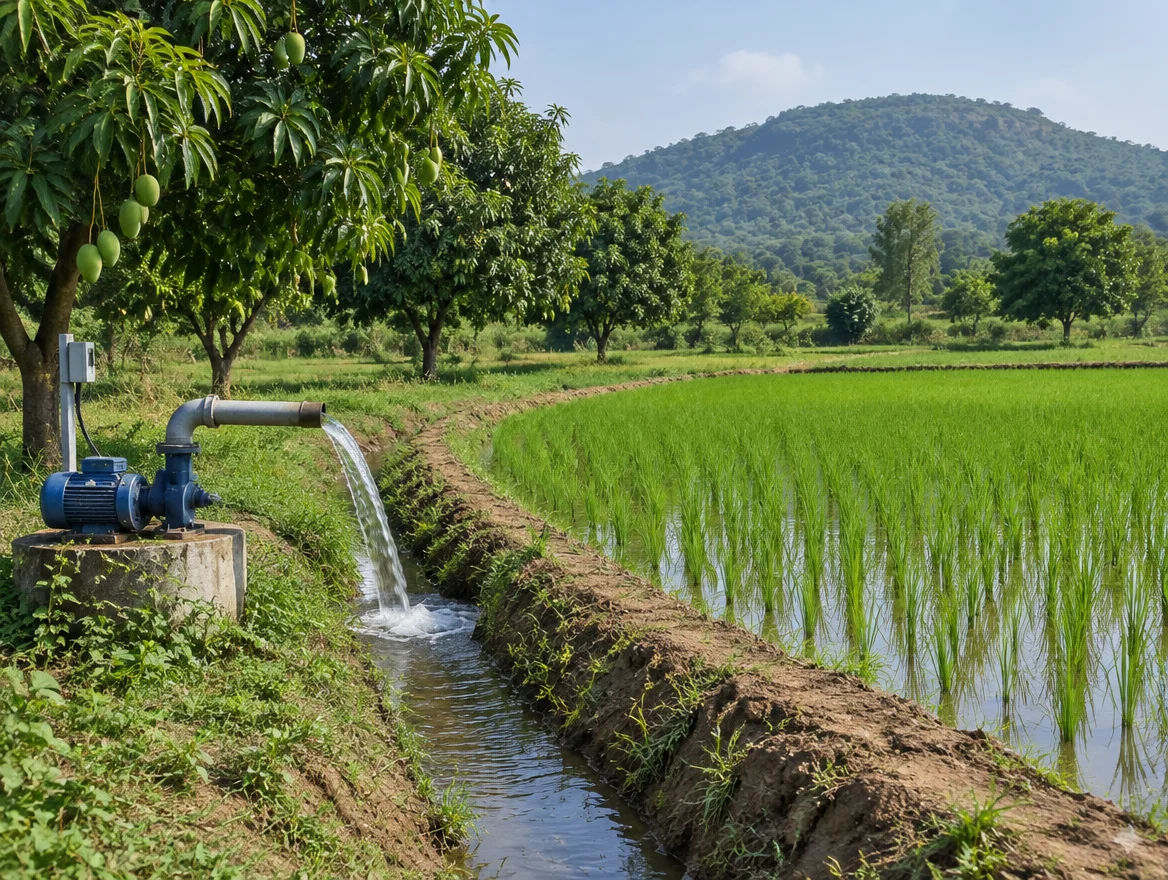
Gross irrigated area was 66,274 ha, of which canals supplied 20,261 ha and tube wells 32,522 ha. Overall groundwater development was 43.16%, but it ran from 89.66% in Baramkela and 63.70% in Pussore to 18.93% in Lailunga. Block averages hide village-level stress.
Rainfall and holdings
Normal annual rainfall is about 1,240 mm (CGWB[2]). With only about a quarter of the sown area irrigated, a plot with a canal outlet or a reliable bore is worth more than its soil alone suggests.
At a glance
Ramgarh vs. nearby districts
| District | Land and law | What links it to Raigarh |
|---|---|---|
| Korba (south-west) | Coal belt; wholly Scheduled | On the Raipur–Dhanbad corridor with Raigarh |
| Jashpur (north-east) | Wholly Scheduled | NH-43 package towards the Jharkhand border |
| Sakti and Sarangarh-Bilaigarh | Newer districts | Carved from older districts; check which district a village falls in today |
| Raipur (south-west) | State capital district | Both were named in the January 2026 guideline-rate rollback |
No newspaper or official source gives a price series for Raigarh or its neighbours, so this table compares law and land, not rates. Raigarh’s distinct feature is the mix of scheduled and general blocks.
Farmland India view
Why investors look at Raigarh
Five reasoned points for Raigarh, each tied to a source on this page.
Scheduled status is the first filter
Five of the district’s blocks are in the 2003 Order. A plot in a scheduled block with a tribal owner cannot be sold to a non-tribal, however cheap it looks.
Roads are sanctioned, not built
The Tamnar bypass, the city ring road and the Kharsia bypass are sanctions. Pay for the status, not for the headline, and ask where the alignment runs.
Guideline rates moved fast
A rate raised four to five times and then capped near double in a few weeks shows how fast the registration base can change. Stamp duty follows the rate on the date of registration.
Water differs by block
Baramkela at 89.66% and Lailunga at 18.93% are in the same district. Check groundwater at the village, not at the district.
Coal-belt land has extra claims
Near mining areas, check whether any acquisition or mining notice covers the khasra number. This page does not name any specific notice.
Compare like with like
A plot in a scheduled block, a plot on the plain and a plot near a town are three different assets. Compare only plots with the same legal status, water source and road access, and quote every price per acre so that offers can be set side by side.
Confirm Bhuiyan entries, mutation, the scheduled status of the village and the current guideline rate before you pay anything, and quote every price per acre. NRIs should read our guide to farmland rules for NRIs first.
STRAIGHT TALK
Risks & challenges in Raigarh
District-specific risks. Read the state page for the general Chhattisgarh risks on tribal land, ceiling and records.
Scheduled-area restrictions
Five blocks are listed in the 2003 Order (Scheduled Areas Order[1]). A sale of tribal land to a non-tribal in such an area is barred, and a deed that ignores this can be set aside.
Guideline-rate swings
The November 2025 hike and January 2026 rollback show how fast the registration base can change (The Hitavada, 31 January 2026[4]). A deal priced at one rate and registered at another changes the stamp duty.
Groundwater stress in places
Baramkela was at 89.66% and Pussore at 63.70% (CGWB[2]). A new bore in these blocks competes with many existing ones.
Sanctioned roads are not built roads
Bypass sanctions give an amount, not a date (The Hitavada, 9 April 2026[5]). Paying a premium before work starts is a bet on delivery.
Small plots and layouts
Registration of rural plots below five decimals is barred (Indian Masterminds[11]). Plots sold as “layouts” without diversion are a legal risk.
Mining and acquisition claims
Coal-bearing geology means some land may be covered by notices for acquisition. Ask the tehsil and the collector’s office for a written statement on the khasra number.
Who to contact
Local revenue & planning offices
The Collector’s office at Raigarh runs the district, with tehsil offices handling mutation, partition and Bhuiyan copies; the sub-registrar offices register deeds; the SDM (revenue) deals with diversion. Ask the tehsildar for a certified B-1 and the village map, and ask the tehsil in writing whether the village is notified as a Scheduled Area.
KEEP EXPLORING
Explore more areas
Other districts in Chhattisgarh
- Balod
- Baloda Bazar-Bhatapara
- Balrampur-Ramanujganj
- Bastar
- Bemetara
- Bijapur
- Bilaspur
- Dantewada
- Dhamtari
- Durg
- Gariaband
- Gaurela-Pendra-Marwahi
- Janjgir-Champa
- Jashpur
- Kabirdham (kawardha)
- Kanker
- Khairagarh-Chhuikhadan-Gandai
- Kondagaon
- Korba
- Koriya
- Mahasamund
- Manendragarh-Chirmiri-Bharatpur
- Mohla-Manpur-Ambagarh Chowki
- Mungeli
- Narayanpur
- Raipur
- Rajnandgaon
- Sarangarh-Bilaigarh
- Shakti
- Sukma
- Surajpur
- Surguja
COMMON QUESTIONS
Frequently asked questions
Everything buyers, NRIs and investors ask before their first reviewed farmland purchase in Raigarh.
Visit full wiki01 of 04
Is Raigarh a Scheduled Area district?
Partly. The 2003 Order lists the Dharamjaigarh, Gharghoda, Tamnar, Lailunga and Kharsia blocks of Raigarh. Blocks such as Raigarh and Pussore are not in that list. Confirm the status of the village with the tehsil before you pay an advance.
02 of 04
Did Raigarh land rates change in 2025-26?
Yes. Guideline rates were raised steeply on 20 November 2025 and partly rolled back in January 2026 in Raipur and Raigarh. Rural land without plotting is capped at about double the earlier level and most urban zones are within double. Ask for the current rate for the village.
03 of 04
Which road projects affect Raigarh land?
State sanctions in April 2026 include a Tamnar four-lane bypass of 6 km at Rs 152.17 crore, a Raigarh city ring road at Rs 70.47 crore and Kharsia Bypass No. 3 at Rs 7.22 crore. Raigarh also sits on the Raipur–Dhanbad corridor.
04 of 04
Can an outsider buy farmland in Raigarh?
Rules for agricultural land apply as in the rest of the state, and tribal land is protected by Section 165(6) of the Land Revenue Code. A non-tribal cannot buy tribal land in a notified area, so check the owner’s category and the village status.
Transparency
Sources and references
Law and courts
- [1][1]Scheduled Areas (States of Chhattisgarh, Jharkhand and Madhya Pradesh) Order, 2003 — latestlaws.com — latestlaws.com
Government
- [2][2]CGWB: ground water information booklet, Raigarh district — cgwb.gov.in — cgwb.gov.in
- [3][3]NIC: ten NGDRS services launched in Chhattisgarh, May 2025 — informaticsweb.nic.in — informaticsweb.nic.in
News
- [4][4]The Hitavada: government rolls back steep land rate hike in Raipur, Raigarh, 31 January 2026 — thehitavada.com — thehitavada.com
- [5][5]The Hitavada: Rs 708 crore sanctioned for 15 four-lane road projects, 9 April 2026 — thehitavada.com — thehitavada.com
- [6][6]Amar Ujala: bypass road sanctions in Chhattisgarh, 7 April 2026 — amarujala.com — amarujala.com
- [7][7]The Hitavada: Rs 3,147 crore highway project, Raipur–Dhanbad corridor, 23 April 2026 — thehitavada.com — thehitavada.com
- [8][8]The Hitavada: railway projects in Chhattisgarh, 13 July 2026 — thehitavada.com — thehitavada.com
- [9][9]Amar Ujala: 12% cess on stamp duty abolished, 3 March 2025 — amarujala.com — amarujala.com
- [10][10]ThePrint (PTI): cabinet halves land registration fees for women, 15 April 2026 — theprint.in — theprint.in
- [11][11]Indian Masterminds: Land Revenue Code amendment bans illegal plotting, 26 September 2025 — indianmasterminds.com — indianmasterminds.com
For developers
Ready to explore Raigarh farmland?
Browse reviewed projects and individual land parcels across Raigarh — or if you own land here, list it with platform review and reach serious buyers.