
District guide
Buying Land in Balod
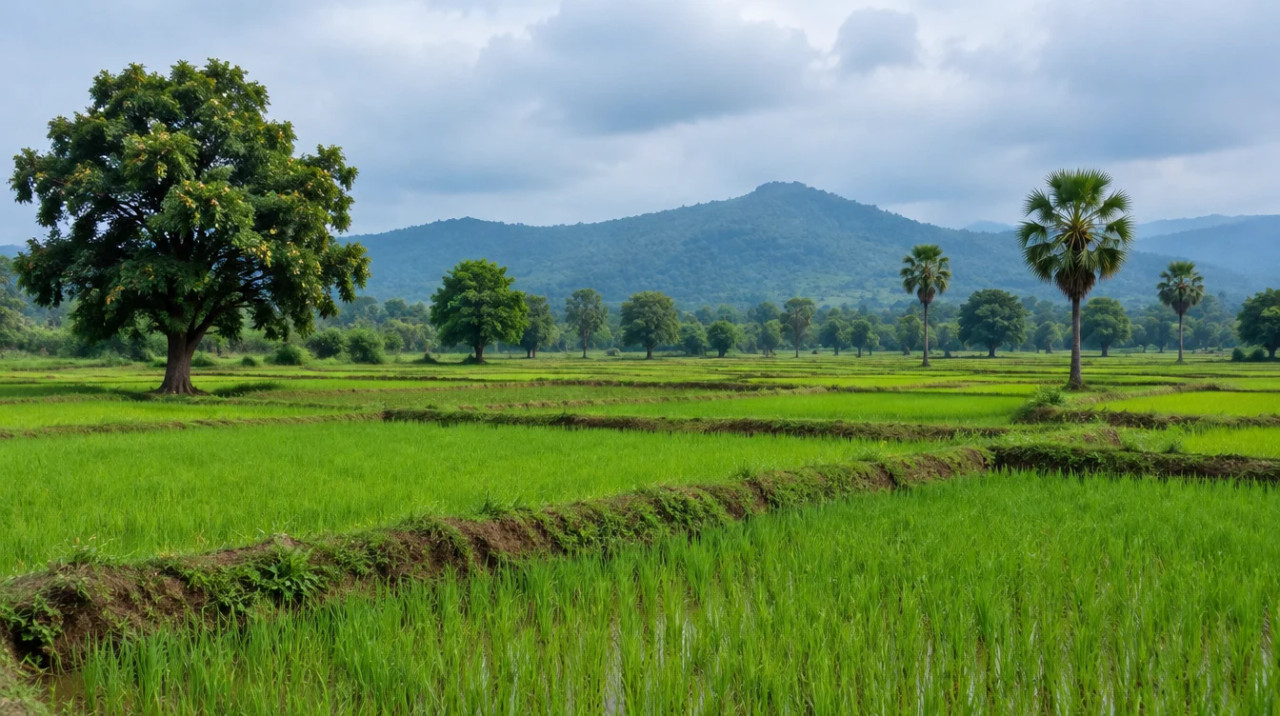
A canal-irrigated paddy district beside Durg, with the Dalli Rajhara iron-ore belt and a new Rowghat rail line opened in October 2026.
3,527 sq km
Area (ICAR-CRIDA)
1,028 mm
Normal annual rainfall (ICAR-CRIDA)
143%
Cropping intensity (ICAR-CRIDA)
About 66%
Irrigation from canals (ICAR-CRIDA)
District land record — Balod
Rev. 2026 · Farmland India desk
State
Chhattisgarh
Sub-divisions
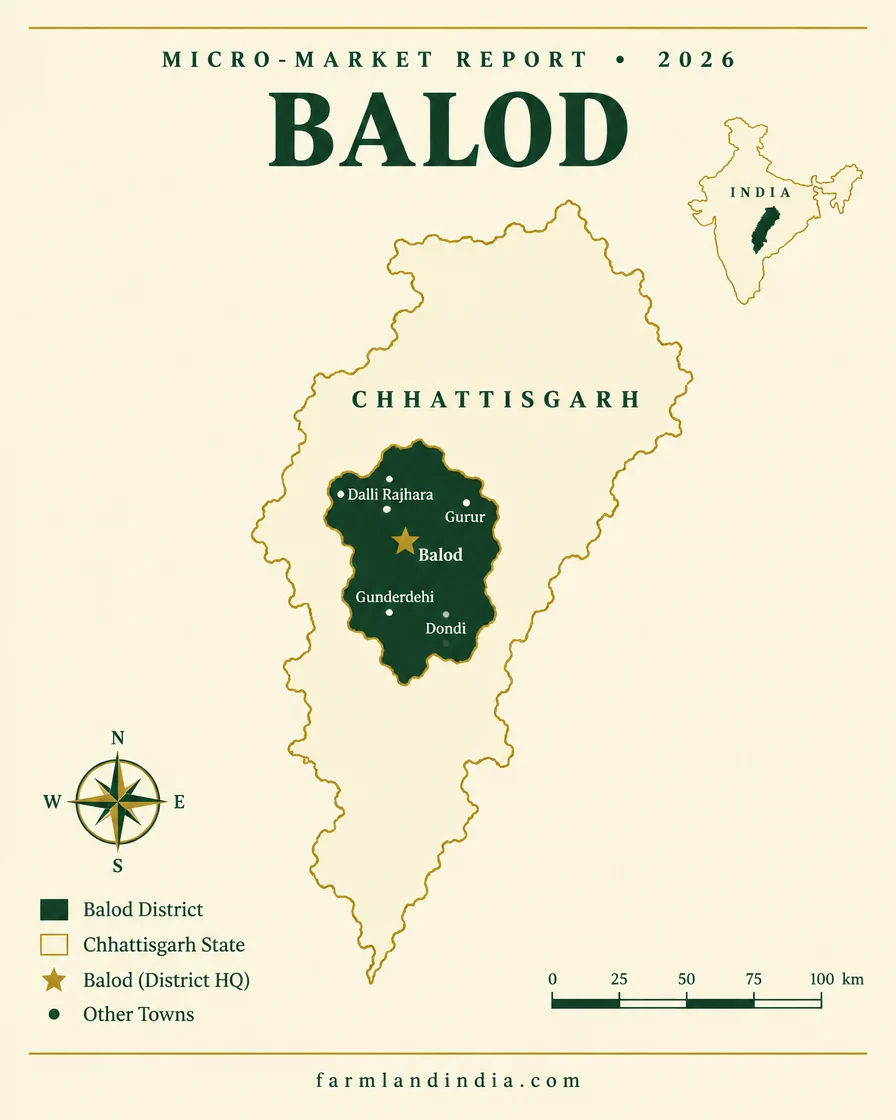
Five blocks: Balod, Dondi, Dondi-Lohara, Gunderdehi and Gurur, with Balod town as district headquarters. The district was carved out of Durg and began functioning in 2012.
Key markets
Balod town · Dalli Rajhara · Gurur · Gunderdehi · Dondi · Dondi-Lohara
Demand anchors
Dalli Rajhara iron-ore mines feeding Bhilai Steel Plant · Dallirajhara–Rowghat rail line completed in 2026 (Indian Infrastructure, 25 Sep 2026[7]) · proximity to Durg–Bhilai
Rail
Dalli Rajhara is the head of the new 95 km line to Rowghat; passenger trains already run on the 77.5 km Dallirajhara–Tadoki section (Construction World, 23 Oct 2026[8])
Size and population
About 3,527 sq km (ICAR-CRIDA[4]) and roughly 8.3 lakh people at the 2011 Census
Pricing unit
Quote any land per acre and confirm the area on the B-1 and khasra.
Local units
Records give area in hectares; sale talk uses acre and decimal (dismil). Ask for the area in acres from the record of rights before comparing offers.
Land records portal
Bhuiyan (B-1 and khasra) at bhuiyan.cg.nic.in; see our Bhuiyan guide
Land law is state law. These rules are maintained on the Chhattisgarh page and apply to every district within it.
Balod — land purchase legal rules
Chhattisgarh’s land law is built on the Land Revenue Code it inherited from Madhya Pradesh. Most farmland can be sold to any Indian buyer, but land held by tribal bhumiswamis is protected, much of the north and south of the state lies in Fifth Schedule areas, and recent reforms have changed how deeds are registered and land is valued. This block applies to every district page in the state.
Who can buy: Chhattisgarh has no farmer-only rule. An Indian citizen who is not a farmer can buy agricultural land held by a bhumiswami (the Code’s word for an owner-occupant with full transfer rights) as long as the seller is free to sell. The restriction runs through the seller: land held by a member of a notified aboriginal tribe is protected, and in large parts of the state it cannot be bought by anyone outside the tribe.
Section 165(6) of the Code: Under Section 165(6) of the Chhattisgarh Land Revenue Code, 1959, the bhumiswami rights of a member of a tribe declared an aboriginal tribe (i) in areas notified as predominantly tribal, cannot be transferred to a non-tribal by sale or otherwise, and (ii) elsewhere, can be transferred to a non-tribal only with the written permission, with reasons recorded, of a revenue officer not below the rank of Collector. The Chhattisgarh High Court restated the rule in June 2026 (Vijay v State of Chhattisgarh, WPC 2351/2023, 18 June 2026).
Void sales and reversion: A transfer made in breach of Section 165 can be set aside under Section 170, and Sections 170-A and 170-B provide for setting aside certain transfers and for the reversion of tribal land that was transferred by fraud. A registered deed, payment of the full price or years of possession do not protect a buyer whose seller was a tribal bhumiswami without the required permission.
Scheduled Areas: Under the Fifth Schedule, the Scheduled Areas (States of Chhattisgarh, Jharkhand and Madhya Pradesh) Order, 2003 (GSR 114(E), 20 February 2003) declares the whole of the then Surguja, Koria, Bastar, Dantewada, Kanker, Korba and Jashpur districts Scheduled Area. Districts carved from them since, such as Balrampur-Ramanujganj, Surajpur, Manendragarh-Chirmiri-Bharatpur, Kondagaon, Narayanpur, Bijapur and Sukma, inherit that status. Parts of other districts are also covered: in old Bilaspur the Marwahi, Gaurela-1 and Gaurela-2 tribal development blocks and the Kota revenue inspector circle; in Raigarh the Dharamjaigarh, Gharghoda, Tamnar, Lailunga and Kharsia blocks; the Dondi block of old Durg (now Balod); Chowki, Manpur and Mohla of old Rajnandgaon; Gariaband, Mainpur and Chhura of old Raipur (now Gariaband district); and Nagri (Sihawa) in Dhamtari. District boundaries have moved since 2003, so confirm the village’s status at the tehsil before you negotiate.
PESA and gram sabhas: Chhattisgarh notified its rules under the Panchayats (Extension to Scheduled Areas) Act on 8 August 2022. In Scheduled Areas the gram sabha has powers that include preventing the alienation of land, and half of its members must be from Scheduled Tribes (Drishti, 10 August 2022). In practice, expect the village to know about, and have a say in, any sale to an outsider.
The 5-decimal rule: The Chhattisgarh Land Revenue Code (Amendment) Act, 2025 bars the registration of rural agricultural plots smaller than 5 decimals (about 2,178 sq ft), to stop the illegal plotting of farmland into small house sites. The same amendment adds geo-referenced maps under Section 107(5) (Indian Masterminds, 26 September 2025). A seller offering a tiny farmland plot in a village is offering something the sub-registrar will refuse to register.
Registration and mutation: Since 3 May 2025 deeds are drafted and registered through NGDRS, with integrated fee payment, e-appointments, home registration with video KYC, online deed search by name or khasra number and certified copies. Once a sale deed is registered, the mutation is now made automatically in the Bhuiyan land records (NIC, May 2025). Check that the new owner’s name actually appears in the B-1 and khasra within a few weeks.
Women buyers: On 15 April 2026 the cabinet halved the registration fee on land registered in a woman’s name, and gave serving soldiers, ex-servicemen and their widows a once-in-a-lifetime 25% stamp duty concession on purchases up to Rs 25 lakh (ThePrint (PTI), 15 April 2026). The 12% cess that had been levied on stamp duty on transfers was abolished in the 2025 budget (Amar Ujala, 3 March 2025).
Guideline rates: Duty is charged on the higher of the deed price and the Collector’s guideline rate. The state raised guideline rates sharply on 20 November 2025, by 400 to 500% in some pockets, then partly rolled the increase back in January 2026 in Raipur and Raigarh, capping rural land without plotting at about double its pre-November 2025 level (The Hitavada, 31 January 2026). Check the rate for the exact village on the day you register.
NRI and OCI buyers: Under the RBI Master Direction on immovable property, NRIs and OCIs may not acquire agricultural land, a farmhouse or a plantation in India except by inheritance. Our NRI guide covers the options.
- No farmer-only rule
- Section 165(6): tribal land
- Collector’s permission
- Scheduled Areas: 2003 Order
- PESA Rules, 2022
- No plots under 5 decimals
- Auto-mutation since May 2025
- NRIs: inheritance only
Balod — district-specific notes
The Chhattisgarh state page applies to Balod in full: the tribal-land rule, the Scheduled Area list, the NGDRS registration route and the guideline-rate revisions. These five points are specific to Balod.
⚠ Dondi block, which sat in Durg district when the 2003 Order was issued and is now in Balod, is listed as partly a Scheduled Area (Scheduled Areas Order, 2003[2]). The order is block-wise, so ask the tehsildar whether your village is inside the notified area before you pay an advance.
⚠ Wherever the seller is a member of a notified tribe, section 165(6) of the Land Revenue Code restricts sale to non-tribals; outside notified areas it needs the Collector’s written, reasoned permission (Land Revenue Code, 1959[1]). Ask for the seller’s caste status entry in the B-1 and the khasra history for the last 30 years.
⚠ Dalli Rajhara is a long-running iron-ore mining belt supplying Bhilai Steel Plant, and the new rail line runs out of it (Indian Infrastructure[7]). Plots near mine leases, rail yards or the line’s alignment can be under lease, acquisition or restricted use; ask the district land acquisition officer and the revenue office before paying.
⚠ Since the 2025 amendment, rural agricultural plots smaller than 5 decimals cannot be registered (Indian Masterminds, 26 Sep 2025[3]). Small “plotted” layouts along the roads from Balod and Gurur may therefore not be registrable as farmland.
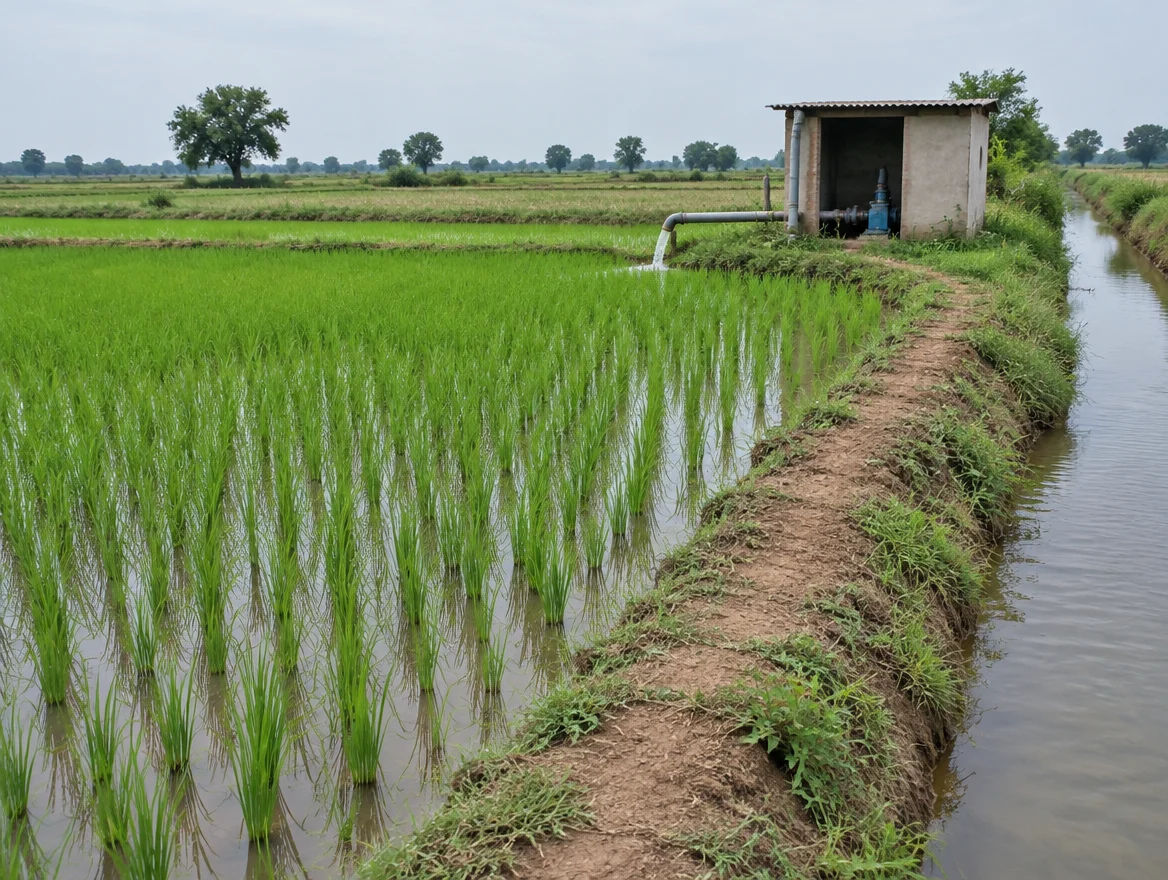
⚠ Much of Balod’s cultivated land sits under canal commands. Check that the plot has recorded access to the field channel and is not irrigation-department land, a canal strip or a tank bed.
NRI and OCI buyers should read can NRIs buy agricultural land in India before shortlisting any farmland; the FEMA bar applies in every district.
- Dondi partly Scheduled Area
- Tribal land rule
- Mining-belt land
- Plotting curbs
- Canal-command land
District overview
Balod — a canal-irrigated paddy district with an iron-ore belt and a new rail line
Balod is a compact district of about 3,527 sq km in the Chhattisgarh plain, west of Durg and north of Dhamtari (ICAR-CRIDA[4]). It was formed out of Durg in 2012 and has five blocks, with Balod town as its headquarters and Dalli Rajhara, Gurur, Gunderdehi and Dondi as the other main centres. Its southern edge climbs into forested hills, but most of the district is gently sloping paddy land.
For a buyer, the district is two markets. The plains around Balod, Gurur and Gunderdehi are farmland: about 1,028 mm of normal rainfall, rice as the dominant crop, and irrigation that is mostly canal-fed (ICAR-CRIDA[4]). The south, around Dalli Rajhara, is an iron-ore mining and township belt that has fed Bhilai Steel Plant for decades.
The big news is rail. The 95 km Dallirajhara–Rowghat line, built at about Rs 1,628 crore to carry iron ore from the Rowghat mines to Bhilai Steel Plant, completed its final 17.5 km section after Commissioner of Railway Safety trials on 22 September 2026 (Indian Infrastructure, 25 Sep 2026[7]). Passenger trains had already begun on the 77.5 km Dallirajhara–Tadoki stretch, and the line was inaugurated in October 2026 (Construction World, 23 Oct 2026[8]). It is single-line, electrified broad gauge. The Rowghat–Jagdalpur extension is sanctioned, with land acquisition a priority.
Durg and Bhilai are the adjacent urban markets, and the district sits inside the wider Raipur–Durg–Bhilai commuter economy. That is the main reason Balod town and the roads towards Durg draw plot buyers, while the rest of the district trades on agricultural value.
Land law matters more here than the headline projects. Dondi block is partly a Scheduled Area, and tribal landholders are protected by section 165(6) of the Land Revenue Code, so the first check on any parcel is the seller’s status and the village’s notification. The other checks are the khasra and B-1 on Bhuiyan, the guideline rate, and the plot’s canal or well source.
If you are comparing districts, Durg and Dhamtari are the nearest alternatives, Durg for urban demand and Dhamtari for the Raipur–Visakhapatnam corridor. Balod is cheaper to enter on rural land but has less corridor-led momentum, and the rail line is a freight line first.
- Dalli Rajhara
- Rowghat rail line
- Canal-fed paddy
- Gurur
- Gunderdehi
- Dondi
Transaction costs
Stamp duty & registration in Balod
Check
Base stamp duty and registration fee
Ask the sub-registrar for the current rate.
Abolished
12% cess on stamp duty
Removed for transfers of immovable property in the 2025 budget ([Amar Ujala, 3 Mar 2025](https://www.amarujala.com/chhattisgarh/chhattisgarh-budget-2025-decision-to-abolish-12-cess-for-stamp-duty-on-transfer-of-immovable-land-2025-03-03))
50% off
Registration fee for women
Cabinet decision of 15 Apr 2026, in effect from May 2026 ([ThePrint/PTI, 15 Apr 2026](https://theprint.in/india/chhattisgarh-cabinet-halves-land-registration-fees-for-women-to-promote-economic-empowerment/2905647/))
Chhattisgarh revised collector guideline rates steeply in November 2025 and partly rolled them back in January 2026, capping rural land without plotting at about double the pre-November 2025 level (The Hitavada, 31 Jan 2026[9]). Check the current guideline rate for your village at the sub-registrar before you agree a price. Registration now runs through the NGDRS portal, with auto-mutation into Bhuiyan after the deed is registered (NIC, May 2025[6]). The Land Revenue Code amendment of 2025 bars registration of rural agricultural plots smaller than 5 decimals (Indian Masterminds, 26 Sep 2025[3]). For Balod, the guideline rate for farmland varies by village and block; Gurur and Gunderdehi plains and the Dalli Rajhara belt can sit in different bands.
Know the belt
What is moving prices in Balod
Rail and town developments reported by the press; no listing-site prices are used.
Balod town
District headquarters market
The Collectorate, courts, sub-registrar and trade keep demand in town. Buyers look for house plots and small commercial land, and for farmland on the roads out towards Durg.
Check: whether the plot lies inside the municipal limit and its recorded land class in the B-1.
Dalli Rajhara and the rail line
Mining and rail belt
Dalli Rajhara is the mining town and the start of the new 95 km Rowghat line, which opened in 2026 (Construction World[8]). Freight lines favour godown, siding and small-industry land near stations over farmland.
Check: lease, acquisition and mine-buffer status before any advance.
Gurur and Gunderdehi plains
Canal-fed paddy belt
The central and eastern blocks are the district’s irrigated rice land; canals serve about two-thirds of irrigated area (ICAR-CRIDA[4]). Farmland buyers here look for irrigated, road-facing parcels.
Check: canal command status, field-channel access and the khasra history.
Dondi and Dondi-Lohara
Forest-edge and Scheduled Area
The south-western blocks include tribal villages and hill-fringe land. Dondi is partly a Scheduled Area (2003 Order[2]), which makes land cheaper to buy on paper but harder to transfer in practice.
Check: village notification status and whether the seller belongs to a notified tribe.
Asking prices
No official farmland price series is published for Balod. Ask the sub-registrar for recent registered sale values in the village you are looking at Use the guideline rate for the village and compare it with recent registered deeds in the same village.
Connectivity
How Balod connects — road, rail and air
Rail is the visible upgrade; road distances are not given because no source was found.
🚗 By road
✈️ By air
🚆 By rail
No drive times are given because none was sourced. The Rowghat line is mainly a freight and Bastar-access line, so check the railway for passenger timetables.
Growth catalysts
Upcoming infrastructure & developments
Statuses and sources are listed for each item.
02Open
03Catalysts
Agriculture & terrain
Soil, crops & water in Balod
A rice district on bhata to kanhar soils, with canals doing most of the irrigation and groundwater safe.
Crops
Rice covers about 177,200 ha, nearly all of the gross cropped area, with about 96,000 ha irrigated and 81,200 ha rain-fed in kharif. Lathyrus is next at about 50,600 ha, with gram, linseed and wheat in rabi (ICAR-CRIDA[4]). Cropping intensity is about 143%.
- Rice
- Lathyrus (khesari)
- Gram
- Wheat and linseed
Soils and horticulture
The plan lists gravelly bhata uplands, sandy-loam matasi, clay-loam dorsa and clayey kanhar. Vegetables cover about 3,400 ha, led by brinjal, tomato and okra, and fruit area is tiny (ICAR-CRIDA[4]).
Water and rainfall
Normal rainfall is about 1,028 mm, nearly 90% of it in June to September. Net irrigated area is about 89,700 ha out of a net sown area of 176,800 ha, and ICAR-CRIDA classes groundwater as safe across the district. Drought, delayed canal release and waterlogging are listed risks (ICAR-CRIDA[4]).
At a glance
Balod vs. nearby districts
| District | Land and water | What links it to Balod |
|---|---|---|
| Durg (east) | Urban Durg–Bhilai belt with steel and industry | Source of most urban demand; Balod was carved out of Durg in 2012 |
| Dhamtari (south-east) | Paddy plains, Raipur–Visakhapatnam corridor | On a six-lane corridor to Visakhapatnam ([Tribune/ANI, 7 Dec 2025](https://www.tribuneindia.com/news/business/six-lane-raipur-visakhapatnam-economic-corridor-to-cut-travel-time-and-boost-regional-growth)), which Balod does not have |
| Kanker (south) | Forest and tribal Scheduled Area | Reached by the new Rowghat line towards Bastar ([Construction World](https://www.constructionworld.in/amp/transport-infrastructure/metro-rail-and-railways-infrastructure/chhattisgarh-opens-two-rail-lines-as-rs.-570-bn-works-advance/99259)) |
No price series is available for any of these districts, so the table compares land type and links only. Compare guideline rates and registered deeds rather than asking prices.
Farmland India view
Why investors look at Balod
Five reasoned points for Balod, each tied to a source on this page.
Irrigated rice land at lower entry cost
Canals irrigate about two-thirds of the district’s irrigated land and groundwater is safe (ICAR-CRIDA[4]). That supports steady paddy income, and the state procures paddy at Rs 3,100 a quintal under the 2025-26 policy (Drishti IAS, 14 Oct 2025[12]).
A rail line that opens the south
The 95 km Rowghat line is complete and carrying passengers on part of it (Construction World[8]). It benefits Dalli Rajhara most; farmland gains are indirect.
Spillover from Durg–Bhilai
Balod town is within reach of the Durg–Bhilai belt, and the state has set up a capital region authority covering Raipur, Durg and Bhilai. Balod is not on that list, so treat spillover as possible, not assured.
Lower prices for a reason
Prices here are not set by an index. Compare the guideline rate and recent registered deeds; a cheaper plot may reflect canal tail-end location or tribal-land complications.
Rules that protect buyers and sellers alike
The 5-decimal bar and NGDRS auto-mutation reduce fraud from illegal plotting and unrecorded transfers (NIC[6]; Indian Masterminds[3]).
Confirm the record of rights (B-1 and khasra), mutation, zoning and acquisition status directly — these are not certified by Farmland India’s review.
STRAIGHT TALK
Risks & challenges in Balod
District-specific risks. Read the Chhattisgarh state page for the general risks on ceiling, conversion and records.
Tribal land and Scheduled Area
Dondi block is partly Scheduled Area and section 165(6) restricts transfers by tribal holders (Scheduled Areas Order[2]). A purchase in breach can be reversed, so confirm status before an advance.
Mining and rail land
Land near Dalli Rajhara mines and the new line may be under lease, acquisition or buffer rules (Indian Infrastructure[7]). Ask for written clearance.
Canal tail-end water
Drought, delayed monsoon and delayed canal release are listed risks (ICAR-CRIDA[4]). A tail-end plot can run short in a dry year.
Illegal plotting
Plots smaller than 5 decimals cannot be registered as rural agricultural land (Indian Masterminds[3]). Avoid small “farm plots” sold on a power of attorney.
Guideline-rate shifts
Rates were hiked and partly rolled back between November 2025 and January 2026 (The Hitavada[9]). Check the current rate before you agree a price.
Joint family land
Unpartitioned joint land needs every co-sharer’s signature, including those who live away. A missing signature can void the sale years later.
Who to contact
Local revenue & planning offices
The Collectorate, tehsil offices and the sub-registrar office for your village handle mutation, partition and registration; check the district page on the state portal for the current offices. Land records are on Bhuiyan[5], and deeds are registered and searched through the NGDRS portal (NIC[6]). For tribal-land permissions, apply to the Collector’s office. For forest or mining land, ask the forest division or the mining office.
KEEP EXPLORING
Explore more areas
Other districts in Chhattisgarh
- Baloda Bazar-Bhatapara
- Balrampur-Ramanujganj
- Bastar
- Bemetara
- Bijapur
- Bilaspur
- Dantewada
- Dhamtari
- Durg
- Gariaband
- Gaurela-Pendra-Marwahi
- Janjgir-Champa
- Jashpur
- Kabirdham (kawardha)
- Kanker
- Khairagarh-Chhuikhadan-Gandai
- Kondagaon
- Korba
- Koriya
- Mahasamund
- Manendragarh-Chirmiri-Bharatpur
- Mohla-Manpur-Ambagarh Chowki
- Mungeli
- Narayanpur
- Raigarh
- Raipur
- Rajnandgaon
- Sarangarh-Bilaigarh
- Shakti
- Sukma
- Surajpur
- Surguja
COMMON QUESTIONS
Frequently asked questions
Everything buyers, NRIs and investors ask before their first reviewed farmland purchase in Balod.
Visit full wiki01 of 04
Can an outsider buy farmland in Balod?
Yes in general, but check the tribal rule first. Under section 165(6) of the Land Revenue Code, tribal bhumiswami land in notified tribal areas cannot pass to a non-tribal, and elsewhere only with the Collector’s written permission. Dondi block is listed as partly Scheduled Area, so confirm the village status at the tehsil.
02 of 04
What are stamp duty and registration costs in Balod?
The 12% cess was abolished in 2025 and the registration fee is halved for land registered in a woman’s name. Ask the sub-registrar for the current figure and the village guideline rate.
03 of 04
Is there a price guide for farmland in Balod?
No newspaper or official price series was found for Balod farmland, so none is shown. Use the collector guideline rate for the village and recent registered deeds in the same village as your reference.
04 of 04
How good is irrigation in Balod?
Better than most of the state: ICAR-CRIDA gives canals about two-thirds of the irrigated area, with borewells next and groundwater safe across the district. Rain-fed pockets remain, so check the plot’s canal or well source.
Transparency
Sources and references
Law and courts
- [1]Chhattisgarh Land Revenue Code, 1959 (PRS) — prsindia.org
- [2]Scheduled Areas (Chhattisgarh, Jharkhand, MP) Order, 2003 — latestlaws.com
- [3]Indian Masterminds: Land Revenue Code amendment, 26 Sep 2025 — indianmasterminds.com
Government
- [4]ICAR-CRIDA: District Agriculture Contingency Plan, Balod — icar-crida.res.in
- [5]Bhuiyan, land records — bhuiyan.cg.nic.in
- [6]NIC: NGDRS reforms in Chhattisgarh, 2025 — informaticsweb.nic.in
News
- [7]Indian Infrastructure: Taroki–Rowghat inspection, 25 Sep 2026 — indianinfrastructure.com
- [8]Construction World: Chhattisgarh opens two rail lines, 23 Oct 2026 — constructionworld.in
- [9]The Hitavada: guideline rate rollback, 31 Jan 2026 — thehitavada.com
- [10]Amar Ujala: 12% cess abolished, 3 Mar 2025 — amarujala.com
- [11]ThePrint/PTI: registration fee cut for women, 15 Apr 2026 — theprint.in
- [12]Drishti IAS: paddy procurement price, 14 Oct 2025 — drishtiias.com
Data-currency note: Sources reviewed in November 2026. Project status, the benchmark valuation and land rules change often; check the linked source and the relevant office before relying on any figure.
For developers
Ready to explore Balod farmland?
Browse reviewed projects and individual land parcels across Balod — or if you own land here, list it with platform review and reach serious buyers.