
District guide
Buying Land in Bhadrak
A low coastal delta district: Dhamra port expansion, rice-dominated farming, saline groundwater in four blocks, flood and cyclone exposure, no tribal blocks.
2,505 sq km
Area (district portal)
15.1 lakh
Population (district portal)
About 94% of cultivable land
Kharif paddy (district portal)
About 62 km
Dhamra port from Bhadrak station
*Indicative range across districts and land types. Stamp duty, registration and conversion charges are additional. Local measurement units vary — every listing states the unit it is priced in. Not a valuation or an offer.
District land record — Bhadrak
Rev. 2026 · Farmland India desk
State
Odisha
Sub-division and blocks
One sub-division, seven tahasils and seven blocks: Basudevpur, Bhadrak, Bhandaripokhari, Bonth, Chandabali, Dhamnagar and Tihidi (district portal).
Key markets
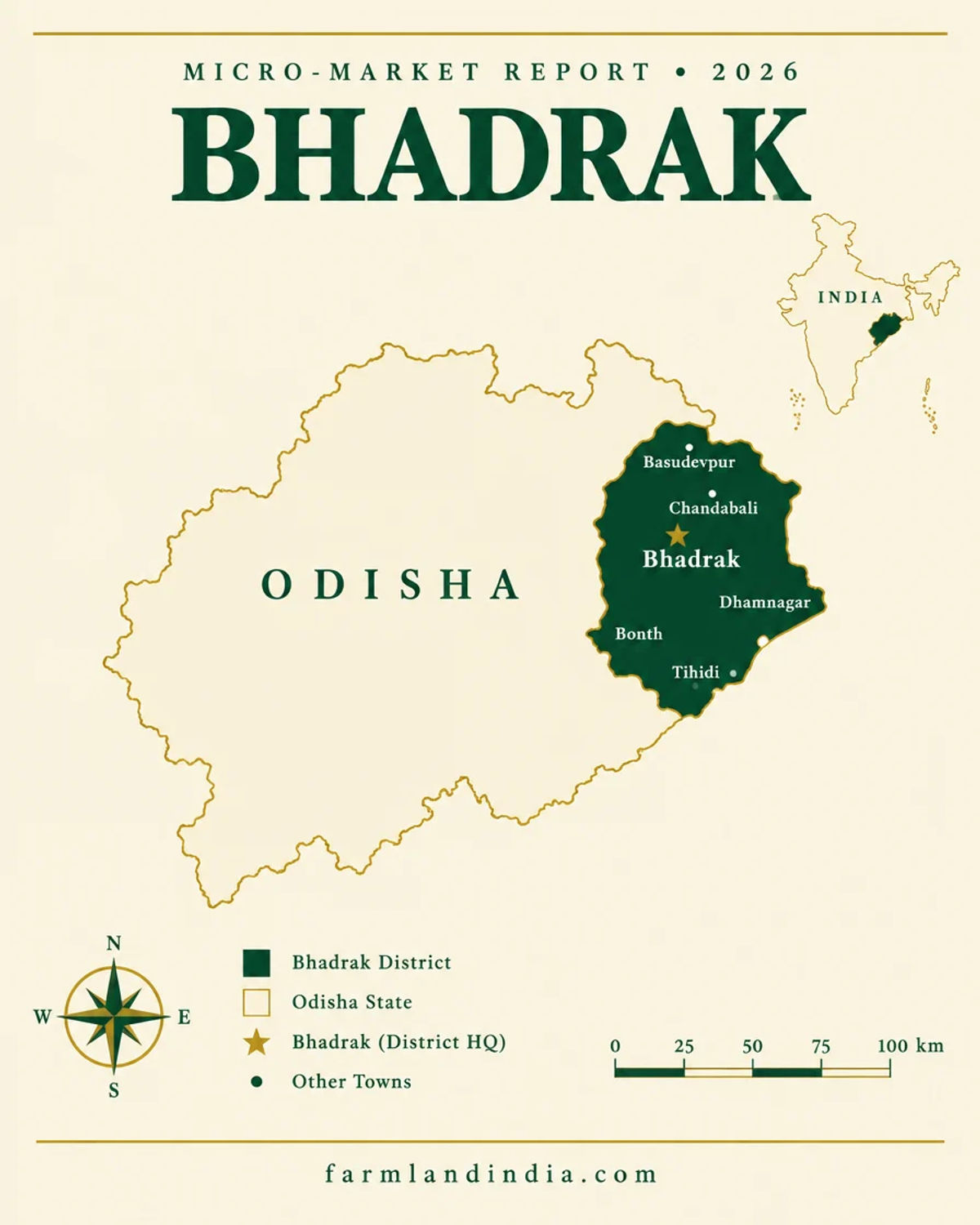
Bhadrak town, Basudevpur, Dhamnagar, Chandabali, Tihidi, Bonth and Bhandaripokhari.
Demand drivers
The Howrah–Chennai corridor, the Dhamra port, a ferro-chrome industry and fisheries on the coast.
Rail and road
Bhadrak station is on the Howrah–Chennai main line; Dhamra port connects to NH-16 by a two-lane road (see infrastructure).
Size and population
2,505 sq km and 15.06 lakh people (district portal).
Pricing
No newspaper or official price series found. Check the benchmark valuation and recent registered deeds.
Local terms
Khata and plot numbers; areas in acres and decimals; record of rights (RoR) for each khata.
Land records
Bhulekh Odisha[3] For RoR. Bhulekh and Bhu Naksha explain both.
Land law is state law. These rules are maintained on the Odisha page and apply to every district within it.
Bhadrak — land purchase legal rules
Odisha does not reserve farmland for farmers. What decides a purchase here is the seller’s caste and tribe status, whether the village lies in a Scheduled Area, how the land was first settled and the family ceiling under the Odisha Land Reforms Act, 1960 (OLR Act). Each of these can undo a registered sale years later, so check them before any money moves.
Who can buy: The Odisha Land Reforms Act, 1960 has no provision that limits agricultural land to farmers or to residents of Odisha. An Indian citizen from another state can buy raiyati (tenant-proprietor) land outside the Scheduled Areas, subject to the ceiling and to the caste and tribe checks below. In practice the seller, not the buyer, is where Odisha’s restrictions bite.
Ceiling limits: Under Section 37-A the ceiling is 10 standard acres for a family of up to five members, plus 2 standard acres for each additional member, with an absolute cap of 18 standard acres. One standard acre equals one acre of Class I land, 1.5 acres of Class II, 3 acres of Class III or 4.5 acres of Class IV land (Section 2), so on the poorest class the cap works out to about 81 ordinary acres. Up to 3 acres of homestead and tank land is left out of the count. Section 40 bars a holder above the ceiling from selling or partitioning until the surplus is settled (PRS copy of the Act).
Scheduled Caste and Scheduled Tribe sellers: Section 22 makes a sale by a Scheduled Tribe raiyat to a non-tribal void unless the Revenue Officer gives prior written permission, and for a sale that permission is granted only if no tribal buyer is willing to pay the market price. Section 22(5) applies the same rule to Scheduled Caste sellers. Under Section 23 the officer can declare the transfer invalid, restore the land to the seller or his heirs and fine the occupant up to Rs 200 an acre a year; the buyer does not get the price back, and Section 23-B puts the burden of proving a valid transfer on the buyer (OLR Act).
Scheduled Areas: In the Scheduled Areas, 119 of the state’s 314 blocks and about 44.7% of its area, the Orissa Scheduled Areas Transfer of Immovable Property (by Scheduled Tribes) Regulation, 1956 (Regulation 2 of 1956), as amended in 2002, places a complete ban on transfer of tribal land to non-tribals (CAG audit on land management in Scheduled Areas). A cabinet decision of 14 November 2023 to allow such transfers with the sub-collector’s permission was withheld within days (ThePrint, 17 November 2023), so the ban stands.
Conversion to non-farm use: Section 8-A lets a raiyat apply to the authorised officer to use agricultural land for other purposes, provided the change does not conflict with a master plan, development plan or town planning scheme. The fee table in the Act runs from Rs 3 lakh an acre within 0.5 km of specified national highways or inside municipal areas, through Rs 1 lakh near specified state highways and Rs 75,000 in other notified or urban areas, down to 5% of market value (minimum Rs 1,000) elsewhere; land already converted without permission pays half the rate on regularisation (PRS copy). Confirm the current rate at the Tahasil, because the PRS copy may not carry the latest amendment.
Government land: Government waste land is settled with individuals under the Odisha Government Land Settlement Act, 1962 (OGLS Act), on a premium and rent fixed by the state. A 2021 amendment lets long-term occupants of some land categories obtain heritable and transferable rights if they apply within the notified window; those who do not can be evicted. Leases settled under the Act often carry conditions, so read the settlement order and the RoR remarks before buying such a plot.
Market value and disputes: Stamp duty is charged on the higher of the deed price and the benchmark valuation. In September 2025 the Orissa High Court quashed blanket percentage hikes in Ganjam’s benchmark values as contrary to Rules 37, 40 and 41 of the Odisha Stamp Rules, 1952, and ordered fresh valuations (OdishaBytes, 3 September 2025).
Documents to check: The current RoR (Khatiyan) and plot details from Bhulekh, the mutation history at the Tahasil, an encumbrance search at the sub-registrar, the kisam (land class) entry, the seller’s caste and tribe status, and whether the village lies in a Scheduled Area. Our Bhulekh Odisha guide explains each field of the RoR.
NRI and OCI buyers: Under the RBI Master Direction on immovable property, NRIs and OCIs may not acquire agricultural land, farmhouses or plantations in India except by inheritance, and may sell such land only to a resident Indian citizen. Land lawfully converted to non-agricultural use is treated differently, so check the conversion order against the exact plot. Our NRI guide covers the options.
- No farmer-only rule found
- Ceiling: Section 37-A
- Cap: 18 standard acres
- SC/ST sales: Section 22
- Scheduled Areas: Regulation 2 of 1956
- Conversion: Section 8-A
- Government land: OGLS Act
- NRIs: inheritance only
Bhadrak — district-specific notes
Bhadrak’s law is straightforward: no tribal block and a small tribal population. Its difficulty is physical, with salt, flood and cyclone risk that decides whether a plot is usable. The state legal block above applies in full; these are the district points.
⚠ Scheduled Area status: no Bhadrak block appears in the ST & SC Development Department’s list of 121 Tribal Sub-Plan blocks[4], the closest published block-level list to the Scheduled Areas, so the Regulation 2 of 1956 ban does not appear to apply. The district portal counts about 25,000 Scheduled Tribe residents and 2.87 lakh Scheduled Caste residents, so the Section 22 check on Scheduled Caste sellers is the likelier one.
⚠ Ceiling and divided holdings: small family holdings are the norm in a densely farmed delta, so ceiling is rarely an issue. Divided inheritance is: insist on every co-owner’s signature and a clean mutation chain.
⚠ Coastal and port land: Dhamra port sits at the mouth of the Dhamra river in the district’s Chandabali area. Land close to the port, its rail doubling or the road upgrade may be notified for acquisition. Ask the Tahasildar before paying a token.
⚠ Salt-affected and tidal land: a plot in a saline block may be recorded as farmland but be unfit for crops. Ask for a soil and water test, and check for tidal embankment or creek restrictions that the RoR does not show.
The ceiling, SC/ST transfer and conversion rules are in the Odisha legal block above. NRIs should first read whether an NRI can buy agricultural land in India.
- No TSP-list blocks
- Saline coastal blocks
- Cyclone and flood zone
District overview
Bhadrak — a low coastal delta district with a major private port
Bhadrak is a small coastal district of 2,505 sq km with 15.06 lakh people, according to the district portal[5]. It has one sub-division, seven tahasils and seven blocks: Basudevpur, Bhadrak, Bhandaripokhari, Bonth, Chandabali, Dhamnagar and Tihidi. The Baitarani forms its southern boundary and the Salandi flows past the Bhadrakali temple. At least 75% of the annual rain falls from June to October.
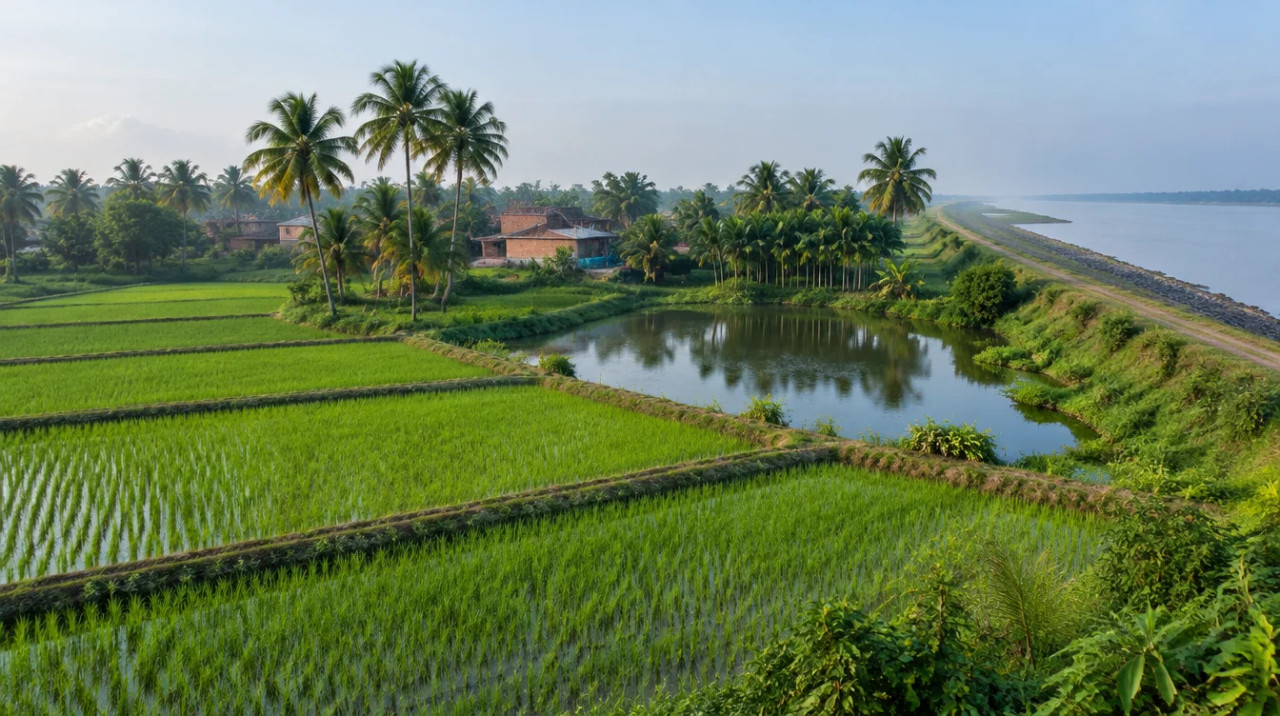
Farming here means rice. The portal says paddy covers about 94% of cultivable land in kharif, and coastal blocks such as Dhamara, Chudamani and Chandabali also depend on fishing. Industry is limited: the portal names FACOR, a large ferro-chrome plant, plus small rice mills and an ice factory. The larger driver is the Dhamra port, which sits on the coast of the same district and is expanding.
For a buyer, Bhadrak is two districts in one. Inland blocks along the Howrah–Chennai corridor are alluvial paddy land with workable groundwater. The coastal fringe is a different market, where salt in the soil and water, cyclone surge and tidal flooding limit what the land can do. Tribal land rules barely arise, since the Scheduled Tribe population is only about 25,000; the checks that matter are water, flood history and co-heir consent. Flood and cyclone exposure also affects what you can build: raised plinths, cyclone-resistant design and insurance cover are worth pricing in before you pay.
- Delta farmland
- Dhamra port
- Chandabali
- Saline blocks
- Arsenic watch
Transaction costs
Stamp duty & registration in Bhadrak
5% / 4%
Stamp duty on a sale deed
5% in general; 4% when a woman buys, per IGR Odisha
Mainly 2%
Registration fee
Of the deed value, per IGR Odisha; other deeds vary
Higher of two
Duty base
Deed price or benchmark valuation, whichever is higher
The rates are from the IGR Odisha FAQ[6], which is undated, so confirm them at the sub-registrar office before you sign. The benchmark valuation is revised every two years from 1 April, and duty follows whichever of deed price and valuation is higher, so a salt-affected plot priced low can still be taxed at the valuation. Budget for a title search across co-heirs and for mutation afterwards. If the plot is in a coastal block, ask the sub-registrar how the benchmark valuation treats salt-affected or tidal land, since the valuation table may not distinguish it from good paddy land.
Know the belt
What is moving prices in Bhadrak
Reported port, rail and coastal developments; no listing-site prices are used.
Bhadrak town and Bonth
District core on the corridor
Bhadrak town is the headquarters and the railhead for the Dhamra port line, which joins the main line at Bhadrak/Ranital. The ICAR-CRIDA plan classes most soils in the district as alluvial, with acid soils next. The tahasil and sub-registrar offices for the surrounding blocks are within reach of the town, which keeps deal logistics simpler than for remote coastal plots.
Check: the plot’s flood history and drainage, and whether it lies in a notified planning area.
Chandabali and Dhamra
Port and coast
Chandabali block holds the Dhamra coast, with the largest salinity-affected area in a 2023 report (62,044 hectares of groundwater of very low quality). The Dhamra port is expanding, but a rail doubling, a four-lane road upgrade and 49 MTPA of added capacity are described as announced or under way, not complete.
Check: port, road and rail notifications, and saline soil and water.
Basudevpur, Dhamnagar and Tihidi
Saline farm blocks
The 2023 report lists all three as fully saline for groundwater, and the ICAR-CRIDA plan notes salt-affected soils of 7.7% of the district. Rice is still grown, but irrigation depends on lifting river and canal water rather than on borewells.
Check: salinity in the plot’s own borewell, and access to a canal or river lift point.
Bhandaripokhari and inland Bonth
Inland paddy belt
Inland blocks are not listed among the saline ones.
Check: arsenic in drinking water (Bhadrak appears in CGWB’s 2024 arsenic list), and road access in the monsoon.
Asking prices
Use the benchmark valuation for the village and recent registered deeds nearby.
Connectivity
How Bhadrak connects — road, rail and air
On the main Kolkata–Chennai corridor and next to a major port.
🚗 By road
✈️ By air
🚆 By rail
Port and rail details come from a July 2026 industry report. Confirm routes and distances with NHAI and Indian Railways, and treat proposed lines as unapproved until a sanction is published.
Growth catalysts
Upcoming infrastructure & developments
Status labels reflect sources read in November 2026. Government-announced timelines are not guaranteed; items with a single or older source say so.
01Open
04Catalysts
Agriculture & terrain
Soil, crops & water in Bhadrak
Crops, soils, irrigation and water from ICAR-CRIDA’s district plan (undated; 2008–09 figures), the district portal and 2023–24 water reports.
Crops
The ICAR-CRIDA plan[8] gives paddy 1.79 lakh ha (about 5.14 lakh tonnes), blackgram 9,600 ha, greengram 7,000 ha, groundnut 1,700 ha and mustard 1,200 ha, with net sown area of 1.73 lakh ha and cropping intensity of 138%. Rice-fallow is the commonest system, and the plan advises cutting rabi rice in canal lowlands when water is short.
- Paddy (about 1.79 lakh ha)
- Blackgram and greengram
- Groundnut and mustard
- Okra, potato and pumpkin
- Mango, guava and citrus
Soils
Alluvial soils cover 56.9% of the district, acid soils 27.3%, salt-affected soils 7.7%, sandy soils 7.4% and laterite 0.3%. Salt-affected land is concentrated in the coastal blocks, so a soil test is essential east of the highway.
- Alluvial (about 57%)
- Acid soils (about 27%)
- Salt-affected (about 8%)
- Sandy (about 7%)
Horticulture and fisheries
Mango is the largest fruit crop at 4,500 ha, then guava (880 ha) and citrus (820 ha). Okra is the main vegetable at 2,651 ha. The district portal adds that coastal areas such as Dhamara, Chudamani and Chandabali also depend on fishing, which brings pond and creek land with separate licences.
- Mango and guava
- Okra and potato
- Coastal fishing
- Pond aquaculture
Water and groundwater
The plan classes all seven blocks safe by quantity, with lift irrigation supplying 33.8% of the irrigated area, bore wells 29.5% and canals only 3.6%. Quality is the problem: groundwater is saline in parts of Basudevpur, Chandabali, Tihidi and Dhamnagar, and a 2023 report[9] lists those four as fully saline, citing a 1995–2001 survey. CGWB’s 2024 assessment[10] lists Bhadrak among districts with arsenic above 10 ppb.
Rainfall, floods and cyclones
The plan gives normal rainfall of 1,427.6 mm, 1,020 mm of it in the south-west monsoon. Floods and cyclones are marked regular hazards in the plan, with sea-water inundation and drought occasional. The Baitarani and Salandi rivers cross the district. Ask villagers how deep and how long past floods stayed.
At a glance
Bhadrak vs. nearby districts
| District | Land and water | What links it to Bhadrak |
|---|---|---|
| Balasore | Nilgiri is the only block on the Tribal Sub-Plan list; partly saline coast | Northern neighbour on the same corridor and coast |
| Kendrapara | Four fully and five partly saline blocks in the 2023 report | Southern neighbour across the Baitarani; similar delta risks |
| Jajpur | Three fully saline blocks in the 2023 report | South-western neighbour, linked to Dhamra by a proposed rail line |
| Keonjhar | Ten blocks on the Tribal Sub-Plan list; mining district | Western neighbour; tribal-land rules apply far more widely than in Bhadrak |
Tribal Sub-Plan listings are from the ST & SC Development Department’s block list; they are a guide to Scheduled Area status, not the Scheduled Areas Order itself.
Farmland India view
Why investors look at Bhadrak
Five reasoned points for Bhadrak, each tied to a source on this page.
A port with a long runway
Dhamra is a large private port with a 100 million tonne target, but the expansion is announced, not commissioned. Land near it carries acquisition risk and speculation; land elsewhere does not share the benefit.
Rail and road upgrades are plans
The line doubling is under way, the Jajpur–Keonjhar Road link has only a DPR, and the NH-16 upgrade has no sanction date in the report. Price only what is built.
Clean legal map, physical risks
No block is on the Tribal Sub-Plan list and the tribal population is small, so legal checks are lighter than in tribal districts. The cost sits in salt, floods and arsenic.
Inland beats coastal for farming
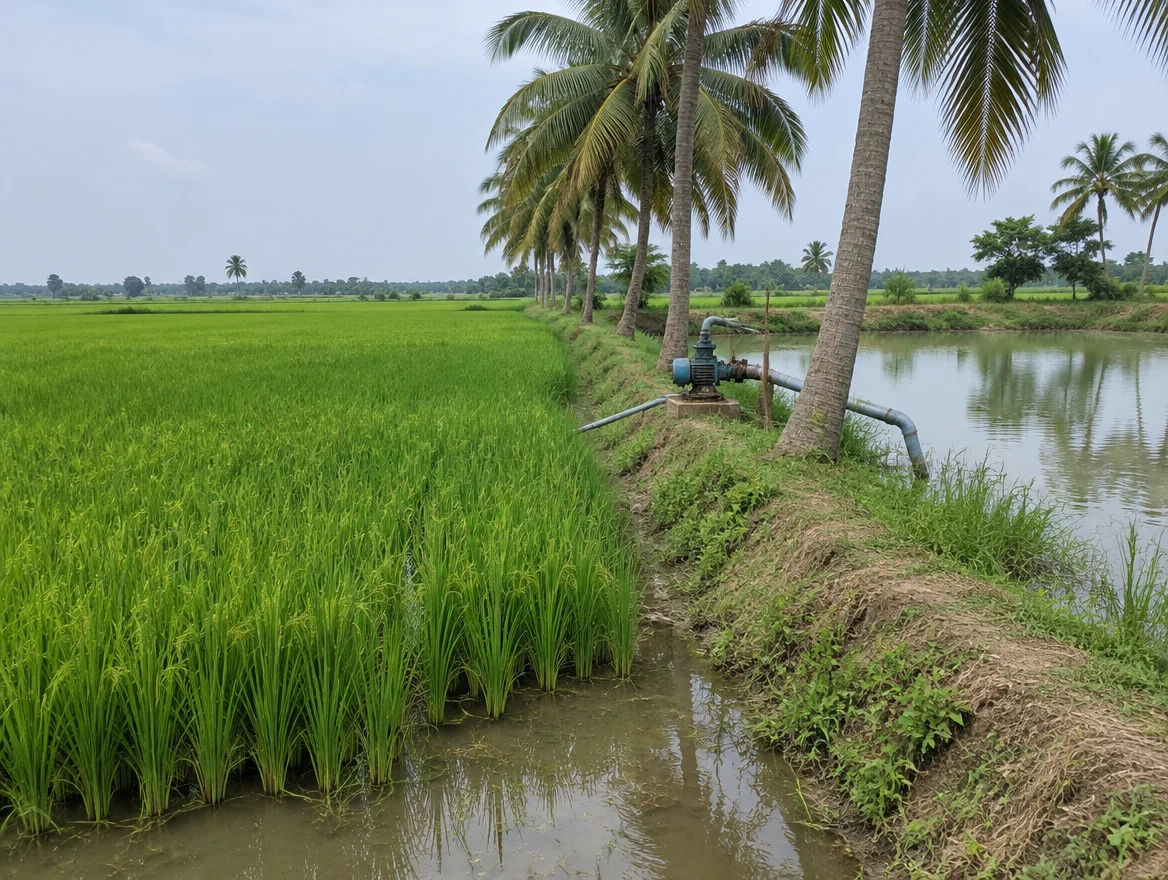
Inland blocks have alluvial soils and workable water. The four fully saline blocks need an irrigation plan before the land is usable. Lift irrigation supplies 33.8% of irrigated area and borewells 29.5% in the ICAR-CRIDA plan, so pump power connection and lifting cost matter more than at canal-fed districts.
Divided holdings slow deals
Small, heavily divided plots mean long title chains. Budget time for every co-heir’s signature.
Confirm the benchmark valuation, salinity and any port or rail notice at the Tahasil before you pay a token.
STRAIGHT TALK
Risks & challenges in Bhadrak
District-specific risks. Read the Odisha state page for the general risks on ceiling, conversion and records.
Saline groundwater
Chandabali, Basudevpur, Dhamnagar and Tihidi are listed as fully saline in a 2023 report, and parts of those blocks are saline in the ICAR-CRIDA plan.
Arsenic
CGWB’s 2024 assessment lists Bhadrak among districts with arsenic above 10 ppb in places. Test drinking water.
Floods and cyclones
The plan marks floods and cyclones as regular hazards. Low coastal plots can be inundated by sea water on occasion.
Salt-affected soil
About 7.7% of soils are salt-affected and unsuitable for ordinary crops without reclamation.
Port and rail notifications
Land near Dhamra and the rail doubling may be notified for acquisition.
Divided ownership
Many co-heirs mean unsigned consent can undo a sale. Insist on all signatures and a clean mutation chain.
Coastal regulation and aquaculture
Plots near the coast and creeks can carry restrictions or unlicensed ponds; the RoR will not show these.
Records mismatch
Check that the RoR owner, khata and plot numbers and area match the ground, and apply for mutation after registration.
Who to contact
Local revenue & planning offices
The Collectorate is at Bhadrak town; land matters sit with the Tahasildar of each of the seven tahasils. RoR corrections, mutation and certified copies start there; conversion under Section 8-A goes to the authorised officer. The sub-registrar office that covers your village registers the deed, and you can confirm which one on the IGR Odisha site. Check the village map on Bhu Naksha Odisha before visiting.
COMMON QUESTIONS
Frequently asked questions
Everything buyers, NRIs and investors ask before their first reviewed farmland purchase in Bhadrak.
Visit full wiki01 of 04
Can an outsider or an NRI buy farmland in Bhadrak?
An Indian citizen from another state can buy raiyati land, subject to the ceiling and the seller checks. NRIs face FEMA limits on agricultural land; read the NRI guide first.
02 of 04
Is Bhadrak a Scheduled Area?
No Bhadrak block appears in the state’s list of 121 Tribal Sub-Plan blocks, so the Scheduled Area ban under Regulation 2 of 1956 does not appear to apply. Scheduled Tribe residents number about 25,000, so the seller checks under Sections 22 and 23 of the OLR Act rarely arise but still apply.
03 of 04
What stamp duty and registration fee apply in Bhadrak?
Per IGR Odisha, stamp duty is 5% on a sale deed, or 4% when a woman buys, and the registration fee is mainly 2%. Duty is charged on the higher of the deed price and the benchmark valuation, revised every two years from 1 April.
04 of 04
Is groundwater safe to use in Bhadrak?
Not everywhere. A 2023 report lists Chandabali, Basudevpur, Dhamnagar and Tihidi as fully saline blocks, and CGWB’s 2024 assessment names Bhadrak among districts with arsenic above 10 ppb in places. Test borewell water on any plot you consider.
Transparency
Sources and references
Law and courts
Government
- [2]Odisha Annual Reference 2017: districts, tahsils and blocks — magazines.odisha.gov.in
- [3]bhulekh.ori.nic.in: Bhulekh Odisha — bhulekh.ori.nic.in
- [4]stsc.odisha.gov.in: ST & SC Development Department’s list of 121 Tribal Sub-Plan blocks — stsc.odisha.gov.in
- [5]bhadrak.odisha.gov.in: district portal — bhadrak.odisha.gov.in
- [6]igrodisha.gov.in: IGR Odisha FAQ — igrodisha.gov.in
- [7]maritimegateway.com: Maritime Gateway, 15 July 2026 — maritimegateway.com
- [8]kvk.icar.gov.in: ICAR-CRIDA plan — kvk.icar.gov.in
- [9]orissapost.com: 2023 report — orissapost.com
- [10]cgwb.gov.in: 2024 assessment — cgwb.gov.in
Project status, valuation rates and rules change often; check the linked source and the relevant office before relying on any figure.
For developers
Ready to explore Bhadrak farmland?
Browse reviewed projects and individual land parcels across Bhadrak — or if you own land here, list it with platform review and reach serious buyers.