
District guide
Buying Land in Kalahandi
A rice and cotton district with big irrigation plans, a stalled rail workshop, the Lanjigarh refinery and two Scheduled Area blocks.
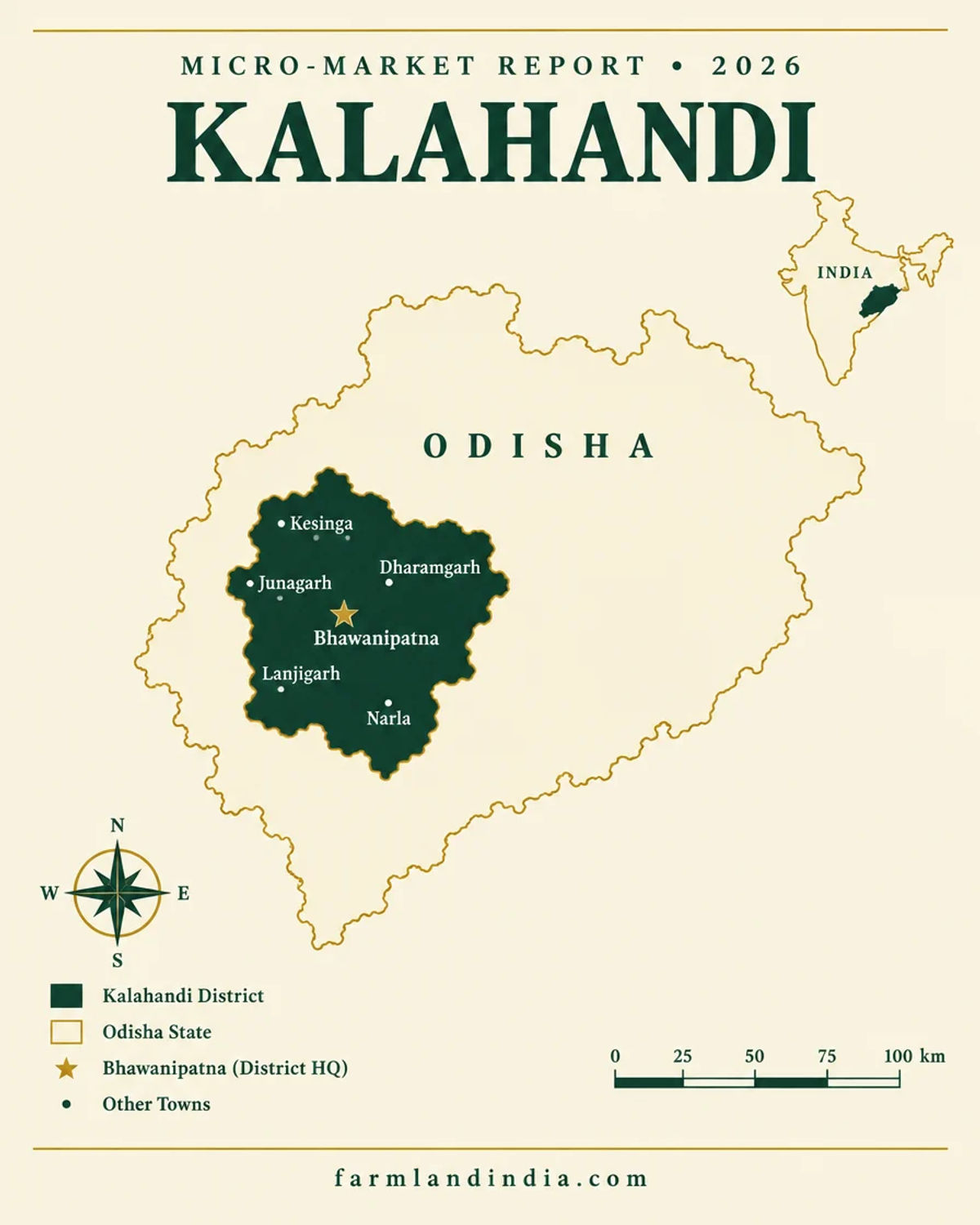
7,920 sq km
Area (KBK profile)
13
Community development blocks (KBK profile)
Lanjigarh, Thuamul Rampur
Scheduled Area blocks (ST and SC list)
Rs 891.39 crore
Projects unveiled, Jan 2026 (OrissaPOST)
*Indicative range across districts and land types. Stamp duty, registration and conversion charges are additional. Local measurement units vary — every listing states the unit it is priced in. Not a valuation or an offer.
District land record — Kalahandi
Rev. 2026 · Farmland India desk
State
Odisha
Sub-divisions
Two sub-divisions, 13 blocks and 13 tahasils in the KBK profile; blocks include Bhawanipatna, Kesinga, Narla, Lanjigarh, Karlamunda and Thuamul Rampur. The headquarters is Bhawanipatna.
Key markets
Bhawanipatna · Kesinga · Junagarh · Dharmagarh · Narla · Lanjigarh
Demand anchors
Irrigation works announced in January 2026, the Narla loco workshop plan and Vedanta’s Lanjigarh refinery.
Rail
Kesinga and Junagarh on the East Coast Railway network; check Indian Railways for current passenger services.
Size and population
7,920 sq km, with 2,236 revenue villages, per the KBK profile.
Pricing unit
Quote land by the acre. Ask the sub-registrar for the village-wise benchmark valuation before you compare offers.
Local units
Sellers in Odisha often quote in decimal (dismil) or kanal; 100 decimals make one acre. Ask for the area in acres as recorded in the RoR.
Land records portal
Bhulekh Odisha (bhulekh.ori.nic.in) for the RoR and plot details; see our Bhu Naksha Odisha guide for maps.
Land law is state law. These rules are maintained on the Odisha page and apply to every district within it.
Kalahandi — land purchase legal rules
Odisha does not reserve farmland for farmers. What decides a purchase here is the seller’s caste and tribe status, whether the village lies in a Scheduled Area, how the land was first settled and the family ceiling under the Odisha Land Reforms Act, 1960 (OLR Act). Each of these can undo a registered sale years later, so check them before any money moves.
Who can buy: The Odisha Land Reforms Act, 1960 has no provision that limits agricultural land to farmers or to residents of Odisha. An Indian citizen from another state can buy raiyati (tenant-proprietor) land outside the Scheduled Areas, subject to the ceiling and to the caste and tribe checks below. In practice the seller, not the buyer, is where Odisha’s restrictions bite.
Ceiling limits: Under Section 37-A the ceiling is 10 standard acres for a family of up to five members, plus 2 standard acres for each additional member, with an absolute cap of 18 standard acres. One standard acre equals one acre of Class I land, 1.5 acres of Class II, 3 acres of Class III or 4.5 acres of Class IV land (Section 2), so on the poorest class the cap works out to about 81 ordinary acres. Up to 3 acres of homestead and tank land is left out of the count. Section 40 bars a holder above the ceiling from selling or partitioning until the surplus is settled (PRS copy of the Act).
Scheduled Caste and Scheduled Tribe sellers: Section 22 makes a sale by a Scheduled Tribe raiyat to a non-tribal void unless the Revenue Officer gives prior written permission, and for a sale that permission is granted only if no tribal buyer is willing to pay the market price. Section 22(5) applies the same rule to Scheduled Caste sellers. Under Section 23 the officer can declare the transfer invalid, restore the land to the seller or his heirs and fine the occupant up to Rs 200 an acre a year; the buyer does not get the price back, and Section 23-B puts the burden of proving a valid transfer on the buyer (OLR Act).
Scheduled Areas: In the Scheduled Areas, 119 of the state’s 314 blocks and about 44.7% of its area, the Orissa Scheduled Areas Transfer of Immovable Property (by Scheduled Tribes) Regulation, 1956 (Regulation 2 of 1956), as amended in 2002, places a complete ban on transfer of tribal land to non-tribals (CAG audit on land management in Scheduled Areas). A cabinet decision of 14 November 2023 to allow such transfers with the sub-collector’s permission was withheld within days (ThePrint, 17 November 2023), so the ban stands.
Conversion to non-farm use: Section 8-A lets a raiyat apply to the authorised officer to use agricultural land for other purposes, provided the change does not conflict with a master plan, development plan or town planning scheme. The fee table in the Act runs from Rs 3 lakh an acre within 0.5 km of specified national highways or inside municipal areas, through Rs 1 lakh near specified state highways and Rs 75,000 in other notified or urban areas, down to 5% of market value (minimum Rs 1,000) elsewhere; land already converted without permission pays half the rate on regularisation (PRS copy). Confirm the current rate at the Tahasil, because the PRS copy may not carry the latest amendment.
Government land: Government waste land is settled with individuals under the Odisha Government Land Settlement Act, 1962 (OGLS Act), on a premium and rent fixed by the state. A 2021 amendment lets long-term occupants of some land categories obtain heritable and transferable rights if they apply within the notified window; those who do not can be evicted. Leases settled under the Act often carry conditions, so read the settlement order and the RoR remarks before buying such a plot.
Market value and disputes: Stamp duty is charged on the higher of the deed price and the benchmark valuation. In September 2025 the Orissa High Court quashed blanket percentage hikes in Ganjam’s benchmark values as contrary to Rules 37, 40 and 41 of the Odisha Stamp Rules, 1952, and ordered fresh valuations (OdishaBytes, 3 September 2025).
Documents to check: The current RoR (Khatiyan) and plot details from Bhulekh, the mutation history at the Tahasil, an encumbrance search at the sub-registrar, the kisam (land class) entry, the seller’s caste and tribe status, and whether the village lies in a Scheduled Area. Our Bhulekh Odisha guide explains each field of the RoR.
NRI and OCI buyers: Under the RBI Master Direction on immovable property, NRIs and OCIs may not acquire agricultural land, farmhouses or plantations in India except by inheritance, and may sell such land only to a resident Indian citizen. Land lawfully converted to non-agricultural use is treated differently, so check the conversion order against the exact plot. Our NRI guide covers the options.
- No farmer-only rule found
- Ceiling: Section 37-A
- Cap: 18 standard acres
- SC/ST sales: Section 22
- Scheduled Areas: Regulation 2 of 1956
- Conversion: Section 8-A
- Government land: OGLS Act
- NRIs: inheritance only
Kalahandi — district-specific notes
The Odisha state page applies in full: the ceiling, the rules on tribal and Scheduled Caste sellers and the conversion route are set out above. These notes cover what is specific to Kalahandi.
⚠ Kalahandi is partly a Scheduled Area. The ST and SC Development Department’s sub-plan block list names Thuamul Rampur and Lanjigarh, and the KBK profile also counts two tribal sub-plan blocks. In a Scheduled Area, Regulation 2 of 1956 bars the transfer of tribal land to non-tribals. Check the village with the Tahasildar before you pay.
⚠ Several large projects need land. The Utei Raul irrigation project, the Belgaon inter-state reservoir and the Sandul barrage were named in January 2026, and the Narla loco workshop needed more than 300 acres. Ask the Tahasil whether the village is in an acquisition notification before paying an advance.
⚠ Irrigation command land and canal margins are public land in part. A canal, a distributary or a drainage line may cross a field that looks private, so read the map and the RoR remarks.
⚠ The Lanjigarh refinery area is tribal-dominated and has a history of land and forest disputes. Land near the refinery or in the Niyamgiri foothills needs careful checking of the seller, the forest entry and any Forest Rights Act claim.
⚠ Forest and hill land cover a large part of western Kalahandi. A plot with a forest entry in the RoR cannot be sold as farmland, so read the kisam before you pay.
Read the full Odisha land buying guide on the state page for the ceiling, tribal-seller and conversion rules.
- Two Scheduled Area blocks
- Irrigation project land
- Rail workshop land
- Refinery area
- Forest and hill land
District overview
Kalahandi — a rice and cotton district with big irrigation plans, a stalled rail workshop and Scheduled Area blocks
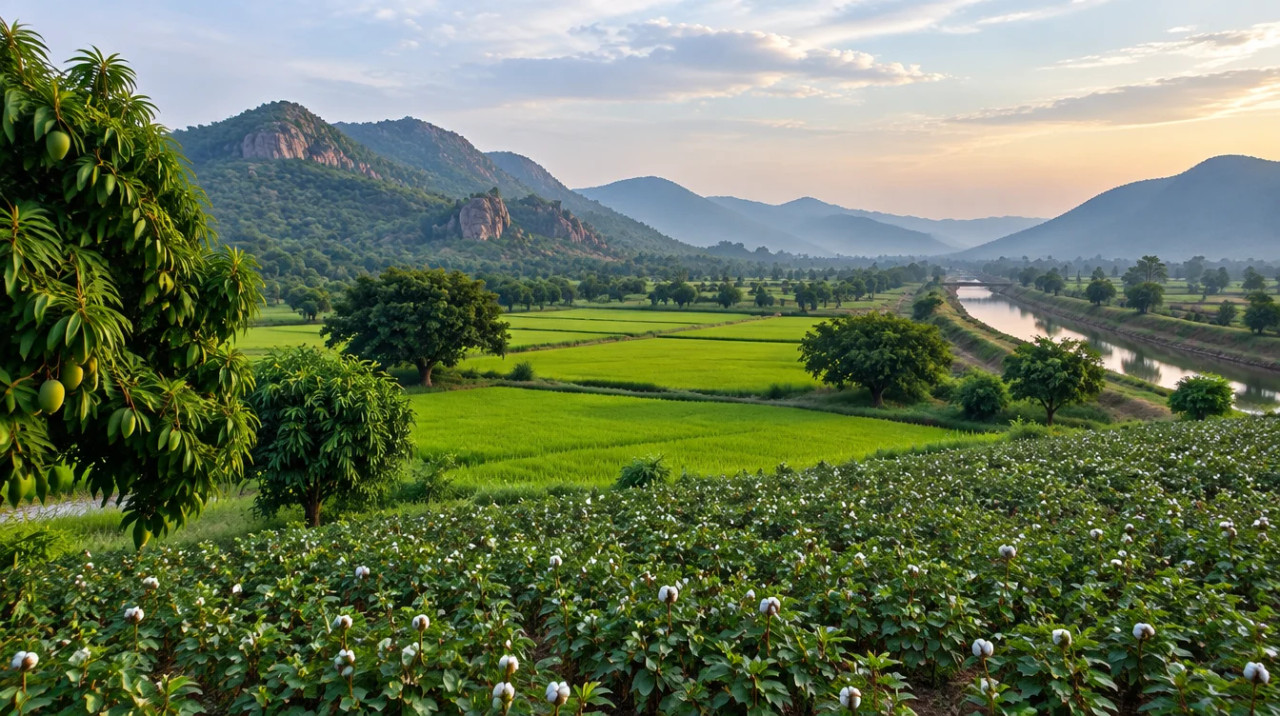
Kalahandi is a district of western Odisha covering 7,920 sq km, with its headquarters at Bhawanipatna. The KBK profile lists 13 community development blocks, including two tribal sub-plan blocks, two sub-divisions, 13 tahasils and 2,236 revenue villages. It lies in the Eastern Ghats, with hills, forests and several rivers. Bhawanipatna, Kesinga, Junagarh and Dharmagarh are the main towns, and the district’s old name is tied to the KBK region, a group of districts that have long been the focus of state development schemes.
Farming here means rice and cotton, helped by the Indravati irrigation project’s command. In January 2026 the chief minister unveiled 3,612 projects worth Rs 891.39 crore, named the Utei Raul irrigation project, the Belgaon reservoir and the Sandul barrage, and announced a Kalahandi–Nabarangpur cotton cluster. Vedanta’s Lanjigarh alumina refinery, set up in 2003, is the district’s main industrial site.
For farmland buyers, Kalahandi is about irrigated farmland and what it needs. Buy inside the canal command and the plot has water; buy outside it and you depend on rain or a borewell. Two blocks are Scheduled Areas, and large public projects can reach any village. The district publishes little in the way of land price data, so the benchmark valuation and registered deeds are the references. If you are buying as an outsider, start with the block, then the canal command, then the village’s Scheduled Area status; in that order the district narrows quickly to a handful of workable pockets.
- Bhawanipatna HQ
- Kesinga
- Narla
- Dharmagarh
- Lanjigarh
Transaction costs
Stamp duty & registration in Kalahandi
5%
Stamp duty, sale deed
On the higher of deed price and benchmark valuation
4%
Stamp duty, woman buyer
Same base, lower rate when a woman buys
2%
Registration fee, mainly
Per IGR Odisha FAQ (undated)
Per IGR Odisha[5], the registration fee is mainly 2%. Duty is charged on the higher of the deed price and the benchmark valuation, which is revised every two years from 1 April. Ask the sub-registrar for the village-wise value in Kalahandi and keep a written copy. After registration, apply for mutation at the Tahasil so the RoR shows your name.
Know the belt
What is moving prices in Kalahandi
Headquarters, rail, canal-command and Scheduled Area pockets; no listing-site prices are used.
Bhawanipatna and Kesinga
Headquarters and rail town
Bhawanipatna is the headquarters and the main market town, and Kesinga is the rail town. Plots near either are bought for housing, storage and later use, and for the irrigated fields beyond. The surrounding fields are mostly paddy, so a plot on the town’s edge is also a choice between a farm income and a building plot.
Check: the municipal or notified-area limit, the canal or road alignment and the access in the monsoon.
Narla and Junagarh
Rail workshop and rail projects
Narla was planned as the site of an electric loco workshop, sanctioned at Rs 186.37 crore and needing more than 300 acres, of which 141 acres had been provided by August 2021. Junagarh is named in rail projects, including a line toward Ambaguda and one to Dharmagarh. Rail land is acquired under the railway land laws, and compensation depends on the notification date, so a purchase made after a notification may not carry the price you paid.
Check: whether the village is in a rail or workshop notification, and the present status of the workshop; the report is from 2021.
Dharmagarh and the canal belt
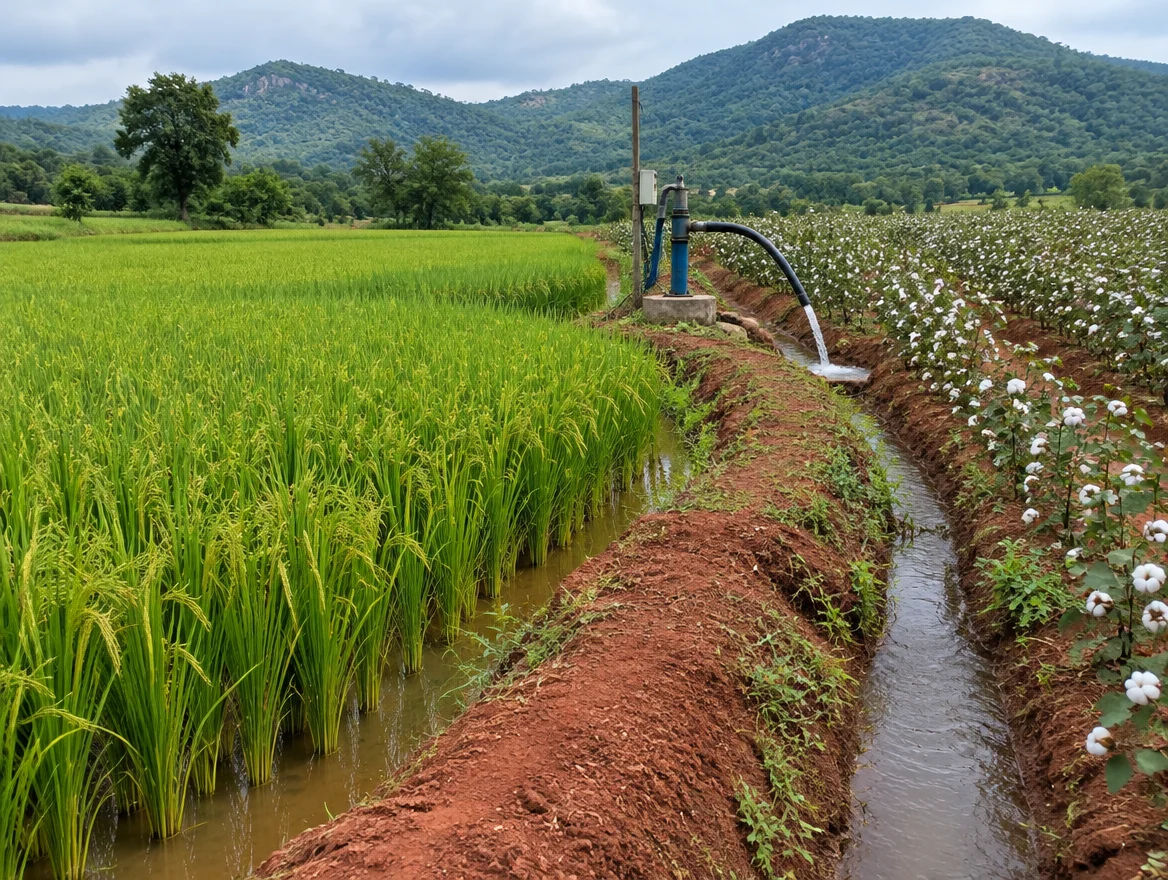
Rice and cotton on canal water
Dharmagarh and nearby blocks sit on the Indravati command, where rice and cotton are the staple crops. Buyers here are mostly farmers and investors who want an irrigated plot with a clean title. Ask neighbouring farmers which crop the plot has actually grown in the last three seasons, and whether canal water reached it in the dry months.
Check: the canal outlet serving the plot, the water-tax record and the previous seasons’ crop.
Lanjigarh and Thuamul Rampur
Scheduled Area blocks
These two blocks are on the ST and SC sub-plan list, and Lanjigarh holds Vedanta’s alumina refinery. Tribal land cannot pass to a non-tribal buyer, so the seller’s identity and the village’s status are the first checks. Forest and hill land is common in these blocks, so the kisam entry in the RoR deserves extra attention before any money is paid.
Check: the seller’s tribe status, the Scheduled Area status of the village and any forest or refinery-related restriction.
Asking prices
None is shown. Use the village-wise benchmark valuation from the sub-registrar and recent registered deeds in the same village as your references.
Connectivity
How Kalahandi connects — road, rail and air
A rail network at Kesinga and Junagarh, state and national roads, and no large airport in the district.
🚗 By road
✈️ By air
🚆 By rail
No drive times are shown because road works and traffic vary; check the NHAI project pages and the local offices before relying on a figure.
Growth catalysts
Upcoming infrastructure & developments
Status labels reflect sources read in November 2026. Government-announced timelines are not guaranteed; items with a single or older source say so.
01Open
04Catalysts
Agriculture & terrain
Soil, crops & water in Kalahandi
A rice and cotton district on the Indravati canal command, with hills and forest in the west and Scheduled Area blocks in the south.
Crops
Rice and cotton are the district’s main crops, and a cotton production cluster with Nabarangpur was announced in 2026. The sources read give no area figures, so none are shown.
- Rice, the staple
- Cotton
- Pulses and oilseeds
- Vegetables near towns
Terrain
Kalahandi is part of the Eastern Ghats, with hills, forest and several rivers and streams. Upland plots are drier and stonier, while valley land along the canals is the productive paddy and cotton land. Take a soil test before you commit to cotton or rice, because upland and valley soils behave very differently.
- Hills and forest
- Valley paddy land
- Canal-fed fields
Water
The Indravati irrigation project’s command is the best-watered farmland, and the Utei Raul, Belgaon and Sandul projects are announced additions. Ask for the outlet number and the water-tax record for any plot you are shown.
- Indravati command
- Utei Raul project
- Sandul barrage
Water and irrigation
The Indravati irrigation project’s command area is the main irrigated belt, and large new projects were announced in January 2026. Plots outside the command rely on rain, tanks or borewells, so ask for the outlet number and the water-tax record.
Climate and rainfall
No rainfall figure is given. Western Odisha has hot summers and a monsoon-dependent rice crop, so a plot with a reliable irrigation source is worth more than one without.
At a glance
Kalahandi vs. nearby districts
| District | Land and water | What links it to Kalahandi |
|---|---|---|
| Kandhamal (east) | Hill district; Scheduled Area | All its blocks are on the ST and SC sub-plan list, so tribal-land rules apply across the district. |
| Rayagada (south) | Hills and tribal blocks | Lanjigarh sits near the Rayagada border; the 2025 refinery rally drew residents from both districts. |
| Nabarangapur (south-west) | Cotton and tribal blocks | Named with Kalahandi in the proposed cotton production cluster. |
| Bolangir (north) | Dry plain and the KBK belt | Another KBK-region district where irrigation and tribal land are central. |
No price series is shown for any neighbouring district here. Compare benchmark valuations and registered deeds, not asking prices.
Farmland India view
Why investors look at Kalahandi
Five reasoned points for Kalahandi, each tied to a source on this page.
Irrigated plots are the safest farming buy
Inside the Indravati command a plot has water, and that matters in a monsoon-dependent district. Verify the canal outlet and the water-tax record. A plot at the tail end of a distributary often gets water last, so ask a neighbour as well as the department.
Announced irrigation is not irrigation yet
The Utei Raul project is approved and said to be starting, but a Rs 3,325 crore project takes years. Do not pay for water that has not arrived. If the project is built, the land it irrigates should gain, but land it submerges or divides will lose, so check the alignment before you buy.
A stalled workshop is a caution on rail land
The Narla loco workshop waited on land from 2021. Treat rail and workshop announcements as slow. The same applies to the rail lines named in 2021, which are plans until the Railways publish a notification.
Two blocks need tribal-law diligence
Thuamul Rampur and Lanjigarh are Scheduled Area blocks, so the village and the seller’s identity must be checked before you buy. Ask the Tahasildar for a village-wise status letter and keep it with the sale papers.
Cotton is a policy bet
The cotton cluster is announced without a site or cost, so it supports crop choice more than price. Do not pay a premium for cotton land unless the plot has proven irrigation.
Confirm the RoR, mutation history, kisam, CRZ or flood status and any acquisition notice before paying a token amount.
STRAIGHT TALK
Risks & challenges in Kalahandi
District-specific risks. Read the Odisha page for the general risks on ceiling, tribal sellers, conversion and records.
Scheduled Area blocks
In Thuamul Rampur and Lanjigarh, tribal land cannot pass to non-tribals under Regulation 2 of 1956. A registered sale can still be undone. A lawyer’s title search should cover every previous owner for the last thirty years.
Project acquisition
Irrigation works, a reservoir, a barrage and a rail workshop all need land. A village in a notification can see sales restricted.
Monsoon dependence
Outside the canal command a crop depends on rain, and drought has been a recurring problem in the region. A failed monsoon can reduce income sharply on rain-fed plots.
Forest and hill land
Forest entries in the RoR block a farmland sale. Check the kisam and any Forest Rights Act claim.
Refinery-area disputes
Land near the Lanjigarh refinery has a history of tribal and forest disputes that can affect title and use. Ask for a written note on the refinery’s boundary and any buffer zone before you buy nearby.
Who to contact
Local revenue & planning offices
The Collectorate is at Bhawanipatna, with Tahasil offices across the blocks; the district website[8] lists them. Registration is at the sub-registrar office for your village, and IGR Odisha[9] provides the registration services. Use the Tahasil for mutation and the RoR, the irrigation department for canal and outlet questions, and the Railways for any workshop or line acquisition. For title disputes the Tahasildar is the first forum, and for forest entries the forest division office should be asked.
COMMON QUESTIONS
Frequently asked questions
Everything buyers, NRIs and investors ask before their first reviewed farmland purchase in Kalahandi.
Visit full wiki01 of 04
Is Kalahandi a Scheduled Area?
Partly. The ST and SC Development Department’s sub-plan block list names the Thuamul Rampur and Lanjigarh blocks of Kalahandi, where Regulation 2 of 1956 bars the transfer of tribal land to non-tribals. The rest of the district is not on the list, but confirm the exact village with the Tahasildar.
02 of 04
What is the stamp duty on land in Kalahandi?
Odisha charges 5% stamp duty on a sale deed, 4% when a woman buys, and a registration fee of mainly 2% per IGR Odisha. Duty is on the higher of the deed price and the benchmark valuation, which is revised every two years from 1 April.
03 of 04
Is there a price guide for farmland in Kalahandi?
None is shown. Use the village-wise benchmark valuation from the sub-registrar and registered deeds in the same village as your references.
04 of 04
Which projects matter for Kalahandi land?
Large irrigation works, including the Utei Raul project, were announced in January 2026, and a Kalahandi–Nabarangpur cotton cluster was proposed. The electric loco workshop at Narla was stalled in 2021 for want of land. Vedanta’s Lanjigarh refinery has run without permanent bauxite mines. Treat each as announced or reported, not built.
Transparency
Sources and references
Government
- [1]KBK districts profile (kbk.nic.in) — kbk.nic.in
- [2]Odisha Annual Reference 2011: districts, sub-divisions, tahasils and blocks — magazines.odisha.gov.in
- [3]ST and SC Development Department: TSP blocks list — stsc.odisha.gov.in
News
- [4]OrissaPOST, 9 Jan 2025: locals demand bauxite mines for Vedanta — orissapost.com
- [5]igrodisha.gov.in: IGR Odisha — igrodisha.gov.in
- [6]orissapost.com: OrissaPOST — orissapost.com
- [7]odishabytes.com: OdishaBytes — odishabytes.com
- [8]kalahandi.odisha.gov.in: district website — kalahandi.odisha.gov.in
- [9]igrodisha.gov.in: IGR Odisha — igrodisha.gov.in
Project status and benchmark valuations change often; check the linked source and the relevant office before relying on any figure.
For developers
Ready to explore Kalahandi farmland?
Browse reviewed projects and individual land parcels across Kalahandi — or if you own land here, list it with platform review and reach serious buyers.