
District guide
Buying Land in Jajpur
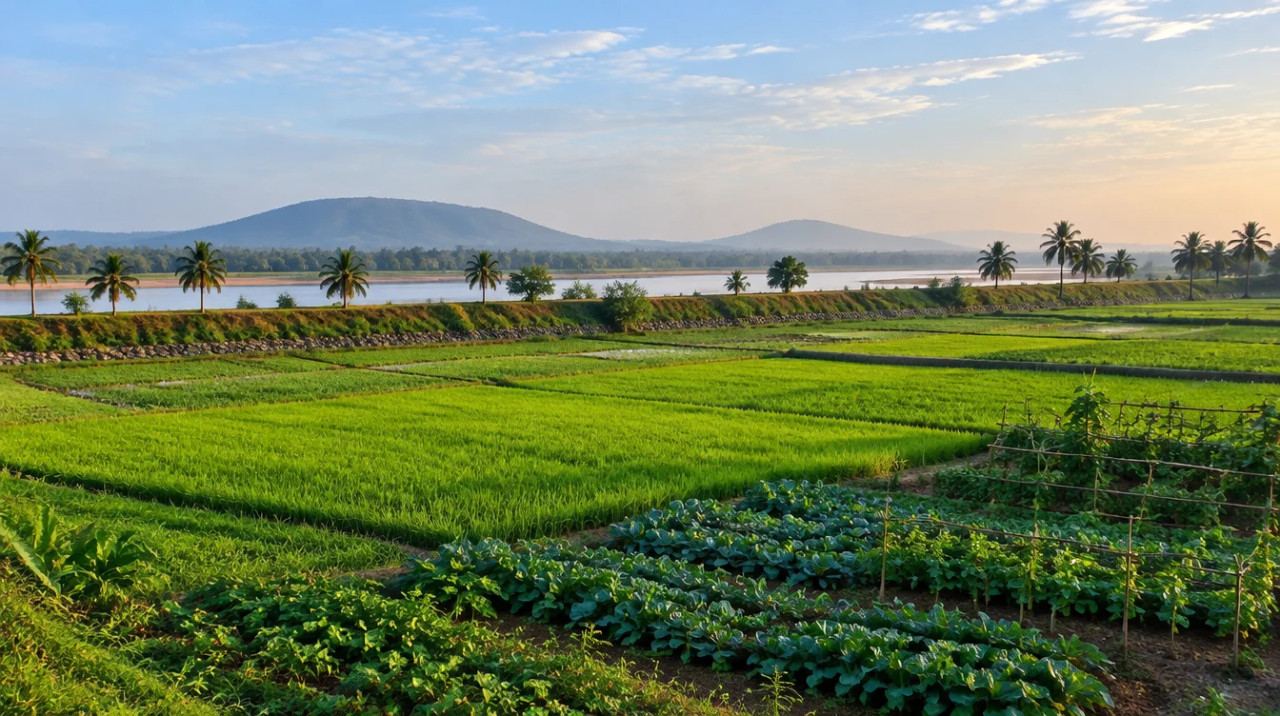
A flood-prone river plain next to Kalinganagar, where Tata Steel has lifted capacity to 8 million tonnes and a Rs 1.15 lakh crore industrial push is reported.
2,887.69 sq km
Area (district portal)
18.26 lakh
Population (Census 2011)
1,014.5 mm
Average rainfall (district portal)
8 million tonnes
Tata Steel Kalinganagar capacity (Tata Steel)
*Indicative range across districts and land types. Stamp duty, registration and conversion charges are additional. Local measurement units vary — every listing states the unit it is priced in. Not a valuation or an offer.
District land record — Jajpur
Rev. 2026 · Farmland India desk
State
Odisha
Sub-divisions
One sub-division, ten tahasils and ten blocks: Bari, Badachana, Binjharpur, Dangadi, Dasarathpur, Dharmasala, Jajpur, Korei, Rasulpur and Sukinda.
Key markets
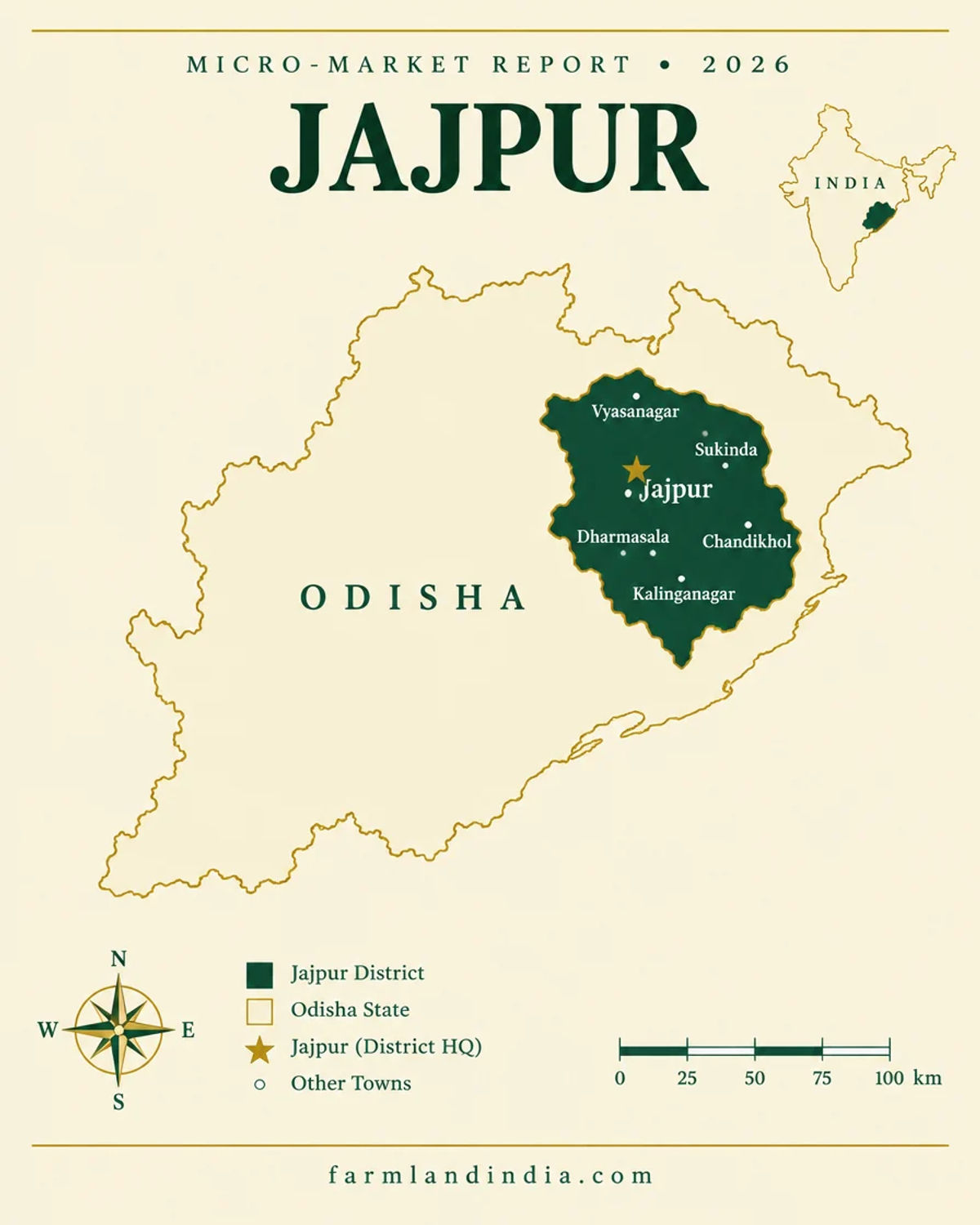
Jajpur Town · Vyasanagar · Kalinganagar · Sukinda · Dharmasala · Chandikhol
Demand anchors
Tata Steel at Kalinganagar, the Sukinda chromite belt, and a reported package of 24 industrial projects.
Rail
Jajpur Keonjhar Road on the Howrah–Chennai main line of East Coast Railway.
Size and population
2,887.69 sq km and 18,26,275 people (Census 2011), per the district portal.
Pricing unit
Quote land by the acre. Ask the sub-registrar for the village-wise benchmark valuation before you compare offers.
Local units
Sellers in Odisha often quote in decimal (dismil) or kanal; 100 decimals make one acre. Ask for the area in acres as recorded in the RoR.
Land records portal
Bhulekh Odisha (bhulekh.ori.nic.in) for the RoR and plot details; see our Bhu Naksha Odisha guide for maps.
Land law is state law. These rules are maintained on the Odisha page and apply to every district within it.
Jajpur — land purchase legal rules
Odisha does not reserve farmland for farmers. What decides a purchase here is the seller’s caste and tribe status, whether the village lies in a Scheduled Area, how the land was first settled and the family ceiling under the Odisha Land Reforms Act, 1960 (OLR Act). Each of these can undo a registered sale years later, so check them before any money moves.
Who can buy: The Odisha Land Reforms Act, 1960 has no provision that limits agricultural land to farmers or to residents of Odisha. An Indian citizen from another state can buy raiyati (tenant-proprietor) land outside the Scheduled Areas, subject to the ceiling and to the caste and tribe checks below. In practice the seller, not the buyer, is where Odisha’s restrictions bite.
Ceiling limits: Under Section 37-A the ceiling is 10 standard acres for a family of up to five members, plus 2 standard acres for each additional member, with an absolute cap of 18 standard acres. One standard acre equals one acre of Class I land, 1.5 acres of Class II, 3 acres of Class III or 4.5 acres of Class IV land (Section 2), so on the poorest class the cap works out to about 81 ordinary acres. Up to 3 acres of homestead and tank land is left out of the count. Section 40 bars a holder above the ceiling from selling or partitioning until the surplus is settled (PRS copy of the Act).
Scheduled Caste and Scheduled Tribe sellers: Section 22 makes a sale by a Scheduled Tribe raiyat to a non-tribal void unless the Revenue Officer gives prior written permission, and for a sale that permission is granted only if no tribal buyer is willing to pay the market price. Section 22(5) applies the same rule to Scheduled Caste sellers. Under Section 23 the officer can declare the transfer invalid, restore the land to the seller or his heirs and fine the occupant up to Rs 200 an acre a year; the buyer does not get the price back, and Section 23-B puts the burden of proving a valid transfer on the buyer (OLR Act).
Scheduled Areas: In the Scheduled Areas, 119 of the state’s 314 blocks and about 44.7% of its area, the Orissa Scheduled Areas Transfer of Immovable Property (by Scheduled Tribes) Regulation, 1956 (Regulation 2 of 1956), as amended in 2002, places a complete ban on transfer of tribal land to non-tribals (CAG audit on land management in Scheduled Areas). A cabinet decision of 14 November 2023 to allow such transfers with the sub-collector’s permission was withheld within days (ThePrint, 17 November 2023), so the ban stands.
Conversion to non-farm use: Section 8-A lets a raiyat apply to the authorised officer to use agricultural land for other purposes, provided the change does not conflict with a master plan, development plan or town planning scheme. The fee table in the Act runs from Rs 3 lakh an acre within 0.5 km of specified national highways or inside municipal areas, through Rs 1 lakh near specified state highways and Rs 75,000 in other notified or urban areas, down to 5% of market value (minimum Rs 1,000) elsewhere; land already converted without permission pays half the rate on regularisation (PRS copy). Confirm the current rate at the Tahasil, because the PRS copy may not carry the latest amendment.
Government land: Government waste land is settled with individuals under the Odisha Government Land Settlement Act, 1962 (OGLS Act), on a premium and rent fixed by the state. A 2021 amendment lets long-term occupants of some land categories obtain heritable and transferable rights if they apply within the notified window; those who do not can be evicted. Leases settled under the Act often carry conditions, so read the settlement order and the RoR remarks before buying such a plot.
Market value and disputes: Stamp duty is charged on the higher of the deed price and the benchmark valuation. In September 2025 the Orissa High Court quashed blanket percentage hikes in Ganjam’s benchmark values as contrary to Rules 37, 40 and 41 of the Odisha Stamp Rules, 1952, and ordered fresh valuations (OdishaBytes, 3 September 2025).
Documents to check: The current RoR (Khatiyan) and plot details from Bhulekh, the mutation history at the Tahasil, an encumbrance search at the sub-registrar, the kisam (land class) entry, the seller’s caste and tribe status, and whether the village lies in a Scheduled Area. Our Bhulekh Odisha guide explains each field of the RoR.
NRI and OCI buyers: Under the RBI Master Direction on immovable property, NRIs and OCIs may not acquire agricultural land, farmhouses or plantations in India except by inheritance, and may sell such land only to a resident Indian citizen. Land lawfully converted to non-agricultural use is treated differently, so check the conversion order against the exact plot. Our NRI guide covers the options.
- No farmer-only rule found
- Ceiling: Section 37-A
- Cap: 18 standard acres
- SC/ST sales: Section 22
- Scheduled Areas: Regulation 2 of 1956
- Conversion: Section 8-A
- Government land: OGLS Act
- NRIs: inheritance only
Jajpur — district-specific notes
The Odisha state page applies in full: the ceiling, the rules on tribal and Scheduled Caste sellers and the conversion route are set out above. These notes cover what is specific to Jajpur.
⚠ Jajpur is not among the districts in the ST and SC Development Department’s list of Scheduled Area sub-plan blocks, so the complete ban of Regulation 2 of 1956 should not apply to its villages. The list is a department document, not the notification, so confirm the village with the Tahasildar. A tribal seller still needs Section 22 permission.
⚠ Land around Kalinganagar and Danagadi has been taken for steel and allied plants for years, and new projects are announced regularly. Before paying an advance, ask the Tahasil and IDCO whether the village or plot is in an acquisition proposal or an industrial-estate notification.
⚠ The Baitarani, Brahmani and Kharasrota can all flood the plain. In August 2026 the Baitarani ran above the danger mark at Dasarathpur and 242 villages were cut off. Ask for the plot’s flood history and look at the road level, not only at the RoR.
⚠ Sukinda is a mining belt. Land near mine leases and overburden dumps can carry lease, forest or environmental conditions, so read the RoR remarks and ask the mining office before buying.
⚠ Government and settled land is common near industrial belts. A seller whose RoR entry shows a settlement lease or a government owner cannot pass full title, so check the kisam and the settlement order.
Read the full Odisha land buying guide on the state page for the ceiling, tribal-seller and conversion rules.
- Not on Scheduled Area list
- Industrial acquisition
- Baitarani flood plain
- Mining belt
- Government land
District overview
Jajpur — a river-plain district with Odisha’s steel belt at Kalinganagar and recurring floods
Jajpur is a district of the Baitarani–Brahmani plain in north-eastern Odisha, with its headquarters at Jajpur Town. It covers 2,887.69 sq km and had 18,26,275 people at Census 2011. It has one sub-division, ten tahasils and ten blocks, and the Howrah–Chennai railway and the coastal national highway both cross it. Its neighbours are Bhadrak and Keonjhar to the north, Cuttack to the south and Kendrapara to the east, so the district sits between the Bhubaneswar–Cuttack market and the mining belt of the north.
The district is best known for Kalinganagar in Danagadi block, which the district portal calls its most industrially developed area. Tata Steel raised crude steel capacity there from 3 to 8 million tonnes a year in a Rs 27,000 crore expansion inaugurated on 22 May 2025, and the state reported a Rs 1.15 lakh crore package of 24 projects for Kalinganagar, Danagadi and Badachana. Sukinda is the chromite belt, and Daitari is known for mining. Together they make Jajpur one of the few Odisha districts where an operating, dated industrial base already exists, beside announced projects that have yet to be built.
For farmland buyers, the district is three things at once: an industrial belt where acquisition decides prices, a mining valley where lease and environmental conditions apply, and a flood plain where drainage matters more than distance to the highway. Most buyers are choosing between the first and the third, and the checks are different for each. Whichever case applies, the plot should be tested against three records before money moves: the current RoR, the mutation history at the Tahasil, and the village’s flood and acquisition status.
- Jajpur Town
- Kalinganagar
- Sukinda
- Baitarani plain
- Chandikhol
Transaction costs
Stamp duty & registration in Jajpur
5%
Stamp duty, sale deed
On the higher of deed price and benchmark valuation
4%
Stamp duty, woman buyer
Same base, lower rate when a woman buys
2%
Registration fee, mainly
Per IGR Odisha FAQ (undated)
Per IGR Odisha[4], the registration fee is mainly 2%. Duty is charged on the higher of the deed price and the benchmark valuation, which is revised every two years from 1 April. Ask the sub-registrar for the village-wise value in Jajpur and keep a written copy. After registration, apply for mutation at the Tahasil so the RoR shows your name.
Know the belt
What is moving prices in Jajpur
Steel belt, mining valley, river-plain and highway pockets; no listing-site prices are used.
Kalinganagar and Danagadi
The steel belt
Kalinganagar in Danagadi block holds Tata Steel’s 8 million tonne plant and other steel, pellet and stainless units. Land close to the plants is wanted for industry, so farmland here is held for allied use and not for farming.
Check: whether the village is in an IDCO notice or an industrial-estate proposal, and the access road to the plant gates.
Sukinda and the mining valley
Chromite and mining
Sukinda is the district’s chromite belt, and the district portal also names Daitari for its mines. Land near leases is not ordinary farmland, because lease boundaries, overburden and environmental conditions can restrict use.
Check: the RoR remarks, nearby lease boundaries and any environmental or forest condition on the plot.
Jajpur Town, Vyasanagar and Chandikhol
The highway and rail corridor
The district headquarters, Vyasanagar (Jajpur Road) and Chandikhol lie along the national highway and the rail line toward Cuttack and Bhadrak. Buyers here are usually looking at plots near the corridor for later use.
Check: the access from the highway, the flood level of the road and whether the plot is inside a municipal or notified-area limit.
Dharmasala, Bari and the Baitarani plain
Paddy and flood plain
Dharmasala, Bari, Dasarathpur and Binjharpur lie on the river plain. They are rice land by tradition and were among the areas hit hard in the August 2026 flood.
Check: the flood marks of 2026 and earlier, the drainage and whether a bund protects the plot.
Korei, Rasulpur and Badachana
Interior blocks and the edge of the steel belt
These inner blocks sit away from the highway. Badachana is named in the 2025 industrial package, which makes it the one to watch for acquisition, while Korei and Rasulpur are mainly farming blocks where road quality and the monsoon decide access.
Check: the notification status of the village and the all-weather road to the plot; interior roads are the first to flood.
Asking prices
None is shown. Use the village-wise benchmark valuation from the sub-registrar and recent registered deeds in the same village as your references.
Connectivity
How Jajpur connects — road, rail and air
A coastal national highway, the Howrah–Chennai rail line and Bhubaneswar’s airport within reach of the district.
🚗 By road
✈️ By air
🚆 By rail
No drive times are shown because road works and traffic vary; check the NHAI project pages and the local offices before relying on a figure.
Growth catalysts
Upcoming infrastructure & developments
Status labels reflect sources read in November 2026. Government-announced timelines are not guaranteed; items with a single or older source say so.
02Open
03Catalysts
Agriculture & terrain
Soil, crops & water in Jajpur
A river-plain district on Baitarani, Brahmani and Kharasrota alluvium with about a metre of rainfall and a recent record of flooding.
Crops
Rice is the staple crop of the Baitarani–Brahmani plain, with pulses, oilseeds and vegetables on higher land. No acreage is given. The paddy economy of the plain depends on the river level and on timely drainage after floods, so a field that drains within days is worth more than one that stays wet.
- Rice, the main crop
- Pulses on higher land
- Oilseeds
- Vegetables near towns
Soils
The plain is built of river alluvium, with sandy loams near the channels and heavier clay in the low basins that hold water.
- Sandy loam near rivers
- Clay in low basins
- Alluvial plain
- Mining spoil near Sukinda
Rivers
The Baitarani, Brahmani and Kharasrota drain the district, and the Baitarani at Dasarathpur is the gauge the state watches in floods.
- Baitarani
- Brahmani
- Kharasrota
Water and irrigation
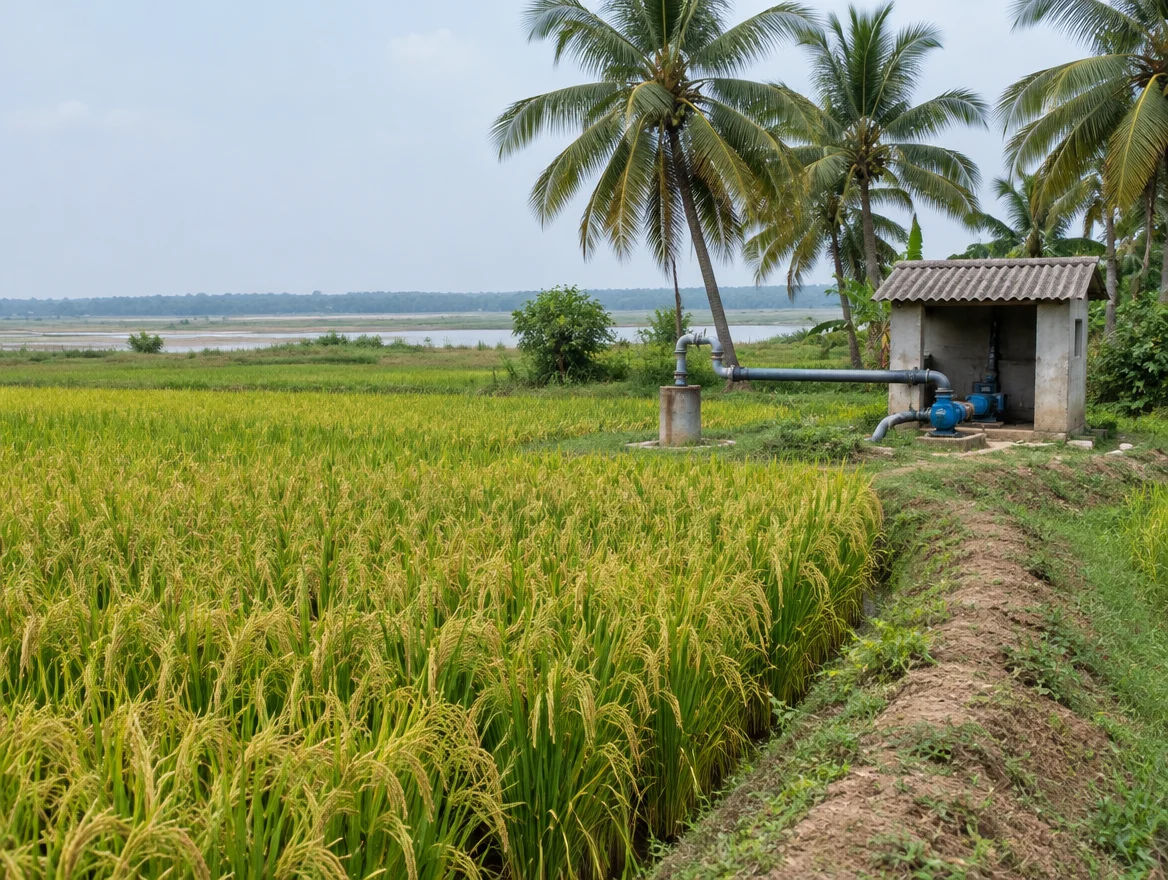
Rainfall, the rivers and canal and lift irrigation supply the plain, though the district portal gives no irrigation figures. Ask where a plot’s water comes from and whether the supply survives a dry kharif or a rabi season. Wells and borewells near industrial or mining areas deserve a water-quality test before you rely on them for drinking or irrigation.
Rainfall and floods
Average rainfall is 1,014.5 mm per the district portal, lower than the coastal districts. The rivers still flood the plain: on 17 August 2026 the Baitarani ran above the danger mark at Dasarathpur, and 242 villages were cut off, with Bari, Jajpur, Dasarathpur and Binjharpur hit hard (Deccan Chronicle[7]).
At a glance
Jajpur vs. nearby districts
| District | Land and water | What links it to Jajpur |
|---|---|---|
| Kendrapara (east) | Delta land across the Brahmani–Baitarani system | Shares the river system and the flood exposure; Jajpur is the upstream district. |
| Cuttack (south) | City and Mahanadi plain | The main connection to Bhubaneswar by road and rail; Cuttack is the nearest large market. |
| Bhadrak (north) | River plain and coast road | Joined to Jajpur by NH 16 and the rail line, and by the Baitarani floods. |
| Keonjhar (north-west) | Hills and mining; part Scheduled Area | Most Keonjhar blocks are on the Scheduled Area sub-plan list, unlike Jajpur’s. |
No price series is shown for any neighbouring district here. Compare benchmark valuations and registered deeds, not asking prices.
Farmland India view
Why investors look at Jajpur
Five reasoned points for Jajpur, each tied to a source on this page.
Kalinganagar is a dated, large industrial fact
Tata Steel’s 8 million tonne capacity is built and inaugurated, not a plan. That is a firmer base for land demand than most Odisha announcements, though it works mainly for land near the plants. Check whether the road to the plant gates is already four-lane and whether your plot is on it; frontage matters more than distance.
Reported pipelines are not built capacity
The Rs 1.15 lakh crore package includes foundation-stage projects. Price land on what is operating and on notified acquisition, not on the total. Foundation-stone projects often change size, owner or site, so a year-old announcement is not evidence that your village will be affected.
Flood history should drive your price
The August 2026 flood put 242 villages under water. A plot that stayed dry is worth more than one that did not, so ask for the flood history village by village. Insist on a written flood record, ideally from the Tahasil or the village, and compare it with the RoR kisam.
Tribal law is simpler here than in the hills
Jajpur is not on the Scheduled Area list, unlike most of neighbouring Keonjhar, so the title risk is lower, though seller status still has to be checked.
Mining land needs its own checks
Sukinda and Daitari land can carry lease or environmental conditions that ordinary farmland does not, so treat it as a separate category. If you want to buy there, ask a local lawyer for the lease map and compare it with the plot’s boundary.
Confirm the RoR, mutation history, kisam, CRZ or flood status and any acquisition notice before paying a token amount.
STRAIGHT TALK
Risks & challenges in Jajpur
District-specific risks. Read the Odisha page for the general risks on ceiling, tribal sellers, conversion and records.
River flooding
The Baitarani above the danger mark at Dasarathpur in August 2026 and 242 villages cut off show how quickly the plain floods. Road access can be lost for days. The 2026 flood followed the usual pattern of the Baitarani rising first and the lower basins staying under water longest.
Industrial acquisition
Land in the steel belt can be notified for industry. Check the Tahasil and IDCO before paying an advance, and be wary of a rise that is not yet notified.
Mining and environmental conditions
Land near Sukinda leases and dumps can carry lease or environmental limits that restrict use.
Government and settled land
Settlement leases and government entries limit what a private seller can pass on. Read the kisam and the settlement order.
Joint holdings
Plain-land holdings are often jointly held by several heirs. A sale needs every co-sharer’s signature, so ask for the mutation trail.
Industrial pollution and mining impact
Land beside steel plants, pellet units and mines can face dust, noise and water issues. Visit in the dry season and in the monsoon, and ask neighbours about the effect on wells and crops.
Unit and price confusion
Sellers in the district may quote per decimal or per plot. Convert every quote to a price per acre and compare it with the village’s benchmark valuation before you negotiate.
Who to contact
Local revenue & planning offices
The Collectorate is at Jajpur, the district’s only sub-division, with ten Tahasil offices across the blocks; the district website[8] lists them. Registration is at the sub-registrar office for your village, and IGR Odisha[9] provides the registration services. Use the Tahasil for mutation and the RoR, and IDCO for any industrial acquisition. Keep copies of every receipt and of the RoR extract on the day of registration, because the Tahasil may take weeks to update the record.
COMMON QUESTIONS
Frequently asked questions
Everything buyers, NRIs and investors ask before their first reviewed farmland purchase in Jajpur.
Visit full wiki01 of 04
Is Jajpur a Scheduled Area?
Jajpur is not in the ST and SC Development Department’s list of Scheduled Area sub-plan blocks, so the complete ban in Regulation 2 of 1956 should not apply to its villages. A tribal seller still needs permission under Section 22 of the Odisha Land Reforms Act, and you should confirm the village with the Tahasildar.
02 of 04
What is the stamp duty on land in Jajpur?
Odisha charges 5% stamp duty on a sale deed, 4% when a woman buys, and a registration fee of mainly 2% per IGR Odisha. Duty is on the higher of the deed price and the benchmark valuation, which is revised every two years from 1 April.
03 of 04
Is there a price guide for farmland in Jajpur?
None is shown. Use the village-wise benchmark valuation from the sub-registrar and registered deeds in the same village as your references.
04 of 04
Which part of Jajpur is the industrial belt?
Kalinganagar in Danagadi block is the district’s most industrialised area, with Tata Steel, Neelachal Ispat and other steel and pellet units. A larger package of 24 projects worth Rs 1.15 lakh crore was reported for Kalinganagar, Danagadi and Badachana, but a reported pipeline is not built capacity.
Transparency
Sources and references
Government
- [1]Jajpur district portal: about the district — jajpur.odisha.gov.in
- [2]Odisha Annual Reference 2011: districts, sub-divisions, tahasils and blocks — magazines.odisha.gov.in
- [3]ST and SC Development Department: TSP blocks list — stsc.odisha.gov.in
- [4]igrodisha.gov.in: IGR Odisha — igrodisha.gov.in
- [5]tatasteel.com: Tata Steel release — tatasteel.com
- [6]thestatesman.com: The Statesman — thestatesman.com
- [7]deccanchronicle.com: Deccan Chronicle — deccanchronicle.com
- [8]jajpur.odisha.gov.in: district website — jajpur.odisha.gov.in
- [9]igrodisha.gov.in: IGR Odisha — igrodisha.gov.in
Project status and benchmark valuations change often; check the linked source and the relevant office before relying on any figure.
For developers
Ready to explore Jajpur farmland?
Browse reviewed projects and individual land parcels across Jajpur — or if you own land here, list it with platform review and reach serious buyers.