
District guide
Buying Land in Jagatsinghapur
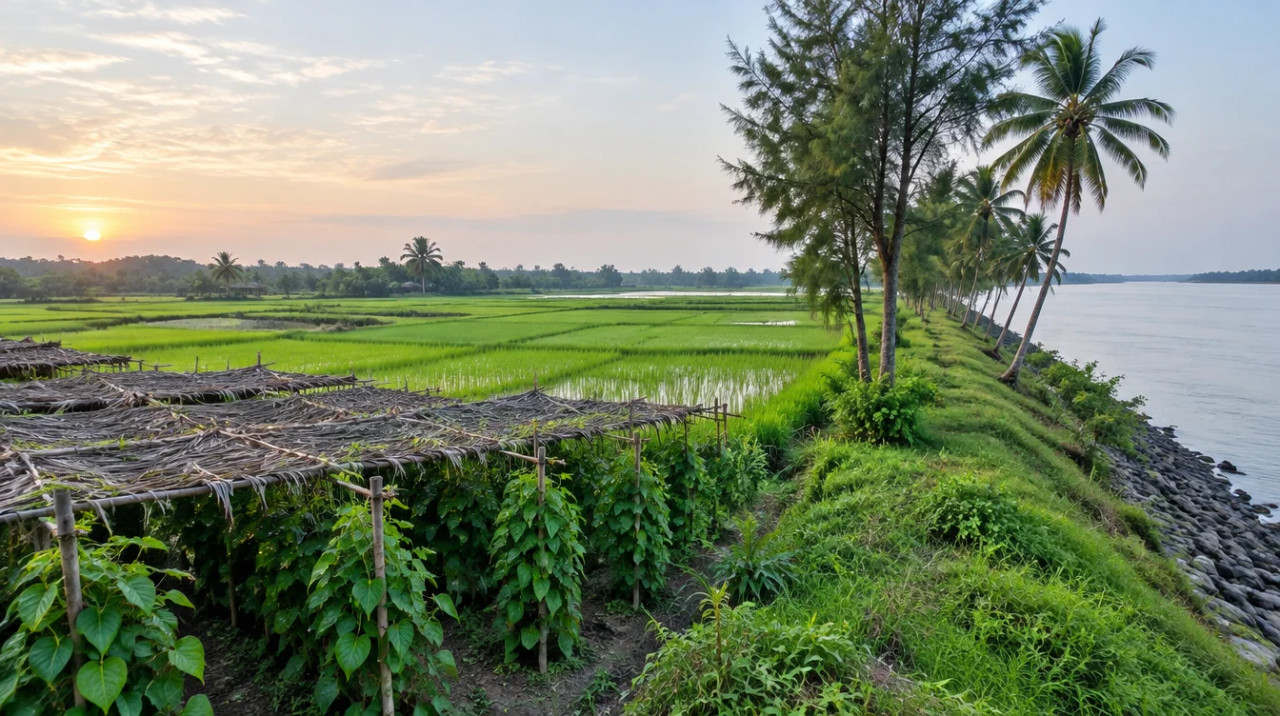
A delta district with Paradip Port, an oil refinery and a proposed Rs 58,042 crore petrochemical complex, set among flood- and cyclone-prone rice land.
1,759 sq km
Area (district portal)
11.37 lakh
Population (Census 2011)
1,521 mm
Average rainfall (district agriculture page)
Rs 58,042 crore
IOCL petrochemical complex (reported)
*Indicative range across districts and land types. Stamp duty, registration and conversion charges are additional. Local measurement units vary — every listing states the unit it is priced in. Not a valuation or an offer.
District land record — Jagatsinghapur
Rev. 2026 · Farmland India desk
State
Odisha
Sub-divisions
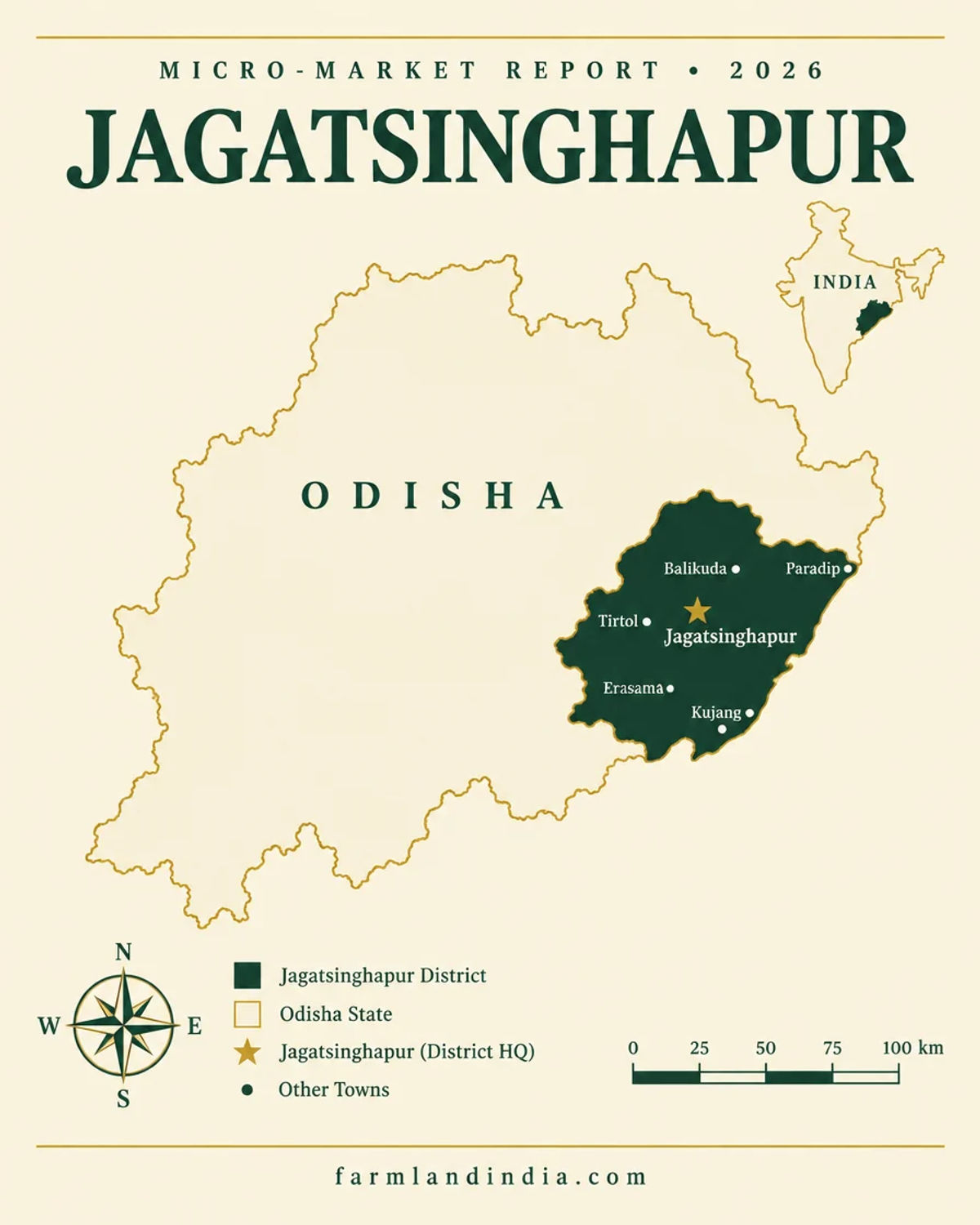
One sub-division, eight tahasils and eight blocks: Balikuda, Biridi, Erasama, Jagatsinghpur, Naugaon, Raghunathpur, Tirtol and Kujanga.
Key markets
Paradip · Erasama · Jagatsinghapur · Tirtol · Balikuda · Kujang
Demand anchors
Paradip Port and its new facilities, IOCL’s Paradip refinery, and a proposed petrochemical complex at Erasama.
Rail
Paradip is linked by rail toward Cuttack and the Howrah–Chennai main line; check Indian Railways for current services.
Size and population
1,759 sq km and 11,36,971 people (Census 2011), per the district portal.
Pricing unit
Quote land by the acre. Ask the sub-registrar for the village-wise benchmark valuation before you compare offers.
Local units
Sellers in Odisha often quote in decimal (dismil) or kanal; 100 decimals make one acre. Ask for the area in acres as recorded in the RoR.
Land records portal
Bhulekh Odisha (bhulekh.ori.nic.in) for the RoR and plot details; see our Bhu Naksha Odisha guide for maps.
Land law is state law. These rules are maintained on the Odisha page and apply to every district within it.
Jagatsinghapur — land purchase legal rules
Odisha does not reserve farmland for farmers. What decides a purchase here is the seller’s caste and tribe status, whether the village lies in a Scheduled Area, how the land was first settled and the family ceiling under the Odisha Land Reforms Act, 1960 (OLR Act). Each of these can undo a registered sale years later, so check them before any money moves.
Who can buy: The Odisha Land Reforms Act, 1960 has no provision that limits agricultural land to farmers or to residents of Odisha. An Indian citizen from another state can buy raiyati (tenant-proprietor) land outside the Scheduled Areas, subject to the ceiling and to the caste and tribe checks below. In practice the seller, not the buyer, is where Odisha’s restrictions bite.
Ceiling limits: Under Section 37-A the ceiling is 10 standard acres for a family of up to five members, plus 2 standard acres for each additional member, with an absolute cap of 18 standard acres. One standard acre equals one acre of Class I land, 1.5 acres of Class II, 3 acres of Class III or 4.5 acres of Class IV land (Section 2), so on the poorest class the cap works out to about 81 ordinary acres. Up to 3 acres of homestead and tank land is left out of the count. Section 40 bars a holder above the ceiling from selling or partitioning until the surplus is settled (PRS copy of the Act).
Scheduled Caste and Scheduled Tribe sellers: Section 22 makes a sale by a Scheduled Tribe raiyat to a non-tribal void unless the Revenue Officer gives prior written permission, and for a sale that permission is granted only if no tribal buyer is willing to pay the market price. Section 22(5) applies the same rule to Scheduled Caste sellers. Under Section 23 the officer can declare the transfer invalid, restore the land to the seller or his heirs and fine the occupant up to Rs 200 an acre a year; the buyer does not get the price back, and Section 23-B puts the burden of proving a valid transfer on the buyer (OLR Act).
Scheduled Areas: In the Scheduled Areas, 119 of the state’s 314 blocks and about 44.7% of its area, the Orissa Scheduled Areas Transfer of Immovable Property (by Scheduled Tribes) Regulation, 1956 (Regulation 2 of 1956), as amended in 2002, places a complete ban on transfer of tribal land to non-tribals (CAG audit on land management in Scheduled Areas). A cabinet decision of 14 November 2023 to allow such transfers with the sub-collector’s permission was withheld within days (ThePrint, 17 November 2023), so the ban stands.
Conversion to non-farm use: Section 8-A lets a raiyat apply to the authorised officer to use agricultural land for other purposes, provided the change does not conflict with a master plan, development plan or town planning scheme. The fee table in the Act runs from Rs 3 lakh an acre within 0.5 km of specified national highways or inside municipal areas, through Rs 1 lakh near specified state highways and Rs 75,000 in other notified or urban areas, down to 5% of market value (minimum Rs 1,000) elsewhere; land already converted without permission pays half the rate on regularisation (PRS copy). Confirm the current rate at the Tahasil, because the PRS copy may not carry the latest amendment.
Government land: Government waste land is settled with individuals under the Odisha Government Land Settlement Act, 1962 (OGLS Act), on a premium and rent fixed by the state. A 2021 amendment lets long-term occupants of some land categories obtain heritable and transferable rights if they apply within the notified window; those who do not can be evicted. Leases settled under the Act often carry conditions, so read the settlement order and the RoR remarks before buying such a plot.
Market value and disputes: Stamp duty is charged on the higher of the deed price and the benchmark valuation. In September 2025 the Orissa High Court quashed blanket percentage hikes in Ganjam’s benchmark values as contrary to Rules 37, 40 and 41 of the Odisha Stamp Rules, 1952, and ordered fresh valuations (OdishaBytes, 3 September 2025).
Documents to check: The current RoR (Khatiyan) and plot details from Bhulekh, the mutation history at the Tahasil, an encumbrance search at the sub-registrar, the kisam (land class) entry, the seller’s caste and tribe status, and whether the village lies in a Scheduled Area. Our Bhulekh Odisha guide explains each field of the RoR.
NRI and OCI buyers: Under the RBI Master Direction on immovable property, NRIs and OCIs may not acquire agricultural land, farmhouses or plantations in India except by inheritance, and may sell such land only to a resident Indian citizen. Land lawfully converted to non-agricultural use is treated differently, so check the conversion order against the exact plot. Our NRI guide covers the options.
- No farmer-only rule found
- Ceiling: Section 37-A
- Cap: 18 standard acres
- SC/ST sales: Section 22
- Scheduled Areas: Regulation 2 of 1956
- Conversion: Section 8-A
- Government land: OGLS Act
- NRIs: inheritance only
Jagatsinghapur — district-specific notes
The Odisha state page applies in full: the ceiling, the rules on tribal and Scheduled Caste sellers and the conversion route are set out above. These notes cover what is specific to Jagatsinghapur.
⚠ Jagatsinghapur is not among the districts in the ST and SC Development Department’s list of Scheduled Area sub-plan blocks, so the complete ban of Regulation 2 of 1956 should not apply to its villages. The list is a department document, not the notification, so confirm the village with the Tahasildar. A tribal seller still needs Section 22 permission.
⚠ The petrochemical site at Badakantakandha in Erasama is at the social-impact-assessment stage. The report said the consent thresholds are 80% of affected families for a private project or 70% for a public-private one. Check whether a village is in a notification before you pay an advance.
⚠ Land near the sea and the tidal rivers can fall inside the Coastal Regulation Zone. Check the CRZ status of any shoreline plot with the district authorities before you pay.
⚠ Paradip Port land, port-trust land and settled government land cannot be bought from a private person. Read the RoR owner entry and the settlement order, and do not rely on a seller’s claim of long possession.
⚠ Waterlogged and saline fields are common in the delta. A registered sale does not change the soil, so ask for the plot’s drainage and flood history in writing.
⚠ Delta holdings are often small and held jointly by several heirs. A sale needs every co-sharer’s signature and a clean partition history; ask for the full chain of mutation entries at the Tahasil and for the latest RoR before you pay anything.
Read the full Odisha land buying guide on the state page for the ceiling, tribal-seller and conversion rules.
- Not on Scheduled Area list
- Acquisition consent stage
- Coast and CRZ
- Port and government land
- Delta flood land
District overview
Jagatsinghapur — a delta district anchored by Paradip Port and exposed to cyclones
Jagatsinghapur (Jagatsinghpur) is a coastal delta district of Odisha, with the Bay of Bengal to the east, Cuttack to the west, Kendrapara to the north and Puri to the south. It covers 1,759 sq km and had 11,36,971 people at Census 2011. The Mahanadi and Paika rivers run along its northern edge and the Devi along the south-west. The district has one sub-division, which keeps administration simple: the Collector, the Tahasildars and the sub-registrars all sit within the same district and are reachable in a day.
Paradip Port, one of India’s major ports, sits in the district, and the refinery and industries around it shape the land market. In August 2026 the port inaugurated projects worth Rs 427.80 crore, including 18.5 m deep-draft capability, and in July 2026 the state began the land process for IOCL’s Rs 58,042 crore petrochemical complex in Erasama.
For farmland buyers, the district is two markets. Near Paradip and Erasama, land is priced on port and project expectations and tied to acquisition and CRZ rules. Inland blocks such as Tirtol, Raghunathpur and Balikuda are rice land on a flood and cyclone coast, where drainage, salinity and the title trail matter more than the headline projects. If you are buying for the long term, decide first which of the two markets you are in, because the checks, the price logic and the exit route are different in each.
- Paradip Port
- Mahanadi delta
- Erasama
- Tirtol
- Bay of Bengal coast
Transaction costs
Stamp duty & registration in Jagatsinghapur
5%
Stamp duty, sale deed
On the higher of deed price and benchmark valuation
4%
Stamp duty, woman buyer
Same base, lower rate when a woman buys
2%
Registration fee, mainly
Per IGR Odisha FAQ (undated)
Per IGR Odisha[6], the registration fee is mainly 2%. Duty is charged on the higher of the deed price and the benchmark valuation, which is revised every two years from 1 April. Ask the sub-registrar for the village-wise value in Jagatsinghapur and keep a written copy. After registration, apply for mutation at the Tahasil so the RoR shows your name.
Know the belt
What is moving prices in Jagatsinghapur
Port, petrochemical-site, town and interior delta pockets; no listing-site prices are used.
Paradip and the port belt
Port, refinery and industry
Paradip Port and the industries that depend on it, including IOCL’s refinery, are concentrated here. Land close to the port is wanted for industry and logistics, so farmland is a long-hold land bank and not a farming purchase. Port expansion, the mechanisation deals and the proposed shipbuilding and steel plants all add to the pressure on land, but none of them guarantees that a particular private plot will be needed.
Check: the port-trust or industrial boundary, any CRZ limit and whether the village is in an IDCO notice.
Erasama and the petrochemical site
Early-stage acquisition
IOCL’s proposed complex needs 219.617 acres of private land at Badakantakandha in Erasama tahasil, and the social impact assessment began in July 2026. The result is still to come, and consent is required from most affected families before any acquisition.
Check: whether your plot or village is in the notified area; a transaction in notified land can be restricted or challenged, so ask the Tahasil.
Jagatsinghapur town, Tirtol and Raghunathpur
Central delta plain
The district headquarters and the central blocks sit on the delta plain between the Mahanadi and Devi systems. Buyers here are mostly buying rice land and plots on the highway side.
Check: the flood history of the field, the sand or clay content and the access road in the monsoon.
Balikuda, Biridi and Naugaon
Cuttack-side and coastal blocks
Balikuda and Biridi lie toward the Cuttack side of the district, while Naugaon reaches the coast. Distances to Cuttack, Paradip and Bhubaneswar decide use more than local demand.
Check: the salinity of the soil near the coast and whether the plot is below the road level.
Kujanga and the coastal edge
Coast, creeks and cyclone shelter land
Kujanga and the coast around it combine low, saline fields with the nearest access to the port. Buyers here are usually looking at industrial-adjacent land or at plots that may later be taken for roads and utilities, and not at productive paddy.
Check: the CRZ line, the tidal creek margins and whether the plot is above the cyclone surge level in any record you can obtain.
Asking prices
None is shown. Use the village-wise benchmark valuation from the sub-registrar and recent registered deeds in the same village as your references.
Connectivity
How Jagatsinghapur connects — road, rail and air
A major port, a road and rail corridor to Cuttack and Bhubaneswar, and no commercial airport in the district.
🚗 By road
✈️ By air
🚆 By rail
No drive times are shown because road works and traffic vary; check the NHAI project pages and the local offices before relying on a figure.
Growth catalysts
Upcoming infrastructure & developments
Status labels reflect sources read in November 2026. Government-announced timelines are not guaranteed; items with a single or older source say so.
01Open
04Catalysts
Agriculture & terrain
Soil, crops & water in Jagatsinghapur
A rice district on the Mahanadi–Devi delta with loam and clay loam soils, lift irrigation, saline patches and recurring flood and cyclone risk.
Crops
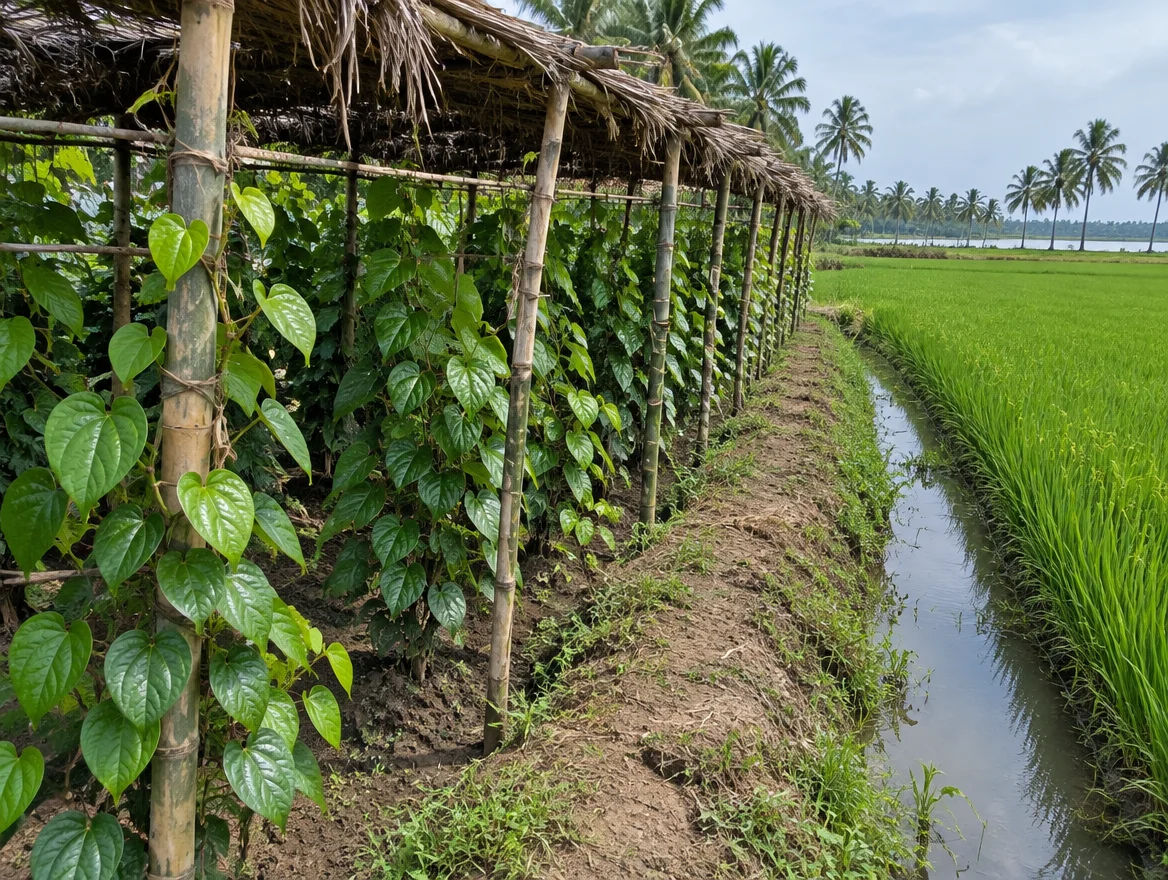
Rice is the main crop, and the district agriculture page promotes high-yielding varieties and scented rice. Sugarcane, jute, pulses and oilseeds are covered under state schemes, though the page gives no area figures. Check the season too: kharif rice depends on the monsoon, while rabi crops depend on lift irrigation and a working electric line.
- Rice, the main crop
- Scented rice
- Sugarcane
- Jute
- Pulses and oilseeds
Soils
Soils are mostly loam, sandy and clay loam. Saline soils and waterlogged areas reduce yields in places.
- Loam and sandy loam
- Clay loam
- Saline patches
- Waterlogged low land
Rivers
The Mahanadi and Paika rivers border the district on the north and the Devi on the south-west.
- Mahanadi and Paika (north)
- Devi (south-west)
Water and irrigation
The district agriculture page promotes private lift irrigation, shallow tubewells, borewells, dug wells and river lift points, with a 50% subsidy for lift points under RIDF-XIV. Ask where a plot’s water comes from and whether an electric line already reaches it. The district has programmed crop loans of Rs 44,762 lakh, which shows how much of the farm economy runs on credit; a plot with a mortgage or loan lien must be cleared before sale.
Rainfall and cyclones
Average rainfall is about 1,521 mm, and more than 75% falls between June and October. The district is prone to floods and cyclones and sometimes to drought; the 1999 Super Cyclone made landfall near Paradip. Check flood marks and drainage before buying low land.
At a glance
Jagatsinghapur vs. nearby districts
| District | Land and water | What links it to Jagatsinghapur |
|---|---|---|
| Kendrapara (north) | Delta land across the Mahanadi and Paika | Shares the flood and cyclone exposure of the delta; the two districts border each other. Both depend on embankments and drainage, so the flood history of the specific village is worth more than the district name. |
| Cuttack (west) | Mahanadi plain, city market | Named with Jagatsinghapur in the proposed economic region; the Cuttack side of the district is nearest. |
| Puri (south) | Coast and Devi–Chilika plain | Also named in the proposed economic region. |
No price series is shown for any neighbouring district here. Compare benchmark valuations and registered deeds, not asking prices.
Farmland India view
Why investors look at Jagatsinghapur
Five reasoned points for Jagatsinghapur, each tied to a source on this page.
Port spending is real and dated
Paradip Port opened Rs 427.80 crore of works in August 2026 and signed Rs 1,580.36 crore of mechanisation deals. That supports demand near Paradip for logistics land, though not necessarily for farmland. Port spending also tends to be announced in rounds, so check the date and the status of each item rather than the total.
The petrochemical complex is not yet a fact on the ground
The complex is at the social-impact-assessment stage and needs consent from affected families. Pay for land near it only on a clear title and a clear notification status. The report also says the final classification as a private or public-private project decides whether 80% or 70% consent is needed, so the process is not settled.
Delta land needs a hazard discount in your own head
A coastal delta with a 1999 super-cyclone record and recurring floods rewards buyers who check drainage and salinity, not those who buy on a project headline. The 1999 Super Cyclone made landfall near Paradip, and this is the history every insurer, lender and buyer will keep in mind.
Tribal law is simpler here
The district is not on the Scheduled Area list, which removes a major title risk found in hill districts, though seller status still has to be checked.
Proximity to Cuttack and Bhubaneswar helps
The proposed economic region joins the district to Cuttack, Bhubaneswar and Puri, which would matter if it is ever notified. Until then, treat the corridor as a reason for patience and not a reason to pay more.
Confirm the RoR, mutation history, kisam, CRZ or flood status and any acquisition notice before paying a token amount.
STRAIGHT TALK
Risks & challenges in Jagatsinghapur
District-specific risks. Read the Odisha page for the general risks on ceiling, tribal sellers, conversion and records.
Cyclone
The 1999 Super Cyclone made landfall near Paradip, and the coast remains cyclone-prone. Storm surge and wind damage affect orchards and structures. Cyclone shelters and embankments reduce but do not remove the risk, and insurance cover for crops and structures should be checked before you plant or build.
Flood and waterlogging
The district agriculture page lists floods and waterlogging among its hazards. Low delta fields can hold water for weeks.
Salinity
Saline soils reduce yield near the coast and may limit what you can grow.
Acquisition and speculative pricing
Land near the Erasama site may be priced on a project that still needs consent. Do not pay for a rise that is not yet notified.
Port, CRZ and government land
Port-trust land, settled government land and CRZ plots need extra checks of the RoR and any settlement conditions.
Joint holdings and title
Small, jointly held plots are common in the delta. A missing co-sharer’s consent or an unrecorded partition is the usual cause of later disputes, so insist on the full mutation trail.
Who to contact
Local revenue & planning offices
The Collectorate is at Jagatsinghpur, which is the single sub-division of the district, with eight Tahasil offices across the blocks; the district website[9] lists them. Registration is at the sub-registrar office for your village, and IGR Odisha[10] provides the registration services. Use the Tahasil for mutation and the RoR, and IDCO for any industrial acquisition. Port-related land questions go to Paradip Port Authority, and acquisition notices to IDCO and the Collector.
COMMON QUESTIONS
Frequently asked questions
Everything buyers, NRIs and investors ask before their first reviewed farmland purchase in Jagatsinghapur.
Visit full wiki01 of 04
Is Jagatsinghapur a Scheduled Area?
Jagatsinghapur is not in the ST and SC Development Department’s list of Scheduled Area sub-plan blocks, so the complete ban in Regulation 2 of 1956 should not apply to its villages. A tribal seller still needs permission under Section 22 of the Odisha Land Reforms Act, and you should confirm the village with the Tahasildar.
02 of 04
What is the stamp duty on land in Jagatsinghapur?
Odisha charges 5% stamp duty on a sale deed, 4% when a woman buys, and a registration fee of mainly 2% per IGR Odisha. Duty is on the higher of the deed price and the benchmark valuation, which is revised every two years from 1 April.
03 of 04
Is there a price guide for farmland in Jagatsinghapur?
None is shown. Use the village-wise benchmark valuation from the sub-registrar and registered deeds in the same village as your references.
04 of 04
What is happening on the land around Paradip?
Paradip Port opened new facilities on 21 August 2026 and signed mechanisation concessions. IOCL’s planned petrochemical complex needs 219.617 acres of private land at Badakantakandha in Erasama, and its social impact assessment was notified in July 2026. Treat the complex as an early-stage, announced project.
Transparency
Sources and references
Government
- [1]Jagatsinghpur district portal: about the district — jagatsinghpur.odisha.gov.in
- [2]Jagatsinghpur district portal: agriculture — jagatsinghpur.odisha.gov.in
- [3]Odisha Annual Reference 2011: districts, sub-divisions, tahasils and blocks — magazines.odisha.gov.in
- [4]ST and SC Development Department: TSP blocks list — stsc.odisha.gov.in
News
- [5]OdishaBytes, 15 Mar 2026: chief minister reviews Paradip industrial projects — odishabytes.com
- [6]igrodisha.gov.in: IGR Odisha — igrodisha.gov.in
- [7]maritimegateway.com: Maritime Gateway — maritimegateway.com
- [8]orissapost.com: OrissaPOST — orissapost.com
- [9]jagatsinghpur.odisha.gov.in: district website — jagatsinghpur.odisha.gov.in
- [10]igrodisha.gov.in: IGR Odisha — igrodisha.gov.in
Project status and benchmark valuations change often; check the linked source and the relevant office before relying on any figure.
For developers
Ready to explore Jagatsinghapur farmland?
Browse reviewed projects and individual land parcels across Jagatsinghapur — or if you own land here, list it with platform review and reach serious buyers.