

District guide
Buying Land in Kandhamal
A wholly Scheduled Area hill district, 67% forest, where Kandhamal turmeric holds a GI tag and the rules on tribal land decide who can buy.
67.4% of area
Forest cover (ISFR 2021)
1,620 mm
Normal rainfall (district average)
Granted 2019
Kandhamal Haldi GI tag
All 12 blocks
Scheduled Area (ST and SC list)
District land record — Kandhamal
Rev. 2026 · Farmland India desk
State
Odisha
Sub-divisions
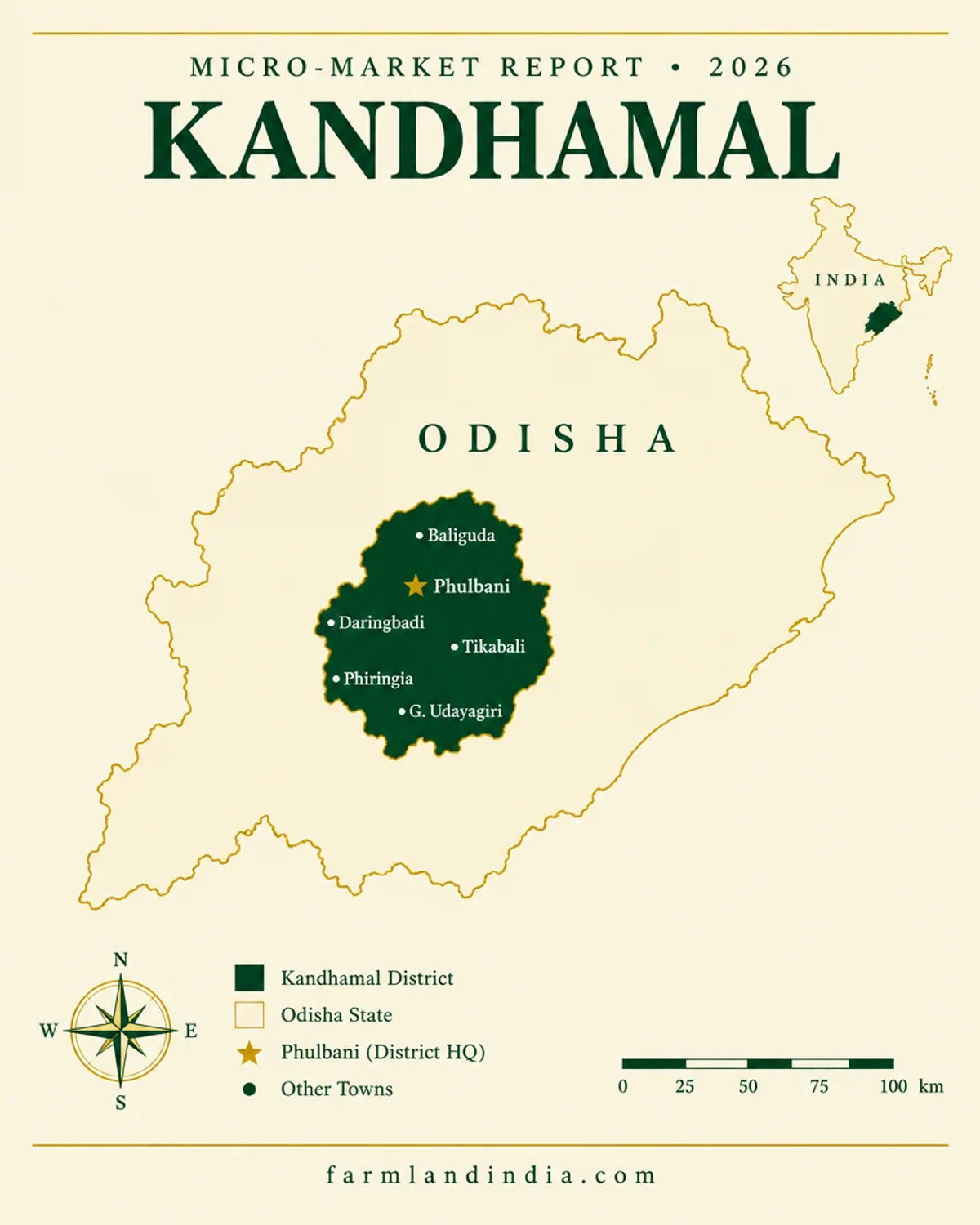
Twelve blocks in the Odisha Annual Reference list, from Phulbani and Baliguda to Daringbadi and Tumudibandh. The district headquarters is Phulbani.
Key markets
Phulbani · Baliguda · Daringbadi · Tikabali · Phiringia · G. Udayagiri
Demand anchors
Kandhamal turmeric (GI tag 2019), hybrid maize and non-timber forest produce, and Daringbadi’s climate and tourism.
Rail
No railway line; the nearest rail stations are in neighbouring districts.
Size and population
About 5,404 sq km of forest, which is 67.4% of the district, per ISFR 2021 as reported.
Pricing unit
Quote land by the acre. Ask the sub-registrar for the village-wise benchmark valuation before you compare offers.
Local units
Sellers in Odisha often quote in decimal (dismil) or kanal; 100 decimals make one acre. Ask for the area in acres as recorded in the RoR.
Land records portal
Bhulekh Odisha (bhulekh.ori.nic.in) for the RoR and plot details; see our Bhu Naksha Odisha guide for maps.
Land law is state law. These rules are maintained on the Odisha page and apply to every district within it.
Kandhamal — land purchase legal rules
Odisha does not reserve farmland for farmers. What decides a purchase here is the seller’s caste and tribe status, whether the village lies in a Scheduled Area, how the land was first settled and the family ceiling under the Odisha Land Reforms Act, 1960 (OLR Act). Each of these can undo a registered sale years later, so check them before any money moves.
Who can buy: The Odisha Land Reforms Act, 1960 has no provision that limits agricultural land to farmers or to residents of Odisha. An Indian citizen from another state can buy raiyati (tenant-proprietor) land outside the Scheduled Areas, subject to the ceiling and to the caste and tribe checks below. In practice the seller, not the buyer, is where Odisha’s restrictions bite.
Ceiling limits: Under Section 37-A the ceiling is 10 standard acres for a family of up to five members, plus 2 standard acres for each additional member, with an absolute cap of 18 standard acres. One standard acre equals one acre of Class I land, 1.5 acres of Class II, 3 acres of Class III or 4.5 acres of Class IV land (Section 2), so on the poorest class the cap works out to about 81 ordinary acres. Up to 3 acres of homestead and tank land is left out of the count. Section 40 bars a holder above the ceiling from selling or partitioning until the surplus is settled (PRS copy of the Act).
Scheduled Caste and Scheduled Tribe sellers: Section 22 makes a sale by a Scheduled Tribe raiyat to a non-tribal void unless the Revenue Officer gives prior written permission, and for a sale that permission is granted only if no tribal buyer is willing to pay the market price. Section 22(5) applies the same rule to Scheduled Caste sellers. Under Section 23 the officer can declare the transfer invalid, restore the land to the seller or his heirs and fine the occupant up to Rs 200 an acre a year; the buyer does not get the price back, and Section 23-B puts the burden of proving a valid transfer on the buyer (OLR Act).
Scheduled Areas: In the Scheduled Areas, 119 of the state’s 314 blocks and about 44.7% of its area, the Orissa Scheduled Areas Transfer of Immovable Property (by Scheduled Tribes) Regulation, 1956 (Regulation 2 of 1956), as amended in 2002, places a complete ban on transfer of tribal land to non-tribals (CAG audit on land management in Scheduled Areas). A cabinet decision of 14 November 2023 to allow such transfers with the sub-collector’s permission was withheld within days (ThePrint, 17 November 2023), so the ban stands.
Conversion to non-farm use: Section 8-A lets a raiyat apply to the authorised officer to use agricultural land for other purposes, provided the change does not conflict with a master plan, development plan or town planning scheme. The fee table in the Act runs from Rs 3 lakh an acre within 0.5 km of specified national highways or inside municipal areas, through Rs 1 lakh near specified state highways and Rs 75,000 in other notified or urban areas, down to 5% of market value (minimum Rs 1,000) elsewhere; land already converted without permission pays half the rate on regularisation (PRS copy). Confirm the current rate at the Tahasil, because the PRS copy may not carry the latest amendment.
Government land: Government waste land is settled with individuals under the Odisha Government Land Settlement Act, 1962 (OGLS Act), on a premium and rent fixed by the state. A 2021 amendment lets long-term occupants of some land categories obtain heritable and transferable rights if they apply within the notified window; those who do not can be evicted. Leases settled under the Act often carry conditions, so read the settlement order and the RoR remarks before buying such a plot.
Market value and disputes: Stamp duty is charged on the higher of the deed price and the benchmark valuation. In September 2025 the Orissa High Court quashed blanket percentage hikes in Ganjam’s benchmark values as contrary to Rules 37, 40 and 41 of the Odisha Stamp Rules, 1952, and ordered fresh valuations (OdishaBytes, 3 September 2025).
Documents to check: The current RoR (Khatiyan) and plot details from Bhulekh, the mutation history at the Tahasil, an encumbrance search at the sub-registrar, the kisam (land class) entry, the seller’s caste and tribe status, and whether the village lies in a Scheduled Area. Our Bhulekh Odisha guide explains each field of the RoR.
NRI and OCI buyers: Under the RBI Master Direction on immovable property, NRIs and OCIs may not acquire agricultural land, farmhouses or plantations in India except by inheritance, and may sell such land only to a resident Indian citizen. Land lawfully converted to non-agricultural use is treated differently, so check the conversion order against the exact plot. Our NRI guide covers the options.
- No farmer-only rule found
- Ceiling: Section 37-A
- Cap: 18 standard acres
- SC/ST sales: Section 22
- Scheduled Areas: Regulation 2 of 1956
- Conversion: Section 8-A
- Government land: OGLS Act
- NRIs: inheritance only
Kandhamal — district-specific notes
The Odisha state page applies in full: the ceiling, the rules on tribal and Scheduled Caste sellers and the conversion route are set out above. These notes cover what is specific to Kandhamal.
⚠ Kandhamal is a wholly Scheduled Area. The ST and SC Development Department’s sub-plan list covers all of its blocks: Baliguda, K. Nuagaon, Daringbadi, Tumudibandh, Kotagarh, Tikabali, G. Udayagiri, Raikia, Chakapad, Phulbani, Phiringia and Khajuripada. Regulation 2 of 1956 bars the transfer of tribal land to non-tribals, so an outside buyer should treat most farmland as closed.
⚠ Only land that has never been held by a tribal owner can pass to a non-tribal buyer. Ask for the full chain of ownership and the caste and tribe status of each earlier holder, and have a lawyer who knows Kandhamal check it. A registered sale can be undone years later.
⚠ Forest covers 67.4% of the district, the highest share in Odisha, and the Forest Rights Act gives individual and community rights that may not be visible in the RoR. Check the kisam and ask the forest division about any claim on the plot.
⚠ Slopes here are unstable. Landslides were reported at Kalinga Ghat in September 2025 and at Kumbharipadar, where about 400 residents were evacuated in October 2022. A hillside plot needs a site visit in the monsoon and a look at the slope above it.
⚠ Government land and forest land are common near towns and along roads. A seller whose RoR entry shows a forest, settlement or government holder cannot pass title, so check the kisam and the settlement order.
Read the full Odisha land buying guide on the state page for the ceiling, tribal-seller and conversion rules.
- Entire district Scheduled Area
- Tribal land ban
- Forest Rights Act claims
- Landslide-prone slopes
- Government land
District overview
Kandhamal — a wholly Scheduled Area hill district, two-thirds forest, known for turmeric
Kandhamal is a hill district of the Eastern Ghats in central Odisha, with its headquarters at Phulbani and twelve blocks, among them Baliguda, Daringbadi, Tikabali, Phiringia and G. Udayagiri. About 5,404 sq km of it, 67.4%, is forest, the highest share in Odisha, according to the India State of Forest Report 2021 as reported in April 2026. The district is tribal-majority in much of its area, with the Kondh communities among its largest groups, and the Kutia Kondh women of Daringbadi are known for collecting non-timber forest produce.
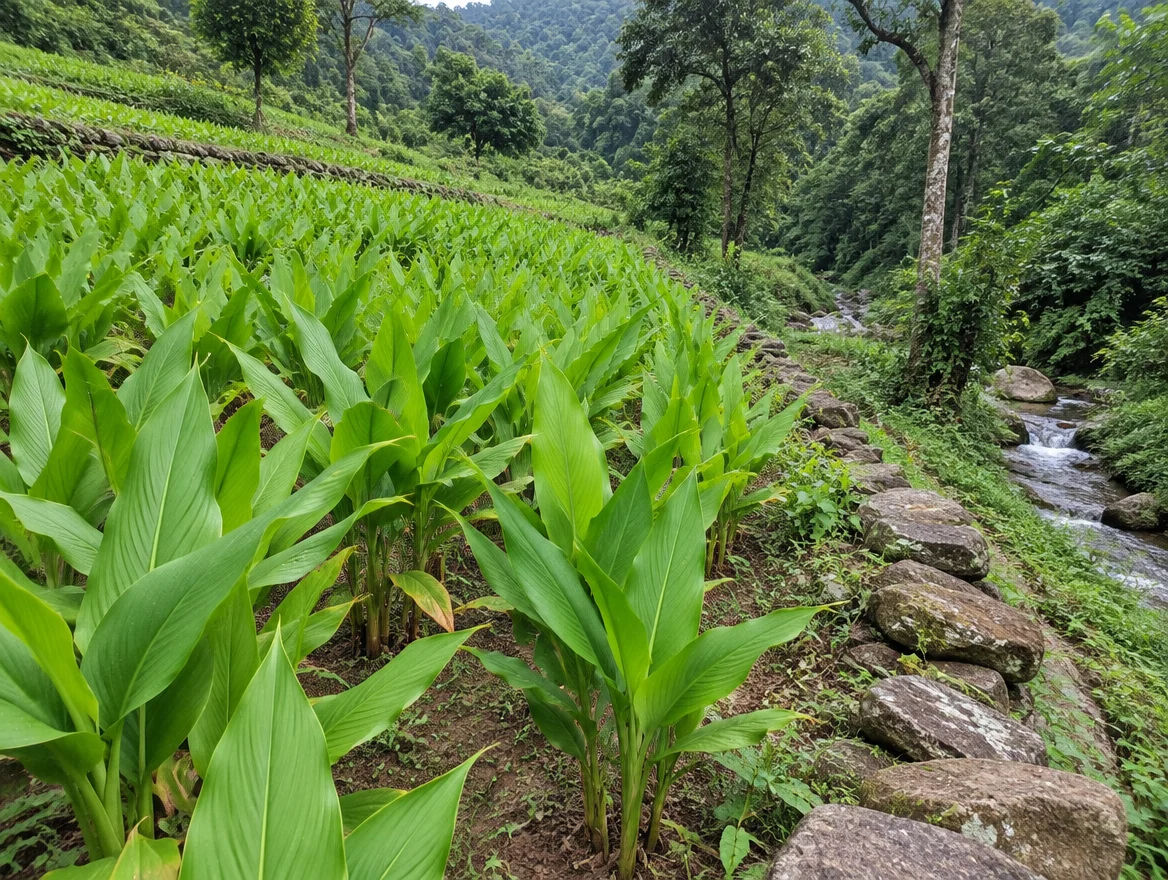
Kandhamal Haldi, the district’s turmeric, has held a GI tag since 2019 and tribal communities grow it with millets, pigeon pea and vegetables. Prices and yields have been poor: in 2026 reports, yields on some farms had fallen from five quintals an acre to two or three, and hybrid maize has been spreading in Daringbadi. Rainfall averages 1,620 mm but swings between about 1,000 and 1,800 mm.
For land buyers, the first fact is legal. The whole district is a Scheduled Area, so the usual idea of buying a farm from a willing seller does not work for a non-tribal buyer unless the land was never tribal. Buyers who can lawfully buy, such as tribal buyers or those holding land of long non-tribal title, should still check forest rights, slopes and access before paying. For everyone else, the district is better understood as a place to study than a place to buy, and the sections below explain what the rules mean in practice.
- Phulbani HQ
- Daringbadi
- Baliguda
- Kandhamal Haldi
- Scheduled Area
Transaction costs
Stamp duty & registration in Kandhamal
5%
Stamp duty, sale deed
On the higher of deed price and benchmark valuation
4%
Stamp duty, woman buyer
Same base, lower rate when a woman buys
2%
Registration fee, mainly
Per IGR Odisha FAQ (undated)
Per IGR Odisha[4], the registration fee is mainly 2%. Duty is charged on the higher of the deed price and the benchmark valuation, which is revised every two years from 1 April. Ask the sub-registrar for the village-wise value in Kandhamal and keep a written copy. After registration, apply for mutation at the Tahasil so the RoR shows your name.
Know the belt
What is moving prices in Kandhamal
Hill-town, turmeric and forest pockets; no listing-site prices are used, and most land is off-limits to non-tribal buyers.
Phulbani and the headquarters belt
District town and administration
Phulbani is the headquarters and the main market, and its municipal edge has plots held by non-tribal families for decades. These are the likeliest parcels to be lawfully available to an outside buyer. Even here, the first check is not price but whether any earlier owner in the chain was a tribal landholder, because that is what the law looks at.
Check: the full chain of ownership, the municipal limit and whether the plot is on government or forest land.
Daringbadi and the high hills
Turmeric, maize and tourism
Daringbadi, nicknamed the Kashmir of Odisha, is a high hill block whose winters have warmed from about -1°C in 2011 to 11°C in 2025 as reported. It grows turmeric and hybrid maize, and sees visitors in the cooler months. Tourist demand can lift prices for homestay plots, but the Scheduled Area rule applies to the land whether or not it is used for tourism.
Check: the slope, the access road, any forest claim and whether the seller is a tribal landholder.
Baliguda and Tikabali
Southern hill blocks
Baliguda and Tikabali are southern blocks with a mix of valley rice land and upland turmeric and millet plots. Most land is in tribal hands, so most plots are not available to outside buyers. Valley rice land is the most productive, and it is also the land most often held by tribal families who have farmed it for generations.
Check: the seller’s tribe status and any Forest Rights Act claim.
Phiringia, G. Udayagiri and Tumudibandh
Deeper hill and forest blocks
These blocks lie deeper in the hills with more forest and fewer roads. They are the least accessible and carry the strongest forest and tribal-land constraints. Distances look short on a map and are long on these roads, so travel time to a hospital or school is a real cost of owning land here.
Check: road access in the monsoon, the forest entry in the RoR and the seller’s status.
Raikia, Khajuripada, Chakapad and K. Nuagaon
Northern and eastern blocks
These blocks lie toward the Boudh and Ganjam sides of the district, with more valley land and a mix of rice, turmeric and forest produce. They share the same Scheduled Area rules as the rest of the district, so the first check is the seller’s status and the history of the plot.
Check: the access road, the forest entry in the RoR and whether the plot lies in a notified forest or a revenue village.
Asking prices
None is shown. Use the village-wise benchmark valuation from the sub-registrar and recent registered deeds in the same village as your references.
Connectivity
How Kandhamal connects — road, rail and air
Road, rail and air links. Check the live route before you travel.
🚗 By road
✈️ By air
🚆 By rail
No drive times are shown because road works and traffic vary; check the NHAI project pages and the local offices before relying on a figure.
Growth catalysts
Upcoming infrastructure & developments
Status labels reflect sources read in November 2026. Government-announced timelines are not guaranteed; items with a single or older source say so.
01Open
03Catalysts
Agriculture & terrain
Soil, crops & water in Kandhamal
A hill district of turmeric, millets, hybrid maize and forest produce, with erratic rainfall, soil decline and landslide risk.
Crops
Tribal farmers grow turmeric, millets, pigeon pea, tubers and vegetables together, and hybrid maize is replacing traditional varieties in Daringbadi. The sources give no district crop-area table, so no acreage is shown. Mixed cropping keeps moisture and soil carbon better than the monocropping that hybrid maize encourages, according to the report.
- Turmeric
- Millets and pigeon pea
- Tubers and vegetables
- Hybrid maize
- Non-timber forest produce
Soils
Hill soils are thin and erode on slopes; farmers report that monocropped fields turn dry and lifeless after three to four years. Mixed cropping keeps more moisture and soil carbon.
- Thin hill soils
- Valley rice soils
- Erosion on slopes
Forests
Forest covers 67.4% of the district, and 459.94 sq km was lost between 2001 and 2019 according to the same report.
- 67.4% forest
- Landslide-prone slopes
Water and irrigation
The sources give no irrigation figure. Hill streams dry earlier than before, and borewells are rare on slopes, so confirm a plot’s water source across a full year. Streams that once ran through the dry season now dry earlier, so a plot that depends on a stream should be seen in April and May.
Rainfall and landslides
The district average is about 1,620 mm, but totals swung from 1,013 mm in 2011 to 1,826 mm in 2018 and 1,208 mm in 2024. Landslides struck Kalinga Ghat in September 2025 and Kumbharipadar in October 2022.
At a glance
Kandhamal vs. nearby districts
| District | Land and water | What links it to Kandhamal |
|---|---|---|
| Ganjam (south-east) | Coast and plains | The coastal market for the district’s produce; Ganjam is not on the Scheduled Area sub-plan list. |
| Boudh (north) | Hills and the Mahanadi side | The road toward the north passes through Boudh. |
| Kalahandi (west) | Hills; two Scheduled Area blocks | Shares the Eastern Ghats and tribal-land rules but only in two blocks. |
| Rayagada (south-west) | Hills and tribal blocks | A tribal district in the same Scheduled Area system. |
No price series is shown for any neighbouring district here. Compare benchmark valuations and registered deeds, not asking prices.
Farmland India view
Why investors look at Kandhamal
Five reasoned points for Kandhamal, each tied to a source on this page.
The law decides who can buy
Because the district is a Scheduled Area, the buyer’s identity and the land’s history matter more than the price. Without a clean chain of non-tribal ownership, there is no purchase to make. This is not a district for a quick investment: the lawful buyer pool is small, and a resale later faces the same rule.
Turmeric has a brand and a price problem
The GI tag is real, but yields and prices have been poor in some years, so turmeric land is not a safe income base. If you want turmeric land, ask the seller for three years of harvest and sale records, not a verbal estimate.
Climate change is changing the farm economy
Warming, erratic rainfall and shifting crops mean that last decade’s income may not repeat. Prefer plots with water and diverse crops. The 2026 report on Daringbadi describes monocropped fields that turn dry after three to four years, which matters if you plan to farm the plot yourself.
Forest and slope risk limit the usable land
With 67.4% forest and recent landslides, usable land is scarce and often steep. Site visits in the monsoon are part of the due diligence. Ask the Tahasildar for the slope and forest status in writing, and keep the reply with the sale papers.
Access matters more than distance
Hill roads can be cut for days. A plot on an all-weather road is worth more than one a short distance away on a track. Check whether a road is maintained by the state or only a village track, and who clears it after a landslide.
Confirm the RoR, mutation history, kisam, CRZ or flood status and any acquisition notice before paying a token amount.
STRAIGHT TALK
Risks & challenges in Kandhamal
District-specific risks. Read the Odisha page for the general risks on ceiling, tribal sellers, conversion and records.
Scheduled Area ban
Regulation 2 of 1956 bars the transfer of tribal land to non-tribals across the district. A registered sale can still be undone. Ask a Kandhamal-based lawyer to check the whole chain, and never rely on a seller’s word about who owned the land before.
Forest Rights Act claims
Individual and community claims may not appear in the RoR. Ask the forest division and the village committee. A community claim over a forest or common land can limit what you can do on a nearby plot, even if your own boundary is clear.
Landslides and erosion
Steep slopes and heavy rain bring landslides, and farmland on hillsides loses topsoil. The Kalinga Ghat landslide in September 2025 and the Kumbharipadar evacuation in October 2022 are reminders that slope stability is a real due-diligence item.
Crop and price risk
Turmeric yields and prices swung in the reports, and hybrid maize carries its own risks.
Poor access
Roads are narrow and can be cut for days in the monsoon.
Seasonal migration and labour
About a fifth of people in each Daringbadi village are estimated to migrate seasonally for work, so labour for farming can be scarce at peak times.
Who to contact
Local revenue & planning offices
The Collectorate is at Phulbani, with Tahasil offices across the twelve blocks; the district website[7] lists them. Registration is at the sub-registrar office for your village, and IGR Odisha[8] provides the registration services. Use the Tahasil for mutation and the RoR, the ITDA for tribal-development matters and the forest division for forest rights questions. Disputes about tribal land are heard by the Revenue Officer under the Odisha Land Reforms Act, so keep copies of every document in case of a later inquiry.
COMMON QUESTIONS
Frequently asked questions
Everything buyers, NRIs and investors ask before their first reviewed farmland purchase in Kandhamal.
Visit full wiki01 of 04
Can an outsider buy farmland in Kandhamal?
Kandhamal is wholly a Scheduled Area: all 12 of its blocks are on the ST and SC Development Department’s sub-plan list. Regulation 2 of 1956 bars the transfer of tribal land to non-tribals, so an outsider can realistically buy only land that was never held by a tribal owner. Prove the chain of ownership before paying.
02 of 04
What is the stamp duty on land in Kandhamal?
Odisha charges 5% stamp duty on a sale deed, 4% when a woman buys, and a registration fee of mainly 2% per IGR Odisha. Duty is on the higher of the deed price and the benchmark valuation, which is revised every two years from 1 April.
03 of 04
Is there a price guide for farmland in Kandhamal?
None is shown. Use the village-wise benchmark valuation from the sub-registrar and registered deeds in the same village as your references.
04 of 04
Is turmeric profitable in Kandhamal?
Kandhamal Haldi got a GI tag in 2019, but yields on some farms fell from about five quintals an acre to two or three, and traders paid as little as Rs 13,000 a quintal, per an April 2026 report. ITC bought 15 tonnes at Rs 168 a kg from one women’s group in October 2024. Prices and yields vary widely by farm and year.
Transparency
Sources and references
Government
- [1]Odisha Annual Reference 2011: districts, sub-divisions, tahasils and blocks — magazines.odisha.gov.in
- [2]ST and SC Development Department: TSP blocks list — stsc.odisha.gov.in
News
- [3]OdishaBytes, 1 Apr 2019: Kandhamal Haldi gets GI tag — odishabytes.com
- [4]igrodisha.gov.in: IGR Odisha — igrodisha.gov.in
- [5]orissapost.com: OrissaPOST — orissapost.com
- [6]odishabytes.com: OdishaBytes — odishabytes.com
- [7]kandhamal.odisha.gov.in: district website — kandhamal.odisha.gov.in
- [8]igrodisha.gov.in: IGR Odisha — igrodisha.gov.in
Project status and benchmark valuations change often; check the linked source and the relevant office before relying on any figure.
For developers
Ready to explore Kandhamal farmland?
Browse reviewed projects and individual land parcels across Kandhamal — or if you own land here, list it with platform review and reach serious buyers.