Bhulekh Delhi: Land Records Guide for Buyers (2026)
How Delhi's village land records are kept, where to get certified copies, and what these records do not cover.
Delhi does not have a confirmed state-wide online Bhulekh. On the official pages we opened, village land records (khatauni, jamabandi, girdawari and the village map) are kept by the Halqa Patwari and issued as certified copies through the Tehsildar's office. This guide explains that system and the limits of Delhi village records for a land buyer.
What Delhi has instead of a state-wide Bhulekh
Search for "bhulekh in Delhi" and you will find many pages that describe a single online portal where you type a khasra number and see the owner. We could not find such a portal on the official Delhi Revenue Department site or on the e-District Delhi home page we opened. The Revenue Department home page lists only "Our Services" and "News & Updates", and the e-District page describes services in general terms without naming land records. We therefore do not tell buyers that a state-wide online Bhulekh for Delhi exists.
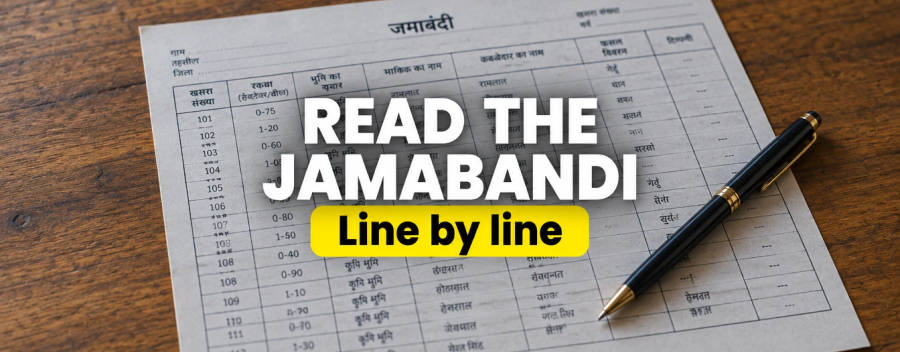
What the official district pages do describe is a working, paper-based record system run from the Tehsil. Each revenue village has a Halqa Patwari (हलका पटवारी, the village record keeper). The patwari keeps the ownership record (khatauni or jamabandi), the cultivation record (Kharsa Girdawari), the village map (Aks Sizra) and the mutation register. Certified copies are issued through the Tehsildar's office. For a buyer of land in a Delhi village, that Tehsil record room is the source of truth.
Delhi has 13 revenue districts, each headed by a Deputy Commissioner, according to the Revenue Department home page. The same page lists a December 2025 notification creating 39 sub-divisions, so the Tehsil or sub-division that covers a village may have changed recently. Confirm the current office before you travel.
The law behind the records
Land held for agriculture in Delhi's rural villages is governed by the Delhi Land Reforms Act, 1954. The Deputy Commissioner (West) FAQ page says mutation disputes are referred under this Act, and that the Tehsildar and Naib Tehsildar must ensure that the jamabandi and khatauni are prepared on the schedule set out in the Act. The South district page says the khatauni and jamabandi are updated every four years, with mutations incorporated. We did not open the Act text itself, so we do not quote section numbers.
The key records, in plain terms:
- Khatauni or jamabandi: the record of who holds which land. See our general explainer on jamabandi and fard and on khasra and khatauni.
- Kharsa Girdawari: the crop and cultivation inspection record, written by the patwari each season. The South district page gives the inspection months as October, February and April, checked by the Field Kanungo.
- Aks Sizra: the village map, supervised by the Field Kanungo. Read more in village maps in Delhi.
- Mutation register: the log of ownership changes. See mutation in Delhi.
Who does what: patwari, kanungo, tehsildar, SDM, collector
| Officer | Role on the official pages |
|---|---|
| Halqa Patwari | Keeps village records, inspects fields each season, starts mutation, issues certified copies |
| Field Kanungo | Supervises the patwari, checks village maps and statistics, carries out demarcation |
| Naib Tehsildar and Tehsildar | Ensure records are correct and prepared on schedule; sanction mutation |
| Revenue Assistant (SDM) | Hears mutation disputes referred by the Tehsildar |
| Collector (DC or ADM) | Hears appeals against mutation orders |
| Financial Commissioner, Delhi | Hears appeals against the Collector's orders |
This ladder matters when something is wrong. A mutation that is rejected or sanctioned wrongly has a defined appeal route, and a buyer should ask which stage a pending case has reached before paying.
How to get a certified copy of a record in 2026
The Deputy Commissioner (South) services page describes this process for certified copies of the khatauni, jamabandi and Kharsa Girdawari:
- Go to the Tehsildar's office that covers the village, and meet the in-charge of the Record Room.
- Apply in Form CA-I on a non-judicial stamp.
- The copy is issued after the original record is located. The page says this normally takes about 7 days.
The page lists all land record services as offline and mentions no online application or payment. It names the non-judicial stamp but no other fee. We could not confirm whether other districts follow the identical counter practice, or what the current stamp value is. Ask the Tehsil clerk and get the stamp from an authorised vendor.
Bring khasra numbers, not only a name
Records are filed by village and khasra (field) number. Carry the khasra number from the seller's sale papers or the earlier deed, along with the village name and Tehsil, so the Record Room can find the right page quickly.
What these records cover, and what they do not
This is the most important point for a buyer. The patwari-based system above applies to Delhi's rural, revenue-village land. Much of Delhi is urban or planned: DDA schemes, lal dora and abadi (the inhabited village core, see lal dora and abadi), unauthorised colonies and regularised areas. For such land, the khatauni of the village is often not the controlling document, and ownership may be shown in a registered deed, DDA papers or a conveyance instead.
Also, Delhi's agricultural land is shrinking fast through acquisition and urbanisation. The Revenue Department home page lists multiple acquisition notices under the RFCTLARR Act, 2013 (October 2025 to January 2026). Before you buy any village land, check whether it appears in an acquisition notice, a land pooling plan or a Master Plan zone. A clean khatauni does not rule these out. We could not confirm from an official source how a buyer should search acquisition status on one portal, so ask the Land Acquisition Collector of the district and read the Gazette notices.
Farmland India Reviewed pages for Delhi therefore treat the khatauni as one document in a set, not as proof of title.
Buyer checklist for Delhi village land
- Get a certified khatauni or jamabandi and Kharsa Girdawari copy for the khasra numbers from the Tehsil.
- Match the seller's name and every co-holder against the sale papers.
- Check the Aks Sizra extract against what you see on the ground, and consider demarcation by the Kanungo if boundaries are unclear.
- Check who is in cultivation in the Girdawari. A different cultivator from the seller needs a written explanation.
- Ask for the mutation history and any pending mutation case, then follow up through mutation status in Delhi.
- Check the encumbrance position at the Sub-Registrar; see DORIS Delhi EC and our encumbrance certificate guide.
- Check the land use and any restriction on transfer to a non-agriculturist, and the acquisition and Master Plan position.
- Run the wider title steps in how to verify land title and the land due diligence checklist.
For comparison with other states, read how to check land records online in India.
Related records and costs
Land records tell you who holds the land. Cost and tax records sit elsewhere: circle rate lookup in Delhi, stamp duty in Delhi and property tax in Delhi. Note that the Revenue Department lists a 13 October 2025 circular on valuation and registration of residential properties under Section 47-A of the Indian Stamp Act. We did not read it in full, so we do not state its effect on agricultural land.
What is unconfirmed
We could not confirm: whether any Delhi government portal lets the public view village khatauni or jamabandi online; the current fee beyond the non-judicial stamp; whether every district runs the same counter process as South; and which Tehsil covers a given village after the 2025 sub-division changes. Where a third-party site claims an online Delhi Bhulekh, treat it as unverified until it points to a delhi.gov.in or nic.in page.
Frequently Asked Questions
Is there an official Bhulekh portal for Delhi?
What is DLRC?
Where do I get a certified khatauni copy?
How long does a certified copy take?
Is there a fee?
Does the khatauni cover all land in Delhi?
How often are the records updated?
Who inspects crops and when?
Can the khatauni prove I own the land?
What if the record has a mistake?
Sources
- Office of the Deputy Commissioner (South), Delhi: Services offered (land records, mutation, demarcation)
- Office of the Deputy Commissioner (South), Delhi: Mutation service page
- Office of the Deputy Commissioner (West), Delhi: Role of Halqa Patwari and revenue staff
- Office of the Deputy Commissioner (West), Delhi: FAQ on land records and mutation appeals
- Revenue Department, Government of NCT of Delhi (home page)
- e-District Delhi portal (home page)