Bhu Naksha Delhi: Village Map Guide (2026)
What the Delhi village map is called, whether it is online, how to get an extract and what it cannot tell you.
In Delhi's revenue villages the village map is called Aks Sizra and is kept by the Halqa Patwari. We could not confirm an official online viewer, so a buyer should ask the Tehsil for a certified extract and compare it with the khatauni and the ground.
What a village map is, and what Delhi calls it
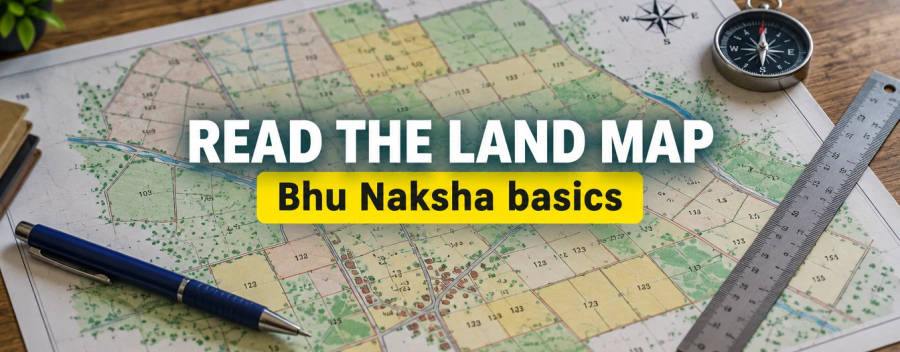
A bhu naksha (भू नक्शा, cadastral or village map) draws each field of a village with its khasra number and boundary. In Delhi's revenue villages the official pages call the village map the "Aks Sizra" (अक्स शजरा). The Deputy Commissioner (West) pages say the Halqa Patwari maintains it and the Field Kanungo supervises and checks village maps. For the general idea of how such maps work, read our explainer on cadastral maps.
The map is not the same as the sale deed plan, a DDA layout, or a Master Plan land-use map. Each serves a different purpose. Mixing them up is a common reason buyers believe they have seen "the map" when they have not.
Is a Delhi bhu naksha available online?
We could not confirm an official online Delhi bhu naksha viewer. The Revenue Department home page we opened lists only "Our Services" and "News & Updates", and the e-District Delhi home page does not name village maps among its services. The Deputy Commissioner (South) services page lists land record services as offline. Treat any website offering an instant Delhi khasra map as unverified until it points to a delhi.gov.in or nic.in source.
Some national map layers exist for India as a whole, and some states publish village maps online (see Bhu Naksha UP, Bhu Naksha Haryana and Bhu Naksha Punjab). We have not confirmed that Delhi villages are covered by any such viewer, so we do not say they are.
How to get a map extract in 2026
The official pages do not describe a stand-alone application for a map copy. They do describe two related facts. First, the village map is held by the patwari and checked by the Kanungo, and certified copies of land records are issued through the Tehsildar's office. Second, the demarcation service on the South page asks the applicant to include a certified map extract and the relevant khasra details.
A practical route, which you should confirm at the Tehsil:
- Note the village name and khasra numbers from the seller's papers.
- Ask the Tehsil Record Room or the Halqa Patwari how a certified Aks Sizra extract is issued and what form and stamp apply.
- Ask for the extract to show the khasra number, its shape, neighbouring khasras and any path or drain.
We could not confirm a form number, fee or timeline for a map extract. For certified copies of the khatauni, jamabandi and Kharsa Girdawari, the South page gives Form CA-I and about 7 days, but it does not say these apply to maps.
Do not buy from a photograph of a map
A phone photo of a map or a hand sketch is not a certified extract. Ask for an extract with an official stamp and signature, and compare it with the khasra numbers on the deed.
Demarcation: when the map and the ground disagree
If boundaries are unclear, the South page describes demarcation as a Tehsildar service. The applicant deposits the prescribed fee and includes a certified map extract and khasra details. Notice is issued to the parties and the Kanungo demarcates the land in their presence. The report is filed in the Tehsil record room, and a copy can be taken from the Record Room in-charge. Boundary disputes go to the Revenue Assistant (SDM). The page does not state the fee amount, so we do not either.
For a buyer, demarcation before purchase is far cheaper than a boundary dispute after. It is most useful when the plot is a part of a larger khasra, or the seller points to a boundary that is a fence or a tree rather than a surveyed line.
What the village map covers and does not cover in Delhi
The Aks Sizra belongs to Delhi's rural revenue-village system. It will not settle questions about:
- Lal dora and abadi: the inhabited village core is treated differently from agricultural fields; see lal dora and abadi.
- DDA and planned land: layouts and land-use come from planning documents, not the village map.
- Acquired land: the Revenue Department lists acquisition notices under the RFCTLARR Act, 2013. A khasra that still appears on an old map may already be subject to an award or notice.
- Master Plan zoning: whether a field can be used for a farmhouse or other purpose.
Before relying on the map, check the notices published by the Revenue Department for the district and the Land Acquisition Collector. We could not confirm a single online place where a buyer can check all of these.
How to read the map against the khatauni
- Pick one khasra number from the khatauni and find it on the map.
- Compare the area on the khatauni with the area the map suggests. Small differences can come from old surveys; large ones need an explanation.
- Look at access. A khasra with no recorded path to a public road may have no legal access, even if the owner says it does.
- Check the neighbours' khasras for conflicts with your boundary.
- Match the map to the Girdawari: if someone else is shown as cultivator, ask why.
Our general guides how to verify land title and land due diligence checklist show where the map fits in the full process. Cost-side records are in circle rate lookup in Delhi and stamp duty in Delhi.
Red flags on Delhi village maps
- Seller offers a map but cannot name the khasra number.
- The map extract carries no office stamp.
- The field on the ground is clearly different in shape from the field on the map.
- The land is shown in or near a notified acquisition area.
- The seller declines demarcation or an inspection with the patwari.
Any one of these is a reason to pause the deal and ask for written clarification.
What is unconfirmed
We could not confirm: any online Delhi village map viewer; the application form, fee and time for a certified map extract; the demarcation fee; or whether every district handles maps the same way as the South and West pages describe. Ask the Tehsildar's office, and write down the officer's answer with the date.
Frequently Asked Questions
What is the village map called in Delhi?
Can I see a Delhi bhu naksha online?
Who supervises the village map?
How do I get a certified map extract?
What is demarcation?
Who decides boundary disputes?
Does the map show if the land is acquired?
Is the village map valid for lal dora land?
Can I rely on a map I found on a third-party website?
Is a map enough to buy land?
Sources
- Office of the Deputy Commissioner (South), Delhi: Services offered (land records, mutation, demarcation)
- Office of the Deputy Commissioner (South), Delhi: Mutation service page
- Office of the Deputy Commissioner (West), Delhi: Role of Halqa Patwari and revenue staff
- Office of the Deputy Commissioner (West), Delhi: FAQ on land records and mutation appeals
- Revenue Department, Government of NCT of Delhi (home page)
- e-District Delhi portal (home page)