Khatauni Delhi: Record of Rights Guide (2026)
How the khatauni is kept in Delhi's villages, how to get a certified copy, and what a buyer should check.
In Delhi's revenue villages the khatauni (record of rights) is kept by the Halqa Patwari. We could not confirm an online search, so the route is a certified copy from the Tehsildar's office. This guide explains the process and the limits of the record for land buyers.
What a khatauni is in Delhi villages
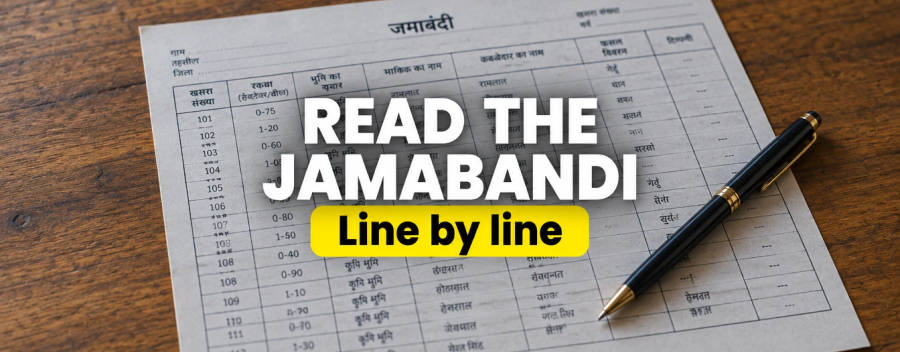
A khatauni (खतौनी) is the record of rights that lists the holders of land in a village. The Deputy Commissioner (West) pages describe the ownership records, "referred to as khatauni/jamabandi", as kept by the Halqa Patwari for each village. The Tehsildar and Naib Tehsildar must ensure they are prepared according to the schedule in the Delhi Land Reforms Act, 1954. The South page adds that the khatauni and jamabandi are updated every four years, with mutations incorporated.
For the general meaning of the terms, see khasra and khatauni explained and jamabandi and fard explained. In UP the khatauni is a widely searched online record (see Khasra Khatauni UP), but Delhi is different, as described below.
Can you see a Delhi khatauni online?
We could not confirm that you can. The Revenue Department home page we opened lists "Our Services" and "News & Updates" and does not show a khatauni search. The e-District Delhi page describes government services in general terms and does not name land records. The South district services page lists certified copies of the khatauni and jamabandi as an offline service with no online application or payment. Pages elsewhere that promise an instant Delhi khatauni search should be treated as unverified.
How to get a certified khatauni copy in 2026
The South district page describes this process:
- Visit the Tehsildar's office for the village and meet the in-charge of the Record Room.
- Apply in Form CA-I with a non-judicial stamp.
- The copy is issued after the original record is located, normally in about 7 days, according to the page.
The page mentions the non-judicial stamp but lists no other fee. We could not confirm the stamp value, the exact office hours for this service, or whether all districts follow the same procedure. The West pages say the patwari issues certified copies, so ask which counter applies in your Tehsil.
Ask for the Girdawari together
When you apply for the khatauni, ask for the Kharsa Girdawari (cultivation record) of the same khasra numbers. The South page says certified copies of both are available through the Tehsildar's office. Comparing them shows who is actually in possession.
How to read a khatauni as a buyer
| Check | Why it matters |
|---|---|
| Name of holder and all co-holders | Every co-holder usually needs to sign the sale |
| Khasra numbers and area | Must match the deed, the site and the map |
| Nature of holding and remarks | Any remark on tenancy, charge or restriction needs a written explanation |
| Date of the latest entry | Shows whether recent mutations are incorporated |
| Cultivator in Girdawari | A different cultivator suggests a possession issue |
The terms on the record can be local. We could not open a sample Delhi khatauni form, so we do not list column names. If a column is unclear, ask the patwari to explain it in writing.
What a Delhi khatauni does not cover
The khatauni belongs to the village revenue-record system. It is not the main document for:
- Lal dora and abadi plots (see lal dora and abadi);
- DDA-allotted or planned land, where DDA papers and conveyance deeds matter;
- Land under acquisition: the Revenue Department lists notices under the RFCTLARR Act, 2013, and a khatauni can still show the old holder during the process;
- Land use and zoning, which are set by planning rules, not by the khatauni.
A khatauni shows who is recorded as holder. It does not show whether the registered deed chain is clean. For that, see DORIS Delhi EC and our encumbrance certificate guide.
After you buy: keeping the khatauni current
A sale deed registered at the Sub-Registrar does not by itself change the khatauni. The mutation process does that. The South page describes mutation as an application to the Tehsildar with supporting documents and an objection period. Read the details in mutation status in Delhi and our general mutation guide. After mutation, ask for a fresh certified khatauni and keep it with your deed. If the land passed by inheritance, see mutation after death.
Because the khatauni is updated every four years according to the South page, a recent mutation may not show in a copy until the entry is made. Ask for the mutation order as well.
Buyer checklist
- Obtain a certified khatauni and Girdawari for each khasra number.
- Match names with the seller's identity documents and the title deeds.
- Check the map extract; see Bhu Naksha Delhi.
- Check for mutation orders, pending cases and objections.
- Check encumbrances at the Sub-Registrar.
- Check acquisition, land pooling and Master Plan status for the village.
- Understand costs: circle rate lookup in Delhi and stamp duty in Delhi.
- Take a lawyer's opinion before paying a booking amount; see how to verify land title.
The parent guide for this cluster is Bhulekh Delhi.
Why village records matter more in Delhi than people expect
Delhi buyers often assume that because the city is fully urban, land records are a formality. In the remaining rural villages the opposite is true. Land values are high, acquisition and pooling are active, and families have often held a khasra jointly for generations without updating names. That makes the khatauni the first place where a gap shows up: a deceased holder still listed, a co-holder you were never told about, or a cultivator who is not the seller.
Read the entry slowly and ask for the previous entries as well. If the seller bought recently, the earlier khatauni shows the chain. If the seller inherited, check that every heir is listed. If anything differs from what you were told, stop and ask for the explanation in writing before paying even a token amount. Farmland India Reviewed pages follow this rule: a record that cannot be explained is treated as unverified.
Finally, keep your own file. Store the certified copy, the date of issue, the name of the officer at the Record Room, and the stamp receipt. If a dispute arises later, this file shows what you checked and when.
What is unconfirmed
We could not confirm: any online Delhi khatauni search; the value of the non-judicial stamp; whether all districts use Form CA-I; the exact structure of a Delhi khatauni; and how fast a new mutation appears in a copy. Ask the Tehsil in person and keep a written note.
Frequently Asked Questions
Is there an online khatauni search for Delhi?
Who keeps the khatauni?
What form do I use for a certified copy?
How long does a copy take?
What does it cost?
How often is the khatauni updated?
Is khatauni the same as jamabandi?
Does the khatauni prove ownership?
Does it work for lal dora plots?
What if my purchase is not in the khatauni yet?
Sources
- Office of the Deputy Commissioner (South), Delhi: Services offered (land records, mutation, demarcation)
- Office of the Deputy Commissioner (South), Delhi: Mutation service page
- Office of the Deputy Commissioner (West), Delhi: Role of Halqa Patwari and revenue staff
- Office of the Deputy Commissioner (West), Delhi: FAQ on land records and mutation appeals
- Revenue Department, Government of NCT of Delhi (home page)
- e-District Delhi portal (home page)