
District guide
Buying Land in Muktsar
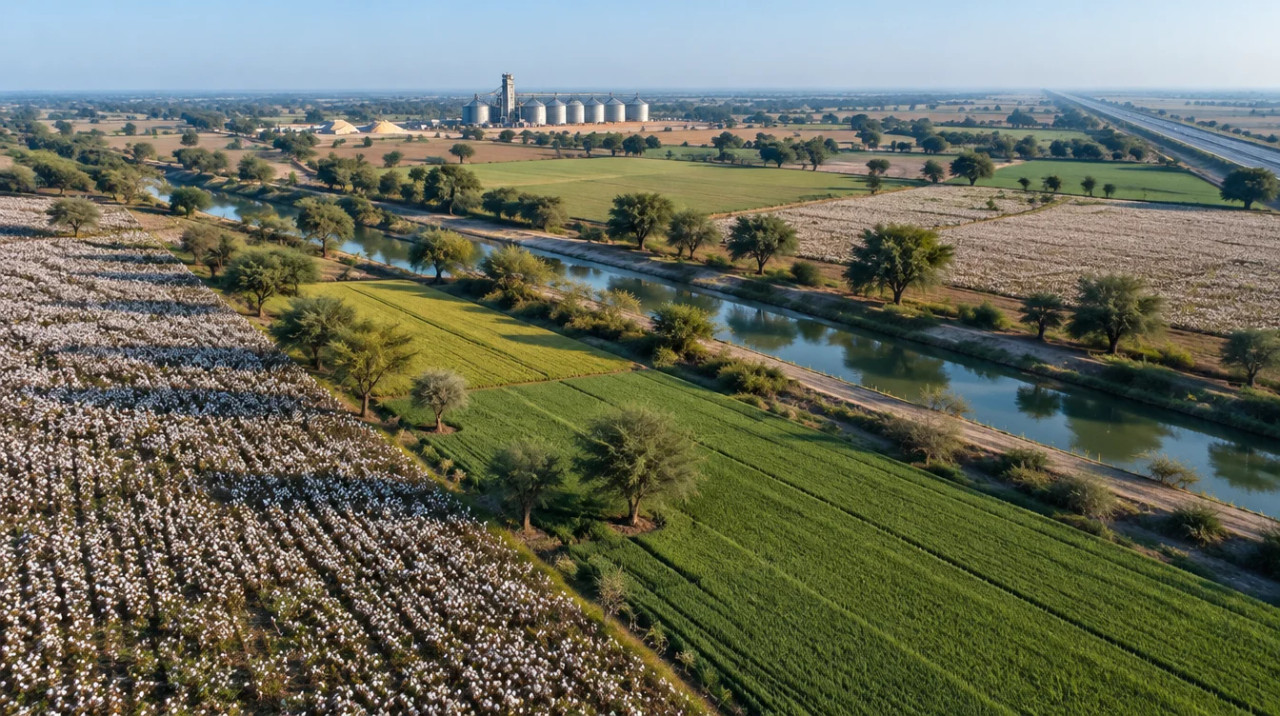
Canal-fed cotton, paddy and wheat land in south-west Malwa: open to Indian buyers, with waterlogging and saline groundwater as the central checks, the Rajasthan Feeder relining, and no sourced price series.
~2,631 sq km
Area
~9.0 lakh
Population (Census 2011)
225 of 234
Villages prone to waterlogging
Open (NRIs barred)
Outsider agricultural land
*Indicative range across districts and land types. Stamp duty, registration and conversion charges are additional. Local measurement units vary — every listing states the unit it is priced in. Not a valuation or an offer.
PLRS — Punjab Land Records SocietyDistrict land record — Muktsar
Rev. 2026 · Farmland India desk
State
Punjab
Sub-divisions
3 sub-divisions (Sri Muktsar Sahib, Malout, Gidderbaha), 4 sub-tehsils (Bariwala, Lakhewali, Lambi, Doda) and 4 blocks (Sri Muktsar Sahib, Malout, Lambi, Kot Bhai), with 234 villages on the administrative set-up page; the demography page gives 233, so confirm the count with the district office
Key markets
Malout · Gidderbaha · Sri Muktsar Sahib city edge · Lambi
Agricultural land
Open to Indian citizens: the Land Reforms Act text sets a holding ceiling but no residence bar (Punjab Land Reforms Act, 1972, PLRS); NRIs and OCIs may not buy (RBI Master Direction, Sep 2022)
Demand anchors
Canal-fed cotton, paddy and wheat farming · Malout on NH-10 · Rajasthan Feeder relining · proposed Malwa canal
Planning authority
Three municipal councils are listed on the district demography page (Muktsar, Malout, Gidderbaha); we found no planning-authority page, so ask the local office which body covers the village
Water
Canals supply about 95% of irrigation (Punjab Agriculture Department; CGWB, 2017); CGWB says almost the whole district faces waterlogging
Border
Not among the six border districts in the Home Ministry's April 2026 fence-survey letters (All India Radio); Rajasthan and Haryana lie to the south (MSME-DI profile)
Rail
Bathinda–Abohar line serves Malout and Gidderbaha (district portal)
Size and population
About 2,631 sq km (2,63,121 ha on the portal) · 9,01,896 people at the 2011 Census (district portal)
Pricing unit
₹ per acre for farmland
Local units
Revenue records use acre, kanal and marla: 1 kanal = 20 marla and 8 kanal = 1 acre. Take the area from the fard
Land records portal
Punjab Land Records Society (PLRS) · jamabandi (fard); the state launched an Easy Jamabandi portal in June 2025 (The Tribune, June 2025)
Land law is state law. These rules are maintained on the Punjab page and apply to every district within it.
Muktsar — land purchase legal rules
The Act text we read limits how much land a family may hold, not who may buy. The main check is land classification: village common land (Shamlat Deh) vests in the Gram Panchayat, and a private seller cannot pass title to it.
Who can buy agricultural land? Section 4 of the Punjab Land Reforms Act, 1972 (Act No. 10 of 1973) caps what a person or family may hold. We found no clause in the text we read that limits the buyer by domicile or occupation; the copy is a 2005 printout, so a Punjab revenue lawyer should confirm there is no later restriction.
Ceiling limits: under Section 4(2) the permissible area is 7 hectares of two-crop irrigated land, 11 hectares of one-crop irrigated land and 20.5 hectares of barani land, with other classes capped at 21.8 hectares. A family of more than five gets one-fifth extra per additional member, for at most three members. Section 12 makes a transfer beyond the limit void (Act text, Punjab Land Records Society). A 2017 amending Bill took land bought for housing, industry, tourism and institutions outside the Act and asks the buyer to tell the Collector of the change of use within a year (Punjab Vidhan Sabha, Bill 33-PLA-2017).
Shamlat Deh — the parcel that cannot be sold: under the Punjab Village Common Lands (Regulation) Act, 1961 this land vests in the Gram Panchayat, which may dispose of it only for the benefit of villagers and, under the rules, with prior government approval; the Collector decides disputes over its status. A private seller therefore cannot give a buyer title to it. Match every khasra number against the seller's current Jamabandi before paying any advance; the state reported in Tribune, June 2025 that its Easy Jamabandi portal issues free digitally signed copies with a QR code.
NRI Power of Attorney: a power-of-attorney sale does not transfer title; in Suraj Lamp & Industries v State of Haryana (Supreme Court, 2011) the Court held that only a registered deed of conveyance does, though an attorney may sign that registered deed for the owner. If the seller is abroad, read the PoA for an express power to sell and for its registration.
NRI & OCI buyers: the Reserve Bank's Master Direction under FEMA 1999 lets NRIs and OCIs buy immovable property other than agricultural land, plantation property or a farm house. That applies across India, Punjab included.
- Ceiling, not buyer class
- Ceiling: 7 / 11 / 20.5 ha
- Shamlat Deh: Panchayat land
- NRI PoA: registered deed
- NRI agri: barred (FEMA)
- Jamabandi check
Muktsar — district-specific notes
The full Punjab legal framework on our state page applies to Sri Muktsar Sahib in full. The notes below are specific to this district and are not repeated from the state page. Law was read in October 2026 from the Act text on PLRS, the RBI Master Direction and press reports; where an official page did not open, the note says so.
⚠ Any Indian citizen can buy, subject to a ceiling. The Punjab Land Reforms Act, 1972 limits a holding under Section 4(2) to 7 hectares of land irrigated for two crops a year, 11 hectares of one-crop irrigated land and 20.5 hectares of barani land, with 21.8 hectares as the outer limit for other classes, and Section 12 makes a transfer beyond the limit null and void. The text carries no clause that bars buyers from outside Punjab or non-agriculturists. A 2017 amendment Bill would keep land acquired for housing, industry and institutions outside the Act (Bill 33-PLA-2017, Punjab Vidhan Sabha); we did not read the final Act, so confirm any exemption with a Punjab revenue lawyer.
⚠ Waterlogging is the district-specific issue. CGWB says almost the whole district faces waterlogging, worst in the south and north-west and worse after the monsoon (CGWB, 2017). An Irrigation Department notification listed 225 of the district's 234 villages as prone to waterlogging and exempted 77 of them from the paddy-sowing schedule (The Tribune, June 2024). In November 2021 the District Revenue Officer said no farmland was left infertile, while the Chief Agriculture Officer said he had seen such land at Midda; the same report says the state once paid ₹3,000 per acre per crop season and had paid none in the previous five years. Walk the field after the monsoon and read the crop entries in the girdawari, not only the jamabandi.
⚠ Salinity and water quality. CGWB's 2017 report finds shallow groundwater moderately to highly saline, with electrical conductivity between 336 and 5,980 µS/cm (CGWB, 2017), and its 2024 Punjab report lists Muktsar for conductivity, fluoride, nitrate, arsenic and uranium above permissible limits (CGWB, December 2024). A tubewell on the parcel may not give usable water, and a house would depend on canal water or treated supply.
⚠ Forest law is not the issue here. The Forest Department's 2022 drone survey of Punjab Land Preservation Act land covered Hoshiarpur, Ropar, Nawanshahr, Dasuya, Mohali and Pathankot, not Muktsar (The Tribune, October 2022), and the MSME-DI profile shows about 2,000 hectares of protected forest in the district (profile, data to 2010-11). The Hoshiarpur page covers the Act in detail. Check the land class in the jamabandi in any case.
⚠ Border: Muktsar is not one of the six districts (Ferozepur, Tarn Taran, Amritsar, Gurdaspur, Pathankot, Fazilka) that the Home Ministry asked for a social impact survey on moving the fence (All India Radio, April 2026), and Rajasthan and Haryana lie to the south. We found no rule that restricts buying near the state line but did not research one; ask the Deputy Commissioner's office.
⚠ NRIs and OCIs cannot buy agricultural land, plantation land or a farmhouse (RBI Master Direction, updated September 2022). Where the owner is abroad, insist on a registered, current power of attorney that authorises sale: the Supreme Court held in Suraj Lamp & Industries v State of Haryana (2011) that a general power of attorney sale does not transfer title. Land recorded as shamilat deh vests in the panchayat under the Punjab Village Common Lands (Regulation) Act, 1961, so a private seller cannot give title to it.
⚠ Land pooling and colonies: the Land Pooling Policy 2025 was notified on 4 June 2025, withdrawn in August 2025, re-issued as optional in November 2025 and enhanced in April 2026 (The Tribune, June 2026). That explainer places the acquisition in the GMADA belt and does not mention Muktsar, and ETV Bharat's list of draft allocations does not include it (ETV Bharat, August 2025), so treat pooling-based uplift claims here as unconfirmed. For plots in colonies, PAPRA (the 1995 Punjab Apartment and Property Regulation Act) applies. A 2024 amendment let plots up to 500 sq yd in unauthorised colonies be registered without a no-objection certificate (NOC) (The Tribune, October 2024); in March 2025 a High Court bench directed strict compliance with Section 20(3) (PTC News, March 2025), and the Tribune reported in May 2025 that registrations without an NOC had been stopped (The Tribune, May 2025). We did not read the order, so ask the Sub-Registrar what the specific plot needs.
Read the full Punjab land buying guide for buyer eligibility, stamp duty and NRI rules.
- Open to Indian citizens
- Holding ceiling
- Waterlogging
- Saline groundwater
- Canal-fed land
- Colony NOC rule
- NRI agri ban (FEMA)
District overview
Muktsar — canal-fed cotton, paddy and wheat land in south-west Malwa, where water is the risk
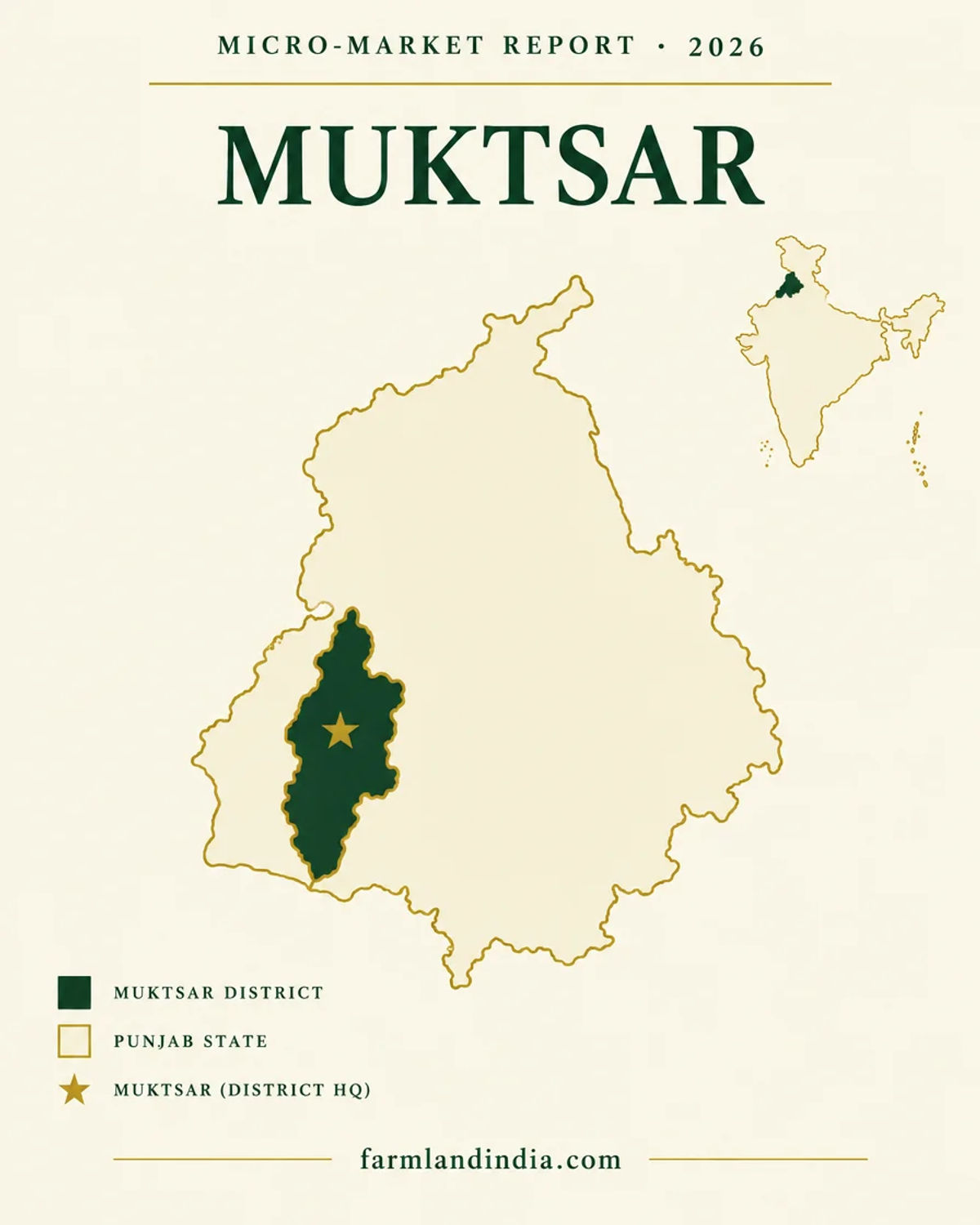
Sri Muktsar Sahib, searched as Muktsar, is a south-west Malwa district of about 2,631 sq km with 9,01,896 people at the 2011 Census (district demography page). The portal lists three sub-divisions, four blocks and 233 to 234 villages (administrative set-up), and CGWB says the district has no river and is covered by the Sirhind feeder canal network (CGWB, 2017). Agricultural land here is flat, canal-irrigated cotton, paddy and wheat land, with waterlogging and salinity as the main risks and Rajasthan to the south.
The Punjab Agriculture Department profile gives an area of 2,63,393 ha, 2,42,989 ha cultivable and 2,20,690 ha irrigated, with a cropping intensity of 175% and canals supplying about 95% of irrigation; kharif crops include cotton, paddy and moong, and rabi crops wheat, barley, raya and gram (Agriculture Department). Cotton area is volatile: the Chief Agriculture Officer told The Tribune in June 2023 that about 20,000 ha had been sown against a target of 50,000 ha (The Tribune, June 2023).
Water is both the asset and the risk. The Sirhind and Rajasthan feeders supply the district, and canal seepage is blamed for the waterlogging: India Water Portal (April 2014) put 84,800 hectares as critically waterlogged across the Faridkot, Muktsar, Malout, Lambi, Abohar and Gidderbaha tracts, about a quarter of it beside the two feeders (India Water Portal). A Lok Sabha reply of 8 August 2024 shows the Rajasthan Feeder relining, meant to ease waterlogging in Muktsar, Faridkot and Ferozepur, with a likely completion of June 2025 (Lok Sabha reply); we did not find whether it was finished.
We found no sourced price for Muktsar farmland, so the price table is empty by design. The Tribune did not name Muktsar among the 12 districts where collector rates had risen by 5% to 50% by August 2025, and we found no Muktsar village rate. Roads are the other open question: Malout sits on NH-10, and an NH-354 upgrade through Muktsar and Malout was reported delayed in August 2025 (Swarajya).
- Malwa
- Cotton belt
- Canal-fed
- Waterlogging
- Malout
- Gidderbaha
- Rajasthan border
Transaction costs
Stamp duty & registration in Muktsar
8%
Usual stamp duty — reported
The Tribune, 15 Jan 2026, on a cooperative-society concession
1%
Registration fee — reported
same report; payable as per rules
Higher of
Deed value or collector rate
duty is charged on the larger figure
The only recent figure we found is in The Tribune, 15 January 2026, which gives the usual stamp duty as 8% and a 1% registration fee in a report on a concession for buyers in cooperative societies, with the cesses exempted. That is not a rate for ordinary land purchases, and we opened no Punjab Revenue Department notification, so confirm the rate in force with the Sub-Registrar before budgeting.
Duty is charged on the higher of the deal value and the collector rate (CAG report, 2019). The Tribune, August 2025 named 12 districts where rates had risen by 5% to 50% and did not include Muktsar; Patiala was the first, by up to 100% (The Tribune, August 2024). We found no Muktsar-specific figure, and the district portal's collectorate documents page did not open for us. Canal-side and highway-side villages can differ widely, so look up the village before agreeing a price.
Know the belt
What is moving prices in Muktsar
Muktsar has no sourced price series: the cards below say what we found and what to check instead of giving a number.
Malout belt
No sourced price
Malout is the district's industrial town: the MSME-DI profile lists an industrial focal point at Danewala (Malout), with 106.28 hectares developed (data to 2010-11, profile). CGWB puts Malout block at 60% extraction on 2013 data and labels it safe, but waterlogging is mapped across nearly the whole district.
Check: canal outlet and turn, post-monsoon waterlogging, and the water quality of any tubewell.
Gidderbaha and Kot Bhai
No sourced price
The district portal says Gidderbaha is on NH-15 and the Bathinda–Abohar rail line (portal). CGWB's 2017 report gives Gidderbaha (Kot Bhai) block a stage of extraction of 105% on 2013 data while labelling all four blocks safe, an inconsistency in the report that we cannot resolve.
Check: borewell depth, salinity of the water, and canal supply rather than relying on a tubewell.
Sri Muktsar Sahib city edge
No sourced price
CGWB's 2017 report gives Muktsar block a stage of extraction of 82% on 2013 data and labels it safe. We found no price, no master-plan page and no municipal boundary map for the city edge.
Check: municipal limits and whether the land is within a master-plan area before assuming a residential use.
Collector rates
Not found for Muktsar
The Tribune did not name Muktsar among the 12 districts with rises of 5% to 50% by August 2025, and we found no village-wise list. Duty is paid on the higher of the deal value and the collector rate.
Check: the village rate at the Sub-Registrar before agreeing a price.
Units: acre, kanal, marla
Punjab sells farmland by the acre; 1 acre = 8 kanal and 1 kanal = 20 marla. We give no square-yard conversion because we opened no official table. Take the area from the fard and recompute any quote from the total price and the area.
Connectivity
How Muktsar connects — road, rail and air
Distances are limited to what we could source from official pages; journey times vary with road works.
By road and rail
By air
Local
For a buyer from Delhi the practical question is the last leg and the canal map, not the highway. The NH-354 upgrade through Muktsar and Malout was reported delayed in August 2025, and the Malout–Abohar–Sadhuwali four-lane was reported with compensation paid in May 2023; we found no later progress report. Read the Punjab agricultural land rules before paying an advance.
Growth catalysts
Upcoming infrastructure & developments
Status labels reflect sources read in October 2026. Government-announced timelines are not guaranteed; items marked as reported rest on a single or dated source.
00Operational
04Planned or in progress
Dates uncertain
Agriculture & terrain
Soil, crops & water in Muktsar
A flat canal-irrigated Malwa plain: cotton, paddy and wheat, with waterlogging and saline groundwater as the central checks.
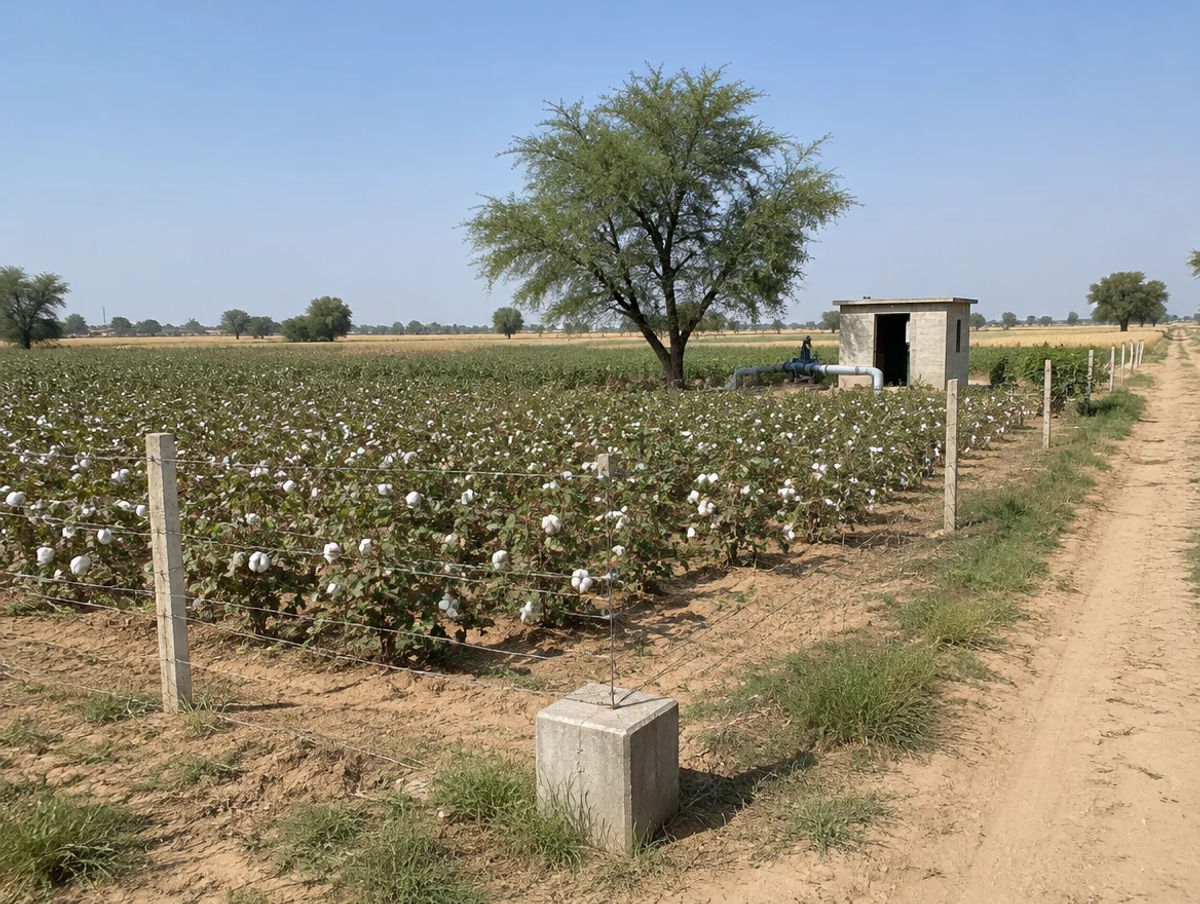
🌾 Cotton, paddy and wheat on canal water
The Punjab Agriculture Department profile gives 2,63,393 ha of area, 2,42,989 ha cultivable and 2,20,690 ha irrigated, with a cropping intensity of 175% and canals supplying about 95% of irrigation; kharif crops include cotton, paddy and moong, and rabi crops wheat, barley, raya and gram (Agriculture Department). Cotton area swings: about 20,000 ha were sown in 2023 against a 50,000 ha target (The Tribune).
- Cotton
- Paddy
- Wheat
- Raya
- Canal-fed
🧂 Water quality and salinity
CGWB's 2017 report finds shallow groundwater moderately to highly saline, with electrical conductivity between 336 and 5,980 µS/cm, and its 2024 Punjab report lists Muktsar for conductivity, fluoride, nitrate, arsenic and uranium above permissible limits (CGWB, December 2024). The 2017 report does not classify surface soils, so we give no soil type. Ask for a soil test and a water test for any parcel.
- Saline water
- Fluoride
- Arsenic
- Uranium
🌊 Waterlogging and the feeder canals
CGWB maps waterlogging across nearly the whole district, worst in the south and north-west and worse after the monsoon, with 2,240 sq km canal-fed. An Irrigation Department notification listed 225 of 234 villages as prone (The Tribune, June 2024). India Water Portal (April 2014) put 84,800 hectares as critically waterlogged, about a quarter beside the Rajasthan and Sirhind feeders, and blamed seepage, flood irrigation and the shift to paddy (India Water Portal). We found no Muktsar-specific report for the 2025 floods.
- Waterlogging
- Feeder canals
- Seepage
- Post-monsoon
💧 Groundwater and rainfall
The problem here is excess and salt more than depletion. CGWB's 2017 report (assessment as on 31 March 2013) gives a district stage of extraction of 70%, with Gidderbaha (Kot Bhai) at 105%, Muktsar 82%, Malout 60% and Lambi 40%, all four blocks labelled safe; the same report gives a 41% to 101% range elsewhere, which conflicts with the 105% figure. Normal rainfall is 430.7 mm, 79% of it in the monsoon, and about 96% of the district is irrigated by canal water and 4% by tubewells (CGWB, 2017). The data are old, so ask for the current block category. Canals can carry contamination too: The Tribune reported in April 2025 that canals in Muktsar and three other south-west districts carried contaminated water from Harike through the Sirhind Feeder (The Tribune, April 2025).
📐 Units and prices
Convert every quote to acres: 8 kanal make 1 acre and 20 marla make 1 kanal. Price a parcel on water, salinity and access, not on a broker's yield claim.
At a glance
Muktsar vs. its neighbours
| District / belt | Collector-rate movement (reported) | Evidence |
|---|---|---|
| Muktsar | Not named in the 12-district rise | The Tribune, 13 Aug 2025; no Muktsar village rate found |
| Faridkot | 5% to 50% rise by Aug 2025 | Named among 12 districts (The Tribune, 13 Aug 2025) |
| Fazilka | 5% to 50% rise by Aug 2025 | Named among 12 districts (The Tribune, 13 Aug 2025) |
| Bathinda | 5% so far | A further rise awaiting approval (The Tribune, 13 Aug 2025) |
| Ludhiana (for scale) | 25% to 40% proposed | Awaiting approval in Aug 2025 (The Tribune) |
*Collector-rate movements as reported by The Tribune, August 2025, not market prices and not like-for-like. Muktsar has no sourced price series to compare. See the Fazilka, Bathinda and Faridkot pages for the neighbouring Malwa markets.
Farmland India view
Why investors look at Muktsar
Five reasoned points, with honest notes that no sourced price exists and waterlogging and salinity decide value.
An open market in the cotton belt
The Land Reforms Act text we read has a holding ceiling but no residence bar, so an outsider can buy within it. The district is a working farming economy, with a cropping intensity of 175% (Punjab Agriculture Department).
Canal water is the base asset
About 95% of irrigation is canal-fed, so a parcel with a reliable outlet does not depend on saline groundwater. The Rajasthan Feeder relining is meant to ease waterlogging, though we found no completion report.
No sourced price, so do your own
We found no sourced price. A buyer must collect registered deeds and the village collector rate from the Sub-Registrar.
Highway and rail links, mostly unfinished
Malout is on NH-10 and the Bathinda–Abohar rail line; the NH-354 upgrade and the Malout–Abohar–Sadhuwali four-lane have no completion report we could find. Price today's roads.
A short, physical checklist
Post-monsoon waterlogging, soil and water tests, canal outlet and turn, jamabandi and mutation chain, the ceiling and shamlat deh make up the list. A buyer who completes it avoids the district's main traps.
Confirm land class, title, flood and forest status directly; these are not certified by Farmland India’s review.
STRAIGHT TALK
Risks & challenges in Muktsar
Read these before shortlisting in Muktsar specifically.
Waterlogging
CGWB maps it across nearly the whole district, and 225 of 234 villages are listed as prone (The Tribune, June 2024). Officials gave conflicting accounts in 2021 of whether land stayed infertile. Visit after the monsoon and read the crop entries.
Saline groundwater
CGWB's 2017 report finds shallow groundwater moderately to highly saline. Do not rely on a tubewell without a water test.
Soil quality unknown
The 2017 CGWB report does not classify surface soils. Test the soil before paying for yield.
Canal dependence and breaches
About 95% of irrigation is canal-fed, and canal seepage contributes to waterlogging. Confirm the outlet, the turn and the distributary condition. Farmers have objected to a new Malwa canal on the same ground (reported, October 2025).
Cotton volatility
Cotton area in the district fell short of its target in 2023 (about 20,000 of 50,000 ha). Income assumptions built on cotton should allow for bad years.
No sourced price
No sourced price was found and the village collector rate was not read. Collect registered deeds from the Sub-Registrar.
Announced is not delivered
The NH-354 upgrade was reported delayed in August 2025, and the Rajasthan Feeder relining had a June 2025 target with no completion report. Price what exists today.
Power of attorney, shamlat deh and the border
A registered, current power of attorney that authorises sale is needed where the owner is abroad; shamlat deh vests in the panchayat; and parcels near the Rajasthan line should be checked with the Deputy Commissioner.
Who to contact
Local revenue, planning & forest offices
Mutation and record matters go through the Patwari and the Tehsildar of the relevant tehsil; the district portal lists the sub-divisions and sub-tehsils (Bariwala, Lakhewali, Lambi, Doda). Shamlat deh and land-class questions are raised with the same offices.
Jamabandi (fard) copies come through the Punjab Land Records Society, and the state launched an Easy Jamabandi portal in June 2025 (The Tribune). Sale-deed registration is handled by the Sub-Registrar, who also gives the collector rate. We did not read a fard-kendra list for Muktsar, so ask the Tehsildar's office which counters operate.
For canal outlets, drains and waterlogging questions, write to the Water Resources Department division for the canal that serves the village; for crop and soil questions, the Chief Agriculture Officer. For layout and building permission, ask the local planning office whether the village falls under a master plan; we opened no planning page for Muktsar.
KEEP EXPLORING
Explore more areas
Other districts in Punjab
Guides & research
- Kanal and Marla in Haryana and Punjab — Conversion GuideWiki · P01 Land Measurement Units
- Punjab Agricultural Land RulesWiki · P04 State-wise Land Laws
- Marla, Kanal and Killa in Punjab — What They MeanWiki · P01 Land Measurement Units
- Farmhouse Rules in Punjab (2026): Mohali and PAPRAWiki · P17 Farmhouse & Lifestyle Land
- Stamp Duty Calculator Punjab: Land Cost Method (2026)Wiki · P11 Taxation, Stamp Duty & Registration
- Bhu Naksha Punjab: Village Land Map Guide (2026)Wiki · P02 Land Records & Documentation
- Stamp Duty Punjab: Land Registry Charges (2026)Wiki · P11 Taxation, Stamp Duty & Registration
- Punjab CLU: Change of Land Use Explained (2026)Wiki · P06 Land Use, CLU & NA Conversion
COMMON QUESTIONS
Frequently asked questions
Everything buyers, NRIs and investors ask before their first reviewed farmland purchase in Muktsar.
Visit full wiki01 of 04
Can an outsider buy agricultural land in Muktsar?
Yes, on the Act text we read. The Punjab Land Reforms Act, 1972 sets a holding ceiling (7 hectares of two-crop irrigated land, 11 hectares of one-crop irrigated land, 20.5 hectares of barani land) but we found no residence bar. NRIs and OCIs cannot buy agricultural land under the RBI's FEMA Master Direction. Confirm any exemption with a Punjab revenue lawyer.
02 of 04
What does agricultural land cost in Muktsar?
We found no sourced price. Muktsar was not among the 12 districts The Tribune named for collector-rate rises of 5% to 50% by August 2025, and we found no village rate. Ask the Sub-Registrar for registered deeds and the rate in force.
03 of 04
Is waterlogging a problem in Muktsar?
Yes. CGWB says almost the whole district faces waterlogging, and an Irrigation Department notification listed 225 of 234 villages as prone (The Tribune, June 2024). Visit a parcel after the monsoon, test the soil and water, and check the canal outlet.
04 of 04
Is Muktsar part of Punjab's cotton belt?
Cotton is one of the main kharif crops on the Punjab Agriculture Department's district profile, but the area swings: about 20,000 ha were sown in 2023 against a 50,000 ha target (The Tribune, June 2023).
Transparency
Sources and references
Law and courts
- Punjab Land Reforms Act, 1972 (ss. 4, 12), Punjab Land Records Society, text opened October 2026
- Punjab Land Reforms (Amendment) Bill 2017, Bill 33-PLA-2017, Punjab Vidhan Sabha, 28 Nov 2017
- Punjab Village Common Lands (Regulation) Act, 1961, India Code
- Suraj Lamp & Industries v State of Haryana, Supreme Court, 11 Oct 2011
Government
- Master Direction FED 12/2015-16 on immovable assets under FEMA, Reserve Bank of India, updated 1 Sep 2022
- Demography, Muktsar district portal, opened October 2026
- Administrative set-up, Muktsar district portal, opened October 2026
- Muktsar introduction, Punjab Agriculture Department, opened October 2026
- Aquifer Mapping and Management Plan, Muktsar, Central Ground Water Board, 2017 (data as on 31 Mar 2013)
- Dynamic Ground Water Resources of Punjab, 2024, Central Ground Water Board, Dec 2024
- Lok Sabha unstarred question 2875 on canal relining, Ministry of Jal Shakti, 8 Aug 2024
- Centre starts process to move border fencing in Punjab, All India Radio, 13 Apr 2026
- Stamp duty chapter, Report No. 3 of 2019 (Revenue Sector, Punjab), Comptroller and Auditor General
News
- Proposals to raise collector rates put on back burner, The Tribune, 13 Aug 2025
- State hikes collector rates, The Tribune, 8 Aug 2024
- Stamp duty relief for cooperative-society buyers, The Tribune, 15 Jan 2026
- Drains clogged, Muktsar district yet to initiate steps to check waterlogging, The Tribune, 14 Jun 2024
- Land no longer infertile due to waterlogging in Muktsar: revenue dept, The Tribune, 6 Nov 2021
- Water woes of a different kind, India Water Portal, 18 Apr 2014
- Cotton sowing over state fails to achieve 3 lakh hectare target, The Tribune, 3 Jun 2023
- Centre grants Rs 825 crore for relining of Sirhind and Rajasthan feeder canals, The Tribune, 26 Sep 2018
- Muktsar farmers oppose Rs 2,300 crore Malwa canal project, The Tribune, 31 Oct 2025
- Explainer: why Malwa is facing a polluted water crisis, The Tribune, 29 Apr 2025
- Punjab's Rs 12,700 crore highway push, Swarajya, 10 Aug 2025
- Muktsar-Malout stretch set to be widened, The Tribune, 18 Apr 2022
- Highways of progress: new expressways in Punjab, India Blooms, 22 May 2023
- Drone survey of Punjab Land Preservation Act area begins, The Tribune, 27 Oct 2022
- Explainer on Punjab's land pooling policy, The Tribune, 24 Jun 2026
- Punjab government withdraws land pooling policy, ETV Bharat, 11 Aug 2025
- Now NOC not needed to register land deeds, The Tribune, Oct 2024
- HC halts plot registrations without mandatory NOC, PTC News, Mar 2025
- Govt stalls registration of plots without NOC, The Tribune, May 2025
- Easy Jamabandi portal rolled out, The Tribune, 13 Jun 2025
Further reading
- District Industrial Profile, Muktsar, MSME Development Institute (data to 2010-11)
- National groundwater assessment 2025, Press Information Bureau, 18 Dec 2025
- Land Pooling Policy 2025, GMADA
- Government to hike collector rates in major cities, The Tribune, 28 May 2025
- Regularisation of illegal colonies, The Tribune, 15 May 2025
- Agriculture land use statistics, Punjab Agriculture Department, to 2022-23
- Southwest monsoon report 2026, IMD Chandigarh, 1 Oct 2026
- Village Common Lands Act and rules, Punjab Revenue Department
- Punjab Basic Statistics, Government of Punjab
Data-currency note: census figures reflect 2011, the latest full Census. CGWB block data for Muktsar are 2013 assessments published in 2017; no newer district table was found. Road and canal statuses were read in October 2026 and change quickly. The stamp-duty figures come from one news report; no Punjab Revenue Department rate page, village collector rate or planning page was opened. This is a general guide, not legal advice. Report inaccuracies to wiki@farmlandindia.com.
For developers
Ready to explore Muktsar farmland?
Browse reviewed projects and individual land parcels across Muktsar — or if you own land here, list it with platform review and reach serious buyers.