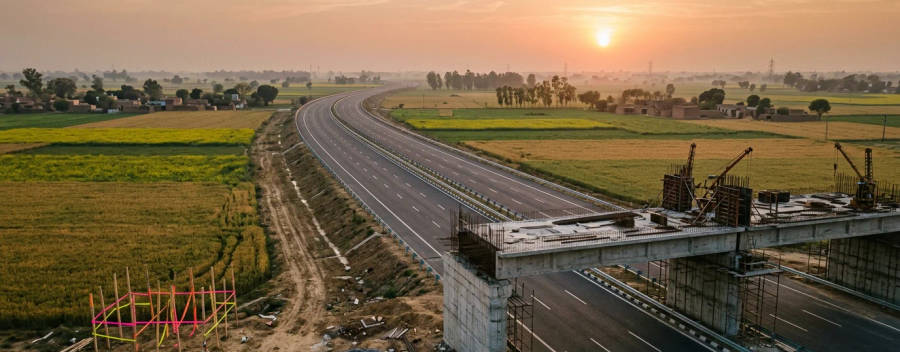
Buying Land Step 2: Choose a State and Corridor (2026)
Step 2 of the 12-step land buying journey: decide which state's rules you can live with, and which corridor is at a stage of approval you are comfortable with, before you look at a single plot.
Most land buyers pick a plot first and learn the rules afterwards. Step 2 reverses that. You choose the state first, because the state decides who may buy, how much, and what you can build. Then you choose a corridor, because a corridor at the gazette stage is a very different thing from one at the announcement stage. This page gives a way to compare states and corridors using documents, not slogans. It does not recommend a place to buy, and it makes no return promises.
Why the state and corridor come before the plot
Two buyers with the same budget can end up with very different land depending on where they look. In some states a person who is not a farmer cannot freely buy agricultural land. In others a buyer can purchase but cannot build a farmhouse without a change of land use. A road may be announced, notified or built, and the law gives each stage different consequences for land in its path. If you choose after you have fallen in love with a plot, you tend to explain the problems away.
The rest of the 12-step journey assumes that you know what you are allowed to do and why you are looking where you are looking. If you have not yet defined your purpose, go back to step 1 and read investing in agricultural land in India. If you are an NRI, read whether NRIs can buy agricultural land first, because the answer can end the search before it starts.
Compare states on the rules that decide what you can do
The table below is a screening aid built from the Acts we read. It is not a substitute for the full state page, and each cell links to deeper reading. Where we could not confirm the current text, we say so.
| State | What to check first | What we confirmed, and what we did not |
|---|---|---|
| Uttar Pradesh | Transfer limits and land-use declaration | In the UP Revenue Code, 2006, the 12.5-acre limit sits in section 89 and the declaration for non-agricultural use in section 80. See UP rules |
| Haryana | Colony licensing, controlled areas and change of land use | The Development and Regulation of Urban Areas Act, 1975, section 7 bars transfer or advertising of plots without a licence. The 1963 controlled area Act, section 7, requires the Director's permission to change land use in a controlled area. See Haryana rules |
| Punjab | Ceiling and tenancy; change of land use | Under the Punjab Land Reforms Act, 1972, section 4 sets a ceiling and section 12 treats transfers above it as void; first-quality land is seven hectares. See Punjab rules |
| Rajasthan | Conversion of agricultural land | Conversion is under section 90-A of the Land Revenue Act, 1956. See Rajasthan rules and 90-A conversion |
| Uttarakhand | Outsider purchase limits | The 2025 changes are known to us from press reports of the Assembly passing the amendment. We could not find the gazette text. See outsider purchase in Uttarakhand |
| Himachal Pradesh | Non-agriculturists | Section 118 of the HP Tenancy and Land Reforms Act, 1972 bars transfer to a non-agriculturist without permission. We read it in the Supreme Court's reproduction, not in the Act. See section 118 explained |
| Delhi | Land reforms and master plan | The Delhi Land Reforms Act, 1954, section 33 limits transfers by a bhumidhar left with less than eight standard acres. The master plan decides use. See Delhi rules |
For a wider comparison read state-wise agricultural land purchase rules, who can own farmland in India, and land ceiling limits by state. For farmhouses, see farmhouse rules in India and minimum land for a farmhouse by state.
Match the state to your purpose
| If your purpose is | Questions that decide the state | Start with |
|---|---|---|
| Farming or a managed farm | Can a non-farmer buy? What is the ceiling? | Can a non-farmer buy agricultural land |
| A farmhouse | Is a farmhouse allowed on agricultural land and on how much land? | Farmhouse without CLU |
| Long-term holding near infrastructure | At what stage is the road? Is the village inside a master plan? | The corridor stages below |
| Plotted land | Is the layout approved? Is the seller licensed? | Before booking a plot |
| Holding as an NRI | Does FEMA allow it? | FEMA and Indian land |
Under the FEM (Non-debt Instruments) Rules, 2019, as we read them in our legal reference, an NRI or OCI may not acquire agricultural land, a farmhouse or plantation property by purchase, though inheritance is treated differently. That single rule removes some options entirely.
Read a corridor by its stage
A road moves through stages, and the legal effect on your land differs at each. A corridor name in an advertisement tells you nothing about the stage.
| Stage | What exists | What it means for a buyer |
|---|---|---|
| 1. Announced | A statement by a minister or an agency | No notified alignment. No village is legally affected. |
| 2. Approved | Cabinet or agency approval, sometimes a project cost | Still usually no village-level alignment. |
| 3. Alignment published | Maps or a project report, possibly a KML | Indicative. Alignment may change. |
| 4. Section 3A notice | Gazette notice listing villages and survey numbers | Intent to acquire. 21-day objection window. See reading an alignment. |
| 5. Section 3D declaration | Land declared acquired and vested | The land vests in the Government free from encumbrances, so the old owner generally cannot sell it. |
| 6. Under construction / open | Contracts awarded or road in use | Check which stretch is actually open. |
A corridor at stage 1 or 2 can still change a lot. A corridor at stage 5 is mostly about compensation, not purchase. The stages that matter most to a buyer are 3 and 4: land is not yet vested, but the risk of a hidden acquisition is real. Read how to check government acquisition notices before you pay a token amount anywhere near stage 4.
Corridor guides on Farmland India
We are building a guide for each major corridor. The guides use the same layout so you can compare them: status, what the gazette shows, and how to check a parcel.
- Yamuna Expressway and the surrounding YEIDA master plan (Uttar Pradesh)
- Ganga Expressway (Uttar Pradesh)
- Shamli-Gorakhpur Expressway (Uttar Pradesh)
- New Noida (DNGIR) (Uttar Pradesh)
- Delhi-Meerut Expressway and RRTS (Uttar Pradesh)
- Dwarka Expressway and the Gurgaon master plan (Haryana)
- KMP Expressway (Haryana)
- Delhi-Amritsar-Katra Expressway (Haryana and Punjab)
- Delhi-Dehradun Expressway and Delhi-Mumbai Expressway
- Dehradun master plan (Uttarakhand)
Some of these pages are still being completed. Where a guide is a draft we mark it. Our farmland near Delhi NCR and best states for agricultural land investment pages give wider context, and how infrastructure moves land prices explains why we avoid forecasts.
A simple scoring sheet
Score each state and corridor from 0 to 2 on the following. A zero is a stop sign for that line. Do not add the scores to produce a winner; use them to find the weak points.
- Eligibility: can you legally buy this land type in this state? (0 no or unclear, 1 yes with permission, 2 yes)
- Use: can you do what you want with the land (farm, farmhouse, hold)?
- Stage clarity: is the corridor at a stage you can verify from a document?
- Record quality: are the land records online and readable for the districts you are considering? See checking land records online.
- Exit: can you sell later without a restriction? See how to sell agricultural land.
- Management: can you manage or inspect the land? See managed farmland explained.
When you have narrowed to one or two state-and-corridor pairs, move to the next steps: check the budget and costs, then the documents. Cost items such as stamp duty are in stamp duty and registration charges by state.
What is unconfirmed
We did not re-read every Act in this page for this review beyond our legal reference. We could not confirm the current gazetted text of the Uttarakhand 2025 changes, the exact wording of Himachal section 118 on an official copy, or the present stage of several corridors. Stage descriptions are general, and each corridor guide gives the specific status. This page is a draft until each linked corridor guide is verified.
Frequently Asked Questions
Why choose the state before the plot?
Which state is easiest for a non-farmer to buy agricultural land?
Can an NRI buy agricultural land?
What is the difference between an announced and a notified corridor?
How do I know the stage of a corridor?
Is land near a corridor always a good investment?
Should I buy near an interchange?
How many states does Farmland India cover?
What comes after Step 2?
Is this financial or legal advice?
Sources
- Uttar Pradesh Revenue Code, 2006 (indiacode)
- Haryana Development and Regulation of Urban Areas Act, 1975 (PRS)
- Punjab Scheduled Roads and Controlled Areas Restriction of Unregulated Development Act, 1963 (Haryana text, PRS)
- Punjab Land Reforms Act, 1972 (indiacode)
- FEM (Non-debt Instruments) Rules, 2019, Chapter IX (Income Tax Department copy)
- The National Highways Act, 1956 (public copy)