

District guide
Buying Land in Central Delhi
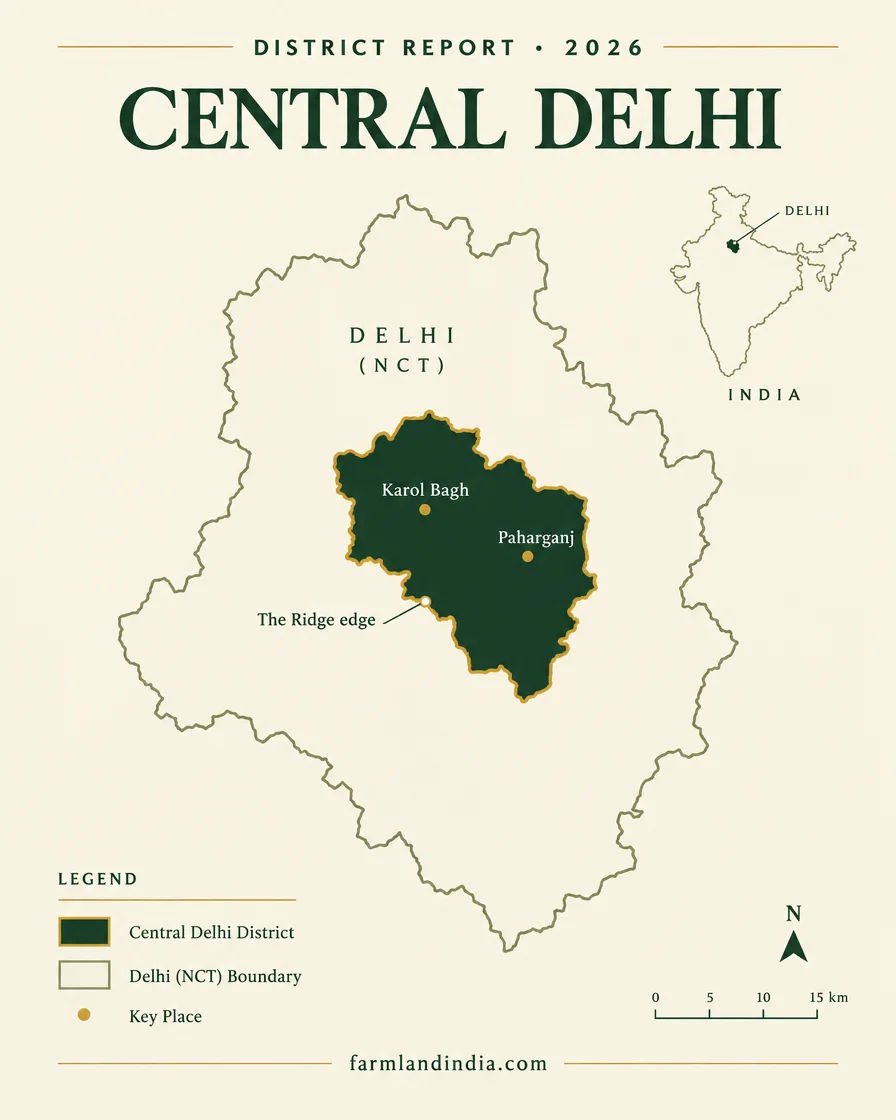
A built-up district of Patel Nagar and Karol Bagh: why Central Delhi is not a farmland market, heritage and redevelopment limits, the Land Reforms Act, and where to look instead.
2 (Dec 2025)
Sub-divisions
5
Revenue villages listed
6% / 4%
Stamp duty (men / women)
None found
Sourced farmland price series
District land record — Central Delhi
Rev. 2026 · Farmland India desk
State
Delhi (National Capital Territory, a Union Territory)
Sub-divisions
2 sub-divisions: Patel Nagar · Karol Bagh, with 5 revenue villages listed (Revenue Department list, 25 Dec 2025)
Key markets
Built-up areas rather than farm markets: Karol Bagh · Patel Nagar · Shadipur · Todapur · Basai Darapur
Agricultural land
Almost none that we could source: a built-up district with five village estates listed; check the land class on the khatauni before relying on any description (confirm)
Demand anchors
Redevelopment and heritage-area schemes (DDA FAQs on MPD-2047) · Delhi Metro (DMRC route map not opened)
Rail
No main-line station listed in the pages we opened; Delhi Metro, where Inderlok–Indraprastha is one of six Phase 4 corridors named (Business Today, Jul 2026)
Size and population
No area or population figure was published for the new boundary in the pages we opened; Census figures for the old district are not used
Pricing unit
₹/acre (agricultural land, where any exists) · ₹/sq yd (built plots); no sourced price series for either
Local units
1 acre = 4,840 sq yd = about 4,047 sq m; papers mix acres, sq yd and sq ft, so convert from the revenue record
Land records portal
Delhi Revenue Department (registration and fee page)
Land law is state law. These rules are maintained on the Delhi page and apply to every district within it.
Central Delhi — land purchase legal rules
⚠ Three layers of control apply to Delhi farm land at once: the Land Reforms Act, the Master Plan and DDA zoning. Check the land record, the Master Plan zone and the floodplain and Ridge position before you pay anything.
Who can buy agricultural land? The Delhi Land Reforms Act, 1954 (DLR Act) puts its main limits on the seller and on use rather than on the buyer, and we found no bar by domicile in the sources we could open. Section 33 restricts transfers by a landholder that would fragment the holding. The Revenue Department's notice inviting amendment suggestions (undated; comments were due 24 June 2016) called Section 33 outdated and proposed deleting it, but those were proposals. We have not read the current Act text, so ask the sub-registrar or the Revenue Department what applies to the seller's holding before any token payment.
Use of agricultural land (Section 81): Under the DLR Act a landholder who puts agricultural land to non-agricultural use is liable to ejectment, as the same Revenue Department notice describes. A house, event venue or "farmhouse" on land still recorded as agricultural therefore carries legal risk, whatever a broker calls the plot. The notice proposed replacing Sections 81 and 82 with a conversion permission, and we found no evidence that this was enacted.
Fragmentation and title: Many Delhi holdings are small, co-owned, or still in a deceased owner's name. Ask for the current revenue record, the mutation status and proof that the seller can transfer the whole holding.
Master Plan zoning decides what can be built: The Master Plan for Delhi 2047 (MPD-2047) replaces MPD-2021. DDA approved it on 12 August 2026 (Tribune, August 2026), and ThePrint reported it as notified by the Ministry of Housing and Urban Affairs on 20 August 2026. Farmhouse rules are the unsettled part. ThePrint quoted the Housing Minister as saying no farm houses will be allowed in low-density areas, while Outlook Money, August 2026 reported that the draft one-acre norm is absent from the final gazette. Treat the rules as restrictive and still under debate. We could not open the gazette copy, so ask DDA for the zone and permitted use of the plot in writing.
Land pooling: MPD-2047 marks nearly 200 sq km for land pooling and expects about 12 lakh homes from it, according to Outlook Money, August 2026. A village inside a pooling zone may be taken into a DDA-led scheme instead of staying farm land. Ask DDA whether the plot falls in one.
Yamuna floodplain, Ridge and heritage areas: The plan bars concrete structures in the core of the Yamuna O-zone (Business Today, August 2026) and aims to preserve about 180 sq km of floodplain and Ridge (ThePrint, August 2026). About 9,700 ha was declared O-zone under MPD-2021, and the High Court ruled on 26 May 2026 against regularising O-zone colonies (Business Standard, June 2026). The NGT has been monitoring encroachment on the floodplain (NGT order, February 2025). We have not sourced the legal limits around the Ridge, Asola Bhatti or the Mehrauli monuments, so ask DDA, the Forest Department and ASI for written positions on any plot near them. Stay out of the floodplain altogether.
Unauthorised colonies: Delhi opened the SWAGAM portal on 24 April 2026 to register land in 1,511 unauthorised colonies under PM-UDAY, on an as-is-where-is basis, as Outlook Money reported in April 2026. The O-zone and Sainik Farms are excluded from that policy under the High Court order (Business Standard, June 2026). A plot sold as "regularised" needs the regularisation certificate in hand.
NRI & OCI buyers: Under the 2018 FEMA regulations on immovable property (RBI, Regulation 3(a)), NRIs and OCIs cannot buy agricultural land, plantation land or a farm house anywhere in India, Delhi included. They may buy residential or commercial land, subject to zoning.
- Buyer eligibility: confirm
- DLR Act Sec 33: transfer limits
- Sec 81: use ejectment
- MPD-2047 zoning
- Floodplain, Ridge: avoid
- Land pooling zones
- NRI agri: barred (FEMA)
Central Delhi — district-specific notes
The Delhi-wide legal framework on our Delhi state page applies to Central Delhi in full. The notes below are specific to this district and are not repeated from the state page. Law and policy as read in October 2026; the MPD-2047 gazette copy could not be opened, so confirm that part with a local advocate.
⚠ Central Delhi is one of 13 revenue districts notified in late December 2025; the Cabinet approved the change on 11 December (Tribune, Dec 2025) and The Week/PTI reported that it took effect immediately (The Week/PTI, Dec 2025). The Revenue Department list gives it two sub-divisions: Patel Nagar (Basai Darapur, Khampur Raya, Sadhorah Khurd) and Karol Bagh (Shadipur, Todapur) (Delhi Revenue Department list, 25 Dec 2025). The Tribune reported that the Chandni Chowk and Sadar Bazaar sub-divisions moved to a new Old Delhi district, so older articles describe a different Central Delhi. Both sub-divisional offices are listed at the Flatted Factory Complex Building, Jhandewalan (Revenue Department sub-divisional offices page). We found no area or population figure for the new boundary.
⚠ Who can buy: the Delhi Land Reforms Act, 1954, in the India Code copy we opened (India Code text), has no residence or domicile bar in the sections we could read, and the copy may not reflect later amendments. Section 1 says the Act does not apply to areas within a municipality, notified area or cantonment, Section 33 stops a bhumidhar from transferring land if that leaves the seller with less than eight standard acres, and Section 42 exposes the buyer to ejectment after a transfer made in breach. In August 2026 the Delhi High Court upheld a Section 81 ejectment over an unauthorised colony on recorded agricultural land in village Goela Khurd and held that such land stays under the Act until a Section 507(a) notification takes it out of the rural area (Delhi High Court, 11 Aug 2026). In this district the practical question is usually whether a parcel is agricultural land at all. Confirm the current text of the Act with a local advocate.
⚠ Redevelopment and heritage, not farming: DDA's FAQs on MPD-2047 set a minimum redevelopment plot of 3,000 sq m for residential use and 1,000 sq m for commercial and similar uses, and name the Walled City, Walled City Extension and Karol Bagh for heritage-sensitive redevelopment under area-specific schemes (DDA FAQs on MPD-2047). ThePrint reports that height norms were removed citywide except in areas such as the Lutyens' Bungalow Zone, the Civil Lines Bungalow Area and Connaught Place and its extension (ThePrint/PTI, Aug 2026). Land here changes hands for building and redevelopment, not cultivation. We could not open the gazette copy, so get the zone, permitted use and any scheme covering a plot confirmed in writing from DDA.
⚠ Land pooling: DDA's FAQs apply the scheme to Planning Zones K-I, L, N, P-II, part of J and part of P-I, and exclude unauthorised colonies and Lal Dora areas (DDA FAQs on MPD-2047). We found no Central Delhi village named in a pooling sector, so treat a claim that a Central Delhi parcel is pooling land as something to check with DDA in writing.
⚠ Registration: stamp duty and the registration fee are charged on the higher of the deal value and the circle rate (Delhi Revenue Department). The Week/PTI reported that the 22 sub-registrar offices would expand to 39 and that interim jurisdictions were set during the transition (The Week/PTI, Dec 2025), so a deed registered in the first months may fall under a different office from the one named in older papers.
⚠ NRIs and OCIs may acquire immovable land or buildings in India other than agricultural land, a farm house or plantation land under Regulation 3(a) of the FEMA acquisition rules (RBI, FEMA 21(R)/2018-RB, Reg 3(a)). Our Delhi state page covers the other limits, such as SC/ST and forest land.
Read the Delhi land buying guide for buyer eligibility, stamp duty and NRI rules.
- Mostly built up
- No sourced price series
- Heritage-area schemes
- Pooling villages not named by DDA
- No residence bar found (confirm)
District overview
Central Delhi — a built-up district, so a short note on why it is not a farmland market
Central Delhi is, for a buyer of agricultural land, close to the bottom of our Delhi list, and it is better to say so plainly. It is a district of two sub-divisions, Patel Nagar and Karol Bagh, and the Revenue Department lists only five revenue villages in it (Revenue Department). We found no crop data, no area or population figure for the new boundary and no sourced price for agricultural land.
Patel Nagar carries Basai Darapur, Khampur Raya and Sadhorah Khurd. Karol Bagh carries Shadipur and Todapur. These are old village estates inside the built-up city, and the list says nothing about land use village by village. The Tribune reported that Chandni Chowk and Sadar Bazaar left Central Delhi for the new Old Delhi district (The Tribune, Dec 2025), and The Week/PTI reported that the reorganisation took effect immediately (The Week/PTI, Dec 2025).
What a buyer can do here is narrow. Land changes hands as built plots, commercial buildings and redevelopment sites, and DDA's FAQs set minimum plot sizes and heritage-area schemes for redevelopment (DDA FAQs on MPD-2047). Anyone shown "farmland in Central Delhi" should ask which of four things it is: a built plot sold by the sq yd, a share of a village estate that is already built over, land inside a heritage or redevelopment scheme, or an agricultural record that no longer matches use on the ground. The khatauni, the DDA zone letter and the local body's sanction settle it.
Where to look instead: for agricultural land inside the capital, read the South West Delhi page (Najafgarh and Matiala sub-divisions) and the Outer North Delhi page (Narela, Bawana and Alipur). For a farmhouse inside Delhi, read the South Delhi page, and for clearer rules next door the Gurugram page covers the Haryana route. Central Delhi has no micro-market pages of its own on this site.
- Patel Nagar
- Karol Bagh
- Basai Darapur
- Khampur Raya
- Sadhorah Khurd
- Shadipur
- Todapur
- Heritage schemes
Transaction costs
Stamp duty & registration in Central Delhi
6%
Stamp duty — male buyer
of the higher of the deal value or the circle rate (Revenue Department)
4%
Stamp duty — female buyer
same basis (Revenue Department)
1%
Registration fee
plus ₹100 pasting fee (Revenue Department)
The Delhi Revenue Department's registration page sets stamp duty on sale, conveyance and gift deeds at 6% for a male buyer and 4% for a female buyer, charged on the consideration or the circle rate, whichever is higher, and a registration fee of 1% on the same basis plus ₹100 (Delhi Revenue Department). The page makes no statement on agricultural land, and we did not find separate rates for NDMC or Cantonment areas. On registration offices, The Week/PTI reported in December 2025 that the existing 22 sub-registrar offices would expand to 39 under a separate notification (The Week/PTI, Dec 2025), so confirm which Sub-Registrar covers the village.
Delhi circle rates are applied by the area and use of the land, and we could not open a notified rate table for Central Delhi, so this page gives no per-area figure. For agricultural land, The Realty Today reported in December 2025 a single circle rate of ₹53 lakh per acre last revised in 2008, a draft of up to ₹5 crore per acre in some locations, and a Revenue Department estimate of more than 50,000 acres in over 200 villages still in agricultural use; the draft was not notified at that date (The Realty Today, Dec 2025). Realty Today is a trade outlet and we found no notified 2026 rate, so get any figure in writing from the Sub-Registrar. Conversion or change of land use is a separate approval, not a stamp-duty line.
Know the belt
What is moving prices in Central Delhi
Two sub-divisions of old village estates inside the built-up city. No listing prices are used; where there is no dated source the notes say so.
Patel Nagar sub-division (Basai Darapur, Khampur Raya, Sadhorah Khurd)
No sourced price series
These three villages are listed in Patel Nagar sub-division (Delhi Revenue Department list, 25 Dec 2025). We found no registered-rate, compensation or news price series for land in any of them and use no listing figure.
Check: the land class on the khatauni, and whether a plot sits in an approved layout, an unauthorised colony or a village abadi.
Karol Bagh sub-division (Shadipur, Todapur)
No sourced price series
Shadipur and Todapur are listed in Karol Bagh sub-division (Delhi Revenue Department list, 25 Dec 2025), and DDA's FAQs name Karol Bagh for heritage-sensitive redevelopment under area-specific schemes (DDA FAQs on MPD-2047). We found no price series for either village.
Check: which redevelopment scheme, if any, covers the plot, and the plot size it requires.
Redevelopment thresholds
3,000 sq m residential · 1,000 sq m commercial (minimum)
DDA's FAQs give these as minimum plot areas for redevelopment unless otherwise specified (DDA FAQs on MPD-2047). Outlook Money reports that the notified plan lowers the minimum area for group-housing redevelopment from 40,000 sq m to 3,000 sq m (Outlook Money, Aug 2026). These are planning thresholds, not prices.
Check: the scheme's own plot rule, because area-specific schemes can differ.
Colony and Lal Dora plots
No sourced price series
DDA's FAQs keep Lal Dora areas and unauthorised colonies out of land pooling (DDA FAQs on MPD-2047). We did not find a list of Central Delhi colonies in the pages we opened, so we give no colony price.
Check: layout approval, the conveyance deed and mutation before any advance.
Circle rates to check
₹53 lakh per acre (2008, reported) vs draft up to ₹5 crore
The Realty Today reported in December 2025 a single agricultural rate of ₹53 lakh per acre since 2008 and a draft of up to ₹5 crore per acre, not notified at that date (The Realty Today, Dec 2025). The villages it names as still agricultural include none from Central Delhi, though its list is partial.
Check: the current rate for the village with the Sub-Registrar before computing stamp duty.
Units: acre, sq yd, sq m
Delhi papers and sale deeds use acres, sq yd, sq ft and sq m interchangeably. Convert from the revenue record before comparing two documents (1 acre = 4,840 sq yd = about 4,047 sq m). This page quotes agricultural land per acre and built plots per sq yd.
Connectivity
How Central Delhi connects — road, rail and air
A dense Metro-and-road city centre. Distances are not stated where we could not source them; journey times vary with traffic.
By road
By air
By rail & metro
The practical question for a Central Delhi plot is the sanction and the scheme that covers it, then the last mile. See the Delhi land rules guide and the neighbouring Gurugram page for the Haryana side. Road status comes from Business Today, Aug 2025, airport status from Noida International Airport, Jun 2026 and Metro status from Business Today, Jul 2026. We did not open DMRC or NHAI pages.
Growth catalysts
Upcoming infrastructure & developments
Status labels reflect sources read in October 2026. Government-announced timelines are not guaranteed; items marked confirm have single or conflicting sources.
02Notified
01Reported or planned
Agriculture & terrain
Terrain, crops & water in Central Delhi
A built-up district with no sourced crop data: land here is valued for building and redevelopment, not crop income. Scheme and land-class status matter more than soil.
🏙️ A district built over village estates
Delhi's net sown area fell from 34,034 hectares in 2000-01 to an estimated 22,300 hectares in 2018-19, and its rural villages from 304 in 1951 to 112 in 2011 (Delhi Economic Survey 2018-19, agriculture chapter). Central Delhi's five listed villages are old estates inside the built-up city. The survey gives no district-wise crop figures.
- Urbanisation
- Village estates
- Declining cultivation
🏛️ Heritage and redevelopment areas
DDA's FAQs name the Walled City, Walled City Extension and Karol Bagh for heritage-sensitive redevelopment under area-specific schemes (DDA FAQs on MPD-2047). Land class and scheme coverage matter more than soil here.
- Karol Bagh
- Heritage schemes
- Redevelopment
🌾 Where the farms are
A December 2025 report on the draft circle-rate revision names Najafgarh, Bijwasan and Dhichau Kalan in South West Delhi and Tigipur, Khampur, Hamidpur, Jhangola, Bankner, Bhorgarh, Lampur and Bakhtawarpur among villages still in agricultural use, as a partial list (The Realty Today, Dec 2025). A buyer after cropland should read the South West Delhi and Outer North Delhi pages, not this one.
- Najafgarh
- Narela
- Bawana
💧 Water & rainfall
Rainfall figures are not quoted here because we found no district series. CGWB's 2024 assessment puts Delhi's stage of groundwater extraction at 100.77%, with 14 of 34 assessment units over-exploited, 13 critical, 2 semi-critical and 5 safe (CGWB, Delhi groundwater assessment 2024). Its district tables list none of the flagged quality exceedances (fluoride, nitrate, uranium, conductivity or arsenic) for Central Delhi on the old district boundary, and the flags elsewhere are sporadic locations rather than district averages. The report gives no block table in the part we could read, so check the latest category for the block and test borewell yield and quality.
📐 Measurement units & market prices
Convert every area to acres or sq m from the revenue record (1 acre = 4,840 sq yd = about 4,047 sq m). We quote no crop prices because we found no sourced district series.
At a glance
Central Delhi vs. its neighbours
| District / belt | Land route / price band* | Evidence |
|---|---|---|
| Central Delhi — Patel Nagar and Karol Bagh | No sourced price series | Built-up; five revenue villages listed (Revenue Department, Dec 2025) |
| West Delhi — Vikaspuri, Janakpuri | No sourced price series | Also mostly urban, with village estates among built-up areas |
| South West Delhi — Najafgarh | No sourced price series | Named as still agricultural in a Dec 2025 report (The Realty Today, Dec 2025) |
| Outer North Delhi — Narela side | No sourced price series | Villages such as Tigipur and Bakhtawarpur named as still agricultural in the same report (The Realty Today, Dec 2025) |
This page quotes no listing prices. Delhi and Haryana follow different land laws; see the Gurugram page and the South West Delhi page, where the farm belt is larger.
Farmland India view
Why investors look at Central Delhi
Five reasoned points and an honest note on what this district is and is not.
A central address, not a farm
Central Delhi's draw is its place in the built-up city. We have no demand data to put a number on it, and land here is bought for building or redevelopment rather than for crop income.
Redevelopment rules are written down
DDA's FAQs set minimum redevelopment plots and name Karol Bagh for heritage-sensitive schemes. That is clearer than before, though the gazette text still needs reading.
Scarcity is regulatory
Height exceptions, heritage schemes and plot thresholds limit what can be built. Scarcity helps only when the plot is clean: sanctioned, mutated and clear of any scheme.
Not a pooling district on our sources
DDA names no Central Delhi village in a pooling sector, so pooling returns are not a reason to buy here.
Settle the route before the price
Ask for the khatauni, the DDA zone letter, the sanction and the mutation entry before any advance. For agricultural land, start with the outer districts.
Confirm land-record status, zoning and scheme coverage for any parcel; our review is not a title guarantee.
STRAIGHT TALK
Risks & challenges in Central Delhi
Read these before shortlisting in Central Delhi specifically.
A farmland label on built land
A plot described as farmland in a built-up district may be a built plot or a share of an old village estate. The khatauni class and the DDA zone letter decide, not the brochure.
Heritage-area schemes
Karol Bagh is named for area-specific heritage-sensitive redevelopment (DDA FAQs). A scheme can fix plot size, use and height, so ask for it before budgeting a build.
Rural-land status and Section 81
Whether a village is still rural for the Delhi Land Reforms Act depends on a Section 507(a) notification, as the Delhi High Court held in August 2026. Using recorded agricultural land for a building can lead to ejectment.
Title and mutation
Co-owned holdings and unmutated inheritance occur in old village estates. Check the revenue record, mutation, the Section 33 position and any acquisition or scheme notice before payment.
Price opacity
We found no sourced price series. The reported agricultural circle rate is ₹53 lakh per acre, with a draft of up to ₹5 crore per acre (Dec 2025 report). Do not budget stamp duty on a number you have not confirmed in writing.
Announced is not delivered
The MPD-2047 gazette copy was not available to us and Metro corridors are named without station detail. Price a plot on what the law allows today, not on a plan or a corridor.
Registration jurisdiction in transition
The sub-registrar offices were reported to be expanding from 22 to 39, with interim jurisdictions. Confirm which office registers a deed for the village before booking a slot.
Who to contact
Local revenue, planning & forest offices
Land-record and mutation matters go through the Sub-Divisional Magistrate and Tehsildar of the sub-division. The Revenue Department lists the Patel Nagar and Karol Bagh sub-divisions at the Flatted Factory Complex Building, Jhandewalan, New Delhi-110002 (Revenue Department sub-divisional offices page). Sale-deed registration is handled by the Sub-Registrar; the existing 22 sub-registrar offices were due to expand to 39 (The Week/PTI, Dec 2025), so confirm which office covers the village. District-level orders sit with the District Magistrate (Central).
Zoning, redevelopment schemes and building permission sit with the Delhi Development Authority and the local body concerned, and heritage distances are an ASI matter. Fee schedules and procedures are on the Delhi Revenue Department registration page. Check the khatauni, mutation and encumbrance before paying any token amount.
COMMON QUESTIONS
Frequently asked questions
Everything buyers, NRIs and investors ask before their first reviewed farmland purchase in Central Delhi.
Visit full wiki01 of 04
Is there agricultural land in Central Delhi?
Almost none that we could source. The Revenue Department list of 25 December 2025 gives Central Delhi two sub-divisions, Patel Nagar and Karol Bagh, with five revenue villages, and we found no crop data or price series for them. Check any plot sold as farmland against the khatauni.
02 of 04
Which areas are in Central Delhi now?
Two sub-divisions: Patel Nagar (Basai Darapur, Khampur Raya, Sadhorah Khurd) and Karol Bagh (Shadipur, Todapur). The Tribune reported that Chandni Chowk and Sadar Bazaar moved to a new Old Delhi district in the December 2025 reorganisation.
03 of 04
Can I buy agricultural land in Central Delhi?
The India Code text of the Delhi Land Reforms Act, 1954 has no residence bar in the sections we could read, and Section 1 excludes areas within a municipality, notified area or cantonment. Section 33 limits a sale that would leave the seller under eight standard acres. Confirm the current Act and the khatauni before paying.
04 of 04
Where should I look for farmland near Central Delhi?
A December 2025 report on the draft circle-rate revision names villages in Najafgarh (South West Delhi) and on the Narela side of Outer North Delhi among those still in agricultural use. Haryana districts such as Gurugram follow a change-of-land-use route.
Ready to look at what is available?
Browse reviewed listingsTransparency
Sources and references
Law and courts
- Delhi Land Reforms Act, 1954 (Sections 1, 33, 42), India Code copy, opened October 2026
- Delhi High Court, LPA 34/2024, judgment of 11 Aug 2026 (Section 81, Section 507(a) notification)
- FEMA 21(R)/2018-RB, acquisition of immovable land by NRIs and OCIs, Regulation 3(a), Reserve Bank of India
Government
- Delhi Revenue Department, list of districts, sub-divisions and villages, 25 Dec 2025
- Delhi Revenue Department, sub-divisional offices page, opened October 2026
- Registration page, Delhi Revenue Department: stamp duty and fees
- FAQs on MPD-2047, Delhi Development Authority (pooling zones, redevelopment, heritage areas)
- Economic Survey of Delhi 2018-19, chapter 10 Agriculture, Planning Department
- Dynamic Ground Water Resources of Delhi 2024, Central Ground Water Board
- Noida International Airport, press release, 15 Jun 2026
News
- National capital gets two new districts, The Tribune, 12 Dec 2025
- Delhi now has 13 districts, The Week/PTI, 26 Dec 2025
- MPD 2047 unveiled, ThePrint/PTI, 20 Aug 2026
- Delhi plans major revision of agricultural land circle rates, The Realty Today, 19 Dec 2025
Further reading
- Delhi Master Plan 2047 notified, Outlook Money, 21 Aug 2026
- Delhi Metro's biggest expansion, Business Today, 24 Jul 2026
- Noida to Delhi airport in 20 minutes, Business Today, 16 Aug 2025
- Delhi O-zone: why homes on Yamuna floodplain face uncertainty, Business Standard, 26 Jun 2026
- Master Plan 2047 protects Lutyens, walled city, Civil Lines, NewsBytes, 20 Aug 2026
- Delhi Master Plan 2047 gets DDA nod, Business Today, 13 Aug 2026
- Who owns the Yamuna floodplain: migrant farmers, landlords or the DDA, India Water Portal, 31 Oct 2025
- The trials of being an urban farmer in Delhi's Yamuna floodplains, Citizen Matters, 2 May 2024
- They say there are no farmers in Delhi, People's Archive of Rural India, 12 Mar 2019
Data-currency note: the district map reflects the notification of 25 December 2025 and may change; planning, court and Metro statuses were read in October 2026 and change quickly. Where an official page did not open for us (the MPD-2047 gazette copy, DMRC and NHAI pages), we say so in the text. This is a general guide, not legal advice. Report inaccuracies to wiki@farmlandindia.com.
For developers
Ready to explore Central Delhi farmland?
Browse reviewed projects and individual land parcels across Central Delhi — or if you own land here, list it with platform review and reach serious buyers.