
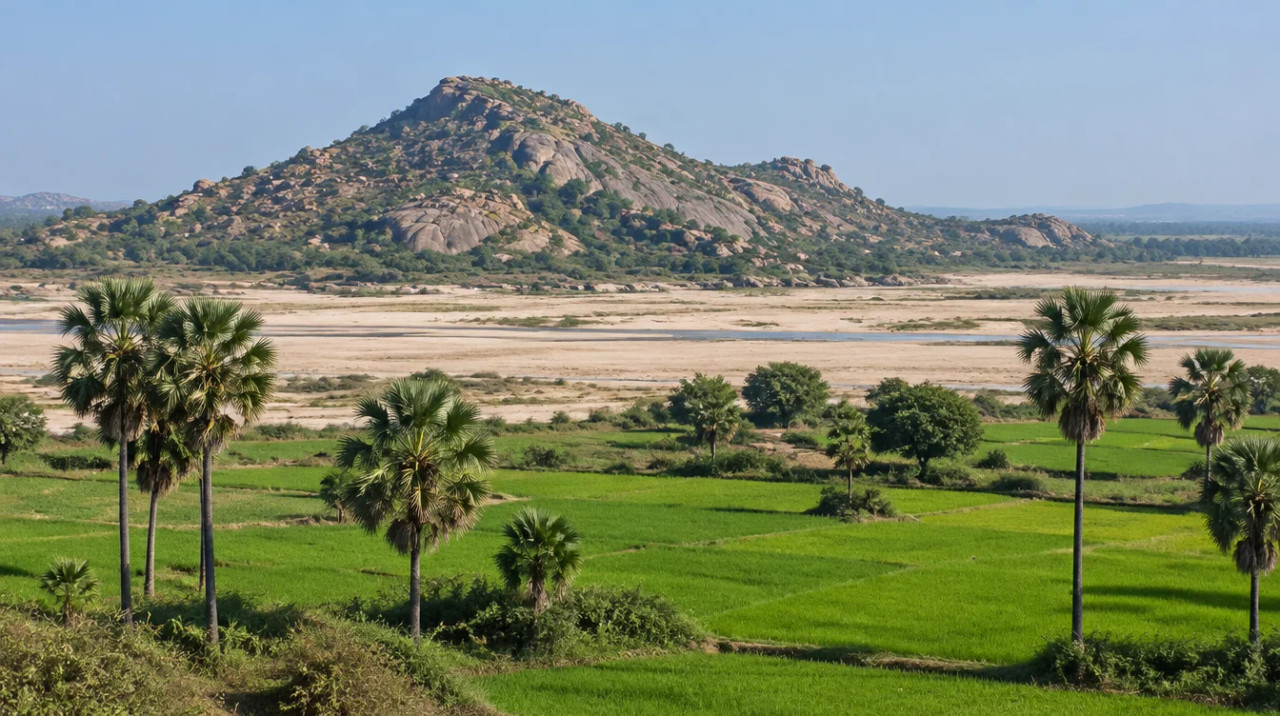
District guide
Buying Land in Gaya Ji (Gaya)
A Magadh pilgrimage district with Bodh Gaya, an airport, the Dobhi manufacturing city on the Amritsar–Kolkata corridor and a June 2026 MVR reset.
4,976 sq km
Area (district site)
43.91 lakh
Population (Census 2011)
About 1,035 mm
Normal annual rainfall
1,670 acres, 13 villages
Dobhi manufacturing city
*Indicative range across districts and land types. Stamp duty, registration and conversion charges are additional. Local measurement units vary — every listing states the unit it is priced in. Not a valuation or an offer.
District land record — Gaya Ji (gaya)
Rev. 2026 · Farmland India desk
State
Bihar
Renamed
Gaya district was renamed Gaya Ji after a Bihar cabinet decision reported in May 2025; records, the CMS slug and many offices still use “Gaya” (India TV, 16 May 2025)
Key markets
Gaya town and Manpur · Bodh Gaya · Dobhi · Sherghati · Tekari · Imamganj · Wazirganj · Belaganj
Demand anchors
Bihar Integrated Manufacturing City near Dobhi · Magadh satellite township · pilgrim and Buddhist tourism at Bodh Gaya and Vishnupad · Grand Trunk Road and Patna–Gaya corridor
Rail and air
Gaya Junction on the Delhi–Howrah line; Gaya International Airport about 30 km from Dobhi (NICDC)
Size and population
About 4,976 sq km and 43.91 lakh people at the 2011 Census (Gaya district administration)
Pricing unit
Asking prices are usually quoted per kattha or decimal; the sourced industrial plot rate near Dobhi is the only price figure on this page
Local units
Kattha (कट्ठा), bigha (बीघा) and decimal (डिसमिल); listings here are in acres
Land records
Jamabandi and map through Bihar Bhumi; see our guide to Bihar Bhumi Jamabandi online
Land law is state law. These rules are maintained on the Bihar page and apply to every district within it.
Gaya Ji (gaya) — land purchase legal rules
Bihar does not reserve agricultural land for farmers the way Gujarat or Maharashtra do, so an Indian resident who is not a cultivator can usually buy farmland here. The limits that bite are different: a family land ceiling, a conversion permission before any non-farm use, an unfinished statewide resurvey that is rewriting old records, and the usual NRI bar under FEMA. Most buyer problems in Bihar come from the records, not from the law.
Who can buy agricultural land? We found no provision in Bihar’s tenancy or ceiling laws that limits farmland purchases to agriculturists. What the Bihar Land Reforms (Fixation of Ceiling Area and Acquisition of Surplus Land) Act, 1961 controls is how much a family may hold, and section 16 bars any acquisition by transfer, exchange, lease, mortgage or settlement that would take the buyer’s family above its ceiling. Inheritance, bequest and gift are outside that bar.
Ceiling limits: Section 4 of the 1961 Act sets the ceiling for a family of up to five by land class: 15 acres for land irrigated by government works and double-cropped, 18 acres for land on private tubewells or lift irrigation, 25 acres for one-season irrigated land, 30 acres for other land including orchards, 37.5 acres for diara or chaur land and 45 acres for hilly, sandy or perennially submerged land. Each extra family member adds one-tenth of the ceiling, up to one and a half times the limit. A “family” is a person, spouse and minor children, and companies, trusts and institutions count as persons.
Conversion to non-farm use: The Bihar Agriculture Land (Conversion for Non-Agriculture Purposes) Act, 2010 requires prior permission from the Sub-Divisional Officer before agricultural land is used for anything else. The fee is 10% of market value as set by the Collector under the Stamp Act, the SDO must decide within 90 days, and converting without permission draws a penalty of half the fee on top of the fee. The Act does not apply inside municipal areas or areas notified as urban, commercial or industrial through a master plan, where building and layout rules take over instead.
Mutation and the Jamabandi: A registered deed is not the end of the job. The buyer has to apply for mutation, called Dakhil Kharij, so that the Jamabandi (register II) moves to the buyer’s name and rent receipts are issued to the buyer. Both steps run online through Bihar Bhumi, and errors in the digitised Jamabandi are corrected through the Parimarjan portal. Sellers whose Jamabandi carries a wrong name, area or plot number should fix it before registry, not after.
The special land survey: Bihar is resurveying land under the Bihar Special Survey and Settlement Act, 2011, which will produce a new Khatiyan (record of rights) and maps for each village. The deadline was moved to December 2026 in March 2025 (PTI via ThePrint), and the revenue minister was reported in March 2026 to have set December 2027 for completion (Prabhat Khabar, March 2026). Buyers in a village under survey should check whether the seller filed the self-declaration and whether any claim or objection is pending on the plot.
Government, Bhoodan and estate land: A large share of disputes involves land that was never the seller’s to sell: government land recorded as gair mazarua, Bhoodan land, or land of former estates. The revenue department reported that 2,56,664.88 acres of the 6,48,593.14 acres donated under Bhoodan had been distributed, and that about 15,358 acres of the former Bettiah Raj estate were set to be taken over (Deccan Herald). Check the khata category in the Khatiyan before paying any token money.
Scheduled Areas and tribal land: Bihar is not among the ten states with notified Fifth Schedule Areas (PIB). The Chotanagpur and Santhal Parganas tenancy restrictions on tribal land went with those regions to Jharkhand in 2000, so buyers moving between the two states should not assume the same rules apply.
Planned township zones: Bihar has finalised areas for 11 greenfield satellite townships and in April 2026 the Urban Development Department barred sale, purchase and construction in seven of them, including the Pataliputra Township around Patna (Prabhat Khabar, April 2026). The ban on sales was lifted in August 2026, though a landowner inside the Pataliputra township area must first inform the government before selling, and a cabinet decision reported on 29 October 2026 removed the restriction in the satellite townships, with construction to follow the development control rules (Prabhat Khabar, 9 August 2026; Prabhat Khabar, 29 October 2026). Zoning under these plans now decides what a plot can be used for.
Documents to ask for: Before paying an advance, collect the current Jamabandi page and the latest rent receipt (lagan rasid), the Khatiyan (record of rights) from the last settled survey and, where it exists, the new survey entry, the Bhu Naksha map sheet with the plot number marked, the seller’s chain of registered deeds (kewala) for at least the last 30 years, the mutation order that put the land in the seller’s name, and a land possession certificate (LPC) from the circle office. Match the khata, khesra (plot) number, area and boundaries across every document. Our Bhu Naksha guide and mutation status guide show how to pull these online.
NRI and OCI buyers: Under the RBI’s Master Direction on acquisition of immovable property, NRIs and OCIs may buy immovable property in India other than agricultural land, plantation property or a farm house. They can inherit such land. Our NRI guide covers the options in detail.
- No farmer-only rule found
- Ceiling Act 1961
- Conversion Act 2010 (SDO)
- Dakhil Kharij mutation
- Special survey to 2027 (reported)
- NRI agri: barred (RBI)
- Records via Bihar Bhumi
Gaya Ji (gaya) — district-specific notes
The Bihar state page applies to Gaya Ji in full: the ceiling law, the 2010 conversion rule, mutation through Bihar Bhumi and the NRI bar. These five points are specific to the district.
⚠ The state is acquiring land for the Bihar Integrated Manufacturing City in Dobhi block, about 1,670 acres across 13 villages, and PTI reported in October 2026 that further acquisition of roughly 13,500 acres for industrial and infrastructure use was being carried out (PTI via ThePrint, 24 October 2026; Indian Masterminds, 25 February 2026). Land inside a notified village can be taken, so check the acquisition notification before paying a token amount near Dobhi.
⚠ The Magadh satellite township was among 11 approved by the cabinet on 22 April 2026, and land transactions in the notified areas were restricted until plans were ready (Swarajya, 22 April 2026). Prabhat Khabar reported on 29 October 2026 that the cabinet lifted the ban, with building to follow the development control rules (Prabhat Khabar, 29 October 2026). Ask the Gaya Ji authorities which villages are inside the township boundary.
⚠ The Minimum Value Register (MVR) was revised from 19 June 2026: urban and peripheral land doubled, rural land up 1.6 times. The peripheral belt covers up to 8 km beyond a municipal corporation, 4 km beyond a nagar parishad and 2 km beyond a nagar panchayat, which pulls land around Gaya town, Bodh Gaya and Sherghati into the higher bracket (Prabhat Khabar, 18 June 2026).
⚠ Around Bodh Gaya and the Vishnupad temple on the Phalgu, heritage, tourism and local-body rules apply. Plot use and building heights can be restricted near protected sites, so ask the municipal body and the relevant authority before assuming a plot can be built on.
⚠ In the southern blocks land is dry, sandy or rocky, and boundaries are often unclear on older maps. Match the current jamabandi with the sale deed plot number, check mutation (dakhil-kharij) with our mutation status guide, and use the Bihar Bhu Naksha guide for the plot map.
Read the full Bihar land buying guide for the ceiling, conversion, survey and NRI rules.
- Industrial acquisition near Dobhi
- Magadh satellite township
- MVR revised June 2026
- Dry-farming and hard-rock belt
- Pilgrim-zone restrictions
District overview
Gaya Ji (gaya) — the Magadh pilgrimage district turning industrial
Gaya Ji (headquarters Gaya, “Gaya” in most records) is a Magadh-region district in south Bihar, one of the largest by area at about 4,976 sq km and with 43.91 lakh people at the 2011 Census (Gaya district administration). It is known worldwide for Bodh Gaya, the Buddhist pilgrimage site, and for the Vishnupad temple on the Phalgu where Hindu pilgrims perform ancestral rites. The name Gaya Ji was adopted after a cabinet decision in May 2025 (India TV).
The land market has two sides. North of the town, along the Grand Trunk Road and the Patna–Gaya corridor, it is driven by industrial and township plans. In the south and east, near the Jharkhand border, it is a rain-fed and groundwater-irrigated farm belt on hard-rock and sandy soils, where plots are larger and prices are far lower than around Gaya town.
The biggest new demand driver is the Bihar Integrated Manufacturing City near Dobhi on the Amritsar–Kolkata Industrial Corridor. Read the infrastructure section for what is built and what is only planned, and use the state page for the general rules.
- Magadh region
- Bodh Gaya
- Vishnupad
- Dobhi
- Phalgu river
- Grand Trunk Road
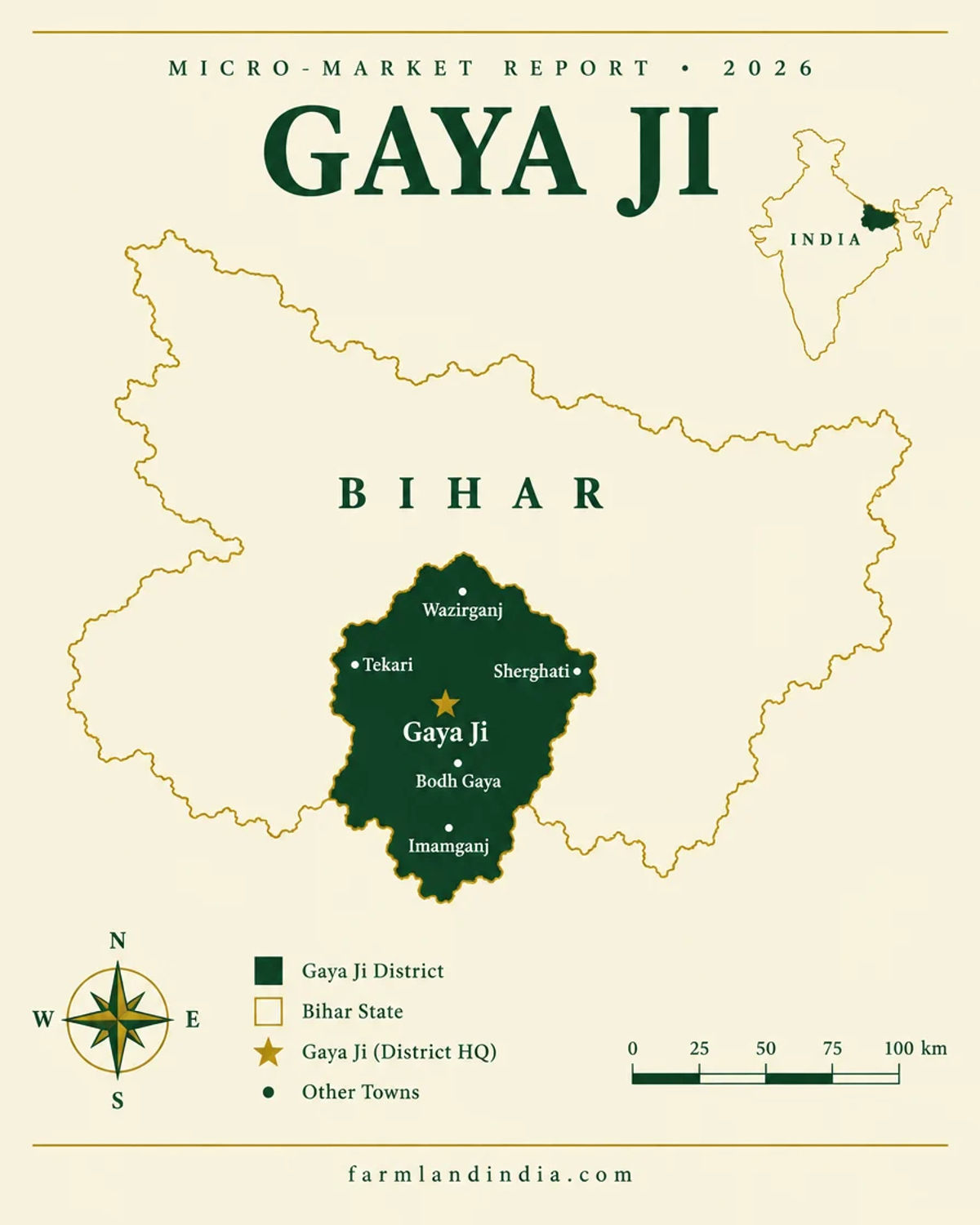
Transaction costs
Stamp duty & registration in Gaya Ji (gaya)
7% · 9%
Stamp duty from 19 June 2026: rural · urban
up from 6% and 8%; reported by Prabhat Khabar
2x · 1.6x
MVR in urban and peripheral · rural areas
from 19 June 2026
+5% a year
Further MVR rise each financial year
full revision every three years
Gaya Ji follows the state rates. Prabhat Khabar reported on 18 June 2026 that the MVR was raised from 19 June, doubling in urban and peripheral areas and rising 1.6 times in rural areas, with a further 5% rise each year and a full revision every three years; general stamp duty went from 6% to 7%, with a 0.4% stamp duty concession and the existing 0.1% registration fee concession for women (Prabhat Khabar, 18 June 2026). Before the change, the CAG audit of Bihar’s revenue for 2017-18 recorded 6% stamp duty plus a 2% registration fee, and 2% extra in municipal areas (CAG Report No. 2 of 2019). A Prabhat Khabar report from the Thakurganj sub-registry office in Kishanganj on 19 June 2026 gave stamp duty at 7% in rural areas (up from 6%) and 9% in urban areas (up from 8%), in line with the extra 2% for municipal areas in the CAG audit (Prabhat Khabar, 19 June 2026). The registration fee was not restated in either report, so confirm the full cost at the sub-registrar office. Our guides to stamp duty in Bihar and the MVR rate explain the calculation.
Know the belt
What is moving prices in Gaya Ji (gaya)
Four belts with different drivers. Read the check line before shortlisting.
Dobhi and the industrial corridor
AKIC node · Grand Trunk Road
Dobhi is the district’s industrial story. NICDC describes the Gaya manufacturing city as a 1,670-acre site near Dobhi, 2 km from NH-22 and 10 km from NH-19, with plots of 1 to 50 acres at Rs 1.42 crore per acre and environmental clearance in hand (NICDC). That is an industrial allotment rate, not a farmland price, but it signals why land near the site is being watched.
Check: whether the village is in the acquisition list, and the exact distance from the NH-19 and NH-22 junctions.
Gaya town, Manpur and Bodh Gaya
Pilgrim and urban fringe
Gaya town and Bodh Gaya carry pilgrim traffic through the year and a hotel and rental economy. Land on the fringe is bought mainly for residential and hospitality use, and the June 2026 peripheral MVR rule applies to much of it. Farm plots are scarcer and priced as potential building land.
Check: zoning, access road width and any heritage or protected-site restriction.
Sherghati, Tekari and the south-east
Farm belt · Phalgu and Morhar side
Sherghati on the Grand Trunk Road and Tekari to the north are rain-fed and canal-irrigated rice and wheat areas. Plots are larger and the market is local. Water is the main limit: the ICAR contingency plan shows wells and canals providing most irrigation (ICAR-CRIDA).
Check: borewell depth in the village, canal access and the last two monsoons.
Imamganj, Dumaria and the forest fringe
Hill and forest-edge blocks
The south and east near the Jharkhand border have hilly, forest-edge land with lower demand. Parts fall inside forest or wildlife limits, and some land is held under older tenures. Prices follow road access more than soil.
Check: forest, wildlife sanctuary or government land status on the plot.
Asking prices
Asking prices are quoted per kattha or decimal and vary sharply between Gaya town, the Grand Trunk Road and the interior. We do not publish a district farmland price series because we found no named source. Use the MVR and registered deeds for comparison.
Connectivity
How Gaya Ji (gaya) connects — road, rail and air
Rail, air and highway links make Gaya Ji one of south Bihar’s best-connected districts.
🚗 By road
✈️ By air
🚆 By rail
Distances are approximate and taken from the NICDC project page for the Dobhi site. Check current timetables and NHAI notices before relying on them.
Growth catalysts
Upcoming infrastructure & developments
Status labels reflect sources read in November 2026. Government timelines are not guarantees.
02Open
05Catalysts
Agriculture & terrain
Soil, crops & water in Gaya Ji (gaya)
A rice and wheat district with mixed soils and a clear dry-season water limit.
Crops
The ICAR-CRIDA district contingency plan records rice as the main kharif crop on about 177,500 ha, and wheat (81,500 ha), lentil, chickpea and rapeseed as the main rabi crops (ICAR-CRIDA).
- Kharif: rice
- Rabi: wheat, lentil, chickpea, rapeseed
- Pulses: greengram, lentil
Soil, rain and water
Normal annual rainfall is about 1,035 mm, of which about 950 mm falls in the June to September monsoon. The plan lists black soils (42% of area), sandy soils (22%), alkali soils (17%), sandy loam (14%) and diara land (5%), and net irrigated area of about 100,000 ha with open wells the largest source.
- Rainfall about 1,035 mm a year
- Black and sandy soils dominate
- Wells and canals irrigate most area
Dry spells and water
South Bihar’s rain-fed paddy is exposed to monsoon gaps, so irrigation and borewell depth matter more than in the north. Ask local farmers how the village fared in the driest recent year.
Alkali and sandy patches
Alkali soils cover roughly one-sixth of the area in the plan, so a soil test is worth doing before paying a farm-use premium.
At a glance
Gaya Ji vs. nearby districts
| District | Land and water | What links it to Gaya Ji |
|---|---|---|
| Aurangabad | Grand Trunk Road district with a larger rural market | Shares NH-19 and the Amritsar–Kolkata corridor |
| Nawada | Dry, hilly, lower-priced farm land | Borders Gaya Ji to the east |
| Jehanabad | Small, dense, canal-fed Magadh district | On the Patna–Gaya corridor |
| Nalanda | Rajgir and Nalanda heritage belt | Linked by Gaya–Rajgir roads and tourism |
Gaya Ji has more industrial and pilgrim demand than most Magadh neighbours, but its interior land is dry and sparsely priced. For listings across the state, see all land for sale in Bihar.
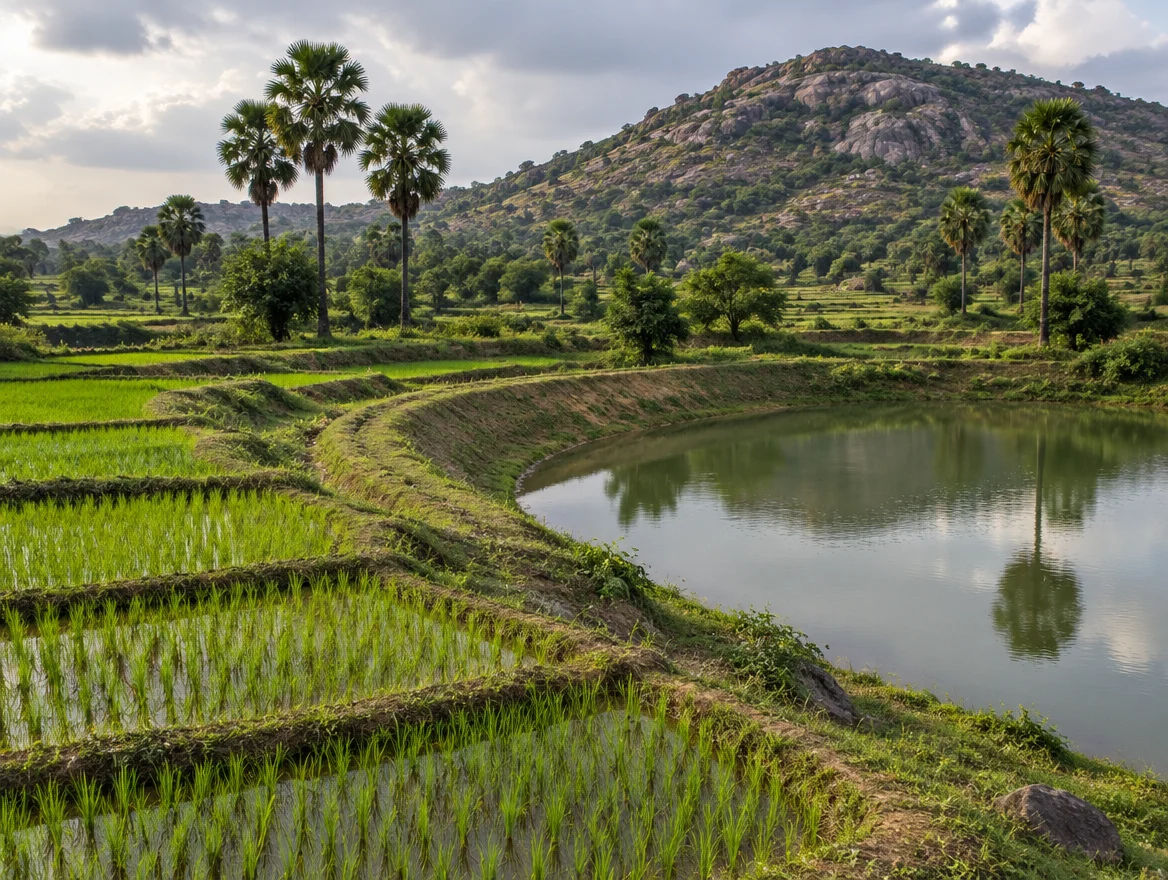
Farmland India view
Why investors look at Gaya Ji (gaya)
Five reasoned points for Gaya Ji, each tied to a source on this page.
An industrial corridor with real money behind it
The Dobhi manufacturing city has land, an environmental clearance and named investors (PTI via ThePrint). The land that matters is inside and next to the hub, and much of it is already acquired.
Pilgrim traffic is steady, not speculative
Bodh Gaya and Vishnupad bring year-round visitors, which supports hospitality and rental land on the city fringe.
Townships can lift or freeze prices
The township freeze came and went in 2026, which shows how policy can change liquidity quickly (Prabhat Khabar).
Higher MVR raises entry costs
The June 2026 reset raised registered values and stamp duty, so total acquisition cost is higher than a year ago (Prabhat Khabar).
Interior farm land is cheap but water-constrained
Dry-season water decides whether a plot can be farmed twice a year, so check wells and canals before paying for productivity.
Confirm Jamabandi, mutation, zoning and acquisition status directly — these are not certified by Farmland India’s review.
STRAIGHT TALK
Risks & challenges in Gaya Ji (gaya)
District-specific risks. Read the state page for the general Bihar risks on ceiling, conversion and records.
Acquisition around Dobhi
The hub is still absorbing land, and compensation depends on the circle rate. Land in notified villages can be acquired; check before paying a token amount (PTI via ThePrint).
Township boundary uncertainty
The satellite township boundary and master plan for Gaya Ji must be confirmed with the authority, since the sales freeze was lifted only on 29 October 2026.
Water scarcity in rain-fed blocks
The district has dry spells, and open wells supply most irrigation. A plot without a working well or canal access is a weaker farm.
Alkali and sandy soils
Alkali soils cover about 17% of area in the ICAR plan (ICAR-CRIDA). Test the soil.
Forest and protected-site limits
Land near the south-east forest belt and around Bodh Gaya may carry forest, wildlife or heritage restrictions.
Government and ceiling land
Surplus, ceiling and government land cannot be sold. Check the plot on Bihar Bhumi and with the Circle Officer (CO).
Who to contact
Local revenue & planning offices
Start with the Gaya Ji district administration (Gaya district site) for the District Magistrate, the Land Acquisition Officer and the Circle Offices (anchal). The sub-registrar office handles registration, and mutation status is on Bihar Bhumi. For rules on conversion, see the Bihar Agriculture Land (Conversion for Non-Agricultural Purposes) Act, 2010.
COMMON QUESTIONS
Frequently asked questions
Everything buyers, NRIs and investors ask before their first reviewed farmland purchase in Gaya Ji (gaya).
Visit full wiki01 of 04
Is Gaya now called Gaya Ji?
Yes. The Bihar cabinet renamed Gaya district as Gaya Ji, as reported by India TV on 16 May 2025. Many records, offices and listings still say Gaya, so search under both names.
02 of 04
What is the Dobhi manufacturing city?
A 1,670-acre industrial hub in Dobhi block on the Amritsar–Kolkata Industrial Corridor, with land acquired across 13 villages and investor MoUs reported in 2026. Check whether a village is in the acquisition list before buying nearby.
03 of 04
Did land rates change in Gaya Ji in 2026?
Yes. Bihar raised the Minimum Value Register from 19 June 2026: doubled in urban and peripheral areas and 1.6 times in rural areas, and general stamp duty went from 6% to 7%, as reported by Prabhat Khabar on 18 June 2026.
04 of 04
Is there a price guide for farmland in Gaya Ji?
We found no newspaper or official price series for Gaya Ji farmland, so we show none. The only sourced figure is the industrial plot rate near Dobhi. Use the revised MVR and registered deeds as references.
Transparency
Sources and references
Official and legal
- Gaya district administration, about the district
- ICAR-CRIDA: Agriculture Contingency Plan for Gaya district
- NICDC: Integrated Manufacturing Cluster, Gaya
- CAG, Report No. 2 of 2019, Revenue Sector, Bihar
- Bihar Bhumi, Revenue and Land Reforms Department
- Bihar Agriculture Land (Conversion for Non-Agricultural Purposes) Act, 2010
News and projects
- Prabhat Khabar, 18 Jun 2026: MVR doubled in urban areas, stamp duty to 7%
- Prabhat Khabar, 29 Oct 2026: satellite township land ban lifted
- Swarajya, 22 Apr 2026: 11 satellite townships approved
- PTI via ThePrint, 24 Oct 2026: Gaya manufacturing city
- Indian Masterminds, 25 Feb 2026: Dobhi industrial hub
- PSU Connect, 31 Jul 2026: Rs 6,000 crore steel MoU
- India TV, 16 May 2025: Gaya renamed Gaya Ji
- JICA, 30 May 2025: Patna–Gaya–Dobhi highway opened
- The Statesman: Patna–Gaya–Dobhi highway progress
- Prabhat Khabar, 19 Jun 2026: Kishanganj registry rates (stamp duty 7% rural, 9% urban)
Data-currency note: sources were read in November 2026. Project status, the MVR and land rules change often; check the linked source and the relevant office before relying on any figure.
For developers
Ready to explore Gaya Ji (gaya) farmland?
Browse reviewed projects and individual land parcels across Gaya Ji (gaya) — or if you own land here, list it with platform review and reach serious buyers.