
District guide
Buying Land in Nawada
A south Bihar district on the Chotanagpur fringe: Kiul–Gaya rail doubling done, a second doubling approved, hilly Rajauli and rain-fed paddy land.
2,494 sq km
Area (CGWB district profile)
22.2 lakh
Population (Census 2011)
1,037 mm
Normal annual rainfall (CGWB)
43.1%
Groundwater development (CGWB)
*Indicative range across districts and land types. Stamp duty, registration and conversion charges are additional. Local measurement units vary — every listing states the unit it is priced in. Not a valuation or an offer.
District land record — Nawada
Rev. 2026 · Farmland India desk
State
Bihar
Sub-division
Fourteen blocks: Akbarpur, Govindpur, Hisua, Kashi Chak, Kauakol, Meskaur, Nardiganj, Narhat, Nawada, Pakribarwan, Rajauli, Roh, Sirdala and Warsaliganj (CGWB district profile)
Key markets
Nawada town · Hisua · Warisaliganj · Rajauli · Akbarpur · Nardiganj
Demand anchors
Kiul–Gaya line doubling through Warisaliganj–Nawada–Tilaiya inaugurated Feb 2025 (Indian Infrastructure) · Bakhtiyarpur–Rajgir–Tilaiya doubling approved Sept 2025 (Construction World)
Rail
Warisaliganj, Nawada and Tilaiya stations on the Kiul–Gaya line (Indian Infrastructure)
Size and population
2,494 sq km and about 22.2 lakh people at the 2011 Census (CGWB district profile)
Pricing unit
Asking prices are usually quoted in kattha or decimal; no sourced price series is shown
Local units
Kattha and bigha vary in size across Bihar and are not fixed by a single official conversion; 1 decimal is one-hundredth of an acre (435.6 sq ft). Always convert to acres or sq ft on the deed.
Land records
undefined
Land law is state law. These rules are maintained on the Bihar page and apply to every district within it.
Nawada — land purchase legal rules
Bihar does not reserve agricultural land for farmers the way Gujarat or Maharashtra do, so an Indian resident who is not a cultivator can usually buy farmland here. The limits that bite are different: a family land ceiling, a conversion permission before any non-farm use, an unfinished statewide resurvey that is rewriting old records, and the usual NRI bar under FEMA. Most buyer problems in Bihar come from the records, not from the law.
Who can buy agricultural land? We found no provision in Bihar’s tenancy or ceiling laws that limits farmland purchases to agriculturists. What the Bihar Land Reforms (Fixation of Ceiling Area and Acquisition of Surplus Land) Act, 1961 controls is how much a family may hold, and section 16 bars any acquisition by transfer, exchange, lease, mortgage or settlement that would take the buyer’s family above its ceiling. Inheritance, bequest and gift are outside that bar.
Ceiling limits: Section 4 of the 1961 Act sets the ceiling for a family of up to five by land class: 15 acres for land irrigated by government works and double-cropped, 18 acres for land on private tubewells or lift irrigation, 25 acres for one-season irrigated land, 30 acres for other land including orchards, 37.5 acres for diara or chaur land and 45 acres for hilly, sandy or perennially submerged land. Each extra family member adds one-tenth of the ceiling, up to one and a half times the limit. A “family” is a person, spouse and minor children, and companies, trusts and institutions count as persons.
Conversion to non-farm use: The Bihar Agriculture Land (Conversion for Non-Agriculture Purposes) Act, 2010 requires prior permission from the Sub-Divisional Officer before agricultural land is used for anything else. The fee is 10% of market value as set by the Collector under the Stamp Act, the SDO must decide within 90 days, and converting without permission draws a penalty of half the fee on top of the fee. The Act does not apply inside municipal areas or areas notified as urban, commercial or industrial through a master plan, where building and layout rules take over instead.
Mutation and the Jamabandi: A registered deed is not the end of the job. The buyer has to apply for mutation, called Dakhil Kharij, so that the Jamabandi (register II) moves to the buyer’s name and rent receipts are issued to the buyer. Both steps run online through Bihar Bhumi, and errors in the digitised Jamabandi are corrected through the Parimarjan portal. Sellers whose Jamabandi carries a wrong name, area or plot number should fix it before registry, not after.
The special land survey: Bihar is resurveying land under the Bihar Special Survey and Settlement Act, 2011, which will produce a new Khatiyan (record of rights) and maps for each village. The deadline was moved to December 2026 in March 2025 (PTI via ThePrint), and the revenue minister was reported in March 2026 to have set December 2027 for completion (Prabhat Khabar, March 2026). Buyers in a village under survey should check whether the seller filed the self-declaration and whether any claim or objection is pending on the plot.
Government, Bhoodan and estate land: A large share of disputes involves land that was never the seller’s to sell: government land recorded as gair mazarua, Bhoodan land, or land of former estates. The revenue department reported that 2,56,664.88 acres of the 6,48,593.14 acres donated under Bhoodan had been distributed, and that about 15,358 acres of the former Bettiah Raj estate were set to be taken over (Deccan Herald). Check the khata category in the Khatiyan before paying any token money.
Scheduled Areas and tribal land: Bihar is not among the ten states with notified Fifth Schedule Areas (PIB). The Chotanagpur and Santhal Parganas tenancy restrictions on tribal land went with those regions to Jharkhand in 2000, so buyers moving between the two states should not assume the same rules apply.
Planned township zones: Bihar has finalised areas for 11 greenfield satellite townships and in April 2026 the Urban Development Department barred sale, purchase and construction in seven of them, including the Pataliputra Township around Patna (Prabhat Khabar, April 2026). The ban on sales was lifted in August 2026, though a landowner inside the Pataliputra township area must first inform the government before selling, and a cabinet decision reported on 29 October 2026 removed the restriction in the satellite townships, with construction to follow the development control rules (Prabhat Khabar, 9 August 2026; Prabhat Khabar, 29 October 2026). Zoning under these plans now decides what a plot can be used for.
Documents to ask for: Before paying an advance, collect the current Jamabandi page and the latest rent receipt (lagan rasid), the Khatiyan (record of rights) from the last settled survey and, where it exists, the new survey entry, the Bhu Naksha map sheet with the plot number marked, the seller’s chain of registered deeds (kewala) for at least the last 30 years, the mutation order that put the land in the seller’s name, and a land possession certificate (LPC) from the circle office. Match the khata, khesra (plot) number, area and boundaries across every document. Our Bhu Naksha guide and mutation status guide show how to pull these online.
NRI and OCI buyers: Under the RBI’s Master Direction on acquisition of immovable property, NRIs and OCIs may buy immovable property in India other than agricultural land, plantation property or a farm house. They can inherit such land. Our NRI guide covers the options in detail.
- No farmer-only rule found
- Ceiling Act 1961
- Conversion Act 2010 (SDO)
- Dakhil Kharij mutation
- Special survey to 2027 (reported)
- NRI agri: barred (RBI)
- Records via Bihar Bhumi
Nawada — district-specific notes
The Bihar state page applies to Nawada in full: the ceiling law, the 2010 conversion rule, mutation through Bihar Bhumi and the NRI bar. These five points are specific to the district.
⚠ The south of the district is hilly and undulating, the southern fringe of the Chotanagpur Plateau, with hills across parts of Rajauli, Sirdala, Govindpur and Kauakol (CGWB district profile). The CGWB booklet records no forest area, but ICAR-CRIDA lists about 56,500 ha of forest (ICAR-CRIDA). Check whether a hill-side plot is recorded as forest, hill or government land before you treat it as farmland.
⚠ The rail corridors need land: the Kiul–Gaya doubling is partly open, and the Bakhtiyarpur–Rajgir–Tilaiya doubling was approved in September 2025 (Indian Infrastructure; Construction World). Plots beside the tracks may fall under an acquisition notice; ask the district land acquisition office before you pay an advance.
⚠ The June 2026 MVR revision doubled the register for urban and peripheral land and raised rural land 1.6 times (Prabhat Khabar, 18 Jun 2026). Land within 4 km of a nagar parishad such as Nawada, or 2 km of a nagar panchayat, is treated as peripheral, which matters on the roads out of Nawada and Hisua.
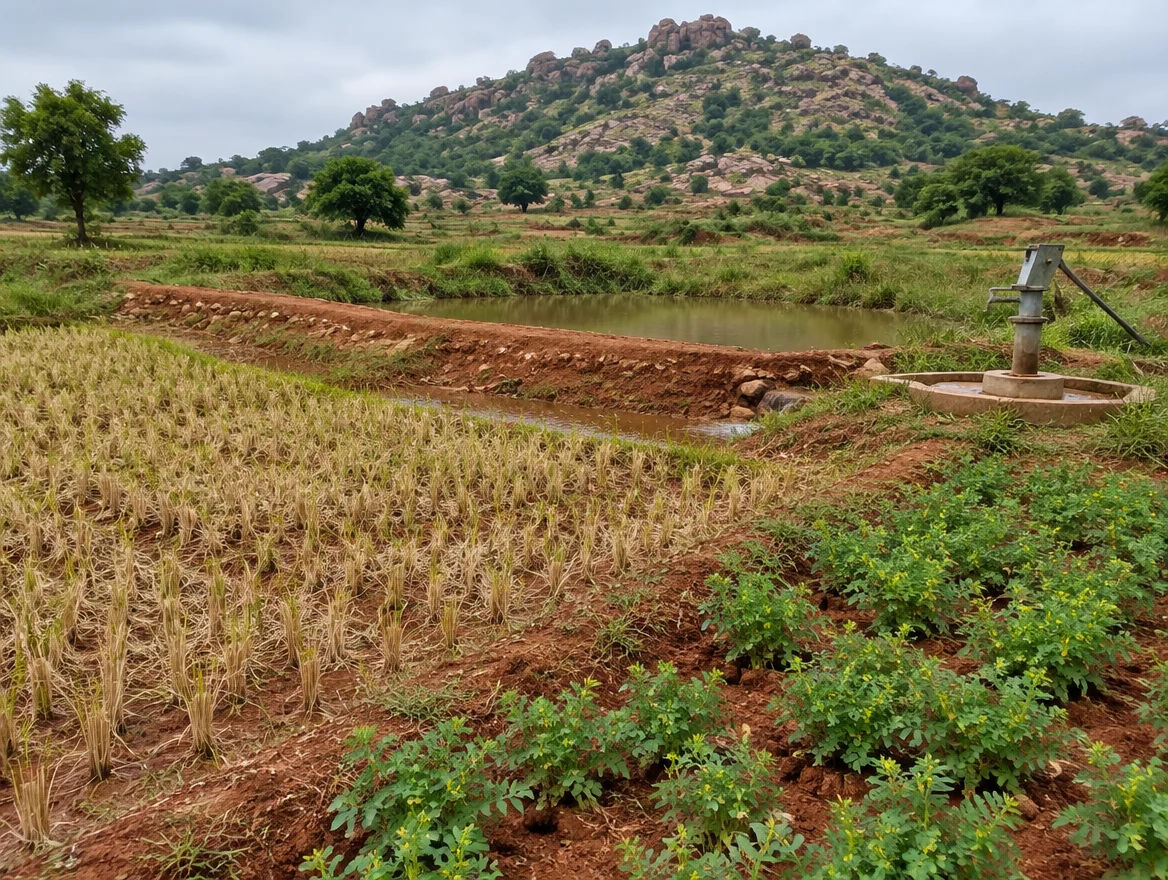
⚠ Water is uneven. The CGWB puts development at 43.1% for the district but 76.9% in Hisua and 74.5% in Meskaur, against 18.8% in Roh and 21.2% in Kauakol (CGWB district profile). Rivers here are ephemeral with wide sandy beds, so a plot’s well matters more than its distance from a river.
⚠ Bihar’s special land survey has been extended more than once and is still running in many mauzas (Deccan Herald). Check on Bihar Bhumi whether the mauza has finished survey and whether the Khatiyan and Jamabandi match what the seller shows you.
Read the full Bihar land buying guide for the ceiling, conversion, survey and NRI rules.
- Hill and forest land
- Rail corridor acquisition
- MVR revised June 2026
- Rain-dependent land
- Survey in progress
District overview
Nawada — a rail-corridor district with a hilly south and rain-dependent farmland
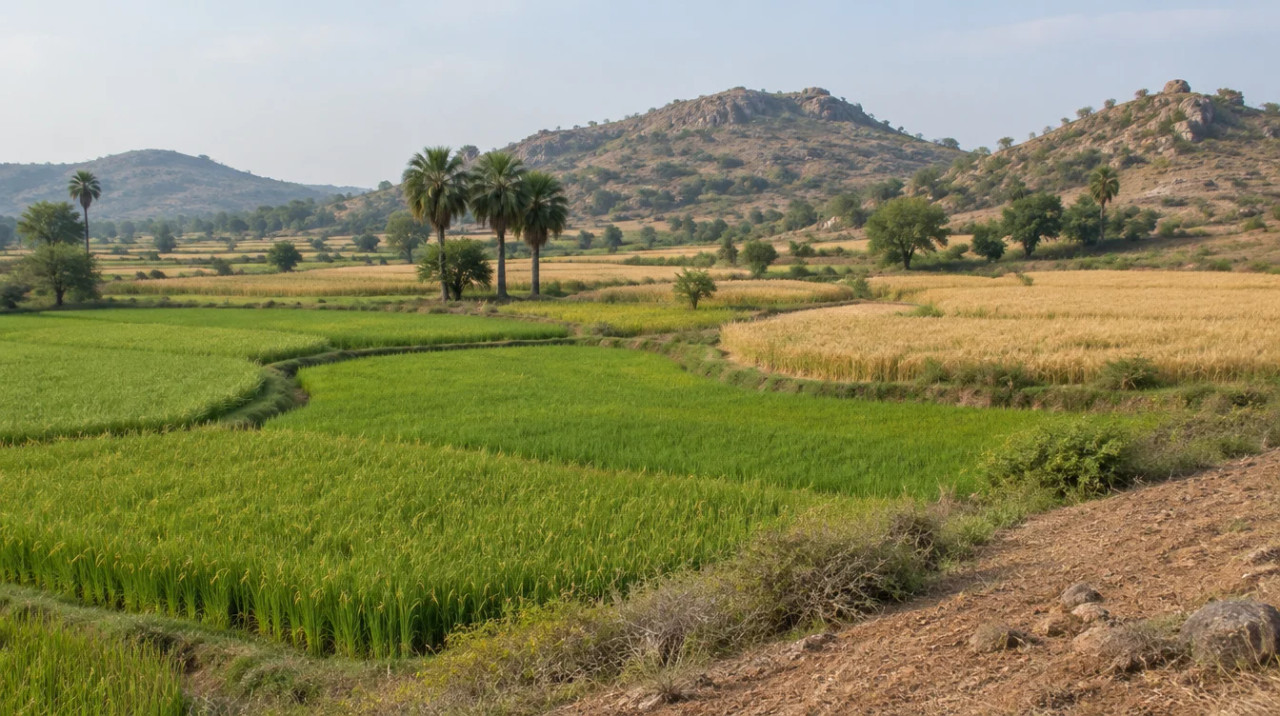
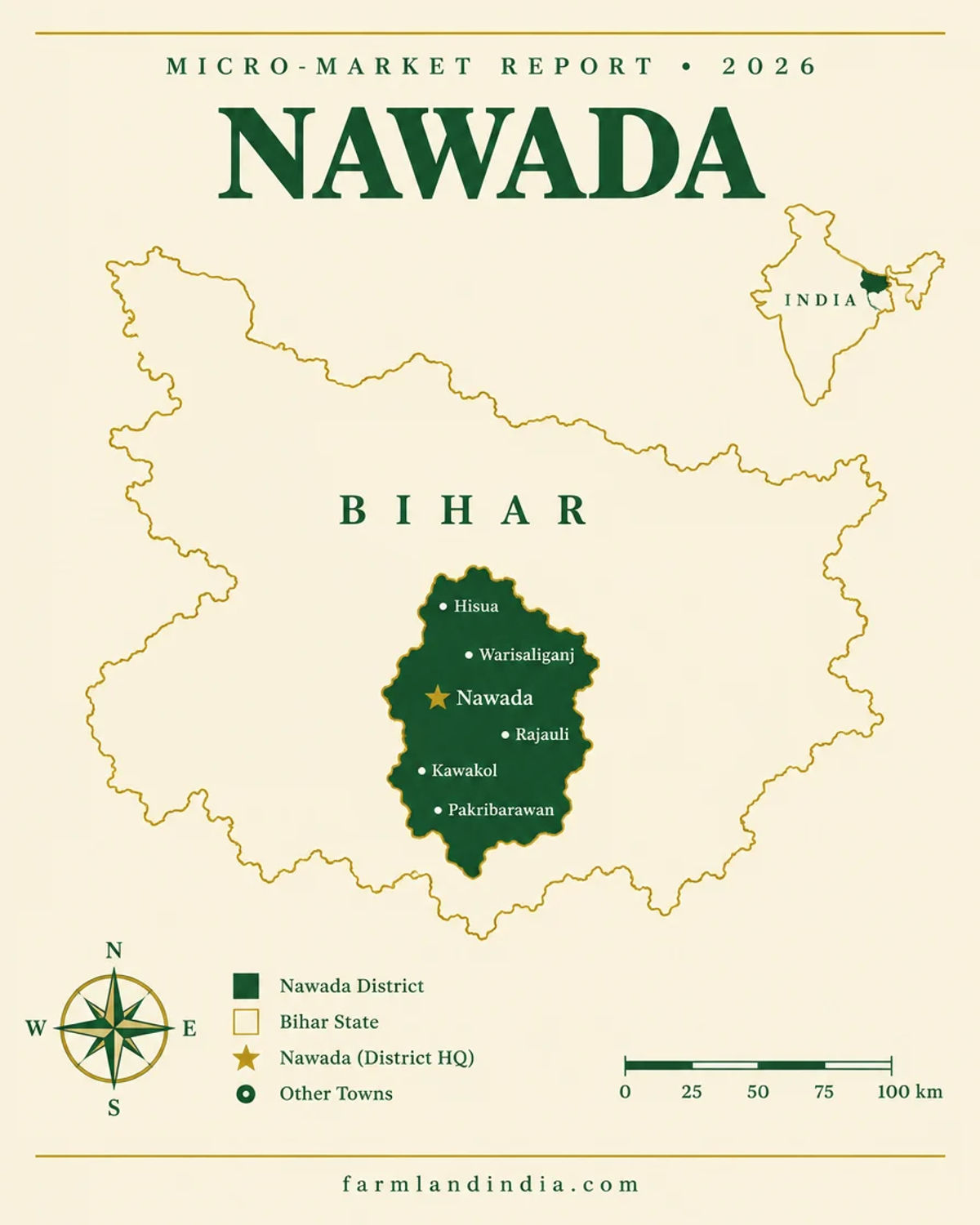
Nawada district covers 2,494 sq km in south-east Bihar and had about 22.2 lakh people at the 2011 Census. It has 14 blocks, with Nawada town as headquarters and Hisua, Warisaliganj and Rajauli as the other main centres (CGWB district profile). The north is alluvial plain; the south is hilly and undulating, the southern fringe of the Chotanagpur Plateau, with hills across Rajauli, Sirdala, Govindpur and Kauakol and waterfalls such as Kakolat. The rivers, the Tilaiya, Ghaghra, Khuri, Sakri and Dhanarji, are ephemeral and flow mainly in the rains.
Rail is the main upgrade. The Warisaliganj–Nawada–Tilaiya section of the Kiul–Gaya line, part of a doubling and electrification project to carry coal and other freight, was inaugurated in February 2025 (Indian Infrastructure, 27 Feb 2025). In September 2025 the Union Cabinet approved doubling of the Bakhtiyarpur–Rajgir–Tilaiya line, 104 km at about Rs 2,192 crore, and the coverage named Nawada among the aspirational districts that would benefit (Construction World, 30 Sep 2025). These are freight-led projects, so they support warehousing, siding and small industrial land more than residential demand.
In February 2025 Nawada saw 142 schemes inaugurated worth Rs 138.06 crore and foundation stones laid for 60 more, including a medical college and hospital, a degree college in Rajauli sub-division, an industrial area in Rajauli and Ganga water supply to the remaining 27 wards of Nawada Municipal Council (Drishti IAS, 11 Feb 2025). The report does not give a timeline for each project.
The government rate changed on 19 June 2026. The MVR doubled for urban and peripheral land and rose 1.6 times for rural land, and general stamp duty rose from 6% to 7% (Prabhat Khabar, 18 Jun 2026). Nawada is a small-town district, so most of its land falls in the rural band and only the rings around Nawada, Hisua and Warisaliganj are in the doubled band.
For farmland: rice is the main kharif crop on about 86,000 ha and wheat the main rabi crop on about 48,000 ha, with lentil, chickpea and pigeonpea in smaller areas, on soils from sandy to clay loam; cropping intensity is about 130% and drought is a listed risk (ICAR-CRIDA). The CGWB finds groundwater safe in all 14 blocks.
- Kiul–Gaya line
- Hilly Rajauli
- Hisua
- Warisaliganj
- Kakolat
- Tilaiya corridor
Transaction costs
Stamp duty & registration in Nawada
7%
General stamp duty from 19 June 2026
up from 6%, as reported by Prabhat Khabar
2.0x / 1.6x
MVR multiplier from 19 June 2026
2.0x urban and peripheral land, 1.6x rural land
5% a year
Annual MVR increase
with a full MVR review every three years
The state rates apply here. Prabhat Khabar reported on 18 June 2026 that from 19 June general stamp duty rose from 6% to 7%, the Minimum Value Register (MVR, the government’s floor value for registration) was doubled for urban and peripheral land and raised 1.6 times for rural land, women buyers get 0.4% off stamp duty and 0.1% off the registration fee, and the MVR will rise 5% each financial year with a full review every three years (Prabhat Khabar, 18 Jun 2026). Peripheral land means land within 8 km of a municipal corporation, 4 km of a nagar parishad or 2 km of a nagar panchayat. For Nawada that means the rings around Nawada town and nagar panchayats such as Hisua and Warisaliganj, where applicable; the hilly south and most villages fall in the 1.6x rural category. The report does not state the registration fee or say whether the older extra 2% duty in municipal areas continues; the 2017-18 state audit gave a 2% registration fee (CAG report No. 2 of 2019), so ask the sub-registrar for the current total before you budget. Our stamp duty guide and MVR guide explain how to look up the rate for a plot, and fees are paid through Nibandhan.
Know the belt
What is moving prices in Nawada
Reported rail and town developments; no listing-site prices are used.
Nawada town and the medical college belt
District headquarters market
The headquarters town is the main registry and trade centre, with a medical college and hospital and extended Ganga water supply reported in February 2025 (Drishti IAS). Demand is for plots and small commercial land.
Check: which ring of the municipal council the plot lies in and whether it is on the water-supply network.
Hisua and Warisaliganj on the Kiul–Gaya line
Rail corridor belt
The Kiul–Gaya doubling was inaugurated over the Warisaliganj–Nawada–Tilaiya section in 2025 (Indian Infrastructure). Freight-led rail upgrades favour siding, godown and small-industry land near stations.
Check: proximity to the station and whether the plot lies in a railway acquisition strip.
Rajauli and the hilly south
Industrial area plan, hill land
Rajauli sub-division has a degree college and an industrial area reported in February 2025 (Drishti IAS). The south is hilly Chotanagpur fringe, and forest and hill entries need checking (CGWB).
Check: the Jamabandi category (hill, forest or government land) and the physical boundary with the hill.
Akbarpur, Nardiganj and the north plain
Paddy and wheat plain
The northern blocks are alluvial plain with paddy and wheat on loam and clay loam, irrigated from tubewells (CGWB). Groundwater development is moderate, about 50% in Akbarpur and 56% in Nardiganj.
Check: local well depth and the mauza’s survey status.
Asking price
We found no newspaper or official price series for Nawada farmland, so none is shown. Government rates went up sharply from 19 June 2026 (Prabhat Khabar); use the MVR for the mauza and recent registered deeds in the same village as your reference, and treat broker quotes as asking prices.
Connectivity
How Nawada connects — road, rail and air
Rail corridors are the main upgrade. Drive times to villages are not given because no source was found.
🚗 By road
✈️ By air
🚆 By rail
No drive times to villages are given because no source was found. The rail doubling projects are freight-led; check the operating railway for passenger services and timelines.
Growth catalysts
Upcoming infrastructure & developments
Status labels reflect sources read in November 2026. Government-announced timelines are not guaranteed; items with a single or older source say so.
01Open
03Catalysts
Agriculture & terrain
Soil, crops & water in Nawada
A paddy and wheat district on sandy to clay loam, irrigated mostly from tubewells, with drought risk and a hilly south.
Crops
Rice is the main kharif crop on about 86,000 ha and wheat the main rabi crop on about 48,000 ha, with lentil, chickpea, pigeonpea and green gram on small areas (ICAR-CRIDA). Cropping intensity is about 130%.
- Rice, then wheat
- Lentil and chickpea
- Pigeonpea
- Green gram in summer
Soils
The CGWB lists loam, sandy, clay, sandy loam and clay loam soils, and notes that sandy land suits maize and groundnut, clay suits paddy and gram, and clay loam suits paddy, wheat and potato (CGWB).
- Sandy to sandy loam
- Clay loam
- Clay in low plots
Horticulture
Mango covers about 1,100 ha, with guava, lemon and banana; potato leads vegetables at about 5,500 ha, followed by cauliflower, brinjal and onion (ICAR-CRIDA).
- Mango
- Potato
- Cauliflower, brinjal
Water and irrigation
The CGWB reports tubewells irrigating about 491 sq km of a 581 sq km net irrigated area, with canals at about 42 sq km, and district groundwater development at 43.1% (CGWB). ICAR-CRIDA gives open wells about 86% of the irrigated area in its approximations, so the mix depends on the year and source (ICAR-CRIDA).
Rainfall and rivers
The CGWB and ICAR-CRIDA both give normal annual rainfall near 1,037 mm, about 85% in June to September (CGWB; ICAR-CRIDA). The Tilaiya, Ghaghra, Khuri, Sakri and Dhanarji are ephemeral, with wide sandy beds, and drought, delayed monsoon and dry spells are listed contingencies.
At a glance
Nawada vs. nearby districts
| District | Land and water | What links it to Nawada |
|---|---|---|
| Gaya Ji (west) | Larger city, airport | Named with Nawada as an aspirational district on the Rajgir–Tilaiya rail line ([Construction World](https://www.constructionworld.in/transport-infrastructure/highways-and-roads-infrastructure/cabinet-approves-4-lane-highway-and-rail-expansion-projects-in-bihar/79362)) |
| Nalanda (north) | Plain with Rajgir hills | Same Bakhtiyarpur–Rajgir–Tilaiya rail corridor ([Business Standard](https://www.business-standard.com/industry/news/cabinet-okays-rs-6-014-crore-highway-railways-projects-125092401251_1.html)) |
| Aurangabad (south-west) | Hilly, rain-dependent paddy | Also in the south Bihar alluvial zone in ICAR-CRIDA’s series ([ICAR-CRIDA](https://icar-crida.res.in/CP/Bihar/BR5_Nawada_28.12.2013.pdf)) |
No price series is available for any of these districts, so the table compares land type and links only. Facts are from Construction World and Business Standard. Compare the MVR and registered deeds rather than asking prices.
Farmland India view
Why investors look at Nawada
Five reasoned points for Nawada, each tied to a source on this page.
Rail upgrades are done and planned
The Kiul–Gaya section through Nawada was inaugurated in 2025 and a second doubling is approved (Indian Infrastructure; Construction World). Freight-led upgrades favour warehousing and siding land near stations.
Lower prices for a reason
Nawada is mostly rural, rain-dependent paddy and hilly land with ephemeral rivers (CGWB). Lower prices than the plain districts around Patna reflect water and market depth, not a mispriced market.
A town with new civic investment
A medical college and hospital, extended Ganga water supply and a Rajauli industrial area were reported in February 2025 (Drishti IAS). Nawada town and Rajauli are the most likely beneficiaries.
A higher government rate changes the cost base
The June 2026 MVR rise and 7% stamp duty raise the cost of each registration (Prabhat Khabar). The doubled band applies only near towns, so most rural plots see the milder 1.6x rise.
Groundwater headroom in much of the district
Development is 43.1% overall, and as low as 18.8% in Roh (CGWB). That leaves room for new tubewells in those blocks, but Hisua and Meskaur are already above 74%.
Confirm Jamabandi, mutation, zoning and acquisition status directly — these are not certified by Farmland India’s review.
STRAIGHT TALK
Risks & challenges in Nawada
District-specific risks. Read the state page for the general Bihar risks on ceiling, conversion and records.
Drought and rain-dependence
ICAR-CRIDA lists drought, delayed monsoon and dry spells among the district’s contingencies (ICAR-CRIDA). A rain-fed plot can fail in a dry year, so price it below irrigated land.
Hill, forest and government land
Hills cover parts of Rajauli, Sirdala, Govindpur and Kauakol, and the two sources disagree on forest area (CGWB; ICAR-CRIDA). A plot shown as farmland on a broker’s sketch may be recorded differently in the Jamabandi.
Rail acquisition
The doubling projects need land (Indian Infrastructure; Construction World). Paying an advance for land beside the tracks can end in a compensation dispute.
Peripheral MVR multiplier
Land within 4 km of a nagar parishad or 2 km of a nagar panchayat is charged at twice the old MVR (Prabhat Khabar). Confirm the ring before you settle on price and budget.
Mismatched records
Old Khatiyan entries, unmutated inheritance and the ongoing special survey mean records often differ from the field (Deccan Herald). Match the plot number on Bihar Bhumi with a physical measurement.
Uneven groundwater
Hisua and Meskaur are above 74% development while Roh is under 19% (CGWB). Check the block and local well depth before paying for irrigated land.
Joint family land
Unpartitioned joint land needs every co-sharer’s signature, including those who work away. A missing signature can void the sale years later.
Thin resale market
Outside Nawada town and a few block headquarters, buyers are few. Hold-period assumptions should allow for slow resale.
Who to contact
Local revenue & planning offices
The Collectorate and district administration are listed on the Nawada district website. Mutation and Jamabandi work go through the circle office and Bihar Bhumi; record corrections run through Parimarjan. Conversion of agricultural land is handled by the sub-divisional officer, and registration through the sub-registrar office covering your mauza, booked on Nibandhan. For building rules inside Nawada town, ask the municipal council. For forest or hill land, ask the divisional forest office.
KEEP EXPLORING
Explore more areas
Other districts in Bihar
- Araria
- Arwal
- Aurangabad
- Banka
- Begusarai
- Bhagalpur
- Bhojpur
- Buxar
- Darbhanga
- East Champaran
- Gaya Ji (gaya)
- Gopalganj
- Jamui
- Jehanabad
- Kaimur (bhabua)
- Katihar
- Khagaria
- Kishanganj
- Lakhisarai
- Madhepura
- Madhubani
- Munger
- Muzaffarpur
- Nalanda
- Patna
- Purnia
- Rohtas
- Saharsa
- Samastipur
- Saran
- Sheikhpura
- Sheohar
- Sitamarhi
- Siwan
- Supaul
- Vaishali
- West Champaran
COMMON QUESTIONS
Frequently asked questions
Everything buyers, NRIs and investors ask before their first reviewed farmland purchase in Nawada.
Visit full wiki01 of 04
What are the stamp duty and MVR changes for land in Nawada?
Prabhat Khabar reported that from 19 June 2026 Bihar’s general stamp duty rose from 6% to 7%, the MVR doubled for urban and peripheral land and rose 1.6 times for rural land. Ask the sub-registrar for the current registration fee and your plot’s category.
02 of 04
Is there a price guide for farmland in Nawada?
We found no newspaper or official price series for Nawada farmland, so we show none. Use the revised 2026 MVR for the mauza and land category, and recent registered deeds in the same village, as your references.
03 of 04
Which rail projects affect land in Nawada?
The Warisaliganj–Nawada–Tilaiya section of the Kiul–Gaya doubling was inaugurated in February 2025. The Cabinet also approved doubling of the Bakhtiyarpur–Rajgir–Tilaiya line in September 2025, with Nawada named among the districts to benefit.
04 of 04
Is Nawada farmland reliably irrigated?
Not everywhere. Tubewells carry most irrigation, and the contingency plan lists drought among the district’s risks. Check the mauza’s well depth and water source before you pay for irrigated land.
Transparency
Sources and references
Law and courts
- Bihar Agricultural Land (Conversion for Non-Agricultural Purposes) Act, 2010
- Bihar Land Reforms (Fixation of Ceiling Area and Acquisition of Surplus Land) Act, 1961
- CAG, Report No. 2 of 2019: stamp and registration fees, Bihar
Government
- Nawada district administration
- CGWB: Ground Water Information Booklet, Nawada
- ICAR-CRIDA: District Agriculture Contingency Plan, Nawada
- Bihar Bhumi, land records
- Parimarjan, record corrections
- Nibandhan e-services
News
- Prabhat Khabar: new MVR and 7% stamp duty from 19 June 2026
- Indian Infrastructure: Warisaliganj–Nawada–Tilaiya section inaugurated, 27 Feb 2025
- Construction World: Cabinet approves rail expansion in Bihar, 30 Sep 2025
- Business Standard: Cabinet okays highway and rail projects, 24 Sep 2025
- Drishti IAS: schemes inaugurated in Nawada, 11 Feb 2025
- Deccan Herald: Bihar land survey deadline extended
Further reading
- Buying land in Bihar: state guide
- Bihar Bhumi: view Jamabandi online
- Dakhil Kharij (mutation) status in Bihar
- MVR rate in Bihar
Data-currency note: sources were read in November 2026. Project status, the MVR and township rules change often; check the linked source and the relevant office before relying on any figure.
For developers
Ready to explore Nawada farmland?
Browse reviewed projects and individual land parcels across Nawada — or if you own land here, list it with platform review and reach serious buyers.