
District guide
Buying Land in Madhubani
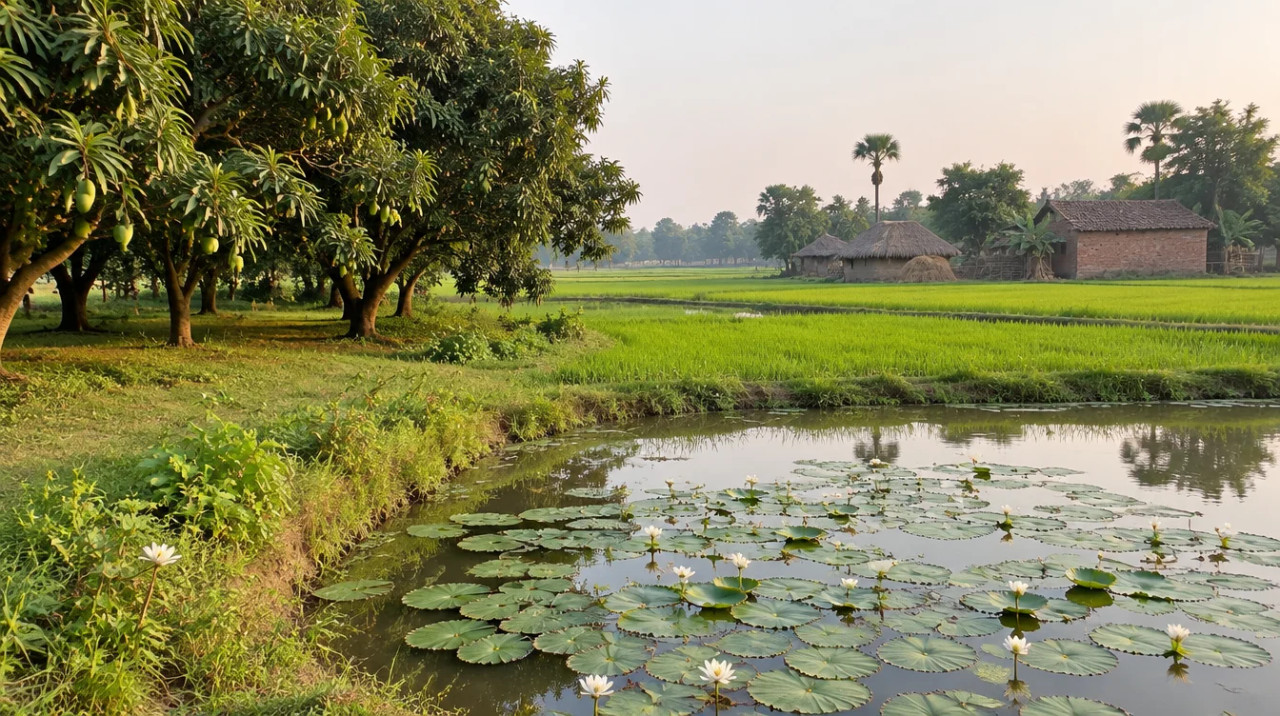
A Mithila district of paddy, mango and makhana ponds, with a national makhana board, Darbhanga’s airport next door and floodplain land to check.
3,501 sq km
Area (CGWB district profile)
44.8 lakh
Population (Census 2011)
1,185 mm
Normal annual rainfall (ICAR-CRIDA)
37.2%
Groundwater development (CGWB)
*Indicative range across districts and land types. Stamp duty, registration and conversion charges are additional. Local measurement units vary — every listing states the unit it is priced in. Not a valuation or an offer.
District land record — Madhubani
Rev. 2026 · Farmland India desk
State
Bihar
Sub-division
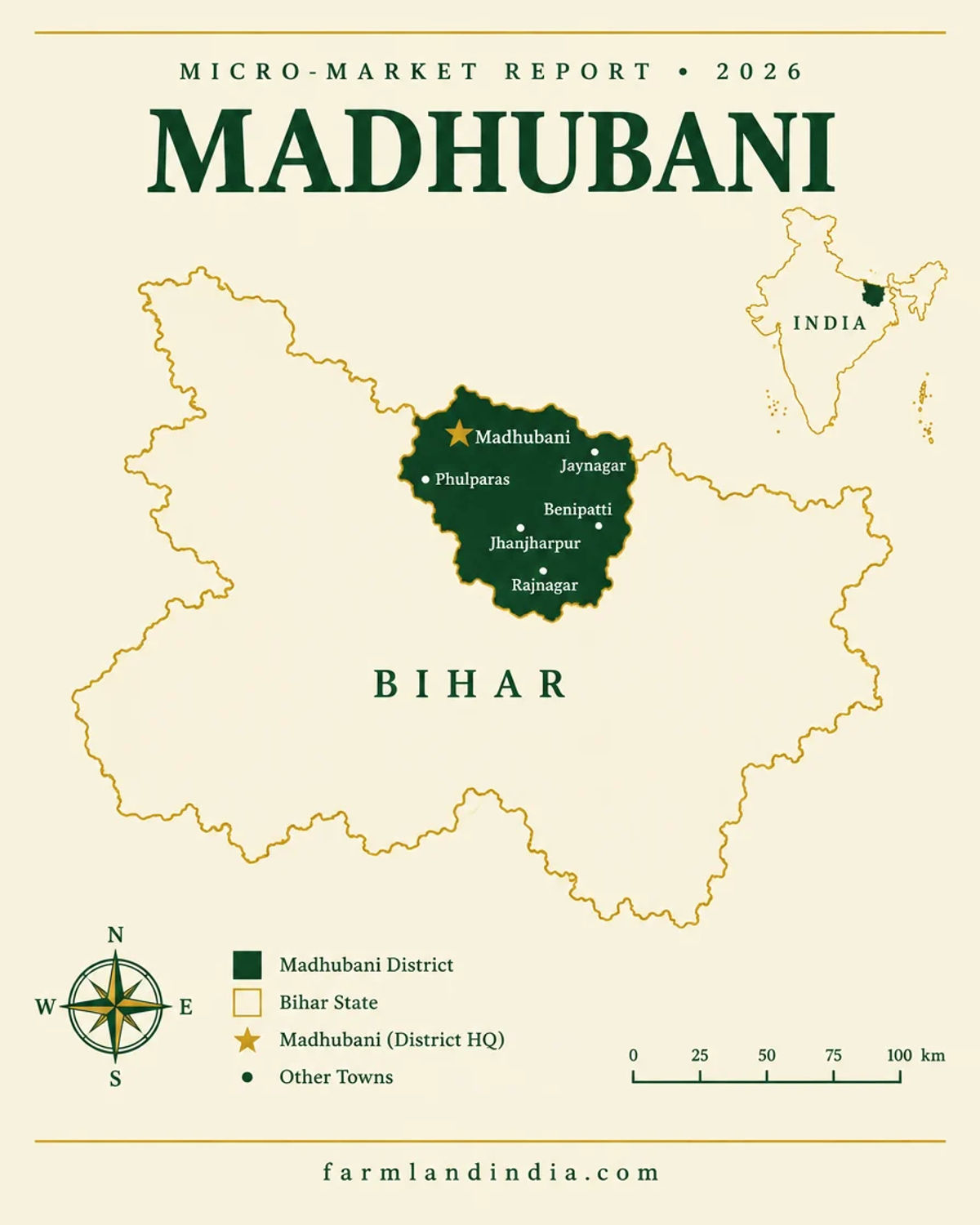
Five sub-divisions, Madhubani, Jaynagar, Benipatti, Jhanjharpur and Phulparas, and about 20 blocks in the CGWB list (ICAR-CRIDA counts 21) (CGWB district profile)
Key markets
Madhubani town · Jaynagar · Jhanjharpur · Benipatti · Phulparas · Rajnagar
Demand anchors
National Makhana Board launched in Bihar, Sept 2025 (India TV) · Darbhanga airport new terminal targeted for Nov 2026 (CAPA) · Patna–Purnia Expressway through neighbouring Darbhanga (Prabhat Khabar)
Rail
Madhubani and Jaynagar on the Darbhanga–Jaynagar line; Jhanjharpur–Nirmali gauge conversion opened in May 2022 (Construction World)
Size and population
3,501 sq km and 44,76,043 people at the 2011 Census, about 96% rural (CGWB district profile)
Pricing unit
Asking prices are usually quoted in kattha or decimal; no sourced price series is shown
Local units
Kattha and bigha vary in size across Bihar and are not fixed by a single official conversion; 1 decimal is one-hundredth of an acre (435.6 sq ft). Always convert to acres or sq ft on the deed.
Land records
undefined
Land law is state law. These rules are maintained on the Bihar page and apply to every district within it.
Madhubani — land purchase legal rules
Bihar does not reserve agricultural land for farmers the way Gujarat or Maharashtra do, so an Indian resident who is not a cultivator can usually buy farmland here. The limits that bite are different: a family land ceiling, a conversion permission before any non-farm use, an unfinished statewide resurvey that is rewriting old records, and the usual NRI bar under FEMA. Most buyer problems in Bihar come from the records, not from the law.
Who can buy agricultural land? We found no provision in Bihar’s tenancy or ceiling laws that limits farmland purchases to agriculturists. What the Bihar Land Reforms (Fixation of Ceiling Area and Acquisition of Surplus Land) Act, 1961 controls is how much a family may hold, and section 16 bars any acquisition by transfer, exchange, lease, mortgage or settlement that would take the buyer’s family above its ceiling. Inheritance, bequest and gift are outside that bar.
Ceiling limits: Section 4 of the 1961 Act sets the ceiling for a family of up to five by land class: 15 acres for land irrigated by government works and double-cropped, 18 acres for land on private tubewells or lift irrigation, 25 acres for one-season irrigated land, 30 acres for other land including orchards, 37.5 acres for diara or chaur land and 45 acres for hilly, sandy or perennially submerged land. Each extra family member adds one-tenth of the ceiling, up to one and a half times the limit. A “family” is a person, spouse and minor children, and companies, trusts and institutions count as persons.
Conversion to non-farm use: The Bihar Agriculture Land (Conversion for Non-Agriculture Purposes) Act, 2010 requires prior permission from the Sub-Divisional Officer before agricultural land is used for anything else. The fee is 10% of market value as set by the Collector under the Stamp Act, the SDO must decide within 90 days, and converting without permission draws a penalty of half the fee on top of the fee. The Act does not apply inside municipal areas or areas notified as urban, commercial or industrial through a master plan, where building and layout rules take over instead.
Mutation and the Jamabandi: A registered deed is not the end of the job. The buyer has to apply for mutation, called Dakhil Kharij, so that the Jamabandi (register II) moves to the buyer’s name and rent receipts are issued to the buyer. Both steps run online through Bihar Bhumi, and errors in the digitised Jamabandi are corrected through the Parimarjan portal. Sellers whose Jamabandi carries a wrong name, area or plot number should fix it before registry, not after.
The special land survey: Bihar is resurveying land under the Bihar Special Survey and Settlement Act, 2011, which will produce a new Khatiyan (record of rights) and maps for each village. The deadline was moved to December 2026 in March 2025 (PTI via ThePrint), and the revenue minister was reported in March 2026 to have set December 2027 for completion (Prabhat Khabar, March 2026). Buyers in a village under survey should check whether the seller filed the self-declaration and whether any claim or objection is pending on the plot.
Government, Bhoodan and estate land: A large share of disputes involves land that was never the seller’s to sell: government land recorded as gair mazarua, Bhoodan land, or land of former estates. The revenue department reported that 2,56,664.88 acres of the 6,48,593.14 acres donated under Bhoodan had been distributed, and that about 15,358 acres of the former Bettiah Raj estate were set to be taken over (Deccan Herald). Check the khata category in the Khatiyan before paying any token money.
Scheduled Areas and tribal land: Bihar is not among the ten states with notified Fifth Schedule Areas (PIB). The Chotanagpur and Santhal Parganas tenancy restrictions on tribal land went with those regions to Jharkhand in 2000, so buyers moving between the two states should not assume the same rules apply.
Planned township zones: Bihar has finalised areas for 11 greenfield satellite townships and in April 2026 the Urban Development Department barred sale, purchase and construction in seven of them, including the Pataliputra Township around Patna (Prabhat Khabar, April 2026). The ban on sales was lifted in August 2026, though a landowner inside the Pataliputra township area must first inform the government before selling, and a cabinet decision reported on 29 October 2026 removed the restriction in the satellite townships, with construction to follow the development control rules (Prabhat Khabar, 9 August 2026; Prabhat Khabar, 29 October 2026). Zoning under these plans now decides what a plot can be used for.
Documents to ask for: Before paying an advance, collect the current Jamabandi page and the latest rent receipt (lagan rasid), the Khatiyan (record of rights) from the last settled survey and, where it exists, the new survey entry, the Bhu Naksha map sheet with the plot number marked, the seller’s chain of registered deeds (kewala) for at least the last 30 years, the mutation order that put the land in the seller’s name, and a land possession certificate (LPC) from the circle office. Match the khata, khesra (plot) number, area and boundaries across every document. Our Bhu Naksha guide and mutation status guide show how to pull these online.
NRI and OCI buyers: Under the RBI’s Master Direction on acquisition of immovable property, NRIs and OCIs may buy immovable property in India other than agricultural land, plantation property or a farm house. They can inherit such land. Our NRI guide covers the options in detail.
- No farmer-only rule found
- Ceiling Act 1961
- Conversion Act 2010 (SDO)
- Dakhil Kharij mutation
- Special survey to 2027 (reported)
- NRI agri: barred (RBI)
- Records via Bihar Bhumi
Madhubani — district-specific notes
The Bihar state page applies to Madhubani in full: the ceiling law, the 2010 conversion rule, mutation through Bihar Bhumi and the NRI bar. These five points are specific to the district.
⚠ Makhana grows in ponds and low-lying fields, and much of the district’s water-logged land is held in small, shared or leased plots. Check whether a pond is recorded as a water body, as cultivated land or under a lease, because the Jamabandi entry decides what you can lawfully do with it (DTE).
⚠ Madhubani is a densely populated, almost wholly rural district: 44.8 lakh people in 3,501 sq km at the 2011 Census (CGWB district profile). Holdings are small and fragmented, so one plot often has several co-sharers whose signatures you need.
⚠ The June 2026 MVR revision doubled the register for urban and peripheral land and raised rural land 1.6 times (Prabhat Khabar, 18 Jun 2026). Land within 4 km of a nagar parishad, such as Madhubani or Jaynagar town, is treated as peripheral, so a plot just outside town is registered at the higher rate.
⚠ Madhubani was among the 17 districts the state disaster management department listed in the September–October 2024 floods (Down To Earth, Oct 2024). Ask the seller for flood history and look at drainage in the monsoon before you agree a price.
⚠ Bihar’s special land survey has been extended more than once and is still running in many mauzas (Deccan Herald). Check on Bihar Bhumi whether the mauza has finished survey and whether the Khatiyan and Jamabandi match what the seller shows you.
Read the full Bihar land buying guide for the ceiling, conversion, survey and NRI rules.
- Pond and low-lying land
- MVR revised June 2026
- Flood-prone blocks
- Survey in progress
- Joint family land
District overview
Madhubani — a Mithila farm district with makhana ponds and an airport next door
Madhubani district lies in Mithila, the flat alluvial country of north Bihar along the Nepal border. It covers 3,501 sq km, had 44,76,043 people at the 2011 Census, about 96% of them in villages, and is divided into five sub-divisions: Madhubani, Jaynagar, Benipatti, Jhanjharpur and Phulparas (CGWB district profile). The rivers here, including the Kamla Balan, Bhutahi Balan and Dhaus and an old Kosi channel, bring silt and also floods.
The anchor for farmland is makhana. Bihar grows about 85% of India’s makhana (fox nut), and Madhubani, Darbhanga and Sitamarhi are named as its Mithila hubs; Madhubani makhana is part of the One District One Product scheme and “Mithila Makhana” carries a Geographical Indication tag (Down To Earth, Feb 2025). The Union Budget 2025-26 announced a National Makhana Board, and the Prime Minister launched it at Purnea in September 2025 with an initial allocation of Rs 100 crore, aimed at processing, marketing and farmer producer organisations (India TV, 15 Sep 2025). It is a reason to look at pond and low-lying land, not a price guarantee.
Infrastructure sits mostly next door. Darbhanga airport, in the neighbouring district, is building a new 51,800 sq m terminal that is reported to be on track for commissioning in November 2026 (CAPA, Feb 2026). The Patna–Purnia Expressway, whose alignment the Centre approved in February 2025, runs through Samastipur, Darbhanga and Saharsa rather than Madhubani itself (Prabhat Khabar, Feb 2025). Inside the district, rail is the story: the Jhanjharpur–Nirmali gauge conversion opened in May 2022 and links Jhanjharpur to the Kosi region (Construction World).
The government rate changed on 19 June 2026. The MVR doubled for urban and peripheral land and rose 1.6 times for rural land, and general stamp duty went from 6% to 7% (Prabhat Khabar, 18 Jun 2026). That raises the cost of every deed and makes clean paper more valuable.
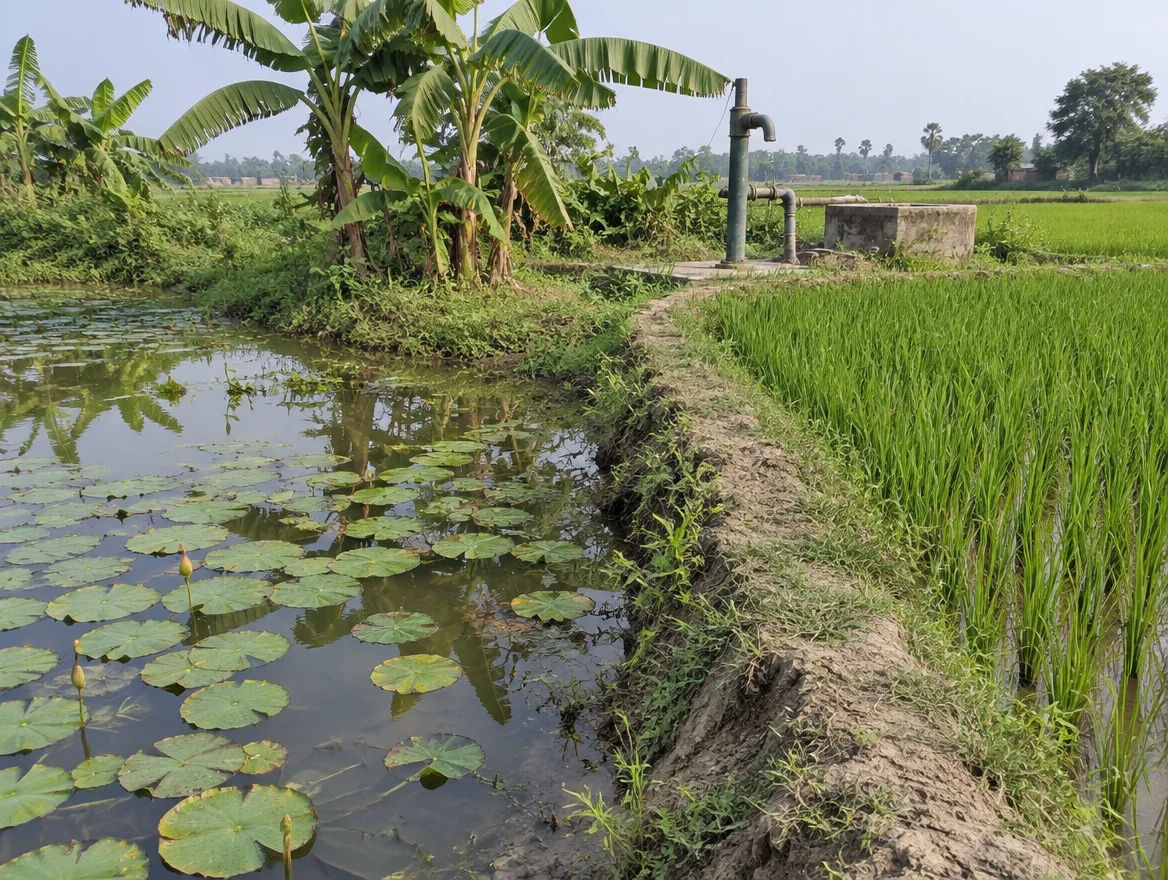
For farmland: paddy is the main kharif crop on about 1.4 lakh ha and wheat the main rabi crop on about 80,000 ha, on silty loam soils, with about half of the irrigated area watered by tubewells and nearly two-thirds of the net sown area still rainfed (ICAR-CRIDA). The CGWB finds groundwater safe in every block except Khajauli (CGWB).
- Mithila plain
- Makhana belt
- Jhanjharpur
- Jaynagar
- Benipatti
- Darbhanga airport
Transaction costs
Stamp duty & registration in Madhubani
7%
General stamp duty from 19 June 2026
up from 6%, as reported by Prabhat Khabar
2.0x / 1.6x
MVR multiplier from 19 June 2026
2.0x urban and peripheral land, 1.6x rural land
5% a year
Annual MVR increase
with a full MVR review every three years
The state rates apply here. Prabhat Khabar reported on 18 June 2026 that from 19 June general stamp duty rose from 6% to 7%, the Minimum Value Register (MVR, the government’s floor value for registration) was doubled for urban and peripheral land and raised 1.6 times for rural land, women buyers get 0.4% off stamp duty and 0.1% off the registration fee, and the MVR will rise 5% each financial year with a full review every three years (Prabhat Khabar, 18 Jun 2026). Peripheral land means land within 8 km of a municipal corporation, 4 km of a nagar parishad or 2 km of a nagar panchayat. For Madhubani that means the rings around Madhubani, Jaynagar and Jhanjharpur towns; the rest of the district’s rural land falls in the 1.6x category. The report does not state the registration fee or say whether the older extra 2% duty in municipal areas continues; the 2017-18 state audit gave a 2% registration fee (CAG report No. 2 of 2019), so ask the sub-registrar for the current total before you budget. Our stamp duty guide and MVR guide explain how to look up the rate for a plot, and fees are paid through Nibandhan.
Know the belt
What is moving prices in Madhubani
Reported makhana, rail and airport developments; no listing-site prices are used.
Madhubani town and the Jaynagar road
District headquarters market
The town has the sub-registrar, the court and the main rail station on the Darbhanga–Jaynagar line, so it draws small plot buyers and traders. Farm blocks around it are small, shared and often seasonally wet.
Check: which ring of the nagar parishad the plot lies in, because land within 4 km is charged at the peripheral MVR (Prabhat Khabar).
Jhanjharpur and the east
Rail and highway junction
The Jhanjharpur–Nirmali line, converted to broad gauge in 2022, opened rail access between Jhanjharpur and the Kosi region (Construction World). The east of the district drains toward Kosi-influenced low land.
Check: flood and drainage history, and whether the mauza lies inside the embankment of a river.
Makhana ponds and low-lying fields
Specialist land use
Makhana is grown in ponds and flooded fields, and the National Makhana Board was launched in September 2025 (India TV). Pond land trades differently from dry farmland and may be leased to growers.
Check: whether the pond is recorded as a water body, who holds the lease and whether any lease or bank charge is registered.
Benipatti, Phulparas and Laukahi
Paddy and wheat blocks
Typical Mithila farmland: paddy and wheat on silty loam, with lentil and mustard in rabi (ICAR-CRIDA). A large part of the sown area is rainfed, so irrigation access is the main price differentiator.
Check: tubewell or canal access and the mauza’s survey status.
Asking price
We found no newspaper or official price series for Madhubani farmland, so none is shown. Government rates went up sharply from 19 June 2026 (Prabhat Khabar); use the MVR for the mauza and recent registered deeds in the same village as your reference, and treat broker quotes as asking prices.
Connectivity
How Madhubani connects — road, rail and air
Rail and highway links to Darbhanga, with its airport close by. Drive times to villages are not given because no source was found.
🚗 By road
✈️ By air
🚆 By rail
No drive times to villages are given because no source was found. Check current road works with the Bihar road construction department or NHAI before you plan around them.
Growth catalysts
Upcoming infrastructure & developments
Status labels reflect sources read in November 2026. Government-announced timelines are not guaranteed; items with a single or older source say so.
02Open
04Catalysts
Agriculture & terrain
Soil, crops & water in Madhubani
A paddy and wheat district on silty alluvium, irrigated about half from tubewells, with a large rainfed area and monsoon flood risk.
Crops
Paddy is the main kharif crop on about 1.42 lakh ha and wheat the main rabi crop on about 80,000 ha, followed by lentil, mustard and a little maize (ICAR-CRIDA). The CGWB puts paddy at about 37% of the agricultural land (CGWB). Cropping intensity is about 134%.
- Paddy, then wheat
- Lentil and mustard
- Potato (about 9,700 ha)
- Sugarcane in places
Soils
Mostly silty loam and silty clay loam, with sandier loam in the older channels; the CGWB lists younger and older alluvium, calcareous patches and alkaline sandy alluvium (ICAR-CRIDA; CGWB).
- Silty loam
- Silty clay loam
- Sandy loam near channels
- Calcareous patches
Horticulture and ponds
Mango covers about 8,500 ha, with banana, litchi and guava smaller (ICAR-CRIDA). The contingency plan lists 5,891 farmer-owned ponds, and makhana is grown in ponds and low fields across the Mithila belt (ICAR-CRIDA; DTE).
- Mango orchards
- Makhana ponds
- Fish ponds
Water and irrigation
Tubewells supply about half the irrigated area and canals about 37% in the ICAR-CRIDA plan, but only about 80,000 ha of 2.33 lakh ha net sown is irrigated, so a large area depends on rain (ICAR-CRIDA). The CGWB puts groundwater development at 37.2%, with every block safe except Khajauli at 79.2% (CGWB).
Rainfall and rivers
ICAR-CRIDA gives normal annual rainfall as 1,185 mm and the CGWB 1,258 mm, with over 80% in the monsoon (ICAR-CRIDA; CGWB). The Kamla Balan, Bhutahi Balan, Dhaus and an old Kosi channel cross the district, and Madhubani was listed among the districts hit in the September 2024 floods (Down To Earth).
At a glance
Madhubani vs. nearby districts
| District | Land and water | What links it to Madhubani |
|---|---|---|
| Darbhanga (south) | Same Mithila plain, airport district | Airport and the expressway route are in Darbhanga ([CAPA](https://centreforaviation.com/news/darbhanga-airport-on-track-to-commission-new-passenger-terminal-by-nov-2026-1348525); [Prabhat Khabar](https://www.prabhatkhabar.com/state/bihar/patna/central-government-approves-patna-purnia-expressway-in-bihar-alignment)) |
| Sitamarhi (west) | Paddy and wheat, Nepal border | Another named Mithila makhana hub ([Down To Earth](https://www.downtoearth.org.in/agriculture/budget-2025-2026-makhana-board-may-help-bihar-reach-every-plate-across-india)) |
| Supaul (east) | Kosi floodplain | Reached from Jhanjharpur by the gauge-converted line ([Construction World](https://www.constructionworld.in/transport-infrastructure/metro-rail-and-railways-infrastructure/railway-minister-inaugurates-jhanjharpur-nirmali-gauged-section/34132)) |
| Saharsa (south-east) | Kosi plain, makhana growing | Both named in Bihar’s makhana belt; expressway passes through Saharsa |
No price series is available for any of these districts, so the table compares land type and links only. Facts are from CAPA, Down To Earth, Construction World and Prabhat Khabar. Compare the MVR and registered deeds rather than asking prices.
Farmland India view
Why investors look at Madhubani
Five reasoned points for Madhubani, each tied to a source on this page.
A named makhana hub
Madhubani is one of the Mithila districts the makhana board literature names, and Mithila Makhana holds a GI tag (Down To Earth). Pond and low-lying land could see steadier demand from growers and processors, but no report links the board to land prices yet.
An airport next door
Darbhanga airport’s new terminal is reported on track for November 2026 (CAPA). Madhubani town and Jaynagar are within road reach, which helps small-plot and rental demand, not farm blocks.
A rail upgrade that is done
The Jhanjharpur–Nirmali gauge conversion opened in 2022 (Construction World). Settled infrastructure is easier to price than announced infrastructure.
Higher government rates change the cost base
The June 2026 MVR rise and 7% stamp duty raise the cost of each registration (Prabhat Khabar). Land near town is assessed at the peripheral multiplier, widening the gap with village land.
Rainfed land needs a reason to pay more
Nearly two-thirds of the net sown area is rainfed, so plots with a tubewell or canal access are worth checking first (ICAR-CRIDA). A premium makes sense only where irrigation and drainage are both proven.
Confirm Jamabandi, mutation, zoning and acquisition status directly — these are not certified by Farmland India’s review.
STRAIGHT TALK
Risks & challenges in Madhubani
District-specific risks. Read the state page for the general Bihar risks on ceiling, conversion and records.
Monsoon floods and waterlogging
Madhubani was among the 17 districts hit in the September–October 2024 floods (Down To Earth). Visit in the monsoon and ask about the highest water level in the last few years.
Pond and lease ambiguity
Makhana ponds are often leased or shared, and a pond’s recorded land type may differ from its use. Check the Jamabandi entry, the lease and any bank charge.
Small, fragmented holdings
With 44.8 lakh people in 3,501 sq km (CGWB), plots are small and often held by several co-sharers. Every co-sharer must sign, including those who live away.
Peripheral MVR multiplier
Land within 4 km of a nagar parishad or 2 km of a nagar panchayat is charged at twice the old MVR (Prabhat Khabar). Confirm the ring before you settle on price and budget.
Mismatched records
Old Khatiyan entries, unmutated inheritance and the ongoing special survey mean records often differ from the field (Deccan Herald). Match the plot number on Bihar Bhumi with a physical measurement.
Rainfed and waterlogged patches
Most of the net sown area is rainfed (ICAR-CRIDA), and low plots can stay wet into the rabi sowing window. Check both drainage and irrigation.
Unapproved plotted colonies
Plots sold near Madhubani and Jaynagar may lack layout approval or road access. Ask for the approval and check whether the land was converted under the 2010 Act.
Thin resale market
Outside the towns and a few block headquarters, buyers are few. Hold-period assumptions should allow for slow resale.
Who to contact
Local revenue & planning offices
The Collectorate and district administration are listed on the Madhubani district website. Mutation and Jamabandi work go through the circle office and Bihar Bhumi; record corrections run through Parimarjan. Conversion of agricultural land is handled by the sub-divisional officer, and registration through the sub-registrar office covering your mauza, booked on Nibandhan. For building rules inside Madhubani town, ask the nagar parishad. For survey maps, use the Bihar Bhumi survey record or the circle amin.
KEEP EXPLORING
Explore more areas
Other districts in Bihar
- Araria
- Arwal
- Aurangabad
- Banka
- Begusarai
- Bhagalpur
- Bhojpur
- Buxar
- Darbhanga
- East Champaran
- Gaya Ji (gaya)
- Gopalganj
- Jamui
- Jehanabad
- Kaimur (bhabua)
- Katihar
- Khagaria
- Kishanganj
- Lakhisarai
- Madhepura
- Munger
- Muzaffarpur
- Nalanda
- Nawada
- Patna
- Purnia
- Rohtas
- Saharsa
- Samastipur
- Saran
- Sheikhpura
- Sheohar
- Sitamarhi
- Siwan
- Supaul
- Vaishali
- West Champaran
COMMON QUESTIONS
Frequently asked questions
Everything buyers, NRIs and investors ask before their first reviewed farmland purchase in Madhubani.
Visit full wiki01 of 04
What are the stamp duty and MVR changes for land in Madhubani?
Prabhat Khabar reported that from 19 June 2026 Bihar’s general stamp duty rose from 6% to 7%, the MVR doubled for urban and peripheral land and rose 1.6 times for rural land. Ask the sub-registrar for the current registration fee and your plot’s category.
02 of 04
Is there a price guide for farmland in Madhubani?
We found no newspaper or official price series for Madhubani farmland, so we show none. Use the revised 2026 MVR for the mauza and land category, and recent registered deeds in the same village, as your references.
03 of 04
Does the makhana board affect land prices in Madhubani?
It may support demand for pond and low-lying land, but we found no report linking the board to land prices. The National Makhana Board was launched in September 2025 with an initial Rs 100 crore, so the effect is still to be seen.
04 of 04
Is Madhubani land prone to floods?
Parts of it are. Madhubani was among the districts hit in the September–October 2024 floods, and several rivers cross the district. Check flood history, drainage and the land class in the Jamabandi before you pay an advance.
Transparency
Sources and references
Law and courts
- Bihar Agricultural Land (Conversion for Non-Agricultural Purposes) Act, 2010
- Bihar Land Reforms (Fixation of Ceiling Area and Acquisition of Surplus Land) Act, 1961
- CAG, Report No. 2 of 2019: stamp and registration fees, Bihar
Government
- Madhubani district administration
- CGWB: Ground Water Information Booklet, Madhubani
- ICAR-CRIDA: District Agriculture Contingency Plan, Madhubani
- Bihar Bhumi, land records
- Parimarjan, record corrections
- Nibandhan e-services
News
- Prabhat Khabar: new MVR and 7% stamp duty from 19 June 2026
- Prabhat Khabar: Patna–Purnia Expressway alignment approved, 14 Feb 2025
- India TV: National Makhana Board launch, 15 Sep 2025
- Down To Earth: Makhana Board may help Bihar, 1 Feb 2025
- Construction World: Jhanjharpur–Nirmali gauged section inaugurated
- CAPA: Darbhanga airport new terminal on track, 13 Feb 2026
- Down To Earth: north Bihar floods, Oct 2024
- Deccan Herald: Bihar land survey deadline extended
Further reading
- Buying land in Bihar: state guide
- Bihar Bhumi: view Jamabandi online
- Dakhil Kharij (mutation) status in Bihar
- MVR rate in Bihar
Data-currency note: sources were read in November 2026. Project status, the MVR and township rules change often; check the linked source and the relevant office before relying on any figure.
For developers
Ready to explore Madhubani farmland?
Browse reviewed projects and individual land parcels across Madhubani — or if you own land here, list it with platform review and reach serious buyers.