
District guide
Buying Land in Jind
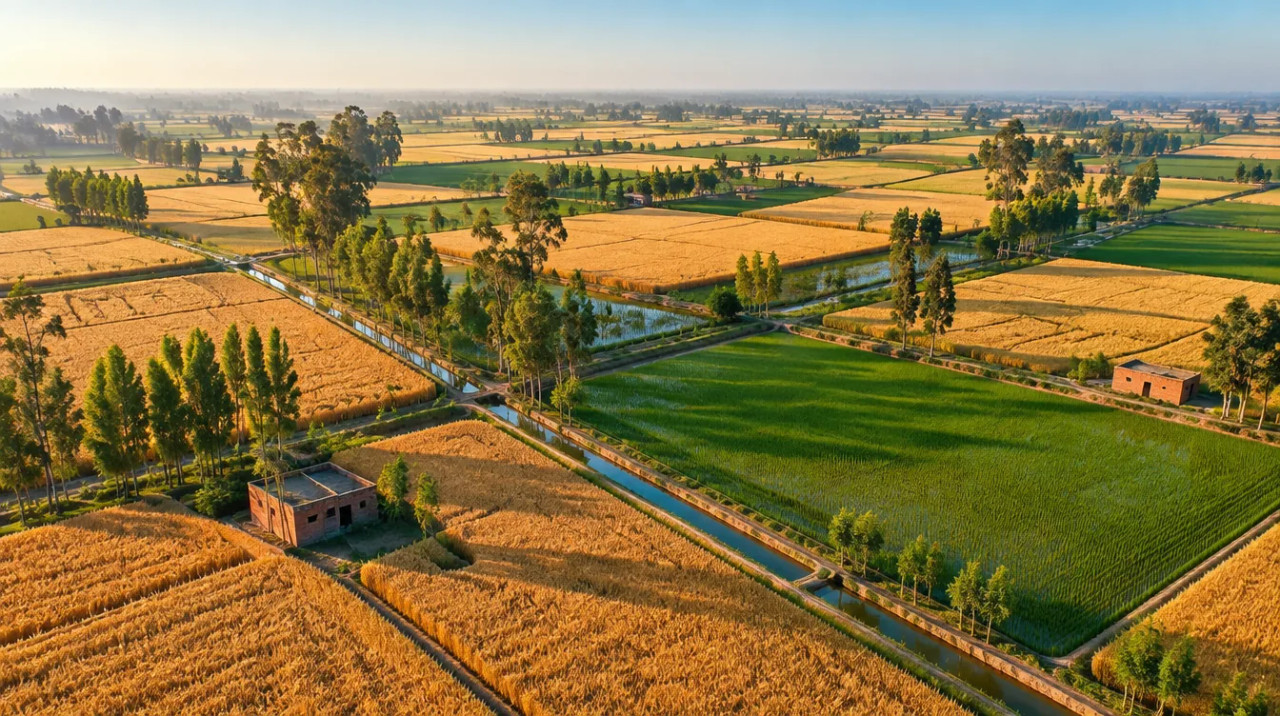
Canal-fed wheat and paddy land at Jind, Safidon and Narwana, with Delhi-facing rail, a hydrogen train and the new Katra expressway, with sourced rules and no listing prices.
2,702 sq km
Area
13,34,152
Population (Census 2011)
~145 km
Delhi by bus
5 of 8
Over-exploited blocks (HWRA, Mar 2024)
District land record — Jind
Rev. 2026 · Farmland India desk
State
Haryana
Tehsils
Jind · Julana · Narwana · Safidon (four tehsils in the CGWB profile; confirm the current list)
Key markets
Jind city · Narwana · Safidon · Julana
Demand anchors
Delhi-facing rail and road links · Katra Expressway · Jind–Sonipat hydrogen train · Wheat-paddy farming
Area and population
2,702 sq km · 13,34,152 people at the 2011 Census (Jind district portal, October 2026)
Delhi by public transport
~145 km by bus (district portal)
Railhead
Jind Junction (Delhi–Fazilka line; Panipat and Sonipat branch lines, per the district portal)
Local units
Killa = 1 acre · kanal = 605 sq yd · marla = 30.25 sq yd (local usage; check the jamabandi)
Land records portal
Online jamabandi nakal and mutation services, Haryana Revenue Department portal
Jind — district-specific notes
The state-level rules on the Haryana state page (CLU, ceiling limits, NRI purchase) apply to Jind in full. The notes below are specific to this district.
⚠ Jind is not among the ten districts on the Haryana Forest Department’s Punjab Land Preservation Act page (Panchkula, Ambala, Yamuna Nagar, Mewat, Gurgaon, Palwal, Faridabad, Mahindergarh, Rewari and Bhiwani; page opened October 2026, last updated April 2021). Under sections 4 and 5 of the Act the state can restrict clearing and tree-cutting in notified areas. The list is one departmental page, so ask the seller for written confirmation that the village is not notified.
⚠ Under section 7 of the Haryana Development and Regulation of Urban Areas Act, 1975 (PRS compilation, unofficial), plots in a colony cannot be transferred or advertised without a licence, and buildings other than for agriculture are restricted on land sub-divided for agriculture. A “plot” cut out of a Jind field and sold by registered sale deed alone is therefore a prompt to ask for the licence, the layout approval and the change-of-land-use order.
⚠ Ceiling limits still apply to farmland. Section 4 of the Haryana Ceiling on Land Holdings Act, 1972 sets the permissible area at 7.25 hectares for land under assured irrigation with two crops a year, 10.9 hectares for one crop, and 21.8 hectares for other land, with a 21.8-hectare overall cap. The ICAR-CRIDA plan records 213,000 ha of 235,000 ha net sown area as irrigated, so the irrigated-land limit is the one to check.
- No PLPA listing
- CLU via DTCP
- Plot licence check
- Ceiling Act 1972
District overview
Jind — a canal-fed wheat-paddy district on the Delhi–Fazilka rail line, now on the expressway map
Jind is a mid-Haryana district of 2,702 sq km with 13,34,152 people at the 2011 Census (district portal). The CGWB profile (2011 data) lists four tehsils, Narwana, Jind, Safidon and Julana, and seven blocks; the March 2024 groundwater notice names eight, including Ujhana, so the administrative list has changed and is worth confirming. The portal gives the road distance to New Delhi as 145 km by bus (127 km by train) and to Chandigarh as 195 km by bus (how to reach).
The land economy is farming. Net area sown is 2,350 sq km in the ICAR-CRIDA plan and 2,570 sq km in the CGWB profile, out of 2,702 sq km, and cropping intensity was 200% in 2008-09, so most fields carry two crops a year: wheat in winter, paddy or bajra in summer. The MSME-DI industrial profile (2010-11 data) counts 288 agro-based units among 1,156 units. This is a working-farm district, not a farmhouse land-banking belt like Sohna.
Buyers should think of Jind as Delhi-facing farmland with improving highways. On 17 July 2026 the first five packages of the Delhi–Amritsar–Katra Expressway were inaugurated at an event in Jind (Swarajya), India’s first hydrogen train was flagged off on the Jind–Sonipat line, and the 40.6 km Jind–Gohana highway (NH-352A) was listed among the projects unveiled (ThePrint; Business Standard). Neither report says whether the highway is open to traffic, so confirm with NHAI. For the state-level legal and buying rules, read our Haryana agricultural land rules guide, and compare the neighbouring wheat-rice district of Sonipat — Kishora village (agricultural).
- Jind City
- Narwana
- Safidon
- Julana
- Jind Junction
- Delhi–Amritsar–Katra Expressway

Transaction costs
Stamp duty & registration in Jind
7%
Stamp duty — male buyer
includes a 2% development fee (reported Aug 2025)
5%
Stamp duty — female buyer
reported Aug 2025
Confirm
Rural and agricultural rates
no official schedule opened; ask the Sub-Registrar
The only duty figures we could source are the urban pair. The Tribune, 28 August 2025 reported a Haryana government statement that sale-deed duty has stayed at 7% for men (including a 2% development fee) and 5% for women since 2008, and that no duty applies to residential plots of up to 50 sq yd in urban areas and 100 sq yd in rural areas allotted under three housing schemes. We opened no official rate schedule and found no sourced rural or agricultural rate or registration fee, so none is quoted; get both from the Sub-Registrar before you sign. The Tribune reported in April 2025 that 2025-26 registrations would continue on the previous collector rates after a December 2024 revision (The Tribune, 11 April 2025), and in March 2026 that statewide rates would rise by up to 75% from 1 April (The Tribune, 29 March 2026; that article names no Jind village). We found no Jind village rate, so none is quoted; confirm which rate applies on the date of your deed.
Know the belt
What is moving prices in Jind
No sourced land-price series was found for Jind, so these cards give what is known about each belt: water category, access and what to check.
Safidon
No sourced price series
Safidon is one of five blocks listed as over-exploited in the March 2024 groundwater notice. The 2011 CGWB profile also records arsenic above the limit at Safidon (0.013 mg/l).
Check: borewell depth and yield, and a water test.
Narwana
No sourced price series
Narwana and Julana are the two blocks listed as Safe in March 2024 (HWRA notice), although the 2011 CGWB profile had Narwana over-exploited at 124%. The category has moved, so the method or the water has changed.
Check: the current block category in writing, and title history.
Jind-tehsil villages
No sourced price series
No dated, sourced per-acre figure was found for villages around Jind city. Asking prices that could not be traced to a deed or an official rate were set aside.
Check: registered comparables for the village, road frontage and whether a layout is approved.
Collector rates
Not quoted
Agricultural collector rates in Haryana are set per acre by village and land category, and tehsil files are hosted on the Urban Local Bodies portal. The Tribune reported that 2025-26 registrations would continue on the previous rates after a December 2024 revision (April 2025), and named Jind among districts with technical delays as new rates took effect on 1 August 2025 (The Tribune, 2 August 2025).
Check: the village rate with the tehsil office, and which rate applies on the deed date.
Connectivity
How Jind connects — Delhi by rail and road, with new links
Jind's buyers look to Delhi, the nearest large metro market by public transport and the one the rail line serves. Distances are from the district portal; drive times were not sourced.
By road from Delhi and Chandigarh
By air
By rail
Delhi is the buyer geography here because the rail line and the new expressway both point that way. The reports of the July 2026 opening (Swarajya) do not name the Haryana stretches, so confirm with NHAI which sections near a parcel are open. State rules: Haryana agricultural land rules guide.
Growth catalysts
Upcoming infrastructure & developments
Status labels reflect sources opened in October 2026. Announced timelines are not guaranteed; items marked confirm rest on one source or an old one.
02Operational
04Pipeline or to confirm
Agriculture & terrain
Soil, water & industry in Jind
Jind is a canal-and-tubewell plain with sandy soils. Water, not soil, is the main question for a buyer, and it differs block by block.
🌾 Cropped area (district)
In 2008-09 the ICAR-CRIDA district plan recorded wheat on 213,000 ha, paddy on 93,700 ha, bajra on 54,000 ha, cotton on 45,800 ha and mustard on 5,900 ha. Cropping intensity was 200%, so most fields carry two crops a year. Net sown area is 2,350 sq km (CRIDA) or 2,570 sq km (CGWB) out of 2,702 sq km.
- Wheat
- Paddy
- Bajra
- Cotton
🧂 Soils
The CGWB profile describes the soils as sandy, kallar (rehi) and sierozem; kallar is the local name for salt-affected soil, so ask for a soil test on any parcel you plan to crop. Village-level test results are published under the national Soil Health Card scheme.
- Sandy Loam
- Kallar
- Sierozem
🏭 Agro-industry and minerals
The MSME-DI industrial profile (2010-11 data) counts 1,156 units, of which 288 are agro-based, and reports mineral production as nil because mining has been banned since 2010 under a High Court order. Quarry-lease questions are therefore less likely than in Aravalli districts, but the profile is dated.
- Agro-based Units
- No Mining
💧 Water & rainfall
Normal rainfall is 487 mm (ICAR-CRIDA) or 434 to 515 mm (CGWB), with most of it in June to September. In 2008-09 canals irrigated 59% of the net irrigated area and tubewells 41%. The Haryana Water Resources Authority notice (as on 31 March 2024) lists Alewa, Uchana, Ujhana, Safidon and Jind blocks as over-exploited, Pillukhera as semi-critical, and Julana and Narwana as safe. The 2011 CGWB data had Alewa, Narwana and Safidon over-exploited (114%, 124%, 109%), Jind critical (91%) and the district at 99%, and recorded fluoride above limits at seven sampled locations and arsenic at three. The CGWB 2024 Haryana report lists the district for electrical conductivity, fluoride, nitrate and uranium exceedances, and puts Haryana as a whole at 135.96% extraction.
🌾 Mandi price reference
Wholesale prices for Jind-district markets are published daily on the national Agmarknet portal. Compare the Narwana and Jind markets for wheat and paddy before assuming a crop-income case, and price a parcel on its location, water and use.
📐 Measurement units
Haryana land units: 1 killa = 1 acre; 1 kanal = 605 sq yd; 1 marla = 30.25 sq yd (local usage). Convert every quote to acres or sq yd before comparing two offers, and take the area from the khasra entry in the jamabandi.
At a glance
Jind and reference points
| District / belt | Collector rate* (per acre) | Evidence |
|---|---|---|
| Jind — all tehsils | No sourced price series | No Jind village rate was read |
| Kaithal — Kalayat tehsil (irrigated) | ₹19 lakh to ₹31.05 lakh | 2026 final rates (ULB Haryana portal PDF) |
| Kurukshetra — Shahabad tehsil (irrigated, sample villages) | ₹30 lakh to ₹43.75 lakh | Draft 2026 rates (ULB Haryana portal PDF) |
| Karnal | ₹1.43 crore to ₹2.5 crore | Proposed 2026-27 rate (The Tribune, 29 Mar 2026) |
*Collector rates are the government’s minimum land values, not market prices, and these rows come from different districts, dates and land categories, so they are not like-for-like. Per acre.
Farmland India view
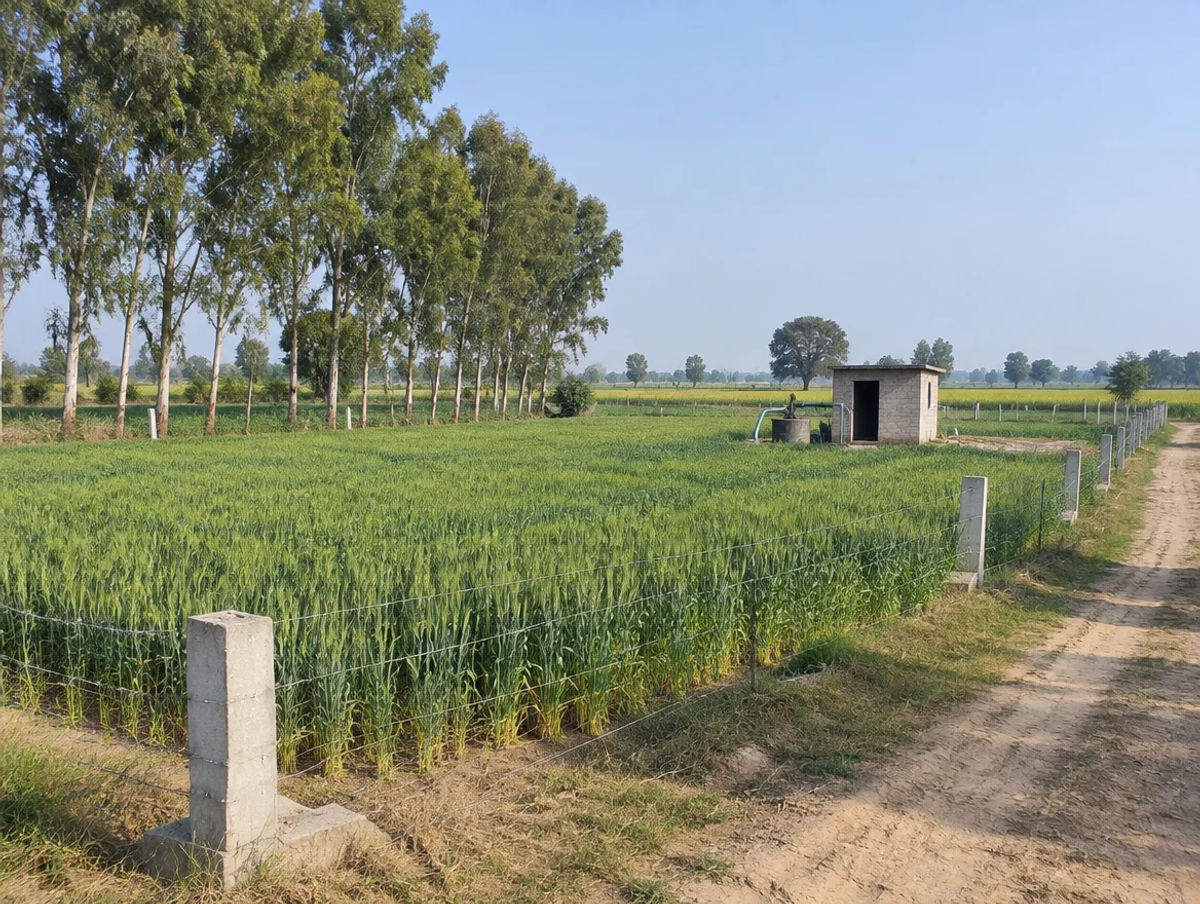
Why investors look at Jind
Five reasoned points, with a plain note that no Jind land-price series was sourced and several catalysts are only just open.
Working two-crop farmland
Cropping intensity of 200%, canal and tubewell irrigation and an agro-based industry base make Jind a district where land is bought for what it grows, not only for where it is (ICAR-CRIDA and MSME-DI data, about 2008-11).
Rail and expressway both opened in July 2026
The Jind–Sonipat hydrogen train began passenger service on 19 July 2026 and the first five Katra expressway packages opened on 17 July. Jind Junction on the Delhi–Fazilka line was already the Delhi link. Treat the new services as a bonus, not a price driver, until ridership and open stretches are clear.
Collector rates sit far below the NCR belt
The only sourced rates nearby are Kaithal’s Kalayat tehsil at ₹19 lakh to ₹31.05 lakh per acre for irrigated land (2026 final collector rates) and Kurukshetra’s Shahabad tehsil at ₹30 lakh to ₹43.75 lakh in a draft sample, against ₹1.43 crore to ₹2.5 crore for a Sonipat village. We read no Jind rate, so this is a pointer to check, not a conclusion.
Water favours some blocks over others
Julana and Narwana were listed as Safe at 31 March 2024, while five other blocks are over-exploited. A buyer who needs a borewell has a clear reason to shortlist by block.
Highway pipeline adds options
The Jind–Gohana highway was unveiled in July 2026 with its status to confirm, and a Jind–Hansi rail link is proposed. Neither has a published completion date, so they are options on future access rather than reasons to pay more today.
Confirm CLU status, water availability and the exact kanal-marla area directly; these are not certified by Farmland India's review.
STRAIGHT TALK
Risks & challenges in Jind
Read these before shortlisting in Jind specifically.
Groundwater over-exploitation
Five of Jind’s eight listed blocks are over-exploited as on 31 March 2024. Check the block and the borewell depth and yield before assuming irrigation for a new orchard or farm.
Sources disagree on water status
The 2011 CGWB data had Alewa, Narwana and Safidon over-exploited and Jind critical, while the March 2024 notice lists Narwana as safe and Jind as over-exploited. Confirm the current block category in writing.
No sourced price series
We found no dated price series for Jind land. Do not anchor to a seller’s figure; collect registered comparables and ask the tehsil for the village collector rate.
Change of land use for non-farm use
Rural land is not automatically buildable. Any farmhouse, resort or commercial use needs CLU from DTCP as described on the Haryana state page, and a licence check applies to plotted sales.
Announced is not delivered
The Jind–Gohana highway’s status is unclear from the reports, the Hansi–Barwala upgrade has only a foundation stone, the Jind–Hansi rail link is a proposal, and the expressway is open only in sections. Price on today’s access.
Salt-affected soils
CGWB lists kallar (rehi) soils in the district. A parcel that looks flat and cheap may have poor yields, so ask for a soil test before paying for farming potential.
Record and boundary details
The 2011 CGWB profile lists four tehsils and seven blocks, and the 2024 groundwater notice names eight blocks, including Ujhana. Confirm the tehsil, block and sub-registrar for your parcel.
Who to contact
Local revenue & registration offices
CLU applications route through the Directorate of Town and Country Planning (DTCP) (tcpharyana.gov.in). Mutation and revenue-record matters go through the Tehsildar of the relevant tehsil (Jind, Julana, Narwana or Safidon in the CGWB list), and sale-deed registration is handled by the local Sub-Registrar. Land records and jamabandi extracts are served through the Haryana Revenue Department portal, and general district information is on the Jind district portal.
KEEP EXPLORING
Explore more areas
Other districts in Haryana
Guides & research
- Stamp Duty Calculator Haryana: Land Cost Method (2026)Wiki · P11 Taxation, Stamp Duty & Registration
- Circle Rate Gurgaon: Collector Rate Lookup (2026)Wiki · P11 Taxation, Stamp Duty & Registration
- Circle Rate Faridabad: Collector Rate Lookup (2026)Wiki · P11 Taxation, Stamp Duty & Registration
- Land Ceiling in Haryana: 1972 Act Explained (2026)Wiki · P05 Agricultural Land Rules
- Stamp Duty Haryana: Land Registry Charges (2026)Wiki · P11 Taxation, Stamp Duty & Registration
- Mutation Status Haryana: How to Check Online (2026)Wiki · P02 Land Records & Documentation
- Fard Haryana: What It Is and How to Get One (2026)Wiki · P02 Land Records & Documentation
- Bhu Naksha Haryana: View Land Map Online (2026 Guide)Wiki · P02 Land Records & Documentation
COMMON QUESTIONS
Frequently asked questions
Everything buyers, NRIs and investors ask before their first reviewed farmland purchase in Jind.
Visit full wiki01 of 04
What does land cost in Jind?
We found no sourced price series for Jind, and listing-portal asking prices are not used. Collector rates are set per village and land category; the tehsil files are hosted on the Haryana Urban Local Bodies portal, but we read no Jind village rate. Ask the tehsil for the rate and the Sub-Registrar for registered deeds nearby.
02 of 04
Which Jind blocks have groundwater problems?
The Haryana Water Resources Authority notice (as on 31 March 2024) lists Alewa, Uchana, Ujhana, Safidon and Jind as over-exploited, Pillukhera as semi-critical, and Julana and Narwana as safe. Confirm the block category in writing and test the borewell on the parcel.
03 of 04
Has the Jind-Gohana highway opened?
The 40.6 km Jind-Gohana highway (NH-352A) was listed among the projects unveiled on 17 July 2026 (ThePrint, Business Standard). The reports do not say whether it is open to traffic or was only launched, so confirm with NHAI.
04 of 04
How is Jind connected to Delhi?
The district portal gives about 145 km by bus and 127 km by train to New Delhi, with Jind Junction on the Delhi-Fazilka line. The first five Delhi-Amritsar-Katra packages opened on 17 July 2026 and a hydrogen train began running to Sonipat on 19 July 2026 (Free Press Journal); check which sections and timings apply to you.
Ready to look at what is available?
Browse reviewed listingsTransparency
Sources and references
Law and courts
- Haryana Ceiling on Land Holdings Act, 1972 (s. 4), India Code
- Haryana Development and Regulation of Urban Areas Act, 1975 (s. 7), PRS Legislative Research compilation, opened October 2026
- Haryana Land Preservation Act, 1900 (ss. 4, 5), India Code
- Foreign Exchange Management (Acquisition and Transfer of Immovable Property in India) Regulations, 2018, Reserve Bank of India
Government
- Jind district portal (area, population), opened October 2026
- How to reach Jind (distances, rail, airports), Jind district portal, opened October 2026
- Punjab Land Preservation Act districts, Haryana Forest Department, opened October 2026
- Ground Water Information Booklet, Jind district, CGWB (2013, data to 2011)
- District agriculture contingency plan, Jind, ICAR-CRIDA (2011)
- Brief industrial profile of Jind district, MSME-DI (2010-11 data)
- Public notice: block-wise groundwater categorisation as on 31 March 2024, Haryana Water Resources Authority
- Dynamic Ground Water Resources and Ground Water Quality of Haryana, 2024, CGWB
- Jind–Hansi new railway line, Haryana Rail Infrastructure Development Corporation (undated)
- Final collector rates 2026, Kalayat tehsil, Kaithal, Urban Local Bodies Haryana portal (printed 31 Mar 2026)
- Draft predictive collector rates 2026, Shahabad tehsil, Kurukshetra, Urban Local Bodies Haryana portal (March 2026)
- Haryana Revenue Department portal (Jamabandi Nakal, Mutation), opened October 2026
- Haryana Town and Country Planning Department, opened October 2026
News
- Delhi–Katra Expressway advances as PM inaugurates 157.92 km stretch, Swarajya, 17 Jul 2026
- PM Modi lays foundation stone, dedicates projects worth Rs 14,700 crore in Jind, ThePrint, 17 Jul 2026
- PM Modi unveils development projects worth Rs 14,700 crore in Haryana, Business Standard, 17 Jul 2026
- India’s first hydrogen train begins passenger service, Free Press Journal, 18 Jul 2026
- NH-152D under trial run, The Tribune, 31 Jul 2022
- Noida to begin commercial flight operations from June 15, ETV Bharat, 15 Jun 2026
- Stamp duty waived on 50 sq yd urban, 100 sq yd rural plots, The Tribune, 28 Aug 2025
- Revision of collector rates put off for now, The Tribune, 11 Apr 2025
- 83 tehsils across 16 districts yet to implement new collector rates, The Tribune, 2 Aug 2025
- Haryana hikes collector rates by up to 75%, The Tribune, 29 Mar 2026
Further reading
- How to reach Kaithal (Narwana and Jind rail service), Kaithal district portal
- Haryana’s 60.48% groundwater over-exploited, The Tribune, 8 Jan 2025
- Haryana okays eco-friendly farmhouses near urban areas, The Tribune, 2021
- Haryana Urban Local Bodies portal (hosts collector-rate PDFs), opened October 2026
- Ground Water Information Booklet, Jhajjar district, CGWB (2013)
- Ground Water Information Booklet, Kaithal district, CGWB (2013)
- Ground Water Information Booklet, Kurukshetra district, CGWB (2013)
- District agriculture contingency plan, Jhajjar, ICAR-CRIDA (2011)
- District agriculture contingency plan, Kaithal, ICAR-CRIDA (2011)
- District agriculture contingency plan, Kurukshetra, ICAR-CRIDA (2011)
Data-currency note: census figures are from 2011, the most recent full Census. ICAR-CRIDA and CGWB agricultural and water figures date from about 2008 to 2011; groundwater block categories are as on 31 March 2024; infrastructure statuses were read in October 2026 and change quickly. No official stamp-duty schedule or Jind village collector rate was read. This is a general guide, not legal advice. Report inaccuracies to wiki@farmlandindia.com.
For developers
Ready to explore Jind farmland?
Browse reviewed projects and individual land parcels across Jind — or if you own land here, list it with platform review and reach serious buyers.