
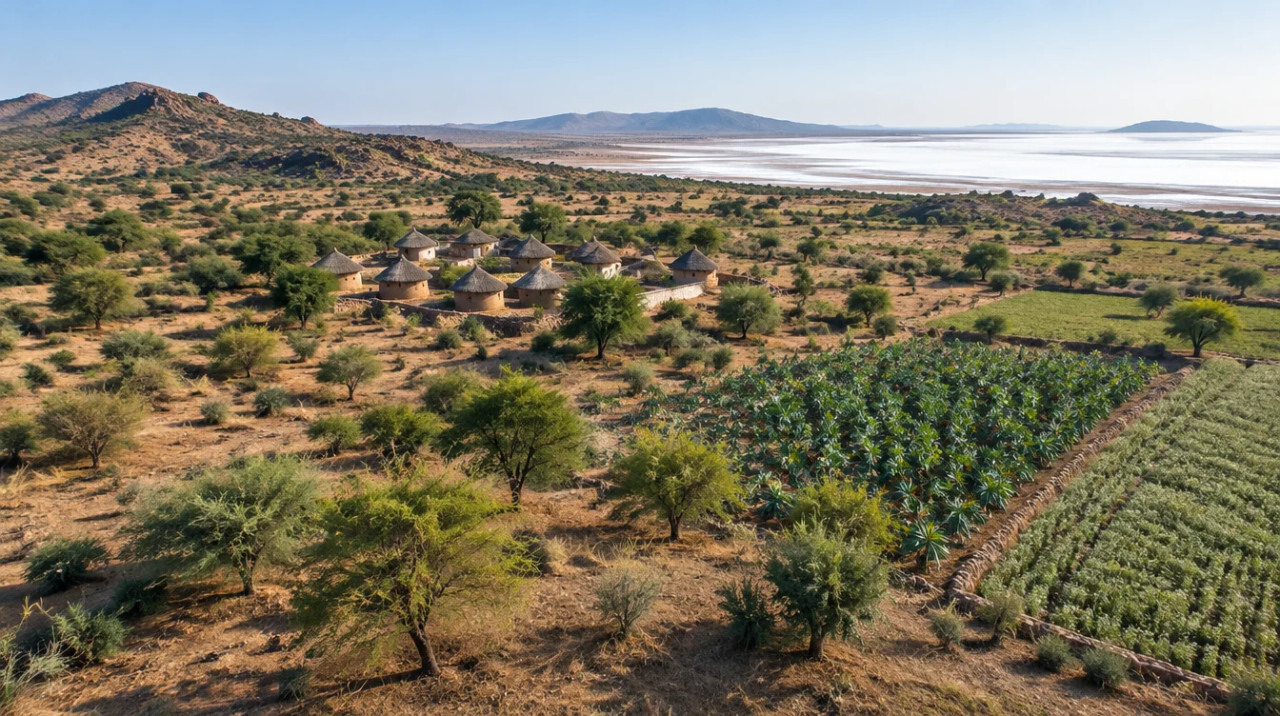
District guide
Buying Land in Kutch
A dry border district of ports, salt, minerals and solar land: farmer-status, border and coastal checks, drought and saline groundwater, and rail and road works still in progress.
45,652 sq km
Area (CGWB brochure)
20.9 lakh
Population (Census 2011)
378.2 mm
Normal rainfall at Bhuj
61%
Rainfall deficit to 7 Sep 2026
*Indicative range across districts and land types. Stamp duty, registration and conversion charges are additional. Local measurement units vary — every listing states the unit it is priced in. Not a valuation or an offer.
District land record — Kutch
Rev. 2026 · Farmland India desk
State
Gujarat
Sub-divisions
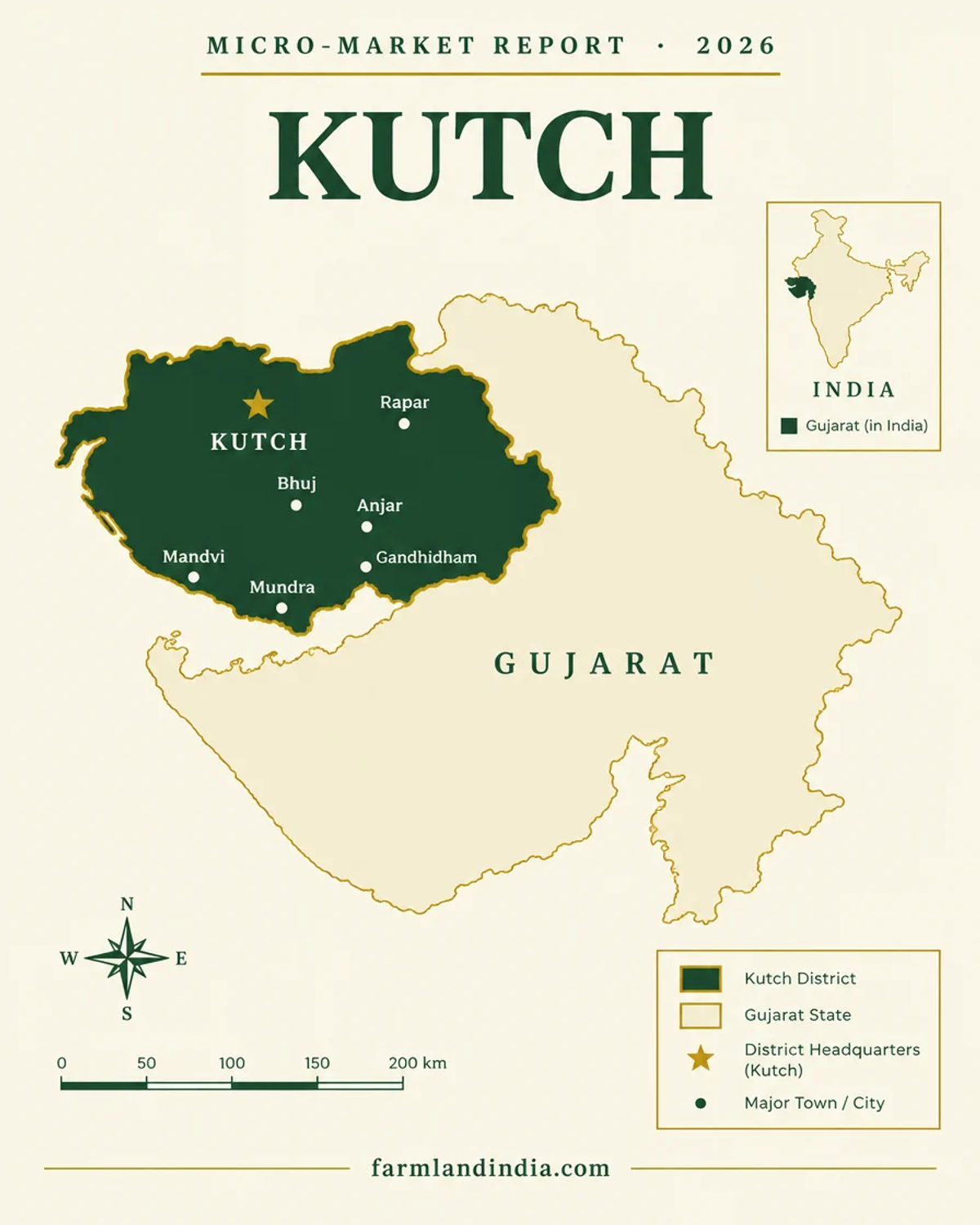
Ten talukas: Bhuj (district seat), Mundra, Mandvi, Abdasa, Lakhpat, Nakhatrana, Rapar, Bhachau, Anjar and Gandhidham (CGWB Kachchh brochure, 2013; the district industrial profile text says nine besides Bhuj but names only eight and omits Nakhatrana, and a September 2025 state decision created 17 talukas elsewhere without naming Kutch, per The Week)
Key markets
Bhuj · Gandhidham · Anjar · Bhachau · Mundra · Mandvi
Demand anchors
Ports at Kandla and Mundra · Khavda renewable-energy cluster · Gandhidham–Adipur rail quadrupling · Kandla–Mundra highway six-laning listed · Narmada water not yet released for Kutch (Sep 2026)
Rail
Gandhidham–Adipur quadrupling complete, speed trials begun (DeshGujarat, March 2026)
Size and population
45,652 sq km · 20,90,313 people at Census 2011, about 46 per sq km, with 8 towns (CGWB Kachchh brochure, 2013)
Pricing unit
₹/vigha or ₹/guntha for farmland (no sourced price series)
Local units
Guntha = 1,089 sq ft · 40 gunthas = 1 acre · vigha varies by region, no official conversion found
Land records portal
AnyROR (not opened for this page; check records there)
Land law is state law. These rules are maintained on the Gujarat page and apply to every district within it.
Kutch — land purchase legal rules
Agricultural land in Gujarat can generally be bought only by an agriculturist, and farmer status is checked before a sale entry is certified. The other main checks are tenure (old or new), NA permission, the fragmentation limit and whether the area is notified under the Disturbed Areas Act.
Who can buy agricultural land? Section 63 of the Gujarat Tenancy and Agricultural Lands Act, 1948 is headed “Transfers to non-agriculturist barred”, and section 2(2) defines an agriculturist as a person who cultivates land personally. A commentary on the Supreme Court appeal Vinodchandra Sakarlal Kapadia v State of Gujarat (Civil Appeal 2573 of 2020) reports that the Gujarat High Court read section 63 to bar a transfer by an agriculturist to a non-agriculturist without the Collector’s permission, including by will (Mondaq, April 2021). Farmer status is checked from revenue records back to a cut-off of 6 April 1995, under Revenue Department circulars of 13 September 2024, and a self-declaration form goes with a sale entry or an NA application (SCC Online, September 2024). We read section 63 through these summaries, not its full text; confirm with a Gujarat revenue lawyer.
Will non-farmers be allowed to buy? A committee chaired by C. L. Meena studied the tenancy laws and its suggestions on non-farmer purchase were being assessed in November 2024, with no decision announced (Gujarat Samachar, November 2024; Gujarat Samachar, November 2024). We found no enacted change by October 2026, so the section 63 rule above is the one to plan on.
Ceiling limits: the Gujarat Agricultural Lands Ceiling Act, 1960 (Gujarat Act 27 of 1961, amendments compiled by PRS Legislative Research) bars a person from holding land above the ceiling area. Land of a spouse and minor children is grouped with the holder, a family of more than five may hold one-fifth of the ceiling area for each extra member up to twice the ceiling, and each major son counts as a separate person; in desert, hill and drought-prone areas the dry-crop ceiling is raised by 12.5% but cannot pass 21.85 hectares (54 acres). These points come from a legal-database copy of the Act that we do not link, because the India Code page did not open here; the class-wise acreage in Schedule I was not in the text we read, so we show no per-class figure.
Tenure, premium and NA permission: section 43 of the Tenancy Act is headed “Restriction on transfers of land purchased or sold under this Act”, which is the basis of what the press calls new tenure land, and the Collector’s office grants permission and collects a premium under it (Surat Collectorate). A government notification of 8 February 2024 lets a tenant who has farmed land for more than 15 years move it from new tenure to old tenure without a conversion fee, but the premium for NA use is still payable (LiveLaw, April 2025). NA (non-agricultural) permission is granted under section 65 of the Gujarat Land Revenue Code, 1879, and is deemed granted if the Collector does not decide within three months (same source); applications have been online since a December 2018 circular (SCC Online, September 2024). Press reports put the NA premium at about 35 to 40 per cent of land value (Gujarat Samachar, March 2024); we found no official schedule. The 2008 resolution on NA procedure also lists distance limits from railways, airports and Air Force installations (900 m) and from the sea high-tide line (500 m) (Revenue Department resolution, July 2008), which later circulars may have changed.
Fragmentation (tukda) limit: the Assembly passed the Gujarat Prevention of Fragmentation and Consolidation of Holdings (Amendment) Bill on 11 September 2026. As reported, it sets a uniform standard area of 10 gunthas (1,012 sq m) for rural land under a new section 5(4), leaves out municipal and urban development authority areas, and regularises violations from 1948 to 31 March 2026 without penalty; before this, buyers paid 10% of jantri value (DeshGujarat, September 2026). We did not see the Act text or any filing deadline.
Industrial and institutional exceptions: sections 63AA and 63AAA allow land bought for industrial, education or health use to be resold on payment of a share of jantri value that falls with the holding period, from 100% at three to five years to 25% beyond ten years (Gujarat Bill 23 of 2020, PRS Legislative Research). We have the Bill, not the enacted Act. A charity that bought in breach before 30 June 2015 may apply for conversion within a period the State notifies (Gujarat Bill 1 of 2024, PRS Legislative Research).
Disturbed Areas Act, 1991: where the State has notified an area under section 3, a transfer of land or buildings there needs the Collector’s prior sanction after an inquiry into free consent and fair value, and a transfer without it is void under section 5; contravention carries imprisonment of three to five years under section 6D (Gujarat Act 12 of 1991, PRS Legislative Research). A 2026 amendment renames these “specified areas”, adds a Monitoring and Advisory Committee and extends the Collector’s checks (Bill 18 of 2026; DeshGujarat, March 2026); the government notified the amendment in July 2026, with the effective date to be notified separately (DeshGujarat, July 2026). As a due-diligence step, ask the Collector or Sub-Registrar whether the survey number lies in a notified area; we hold no list of notified areas.
Land Grabbing Act, 2020 and tribal land: the Gujarat Land Grabbing (Prohibition) Act, 2020 works through district committees, and in December 2024 a Gujarat High Court bench issued guidelines for those committees (LiveLaw, December 2024). Land held by Scheduled Tribe occupants is separately restricted under section 73AA of the Land Revenue Code, which the 2020 Bill cross-refers to (PRS Legislative Research); we did not open the Code, so check the occupant’s status in the 7/12.
NRI & OCI buyers: regulation 3 of the Foreign Exchange Management (Acquisition and Transfer of Immovable Property in India) Regulations, 2018 lets NRIs and OCIs buy land other than agricultural land, a farm house or plantation property (Reserve Bank of India, 2018 regulations). Residential and commercial land is open to them. The same section 63 rule applies to a resident non-farmer.
- Agriculturists only (s.63)
- Ceiling Act 1960
- NA via s.65
- Fragmentation: 10 gunthas
- Disturbed Areas Act
- NRI agri: barred (RBI 2018)
- 7/12 via AnyROR
Kutch — district-specific notes
The Gujarat state page applies to Kutch in full. The notes below are specific to this district. Law was read from the 1948 Tenancy Act headings, PRS Act texts and news reports. The Kutch district portal refused automated access, and the Revenue Department, AnyROR and gARVI portals did not open for us.
⚠ Farmer status decides who can buy agricultural land. Section 63 of the Gujarat Tenancy and Agricultural Lands Act, 1948 is headed "Transfers to non-agriculturist barred" (India Code), and farmer verification runs through revenue records to 6 April 1995 (SCC Online, September 2024). A reform to let non-farmers buy was reported under review in November 2024 and we found nothing enacted by October 2026 (Gujarat Samachar, November 2024). Ask for the seller's farmer evidence and the NA order, not a broker's summary.
⚠ Kutch borders Pakistan and has a long coast, but we found no published rule on who may buy agricultural land in border or coastal talukas, and no Coastal Regulation Zone limit for named Kutch villages. The 2008 Revenue Department resolution on NA permission lists limits of 900 m from a railway, airport or air force station and 500 m from the high-tide line, and it may since have been superseded (Revenue Department GR, July 2008). For any parcel near the border, the coast, a port or a defence site, ask the Collector in writing what permissions apply before paying a deposit.
⚠ Holdings are capped by the Gujarat Agricultural Lands Ceiling Act, 1960: family land is grouped, and extra family members add one-fifth each up to twice the ceiling (Act 27 of 1961, PRS copy). The state page reports that in desert, hill and drought-prone areas the dry-crop ceiling is raised by 12.5% but cannot pass 21.85 hectares (54 acres); the text for that point is a legal-database copy we do not link, and we do not know which Kutch talukas, if any, are so classed, so confirm the ceiling that applies. A 10-guntha rural standard area under the fragmentation amendment reported as passed on 11 September 2026 applies outside urban and development-authority areas (DeshGujarat, September 2026); we have not seen the Act text.
⚠ Power-line and renewable-energy works touch private land. DeshGujarat reported farmer protests over transmission lines in Kutch and Saurashtra in January 2026 (DeshGujarat, January 2026), and in July 2026 the state revised compensation for farmland under lines and towers, scrapping the three-instalment payment for full payment before work and letting landowners on projects still under way claim the new rates (National Herald, July 2026). We found no published rule on private-land sales for solar parks, so ask for any acquisition, lease or right-of-way entry on the 7/12 record before buying.
⚠ The Disturbed Areas Act, 1991 lets the State notify areas where a transfer needs the Collector's prior sanction, with the transfer void without it (Disturbed Areas Act (PRS copy)). A 2026 amendment renames them "specified areas" and was notified in July 2026, with the effective date to be notified separately (DeshGujarat, July 2026). We obtained no list of notified areas and do not name any, so ask the Collector or Sub-Registrar whether the survey number falls in one.
Read the full Gujarat land buying guide for buyer eligibility, NA permission, stamp duty and NRI rules.
- Section 63 farmer status
- Border and coast checks
- Transmission-line compensation
- Disturbed Areas Act
District overview
Kutch — a dry-land border district of ports, salt, minerals and a renewable-energy cluster
Kutch is the district of western Gujarat with its seat at Bhuj, covering 45,652 sq km and 20,90,313 people at Census 2011, about 46 per sq km, in ten talukas and eight towns (CGWB Kachchh brochure, 2013). It includes a stretch of the Rann, a marshy salt and mud flat of roughly 25,000 to 26,000 sq km where groundwater is brine (same booklet). Kutch is also the main source of Gujarat's salt, over 60% by the district industrial profile, and of a large share of its minerals (about 75% by the same profile, using 2010-11 output) (MSME district profile).
We publish no per-vigha or per-acre band for Kutch. No district or village jantri schedule could be opened, and listing-site asking prices could not be traced to registered deals. The only official reference is the statewide jantri, reported doubled from 15 April 2023 (DeshGujarat, February 2023), with a revised draft pending in November 2024 (The Secretariat, November 2024). A jantri is a registration floor, not a market price.
Farming here is dry-land farming. Bhuj averages 378.2 mm of rain a year (CGWB Kachchh brochure, 2013), and to 7 September 2026 Kutch had received 61% less than normal, with Abdasa at 10.28% of its normal (Down To Earth, September 2026). Water, border and coastal permissions, and the renewable-energy and port economy shape land here more than crop yield does.
- Bhuj
- Gandhidham
- Anjar
- Mundra
- Mandvi
- Rann of Kutch
Transaction costs
Stamp duty & registration in Kutch
4.9%
Stamp duty on a conveyance deed
CAG audit for the year ended 31 Mar 2018; current rate to confirm
Not sourced
Registration fee on land deeds
no rate found; ask the Sub-Registrar
2x
Jantri doubled from 15 Apr 2023
reported statewide; no Kutch schedule opened
The Comptroller and Auditor General's audit for the year ended 31 March 2018 states stamp duty on a conveyance deed at 4.9% of the greater of consideration and market value, and gives no registration-fee rate for conveyances (CAG, Report 3 of 2019). Jantri rates were reported doubled from 15 April 2023 after about twelve years (DeshGujarat, February 2023), and a revised draft was reported pending in November 2024 (The Secretariat, November 2024). Registration runs through gARVI 2.0 across 294 Sub-Registrar offices (Inspector General of Registration summary); we could not open the portal (gARVI), so we quote no women's concession and no Kutch guideline value. Ask the Sub-Registrar for the duty, fee and jantri on your survey number.
Know the belt
What is moving prices in Kutch
Official numbers are statewide and partial: a doubled jantri, a solar unit and a drought year. No district price series and no listing-site prices are used.
Statewide jantri
Doubled from 15 Apr 2023 (reported)
The state doubled jantri rates from 15 April 2023 after about twelve years (DeshGujarat, February 2023). A revised draft for agricultural land was reported pending in November 2024 (The Secretariat, November 2024). We opened no Kutch taluka schedule, so we cannot say how any Kutch taluka compares.
Check: the jantri for your survey number at the Sub-Registrar office; drafts may not be in force.
Power lines and solar land
Compensation revised, Jul 2026
A 165 MW solar unit was reported commissioned at Khavda (DeshGujarat, March 2026), and farmers protested transmission lines in Kutch and Saurashtra (DeshGujarat, January 2026). The July 2026 compensation revision is statewide (National Herald, July 2026). We found no land price for the Khavda area.
Check: any lease, right-of-way or acquisition entry on the 7/12 record and which taluka the village sits in.
Water stress
Rainfall 61% below normal to 7 Sep 2026
Kutch's 20 reservoirs held 23.79% of capacity on 7 September 2026, and no Narmada release for Kutch itself was reported (Down To Earth, September 2026). A parcel with a working well or canal access is a different asset from one without.
Check: borewell depth, salinity and any canal or pipeline access in writing.
Asking prices
No sourced price series
Listing-site asking prices for Kutch could not be traced to registered deals, so none are shown. The jantri is the only official reference and it is a floor for registration, not what a seller will accept.
Check: registered sale deeds in the same village before negotiating.
Units: guntha, acre and vigha
Gujarat land is recorded in gunthas and acres: a guntha is about 101 sq m (1,089 sq ft), 10 gunthas are 1,012 sq m, and 40 gunthas make an acre. The vigha varies by region and we found no official conversion for Kutch, so ask for the area in square metres from the 7/12 extract and convert any vigha quote to that before comparing offers.
Connectivity
How Kutch connects — road, rail and air
Distances from Kutch towns to Ahmedabad and other cities are not given because no official or news source was found. Journey times vary with traffic and road works.
By road
By sea & air
By rail
The road lengths are 2010-11 figures from the district industrial profile and are out of date; the rail and highway items come from one DeshGujarat round-up. Full Gujarat rules for buyers from outside the state: Gujarat agricultural land rules. Sources: DeshGujarat, March 2026; DeshGujarat, January 2026; MSME district profile.
Growth catalysts
Upcoming infrastructure & developments
Status labels reflect sources read in October 2026. Government-announced timelines are not guaranteed; items marked confirm have a single or an older source.
02Open or inaugurated
04In progress or pending
Agriculture & terrain
Soil, crops & water in Kutch
A dry, semi-arid district of black and sandy soils, rainfed castor and bajra, a saline coast and the Rann, where water decides what a parcel is worth.
🌾 Mainland plains (Bhuj, Anjar, Bhachau, Nakhatrana, Rapar)
The CGWB brochure lists shallow black soils, residual sandy soils, coastal alluvial soils and desert soils, with bajra, greengram, castor, groundnut, cotton and mothbean in kharif and wheat in rabi. It gives net irrigated area as 107, gross irrigated 341.2 and rainfed 502 thousand hectares, and land use of 1,958 thousand hectares in all, of which 680 cultivable and 307 forest (CGWB Kachchh brochure, 2013). Kutch is among the top castor districts of Gujarat (DESAGRI castor report) and the Kesar mango GI also covers Kutch (ThePrint, July 2024).
- Castor
- Bajra
- Groundnut
- Cotton
- Kesar mango
🌊 Coastal belt (Mundra, Mandvi, Abdasa, Lakhpat)
The coast carries ports, salt and industry: salt is over 60% of Gujarat output by the district industrial profile, and about 60% of the district holds native saline groundwater (MSME district profile; CGWB Kachchh brochure, 2013). Abdasa received only 10.28% of normal rain to 7 September 2026 (Down To Earth, September 2026). The 2008 resolution lists a 500 m limit from the high-tide line for NA permission (Revenue Department GR), which may be superseded, so ask for the parcel's coastal status in writing.
- Salt
- Ports
- Saline water
- Coastal alluvium
🏜️ Rann and desert land
The Rann is a marshy salt and mud flat of roughly 25,000 to 26,174 sq km in two parts, the Great Rann in the north and the Little Rann in the east, with brine groundwater and salinity ingress (CGWB Kachchh brochure, 2013). We found no published rule on private purchase of Rann-edge land, and the border and coastal checks in the legal notes apply. Treat any marketed Rann-edge parcel as needing the Collector's written position.
- Great Rann
- Little Rann
- Brine
- Desert soils
💧 Water & rainfall
Average rainfall at Bhuj is 378.2 mm, about 345 mm of it in the southwest monsoon, and the district industrial profile says as little as 350 to 375 mm in a whole monsoon (CGWB Kachchh brochure, 2013; MSME district profile). The brochure puts the stage of groundwater development at 79.34% (semi-critical), using 2011 data, by taluka: Abdasa 61.15%, Lakhpat 24.40%, Mundra 63.28% and Rapar 54.73% (safe); Nakhatrana 85.62% (semi-critical); Anjar 92.62% and Bhuj 94.12% (critical); Bhachau 107.98% and Mandvi 101.23% (over-exploited); Gandhidham saline. That is 15 years old. Gujarat Samachar named Kutch among stressed districts in September 2026 (Gujarat Samachar, September 2026), and the state's 2024 assessment counts 22 of 252 units over-exploited (CGWB, 2024).
📐 Measurement units
Gujarat land units: guntha = 1,089 sq ft (about 101 sq m); 40 gunthas = 1 acre; the vigha varies by region with no official conversion found. Convert every quote to square metres or acres before comparing two offers. Live wholesale mandi prices are on Agmarknet (not opened for this page); crop income is modest next to land values, so price a parcel on its location, water and permitted use, not on castor or bajra yield.
At a glance
Kutch vs. its neighbours
| District / belt | Price band* (per vigha or acre) | Evidence |
|---|---|---|
| Kutch | No sourced price series | No figure used on this page; jantri doubled statewide Apr 2023 |
| Banaskantha | No sourced price series | Top castor district with Kutch (DESAGRI); no price figure used |
| Patan | No sourced price series | No figure used on this page |
| Morbi | No sourced price series | No figure used on this page |
*No district price series could be sourced, and jantri rates are registration floors, not market prices. See the Kheda page for a canal-irrigated Charotar district and the Ahmedabad page for the state's largest urban market.
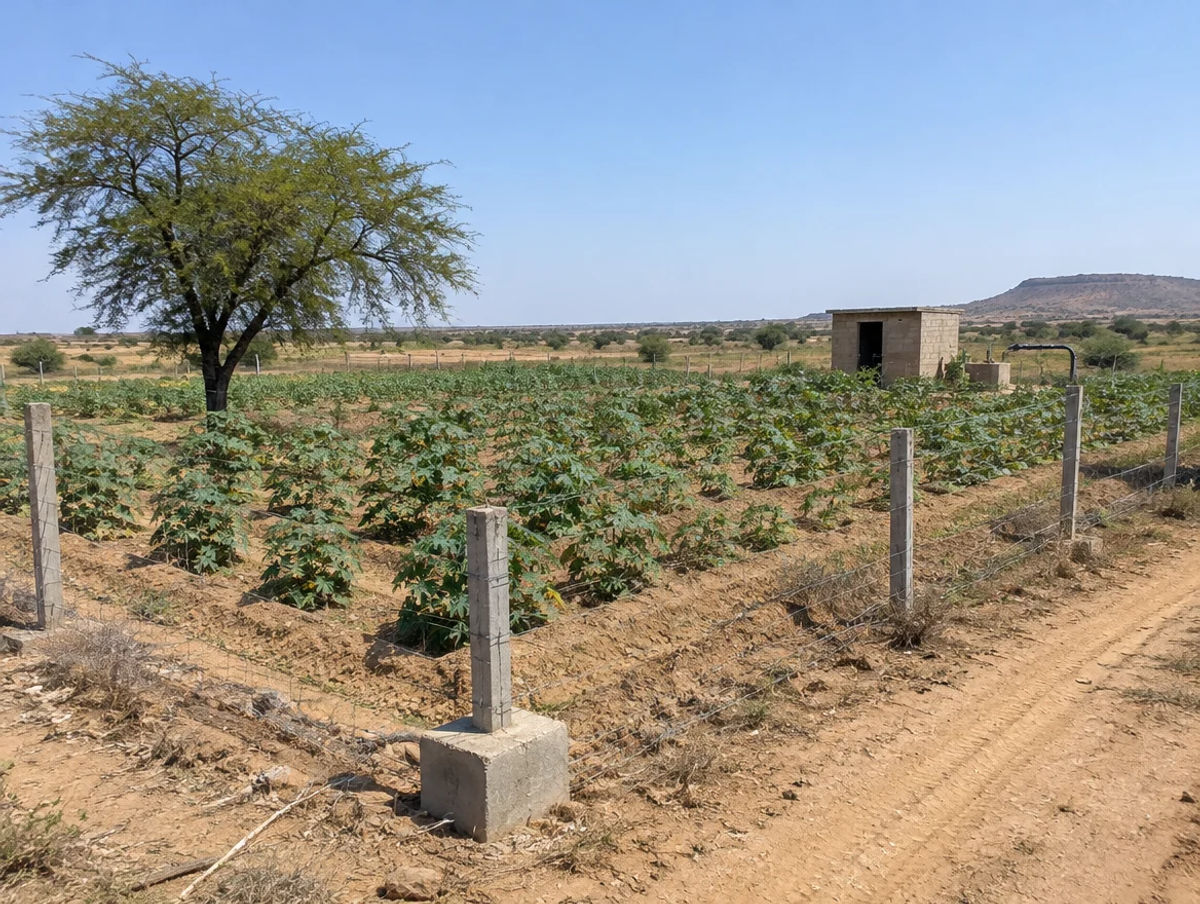
Farmland India view
Why investors look at Kutch
Five reasoned points, with an honest note that the price evidence is thin and water and permission risks are high.
Ports, salt and minerals under one district
The district industrial profile credits Kutch with over 60% of the state's salt and about 75% of its minerals (2010-11 output), and two ports sit on its coast. That is an industrial economy; it does not translate to farm-land prices on its own.
A renewable-energy and rail build-out
A 165 MW solar unit at Khavda was reported commissioned and the Gandhidham–Adipur line has been quadrupled. Both are delivered, but neither is a price series and the Khavda park size is not sourced.
Very large, thinly settled
At 45,652 sq km and about 46 people per sq km at Census 2011, Kutch has room, which cuts both ways: supply is large and the buyer pool is thin.
Water is the discount factor
Rainfall is under 400 mm in a normal year, 2026 was 61% below normal to 7 September, and groundwater was semi-critical in 2011 with about 60% of the district on saline water. Land with reliable water is scarce.
Thin price evidence
No district price series could be sourced, so any return case rests on registered comparables the buyer collects. This desk does not endorse a growth figure for Kutch.
Confirm farmer status, border and coastal permissions and water directly; these are not certified by Farmland India’s review.
STRAIGHT TALK
Risks & challenges in Kutch
Read these before shortlisting in Kutch specifically.
Drought and water
Rainfall was 61% below normal to 7 September 2026 and reservoirs held 23.79% of capacity (Down To Earth, September 2026). The desalination allocation of Rs 300 crore had no recorded spend. Ask for borewell depth, salinity and access to any pipeline in writing.
Saline groundwater
About 60% of the district holds native saline groundwater and the Gandhidham taluka is classed saline in the 2013 brochure. A cheap parcel may have no usable water.
Border and coastal permissions
We found no published purchase rule for border or coastal talukas, and the 2008 distance limits may be superseded. Get the Collector's position on the survey number in writing.
Farmer-status rule
Section 63 bars transfers to non-agriculturists, and the non-farmer reform was under review in November 2024 with nothing enacted found. Ask for the seller's farmer evidence and your own eligibility route.
Power-line and solar land
Transmission-line protests were reported in January 2026 and compensation was revised in July 2026. Check the 7/12 record for leases, rights of way or acquisition entries.
Announced is not delivered
The NH-41 six-laning has no date or cost, the Kandla hydrogen plant status is unconfirmed and no Narmada release for Kutch was reported. Price on today's fundamentals.
No sourced price series
We use no listing-site prices for Kutch, and the jantri is only a floor. Collect registered comparables from the same village before negotiating.
Who to contact
Local revenue & planning offices
Mutation and revenue-record matters go through the Mamlatdar of the taluka and the talati of the village, with the Prant officer (sub-divisional officer) above them and the District Collector at the top; the talukas are listed in the CGWB Kachchh brochure, 2013, because the Kutch district portal refused automated access for us. NA permission is applied for to the Collector under section 65 of the Land Revenue Code, and a decision is deemed granted if none comes in three months (LiveLaw, April 2025; applications have been online since a December 2018 circular, SCC Online, September 2024). Zoning and building permission inside a town-planning area go through the urban development authority under the Gujarat Town Planning and Urban Development Act, 1976 (Act text, not opened). Sale-deed registration is handled by the Sub-Registrar office for the village, with land records on AnyROR and registration on gARVI. We could not open the Revenue Department, AnyROR and gARVI portals, so check them directly.
COMMON QUESTIONS
Frequently asked questions
Everything buyers, NRIs and investors ask before their first reviewed farmland purchase in Kutch.
Visit full wiki01 of 04
What does agricultural land cost in Kutch?
We publish no per-vigha or per-acre band for Kutch because no district jantri schedule could be opened and listing-site asking prices could not be traced to registered deals. The only official reference is the statewide jantri, reported doubled from 15 April 2023 (DeshGujarat, February 2023), and it is a registration floor, not a market price. Collect registered comparables from the same village.
02 of 04
Who can buy agricultural land in Kutch, and are there border rules?
Section 63 of the Gujarat Tenancy and Agricultural Lands Act, 1948 bars transfers to non-agriculturists, and farmer status is checked from revenue records back to 6 April 1995 (SCC Online, September 2024). We found no published purchase rule specific to border or coastal talukas, so ask the Collector in writing what permissions apply to your survey number.
03 of 04
What stamp duty applies to land in Kutch?
The Comptroller and Auditor General's audit for the year ended 31 March 2018 states stamp duty on a conveyance deed at 4.9% of the greater of consideration and market value, with no registration-fee rate given (CAG, Report 3 of 2019). We could not open the registration portal, so ask the Sub-Registrar for the current duty, fee and jantri on your survey number.
04 of 04
What affects Kutch land values besides price?
Water and works. Rainfall was 61% below normal to 7 September 2026 and no Narmada release for Kutch was reported (Down To Earth, September 2026), while a 165 MW solar unit at Khavda and the Gandhidham–Adipur rail quadrupling were reported delivered, with Kandla–Mundra six-laning listed but undated (DeshGujarat, March 2026).
Transparency
Sources and references
Law and courts
- Gujarat Tenancy and Agricultural Lands Act, 1948 (headings and s 2(2)), India Code
- An agriculturist is debarred from bequeathing agricultural land to a non-agriculturist, Mondaq, 29 Apr 2021
- Balancing reform and responsibility: rethinking land conversion policies, LiveLaw, 1 Apr 2025
- Shashikant Vasudevbhai Patel v State of Gujarat, Gujarat High Court, 10 Sep 2018
- Gujarat Bill 23 of 2020 (ss 63AA, 63AAA, 73AA reference), PRS
- Gujarat Agricultural Lands Ceiling Act, 1960 (Act 27 of 1961), PRS Legislative Research copy
- Gujarat Disturbed Areas Act, 1991 (Act 12 of 1991), PRS copy
- Gujarat Bill 18 of 2026 (Disturbed Areas amendment), PRS
- Gujarat Town Planning and Urban Development Act, 1976, India Code (not opened)
- FEMA Acquisition and Transfer of Immovable Property in India Regulations, 2018, Reserve Bank of India
Government
- Ground water information booklet, Kachchh district, Central Ground Water Board (2013; 2011 resources)
- District Industrial Profile of Kutch, MSME Development Institute (2010-11 data)
- Dynamic Ground Water Resources of Gujarat State, 2024, Central Ground Water Board
- Castor crop cultivation in Gujarat 2021-22, Directorate of Economics and Statistics
- CAG Report 3 of 2019, Revenue Sector, Gujarat, chapter 4 (stamp duty and registration fees)
- Revenue Department GR, 1 Jul 2008 (non-agricultural permission distance limits)
- Tenancy page, Surat Collectorate
- Registration System of Gujarat (gARVI 2.0, 294 Sub-Registrar offices), Inspector General of Registration summary
- gARVI registration portal, Gujarat (not opened for this page)
- AnyROR land records portal, Gujarat (not opened for this page)
- Revenue Department, Government of Gujarat (not opened for this page)
- Agmarknet mandi prices (not opened for this page)
News
- As Kutch and Saurashtra teeter on the edge of drought, farmers demand Narmada water, Down To Earth, Sep 2026
- Key highlights of Gujarat's infrastructure push in February 2026, DeshGujarat, 4 Mar 2026
- Gujarat logs major infrastructure gains in January 2026, DeshGujarat, 31 Jan 2026
- Gujarat revises compensation policy after farmers' protests, National Herald, 4 Jul 2026
- Gujarat government hikes compensation to farmers for land used for power transmission lines, Deccan Herald, 4 Jul 2026 (summary only)
- Gujarat faces growing groundwater crisis as recharge falls behind consumption, Gujarat Samachar, 28 Sep 2026
- Gujarat exported 689.5 tonnes of mangoes in 2023-24, ThePrint, Jul 2024
- Gujarat assembly passes tukda dhara amendment bill, DeshGujarat, 11 Sep 2026
- Gujarat notifies Disturbed Areas Act amendment, DeshGujarat, 15 Jul 2026
- Jantri rate hike effective from April 15, DeshGujarat, 11 Feb 2023
- Gujarat to revise minimum rates for agricultural land, The Secretariat, Nov 2024
- Gujarat assessing non-farmers' access to agricultural land, Gujarat Samachar, 12 Nov 2024
- Gujarat farmer verification process streamlined, SCC Online, 25 Sep 2024
- Gujarat cabinet approves 17 new talukas, The Week (PTI), 24 Sep 2025
Further reading
- Major changes likely in Gujarat tenancy and agricultural land laws, Gujarat Samachar, 9 Mar 2024
- Gujarat amends land revenue law, DeshGujarat, 1 Apr 2026
- Gujarat assembly passes land revenue, GST and livestock feed bills, ThePrint, Sep 2026
- Gujarat High Court guidelines on misuse of the Land Grabbing Act, LiveLaw, Dec 2024
- Report on best practices: SAUNI, Ministry of Jal Shakti
- 69,800 km of Narmada canals done, DeshGujarat, 8 Mar 2025
- When will India's first bullet train run? Construction figures and timeline caveats, Business Today, 16 Aug 2026
- Delhi–Mumbai Expressway: all packages open on Vadodara–Navsari, DeshGujarat, 12 Jan 2026
- Gujarat approves new district Vav-Tharad, AIR News, Jan 2025
- India State of Forest Report 2019, Gujarat volume, Forest Survey of India
- Soil Health Card portal (not opened for this page)
Data-currency note: area and population are Census 2011 figures from a 2013 groundwater brochure; groundwater stages use 2011 data; road lengths and mineral output are 2010-11 figures; infrastructure statuses were read in October 2026 and change quickly; no price series is published. The Kutch district portal refused automated access. Pages marked "not opened" are named only as places to check. This is a general guide, not legal advice. Report inaccuracies to wiki@farmlandindia.com.
For developers
Ready to explore Kutch farmland?
Browse reviewed projects and individual land parcels across Kutch — or if you own land here, list it with platform review and reach serious buyers.