
District guide
Buying Land in Mehsana
A north Gujarat farm district on the Ahmedabad highway: castor, potato and cumin cropland, groundwater stress, farmer-status rules and corridor projects still pending.
4,484 sq km
Area (district portal)
10
Talukas
614
Villages (portal)
51.6 km, approved Jan 2026
Ahmedabad–Mehsana widening
District land record — Mehsana
Rev. 2026 · Farmland India desk
State
Gujarat
Sub-divisions
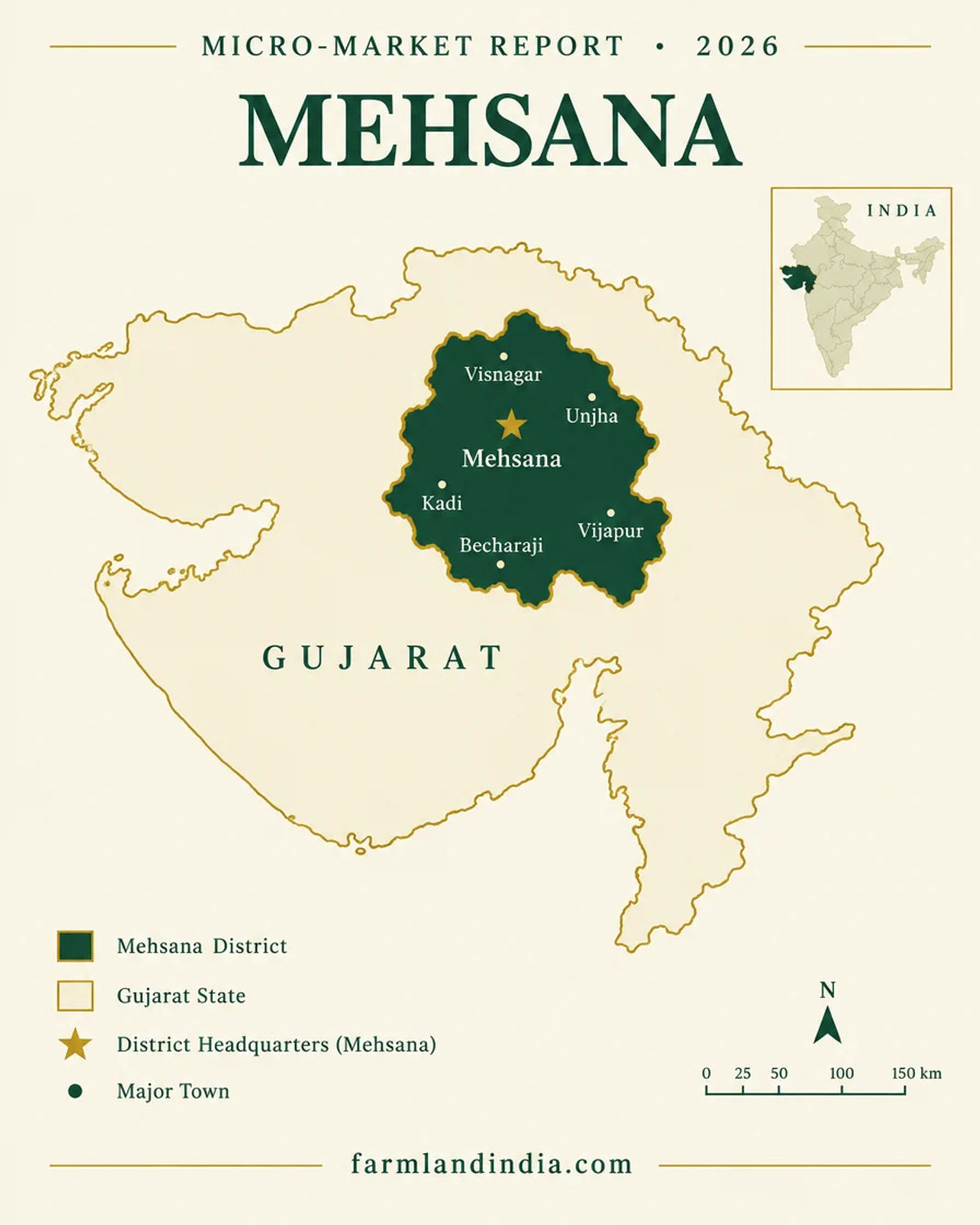
10 talukas (Mehsana, Kadi, Visnagar, Vijapur, Vadnagar, Kheralu, Becharaji, Satlasana, Jotana, Unjha) in 4 sub-divisions, with 614 villages and 7 municipalities (Mehsana district portal, undated; home page)
Key markets
Mehsana city · Kadi · Unjha · Visnagar · Vijapur · Becharaji · Vadnagar
Demand anchors
Ahmedabad–Mehsana highway widening approved January 2026 · Tharad–Ahmedabad Expressway corridor, stalled or unbid in the reports found · Mahesana Jn and Unjha stations on the Amrit Bharat list
Rail
Mahesana Jn, which the district portal places on the Jaipur–Ahmedabad line (Mehsana district portal); Mahesana Jn and Unjha are in the Gujarat list of the station scheme (PIB, March 2026)
Size and population
4,484.10 sq km and about 20 lakh people on the portal home page (Mehsana district portal; undated, and its About page gives about 5,600 sq km, so CONFIRM against Census tables)
Pricing unit
₹/acre or ₹/guntha (farmland) · ₹/sq yd (plots)
Local units
Guntha = 1,089 sq ft (about 101 sq m) · 40 gunthas = 1 acre · vigha varies by region
Land records portal
anyror.gujarat.gov.in (not opened for this page; check village records there)
Land law is state law. These rules are maintained on the Gujarat page and apply to every district within it.
Mehsana — land purchase legal rules
Agricultural land in Gujarat can generally be bought only by an agriculturist, and farmer status is checked before a sale entry is certified. The other main checks are tenure (old or new), NA permission, the fragmentation limit and whether the area is notified under the Disturbed Areas Act.
Who can buy agricultural land? Section 63 of the Gujarat Tenancy and Agricultural Lands Act, 1948 is headed “Transfers to non-agriculturist barred”, and section 2(2) defines an agriculturist as a person who cultivates land personally. A commentary on the Supreme Court appeal Vinodchandra Sakarlal Kapadia v State of Gujarat (Civil Appeal 2573 of 2020) reports that the Gujarat High Court read section 63 to bar a transfer by an agriculturist to a non-agriculturist without the Collector’s permission, including by will (Mondaq, April 2021). Farmer status is checked from revenue records back to a cut-off of 6 April 1995, under Revenue Department circulars of 13 September 2024, and a self-declaration form goes with a sale entry or an NA application (SCC Online, September 2024). We read section 63 through these summaries, not its full text; confirm with a Gujarat revenue lawyer.
Will non-farmers be allowed to buy? A committee chaired by C. L. Meena studied the tenancy laws and its suggestions on non-farmer purchase were being assessed in November 2024, with no decision announced (Gujarat Samachar, November 2024; Gujarat Samachar, November 2024). We found no enacted change by October 2026, so the section 63 rule above is the one to plan on.
Ceiling limits: the Gujarat Agricultural Lands Ceiling Act, 1960 (Gujarat Act 27 of 1961, amendments compiled by PRS Legislative Research) bars a person from holding land above the ceiling area. Land of a spouse and minor children is grouped with the holder, a family of more than five may hold one-fifth of the ceiling area for each extra member up to twice the ceiling, and each major son counts as a separate person; in desert, hill and drought-prone areas the dry-crop ceiling is raised by 12.5% but cannot pass 21.85 hectares (54 acres). These points come from a legal-database copy of the Act that we do not link, because the India Code page did not open here; the class-wise acreage in Schedule I was not in the text we read, so we show no per-class figure.
Tenure, premium and NA permission: section 43 of the Tenancy Act is headed “Restriction on transfers of land purchased or sold under this Act”, which is the basis of what the press calls new tenure land, and the Collector’s office grants permission and collects a premium under it (Surat Collectorate). A government notification of 8 February 2024 lets a tenant who has farmed land for more than 15 years move it from new tenure to old tenure without a conversion fee, but the premium for NA use is still payable (LiveLaw, April 2025). NA (non-agricultural) permission is granted under section 65 of the Gujarat Land Revenue Code, 1879, and is deemed granted if the Collector does not decide within three months (same source); applications have been online since a December 2018 circular (SCC Online, September 2024). Press reports put the NA premium at about 35 to 40 per cent of land value (Gujarat Samachar, March 2024); we found no official schedule. The 2008 resolution on NA procedure also lists distance limits from railways, airports and Air Force installations (900 m) and from the sea high-tide line (500 m) (Revenue Department resolution, July 2008), which later circulars may have changed.
Fragmentation (tukda) limit: the Assembly passed the Gujarat Prevention of Fragmentation and Consolidation of Holdings (Amendment) Bill on 11 September 2026. As reported, it sets a uniform standard area of 10 gunthas (1,012 sq m) for rural land under a new section 5(4), leaves out municipal and urban development authority areas, and regularises violations from 1948 to 31 March 2026 without penalty; before this, buyers paid 10% of jantri value (DeshGujarat, September 2026). We did not see the Act text or any filing deadline.
Industrial and institutional exceptions: sections 63AA and 63AAA allow land bought for industrial, education or health use to be resold on payment of a share of jantri value that falls with the holding period, from 100% at three to five years to 25% beyond ten years (Gujarat Bill 23 of 2020, PRS Legislative Research). We have the Bill, not the enacted Act. A charity that bought in breach before 30 June 2015 may apply for conversion within a period the State notifies (Gujarat Bill 1 of 2024, PRS Legislative Research).
Disturbed Areas Act, 1991: where the State has notified an area under section 3, a transfer of land or buildings there needs the Collector’s prior sanction after an inquiry into free consent and fair value, and a transfer without it is void under section 5; contravention carries imprisonment of three to five years under section 6D (Gujarat Act 12 of 1991, PRS Legislative Research). A 2026 amendment renames these “specified areas”, adds a Monitoring and Advisory Committee and extends the Collector’s checks (Bill 18 of 2026; DeshGujarat, March 2026); the government notified the amendment in July 2026, with the effective date to be notified separately (DeshGujarat, July 2026). As a due-diligence step, ask the Collector or Sub-Registrar whether the survey number lies in a notified area; we hold no list of notified areas.
Land Grabbing Act, 2020 and tribal land: the Gujarat Land Grabbing (Prohibition) Act, 2020 works through district committees, and in December 2024 a Gujarat High Court bench issued guidelines for those committees (LiveLaw, December 2024). Land held by Scheduled Tribe occupants is separately restricted under section 73AA of the Land Revenue Code, which the 2020 Bill cross-refers to (PRS Legislative Research); we did not open the Code, so check the occupant’s status in the 7/12.
NRI & OCI buyers: regulation 3 of the Foreign Exchange Management (Acquisition and Transfer of Immovable Property in India) Regulations, 2018 lets NRIs and OCIs buy land other than agricultural land, a farm house or plantation property (Reserve Bank of India, 2018 regulations). Residential and commercial land is open to them. The same section 63 rule applies to a resident non-farmer.
- Agriculturists only (s.63)
- Ceiling Act 1960
- NA via s.65
- Fragmentation: 10 gunthas
- Disturbed Areas Act
- NRI agri: barred (RBI 2018)
- 7/12 via AnyROR
Mehsana — district-specific notes
The Gujarat state page applies to Mehsana in full. The notes below are specific to this district and are not repeated from the state page. Law was read through India Code, PRS texts, the 2008 Revenue Department resolution and news reports; the Revenue Department, AnyROR and gARVI sites would not open for us, so statements about them are second-hand.
⚠ Mehsana is mostly farmland: the district portal reports cultivable land at 83.88% of a reported 439,153 hectares (Mehsana district portal, Economy). Section 63 of the Gujarat Tenancy and Agricultural Lands Act, 1948 is headed "Transfers to non-agriculturist barred", and section 2(2) defines an agriculturist as a person who cultivates land personally (Tenancy Act, India Code; commentary in Mondaq, April 2021). A buyer who is not a farmer needs a route through the Act or a farmer-status declaration; the circulars of 13 September 2024 are described by SCC Online, September 2024, which we did not check against the circulars. Ask the Mamlatdar which route applies to the survey number.
⚠ Non-agricultural (NA) use needs permission from the Collector under section 65 of the Land Revenue Code, deemed granted if no decision follows in three months (LiveLaw, April 2025). The 2008 Revenue Department resolution lists a 900 metre limit from railway lines, airports and air force installations (Revenue Department resolution, 2008); it may have been superseded. The district portal describes a Mehsana airport of 64 acres and the Jaipur–Ahmedabad rail line (Mehsana district portal, How to reach), so land close to either should be checked against that limit in writing.
⚠ Under the fragmentation law, an amendment passed on 11 September 2026 sets a rural standard area of 10 gunthas (1,012 sq m), excludes urban development areas and regularises past violations from 1948 to 31 March 2026 without penalty (DeshGujarat, September 2026). We have not seen the Act text. The portal counts seven municipalities in Mehsana, so check whether a plot sits inside an urban development area before applying the rural figure.
⚠ Oil and natural gas exploration in the district began in 1961, and the portal reports 153 wells drilled (Mehsana district portal, Economy). We found no published rule on land near wells or pipelines, so ask for any well-site, pipeline or authority entry in the village record before paying a deposit.
⚠ The Gujarat Prohibition of Transfer of Immovable Property and Provision for Protection of Tenants from Eviction from Premises in Disturbed Areas Act requires Collector sanction for a transfer inside a notified area (Disturbed Areas Act, PRS copy); a 2026 amendment renames these "specified areas" (DeshGujarat, July 2026). We found no list of notified areas, so ask the Collector or Sub-Registrar whether the survey number falls in one.
Read the full Gujarat land buying guide for farmer status, ceiling, stamp duty and NRI rules.
- Tenancy Act s 63
- NA permission
- Fragmentation law
- Disturbed Areas Act
District overview
Mehsana — a north Gujarat farm district on the Ahmedabad highway
Mehsana is a north Gujarat district with its headquarters at Mehsana city. The district portal gives 4,484.10 sq km, about 20 lakh people, ten talukas, four sub-divisions and 614 villages on its home page (Mehsana district portal (home)), while its About page says about 5,600 sq km and names Banaskantha, Patan, Ahmedabad, Gandhinagar and Sabarkantha as neighbours (Mehsana district portal, About). We use the home-page figures and flag the difference. The Sept 2025 statewide taluka expansion added none in Mehsana (PTI via The Week, September 2025).
We publish no per-acre price band for Mehsana. No district or village jantri schedule opened for us, and listing-site asking prices could not be traced to registered deals. The state-level reference is the jantri doubling from 15 April 2023 (DeshGujarat, February 2023), with a revised draft still pending in November 2024 (The Secretariat, November 2024).
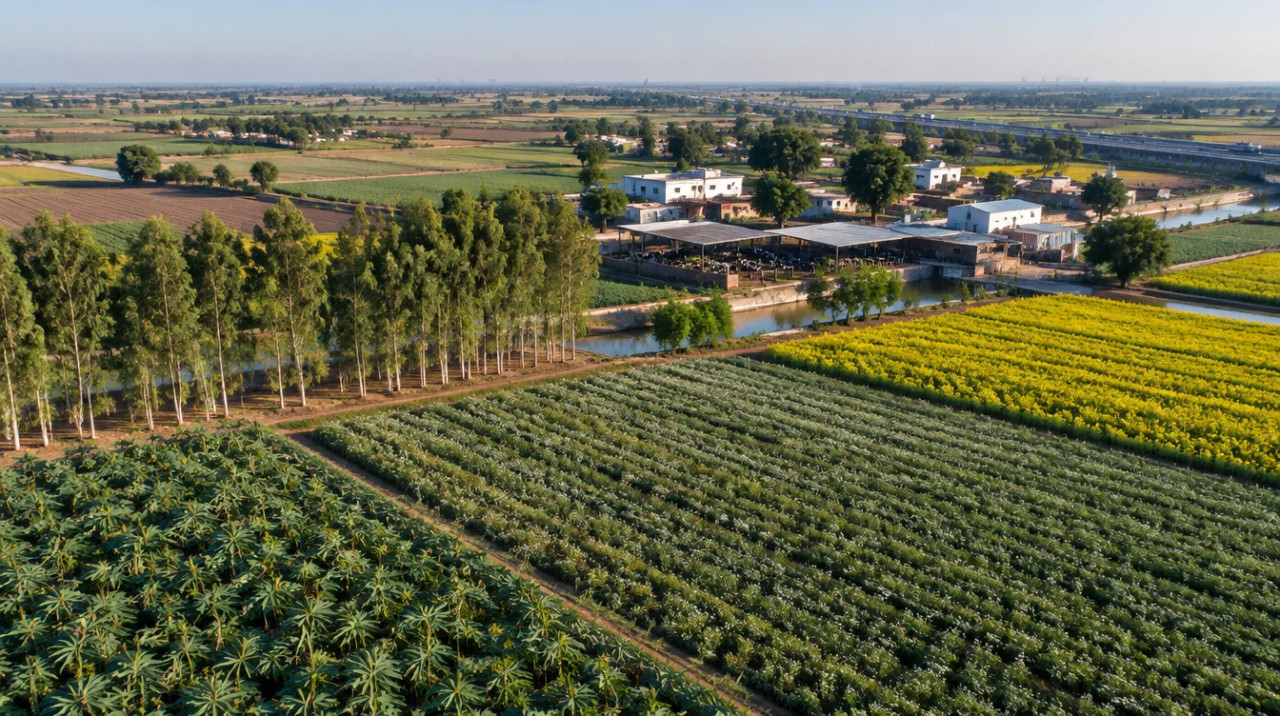
Land use is agricultural first. Of the portal's reported area, 79.55% is net cropped and 65.55% is irrigated, with potato, cotton, tobacco, oilseeds, castor, cumin, psyllium and anise named as the major crops (Mehsana district portal, Economy). Mehsana is among the five main castor districts of Gujarat, and the castor study says the Kadi area has the world's highest castor yield per hectare (DESAGRI castor study). Groundwater is the constraint: Gujarat Samachar listed Mehsana among the stressed north Gujarat districts in September 2026 (Gujarat Samachar, September 2026).
- Mehsana
- Kadi
- Unjha
- Visnagar
- Becharaji
- Ahmedabad highway
Transaction costs
Stamp duty & registration in Mehsana
4.9%
Stamp duty on conveyance
audit year 2017-18 (CAG); current rate not confirmed
Not sourced
Registration fee on land deeds
no page found; ask the Sub-Registrar
Not sourced
Concessions for women buyers
no government source found
The CAG audit of the year ended 31 March 2018 records stamp duty on conveyance at 4.9% (CAG Report 3 of 2019). That is the only dated rate we could trace, so treat it as a reference and ask the Sub-Registrar for the rate in force. Registration runs through gARVI 2.0 at 294 Sub-Registrar offices (Inspector General of Registration summary; the gARVI portal would not open for us). Duty is charged against the higher of the stated value and the jantri value; we did not see an official page stating that rule for Gujarat. The jantri was doubled from 15 April 2023 (DeshGujarat, February 2023). The state page gives the same figures and flags, and the mutation reform of 2026 is described in DeshGujarat, April 2026.
Know the belt
What is moving prices in Mehsana
Official numbers are thin for Mehsana: a statewide jantri change and district-portal land-use figures. No listing-site prices are used.
Jantri: state-wide, not village-wise
Doubled from 15 April 2023 (reported)
DeshGujarat reported that jantri rates would double from 15 April 2023 after about twelve years (DeshGujarat, February 2023), and The Secretariat reported a revised draft for agricultural land pending in November 2024 (The Secretariat, November 2024). We did not obtain a Mehsana village schedule.
Check: the jantri value for the exact survey number on the Sub-Registrar's listing.
Highway widening
Ahmedabad–Mehsana, 51.60 km, Rs 2,630 crore
The Gujarat cabinet approved eight-laning from Adalaj to Palavasna Circle in Mehsana on 28 January 2026, with a 6.10 km elevated corridor at Kalol and tenders expected soon (IANS, January 2026). No price effect has been measured.
Check: whether a parcel lies in an acquisition strip; the report does not give alignment widths.
Castor, potato and cumin belt
Crop income is not a land price
The portal lists potato, cotton, tobacco, oilseeds, castor, cumin, psyllium and anise as major crops (Mehsana district portal, Economy). We have no price series for any of them in Mehsana.
Check: village-level irrigation and borewell status, not district averages.
Asking prices
No sourced price series
Listing-site asking prices for Mehsana could not be traced to registered deals, so none are shown. The jantri value is a floor for duty, not what a seller will accept.
Check: registered deeds in the same village before negotiating.
Units: guntha, acre, vigha
Gujarat farmland is measured in gunthas (1 guntha is about 101 sq m or 1,089 sq ft) and acres, with 40 gunthas to the acre. The vigha varies by region and we found no official conversion, so ask the Talati for the area in the 7/12 extract in sq m and convert from that. We did not open a revenue manual for these definitions.
Connectivity
How Mehsana connects — road, rail and air
Distances are the district portal's own and are undated; journey times vary with traffic and road works.
By road
By air
By rail
The practical question is the last leg from the highway to the parcel; ask for the access road in the 7/12 and the village map. Distances come from the district portal. Rules for buyers from outside the state: Gujarat agricultural land rules.
Growth catalysts
Upcoming infrastructure & developments
Status labels reflect sources read in October 2026. Government timelines are not guaranteed; items marked listed or reported rest on a single news source or a list entry.
01Open or in service
04In progress or pending
Agriculture & terrain
Soil, crops & water in Mehsana
A groundwater-stressed castor, potato and cumin district in north Gujarat; irrigation is the question for any parcel.
🌾 Cropland and crops
The district portal reports cultivable land at 83.88% of a reported 439,153 hectares, net cropped area at 79.55% and irrigated area at 65.55%. Potato, cotton, tobacco, oilseeds, castor seed, cumin, psyllium and anise are named as major crops, and Mehsana taluka has the largest net cropped and irrigated area (Mehsana district portal, Economy). The page is undated. Village-level soil data: Soil Health Card portal (not opened for this page).
- Castor
- Cumin
- Potato
- Cotton
🛢️ Castor and the Kadi belt
Mehsana is one of the five districts studied in the national castor survey, which says the Kadi area has the world's highest castor yield per hectare; Gujarat held 85.6% of India's castor production in 2020-21 (DESAGRI). The text gives no Mehsana area or production figures.
- Castor
- Kadi
- Oilseeds
🥛 Dairy, markets and oil
The portal says dairy, oil and gas and other primary industries are in and around the city, calls Unjha the largest market yard and says exploration drilling began in 1961 (Mehsana district portal, Economy). It gives no area for these uses, so they are context, not a land-price driver we can measure.
- Unjha market yard
- Dairy
- Oil and gas
💧 Water & rainfall
Statewide, CGWB assessed 252 units in 2024 with 22 over-exploited, 10 critical and 24 semi-critical and extraction at 54.21% (CGWB, Gujarat 2024); that report gives no district-wise stage that we could read. Gujarat Samachar named Mehsana among the stressed districts of north Gujarat in September 2026 and did not give a Mehsana depth (Gujarat Samachar, September 2026). We found no sourced rainfall figure for Mehsana. Narmada canals run across Gujarat (a network of 63,908 of 69,830 km completed by January 2025, DeshGujarat, March 2025) but we found no source tying them to Mehsana parcels, so ask whether a field has canal water as well as a borewell.
📐 Measurement units
Gujarat land units: 1 guntha is about 101 sq m (1,089 sq ft); 40 gunthas make one acre. The vigha differs by region and we found no official conversion, so ask for sq m. Convert every quote before comparing two offers; mandi prices are on Agmarknet (not opened for this page), and crop income is modest next to land values.
At a glance
Mehsana vs. its neighbours
| District / belt | Price evidence* | Evidence |
|---|---|---|
| Mehsana | No sourced price series | No district jantri schedule obtained; state jantri doubled from Apr 2023 (reported) |
| Banaskantha | No sourced price series | No figure used on this page |
| Ahmedabad | No sourced price series | No figure used on this page |
| Gandhinagar | No sourced price series | No figure used on this page |
*Reported or listed evidence only; the jantri is a registration floor, not a market price. See the Ahmedabad page, Gandhinagar page and Banaskantha page for the neighbours the Mehsana portal names, and Mahisagar for another Gujarat district page.
Farmland India view
Why investors look at Mehsana
Five reasoned points, with an honest note that price evidence is thin and the larger road projects are unfinished.
A highway edge on Ahmedabad
The Ahmedabad–Mehsana highway has been four-lane since 1999 and carries more than a lakh vehicles a day according to a survey cited by IANS; the widening is approved but not built (IANS, January 2026). A buyer should time the actual drive to the village.
Agriculture with a name
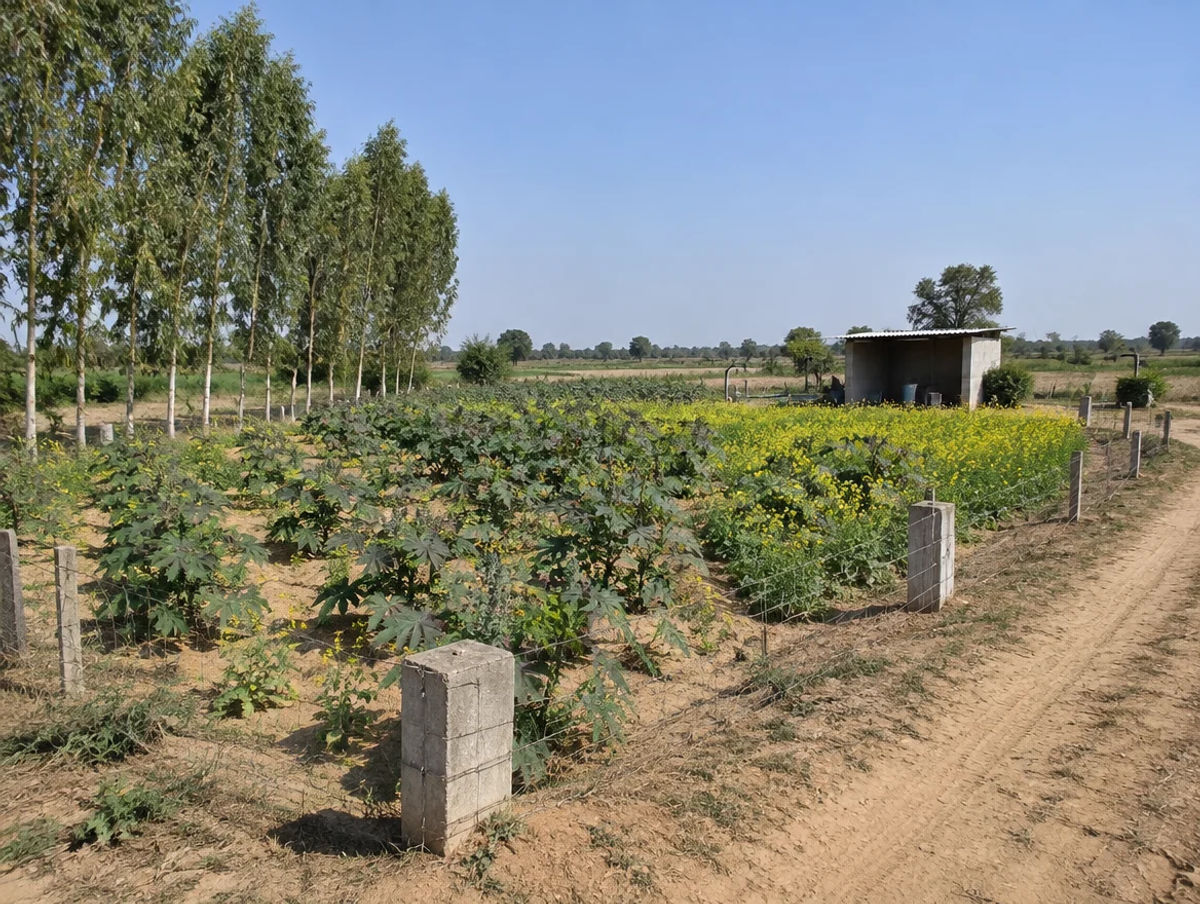
The Kadi castor belt and Unjha market yard give the district a farm-economy identity, though crop income is not a land price.
Pending corridors, not delivered ones
The Tharad–Ahmedabad Expressway had no bids on its 105.8 km package in March 2026. Price on today's roads.
Water decides the farm case
North Gujarat is reported as groundwater-stressed (Gujarat Samachar, September 2026). A parcel with canal or reliable borewell water is a different asset from one without.
Paperwork is parcel-specific
Farmer status, NA permission, the 10-guntha rule and the Disturbed Areas check differ per survey number; a buyer who documents them is better placed than one relying on a broker summary.
Confirm farmer status, NA and fragmentation status directly; these are not certified by Farmland India’s review.
STRAIGHT TALK
Risks & challenges in Mehsana
Read these before shortlisting in Mehsana specifically.
Farmer-status rule
Most Mehsana land is agricultural, so section 63 matters in almost every deal. Ask for the route in writing; we have not seen the operative text.
Groundwater stress
North Gujarat is reported as stressed, with Mehsana named. Check borewell depth and yield before assuming irrigation.
Fragmentation and urban limits
The 10-guntha rural standard and the regularisation window come from a news report of a September 2026 bill; the Act text and the urban-area boundary are unconfirmed.
NA limits near airport and rail
The 2008 resolution lists 900 m limits from railways and airports, and Mehsana has both. It may be superseded; ask the Collector.
Oil and gas sites
The portal reports 153 wells drilled. No land rule found; look for well-site or pipeline entries in the record.
Disturbed Areas check
Transfers inside a notified area need Collector sanction. No list of areas obtained; ask the Collector or Sub-Registrar.
Announced is not delivered
The Tharad–Ahmedabad package drew no bids in March 2026, and the Ahmedabad–Mehsana widening had no award in the sources read.
No sourced price series
We use no listing-site prices; the jantri is a floor. Collect registered comparables.
Who to contact
Local revenue, planning & registration offices
Mutation and revenue-record matters go through the Mamlatdar of the relevant taluka; the Mehsana district portal lists Mamlatdar offices for Mehsana, Kadi, Vijapur, Visnagar, Becharaji, Unjha, Vadnagar, Satlasana and Jotana (Kheralu, named on its About page, was not in that list). The Collector and the Prant (sub-division) officers handle NA permission and tenure matters; the portal home page counts four sub-divisions, but we did not find a Prant page. Sale-deed registration is at the local Sub-Registrar through gARVI (gARVI), and village records are on AnyROR. The Revenue Department, AnyROR and gARVI sites would not open for us, so check them directly. No phone numbers or officials' names are given here.
COMMON QUESTIONS
Frequently asked questions
Everything buyers, NRIs and investors ask before their first reviewed farmland purchase in Mehsana.
Visit full wiki01 of 04
What does agricultural land cost in Mehsana?
We publish no per-acre band for Mehsana. No district or village jantri schedule opened for us, and listing-site asking prices could not be traced to registered deals. The state-level reference is the jantri doubling from 15 April 2023 (DeshGujarat, February 2023); a revised draft was pending in November 2024 (The Secretariat). The jantri is a registration floor, not a market price.
02 of 04
Can a non-farmer buy agricultural land in Mehsana?
Section 63 of the Gujarat Tenancy and Agricultural Lands Act, 1948 is headed "Transfers to non-agriculturist barred", and an agriculturist is a person who cultivates land personally. Farmer-verification circulars of 13 September 2024 are described by SCC Online. We found nothing enacted by October 2026 to open purchase to non-farmers. Ask the Mamlatdar which route applies to the survey number.
03 of 04
What stamp duty applies to land in Mehsana?
The CAG audit of the year ended 31 March 2018 records stamp duty on conveyance at 4.9% in Gujarat. We found no registration-fee rate for land deeds and no sourced concession for women, and the rate may have changed since the audit, so ask the Sub-Registrar for the rate in force.
04 of 04
Which infrastructure affects Mehsana?
The cabinet approved eight-laning of the 51.60 km Ahmedabad-Mehsana highway on 28 January 2026 (IANS), with tenders expected. The 214 km Tharad-Ahmedabad Expressway, which includes Mehsana, was reported stalled on land acquisition in April 2025 and drew no bids for a 105.8 km package in March 2026 (DeshGujarat). Mahesana Jn and Unjha are on the Amrit Bharat station list.
Transparency
Sources and references
Law and courts
- Gujarat Tenancy and Agricultural Lands Act, 1948 (ss. 2(2), 43, 63 headings), India Code
- An agriculturist is debarred from bequeathing agricultural land to a non-agriculturist, Mondaq, 29 Apr 2021
- Balancing reform and responsibility: rethinking land conversion policies, LiveLaw, 1 Apr 2025
- Gujarat farmer verification process streamlined, SCC Online, 25 Sep 2024
- Gujarat Bill 23 of 2020 (ss. 63AA, 63AAA, 73AA cross-reference), PRS Legislative Research
- Gujarat Agricultural Lands Ceiling Act, 1960 (Act 27 of 1961), PRS Legislative Research copy
- Gujarat Prohibition of Transfer of Immovable Property and Provision for Protection of Tenants from Eviction from Premises in Disturbed Areas Act (PRS copy)
- Disturbed Areas Act amendment notified: "specified area", DeshGujarat, 15 Jul 2026
- Assembly passes tukda (fragmentation) amendment bill, DeshGujarat, 11 Sep 2026
- Revenue Department resolution on NA permission, 1 Jul 2008, Gujarat Revenue Department
- Foreign Exchange Management (Acquisition and Transfer of Immovable Property in India) Regulations, 2018, Reserve Bank of India
Government
- Mehsana district portal, home page (4 sub-divisions, 10 talukas, 614 villages, 4,484.10 sq km, about 20 lakh)
- Mehsana district portal, About the district (history, borders, 10 talukas, 7 municipalities)
- Mehsana district portal, How to reach (distances, rail, airport)
- Mehsana district portal, Economy (land use, crops, workforce, oil and gas)
- Mehsana district portal, Tehsil (Mamlatdar offices by taluka)
- Stamp duty and registration fees, CAG Report 3 of 2019 (Gujarat revenue sector, year ended 31 Mar 2018), chapter 4
- Registration System of Gujarat (gARVI 2.0, 294 Sub-Registrar offices), Inspector General of Registration, undated
- Dynamic Ground Water Resources of Gujarat 2024, Central Ground Water Board
- Castor crop cultivation in Gujarat 2021-22, Directorate of Economics and Statistics, Ministry of Agriculture
- Amrit Bharat Station Scheme making rapid progress, PIB, 12 Mar 2026
- AnyROR land records portal, Gujarat (not opened for this page)
- gARVI registration portal, Gujarat (not opened for this page)
News
- Gujarat govt approves Rs 2,630 crore project to widen Ahmedabad-Mehsana highway, IANS, 28 Jan 2026
- Tharad-Ahmedabad Expressway: route, interchanges, details and current status, DeshGujarat, 24 Apr 2025
- NHAI fails to attract bids for 105-km section of Tharad-Ahmedabad Expressway under BOT, DeshGujarat, 24 Mar 2026
- Amrit Bharat Scheme: railway minister updates on redevelopment of Ahmedabad, Surat, other stations, DeshGujarat, 1 Aug 2025
- Gujarat cabinet approves 17 new talukas, PTI via The Week, 24 Sep 2025
- Gujarat faces growing groundwater crisis, Gujarat Samachar, 28 Sep 2026
- Jantri rate hike to be effective from April 15, DeshGujarat, 11 Feb 2023
- Gujarat to revise minimum rates for agricultural land, The Secretariat, 13 Nov 2024
- 69,800 km of Narmada canals done, 5,900 km works in progress, DeshGujarat, 8 Mar 2025
Further reading
- Mehsana district portal, Tourist places (Modhera, Vadnagar, Dharoi Dam)
- Gujarat High Court guidelines on misuse of the Land Grabbing Act, LiveLaw, 11 Dec 2024
- Gujarat Land Revenue (Amendment) Act, 2025 (Act 10 of 2025), PRS Legislative Research
- Land revenue law amended: 30-day notice waived for undisputed deals, DeshGujarat, 1 Apr 2026
- Major changes likely in Gujarat tenancy and agricultural land laws, Gujarat Samachar, 9 Mar 2024
- Gujarat assessing non-farmers' access to agricultural land, Gujarat Samachar, 12 Nov 2024
- Shashikant Vasudevbhai Patel v State of Gujarat, Gujarat High Court, 10 Sep 2018 (s 63AB)
- Gujarat Town Planning and Urban Development Act, 1976, India Code (not opened for this page)
- Report on best practices: SAUNI Gujarat, Ministry of Jal Shakti
Data-currency note: the district portal pages are undated and use the old NH 8 name; castor data are 2020-21; groundwater is the 2024 state assessment; infrastructure statuses were read in October 2026 and change quickly; the stamp-duty rate is from an audit of 2017-18. Pages marked "not opened" are named only as places to check. This is a general guide, not legal advice. Report inaccuracies to wiki@farmlandindia.com.
For developers
Ready to explore Mehsana farmland?
Browse reviewed projects and individual land parcels across Mehsana — or if you own land here, list it with platform review and reach serious buyers.