
District guide
Buying Land in Didwana-Kuchaman
A Nagaur-split district between the Makrana marble belt and dryland plains: Section 42 and ceiling checks, saline pockets, thin irrigation and an unsettled district seat.
6,769 sq km
Reporting area (2023-24)
66.1%
Net sown area (2023-24)
25.5%
Net irrigated, share of net sown
8
Tehsils (reported)
District land record — Didwana-Kuchaman
Rev. 2026 · Farmland India desk
State
Rajasthan (district created in 2023 from Nagaur; kept in the December 2024 decision) (Rajras, reported; Scroll, December 2024)
Sub-divisions
6 sub-divisions and 8 tehsils in a compilation of the 2023 notification: Didwana, Maulasar, Chhoti Khatu, Ladnun, Parbatsar, Makrana, Nawa, Kuchaman City; headquarters temporarily at Didwana (Rajras, reported; notification not opened)
Key markets
Didwana · Kuchaman City · Makrana · Ladnun · Nawa · Parbatsar
Demand anchors
Makrana marble belt · Merta Road–Degana–Ratangarh rail electrification · dryland farming on the Nagaur plain
Rail
Line electrification covering Didwana-Kuchaman dedicated in December 2024 (Rail Analysis India, December 2024); station data not checked
Size and population
6,769 sq km reporting area (676,853 ha, 2023-24) (Directorate of Economics and Statistics); no Census total for the district as now bounded was found on a page we could open
Pricing unit
₹/hectare or ₹/acre (farmland) · ₹/sq m (plots, DLC)
Local units
Village units differ by tehsil; agricultural registration is in hectares since the December 2024 DLC revision (Patrika, December 2024)
Land records portal
Revenue Department land-records portal (Apna Khata) not opened for this page; sale deeds register through ePanjiyan (NeGD listing)
Land law is state law. These rules are maintained on the Rajasthan page and apply to every district within it.
Didwana-Kuchaman — land purchase legal rules
In the Ceiling Act and the part of the Tenancy Act we read, no clause limits the purchase of agricultural land to farmers. The limits that do appear sit elsewhere: who may sell (Section 42), how much one family may hold, and how the land may be used once bought.
Who can buy agricultural land? We found no farmer-only clause in the Rajasthan Imposition of Ceiling on Agricultural Holding Act, 1973 or in the first 100,000 characters (of about 108,700) of the Tenancy Act, 1955, apart from the Section 42 bar described below. Clause (a) of Section 42 was omitted with effect from 11 November 1992. Whether any residency or farmer test applies to a particular parcel should be checked with the Sub-Registrar before an advance is paid.
Ceiling limits still apply: Section 4(1) of the Ceiling Act sets, for a family of up to five members, 18 acres of land under assured irrigation that can grow two crops a year and 27 acres where it can grow one crop. Unirrigated land is capped by zone: 48 acres in the fertile zone, 54 in the semi-fertile zone, 125 in the semi-desert zone and 175 in the desert zone (the hilly-zone figure is unclear in the printed text). The ceiling rises by one-fifth for each member beyond five, up to twice the base. Section 17(1) bars acquiring land that takes a holding past the ceiling, and Section 17(2) requires declarations from buyer and seller before the transfer document is registered. The India Code text records amendments up to 2020, so the current schedule needs checking.
SC/ST khatedar land, Section 42 of the Tenancy Act: under clause (b), a sale, gift or bequest of khatedari rights by a Scheduled Caste member to a person outside that community, or by a Scheduled Tribe member to a person outside that tribe, is void; clause (bb) adds the Saharia tribe (Tenancy Act). In State of Rajasthan v. Aanjaney Organic Herbal Pvt. Ltd., Civil Appeals 6741-6742 of 2012, the Supreme Court held on 20 September 2012 that a sale by an SC member to a company was void (Supreme Court, September 2012). In February 2025 the Rajasthan High Court held again that a non-SC/ST buyer cannot acquire khatedari rights by adverse possession (LiveLaw, February 2025). The seller's community should be read from the jamabandi before any money moves.
Conversion for non-agricultural use, Section 90A: Section 90A of the Rajasthan Land Revenue Act, 1956 requires permission before agricultural land is put to non-agricultural use, building included. The State Government decides after an inquiry, the holder pays urban assessment or a premium, and use without permission exposes the holder to ejectment under Section 91 or to a penalty (Indian Kanoon text of Section 90A; the India Code copy could not be opened). The Rajasthan High Court noted in February 2022 that the government may regularise unauthorised conversions (LiveLaw, February 2022). For rural land, the 2007 conversion rules name the deciding officer by use and size: the Tehsildar for a residential unit up to 2,500 sq m, the Sub-Divisional Officer, Collector or State Government for larger plots. A complete application is to be decided within 90 days, and the converted land used within five years (Rules 9(3) and 14(1), Revenue Department rules, 2019 compilation). Later amendments to the rules were not read.
NRI & OCI buyers: The Reserve Bank's Master Direction under FEMA 1999 lets NRIs and OCIs buy immovable property other than agricultural land, plantation property or a farm house, in Rajasthan as elsewhere (RBI Master Direction, updated to 1 September 2022). The inheritance clauses carry no such exclusion, and residential or commercial plots are not on the excluded list.
- No farmer-only bar found
- Ceiling: 18–175 acres by class
- Tenancy Act §42
- Sec 90A conversion
- NRI agri: barred (FEMA)
- Land records portal
Didwana-Kuchaman — district-specific notes
The Rajasthan state page applies to Didwana-Kuchaman in full. The notes below restate the points that matter most here and add what is specific to this district. Law was read from Act texts on India Code, Supreme Court and High Court judgments and a Revenue Department rules compilation; where an official page did not open, the note says so.
⚠ Didwana-Kuchaman was created in 2023 from Nagaur, and Scroll lists it among the districts kept on 28 December 2024, which left Rajasthan with 41 districts (Scroll, December 2024). The Rajras compilation says the headquarters is temporarily at Didwana until a mini-secretariat building is completed (Rajras); we found no later report on the building. Deeds, jamabandi extracts and approvals dated before 2023 name Nagaur, so ask which tehsil record and Sub-Registrar office a village now falls under.
⚠ Section 42(b) of the Rajasthan Tenancy Act, 1955 makes void a sale, gift or bequest of khatedari rights by a Scheduled Caste member to a person outside that community, or by a Scheduled Tribe member to a person outside that tribe (Tenancy Act). The Supreme Court applied the bar to a company buyer on 20 September 2012 (Supreme Court, September 2012), and the Rajasthan High Court held in February 2025 that adverse possession gives a non-SC/ST buyer no khatedari rights (LiveLaw, February 2025). Read the seller's community from the jamabandi before any advance.
⚠ Putting agricultural land to any other use needs permission under Section 90A of the Rajasthan Land Revenue Act, 1956 (Indian Kanoon text of Section 90A; the India Code copy could not be opened). For rural land the 2007 conversion rules name the deciding officer by use and size, set a 90-day decision period and require the converted land to be used within five years (Revenue Department rules, 2019 compilation); later amendments were not read, and the Rajasthan High Court noted in February 2022 that the government may regularise unauthorised conversions (LiveLaw, February 2022).
⚠ Makrana lies in a marble belt, and the Indian Minerals Yearbook lists Makrana deposits among Nagaur's marble-bearing areas (Indian Bureau of Mines, 2015). Mineral rights and mining leases are handled separately from agricultural title. We did not research Rajasthan's mineral-concession rules for this page, so ask the Mines Department whether a khasra lies inside a lease or a prospecting area before paying a deposit.
⚠ Section 4(1) of the Rajasthan Imposition of Ceiling on Agricultural Holding Act, 1973 caps a family of up to five at 18 acres of land under assured irrigation that can grow two crops a year and 27 acres where it can grow one crop; unirrigated land is capped by zone from 48 acres in the fertile zone to 175 acres in the desert zone, and the ceiling rises by one-fifth for each member beyond five, up to twice the base. Section 17(1) bars acquiring land that takes a holding past the ceiling, and Section 17(2) requires declarations from buyer and seller before the deed is registered (Ceiling Act, 1973). The India Code text records amendments up to 2020, so the current schedule needs checking. Only 25.47% of the district's net sown area is irrigated (Directorate of Economics and Statistics, 2023-24), so the unirrigated zone limits of 48 to 175 acres may matter more than the irrigated tiers; the class recorded against a khasra decides, and we found no zone classification for the district's tehsils.
⚠ The Directorate of Economics and Statistics classifies 14,842 hectares, 2.19% of the district's reporting area, as forest in 2023-24 (Directorate of Economics and Statistics). That is a revenue classification, not a parcel map. Ask the Tehsildar for the khasra's status in writing before paying a deposit.
Read the full Rajasthan land buying guide for buyer eligibility, stamp duty and NRI rules.
- District formed 2023
- Tenancy Act §42
- Ceiling Act 1973
- Marble and mining land
District overview
Didwana-Kuchaman — a Nagaur-split district between the marble belt and dryland plains
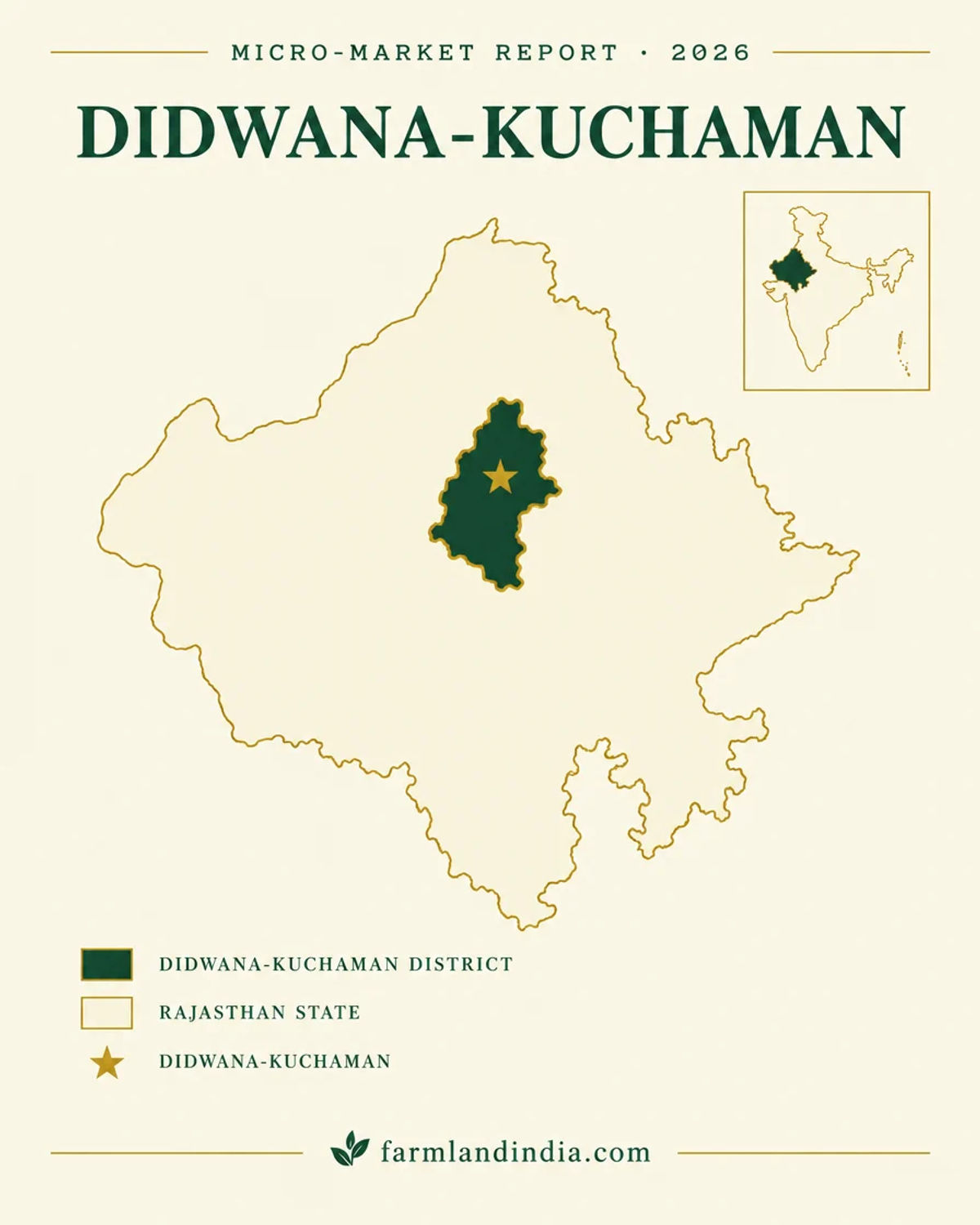
Didwana-Kuchaman was created in 2023 from Nagaur. The Directorate of Economics and Statistics gives it a reporting area of 676,853 hectares, about 6,769 sq km, of which 66.07% is net sown (Agricultural Statistics of Rajasthan 2023-24). A compilation of the 2023 notification lists 6 sub-divisions and 8 tehsils: Didwana, Maulasar, Chhoti Khatu, Ladnun, Parbatsar, Makrana, Nawa and Kuchaman City (Rajras). We could not open the notification, and no Census total for the district as now bounded turned up on a page we could open.
We publish no per-acre price band for Didwana-Kuchaman. No official or news series for the district turned up, and the statewide DLC revisions Patrika reported do not name it (Patrika, August 2026). The documented economic base is stone. The Indian Minerals Yearbook calls Makrana famous for pure white crystalline marble, names the Makrana–Kishangarh region as one of five key marble regions in Rajasthan, and puts Rajasthan's share of India's marble production value at about 88% in 2013-14 (Indian Bureau of Mines, 2015). The Merta Road–Degana–Ratangarh rail line, which covers this district, was reported electrified in December 2024 (Rail Analysis India, December 2024).
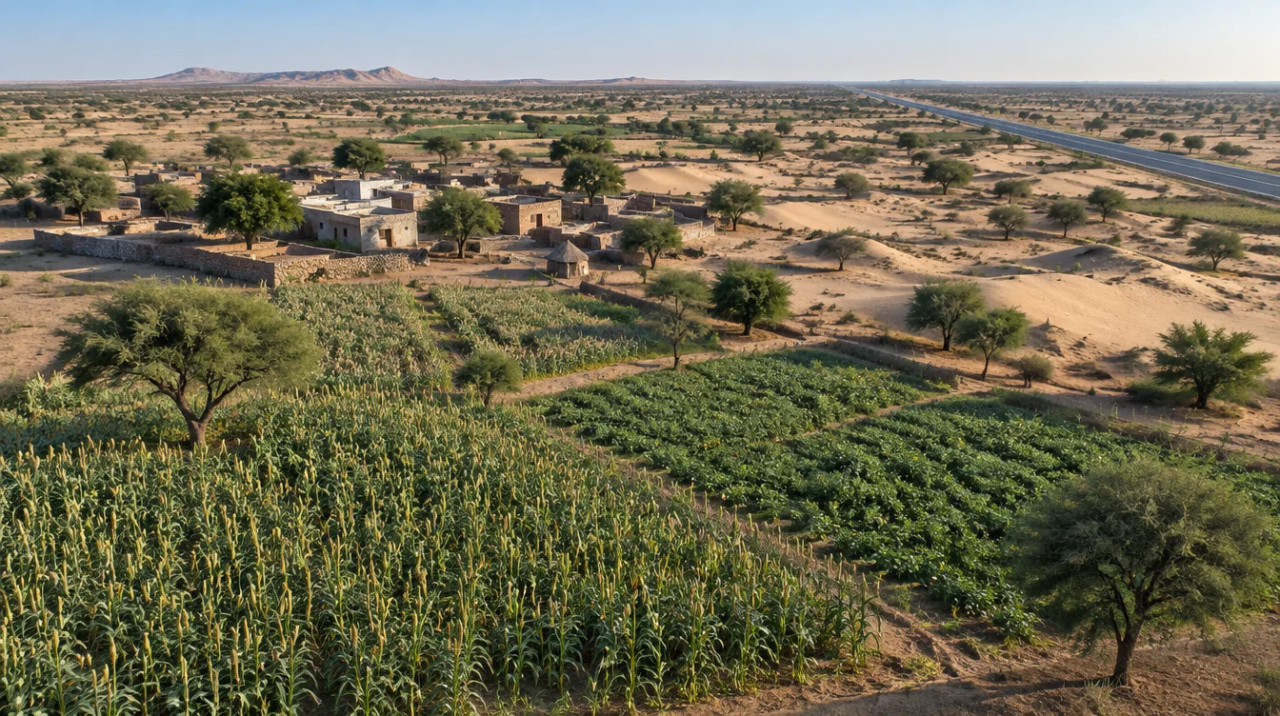
Farming is dryland. In 2023-24 bajra took 28.17% of cropped area, wheat 4.87% and mustard 2.81%; only 25.47% of net sown land was irrigated and 20.38% was sown more than once, with tubewells and open wells and no canals (Directorate of Economics and Statistics). The CGWB brochure for Nagaur puts saline soils and an alkaline belt from Didwana towards Nawa on the record, and its block data from March 2009 shows Didwana, Makrana, Parbatsar and Kuchaman over-exploited (CGWB Nagaur brochure).
- Didwana
- Kuchaman City
- Makrana
- Ladnun
- Nawa
- Parbatsar
Transaction costs
Stamp duty & registration in Didwana-Kuchaman
Up to 20%
Surcharge on stamp duty
Cow-protection surcharge, Section 3-B, Stamp Act 1998; cap raised from 10% in 2018
DLC
Valuation basis
Patrika reported in August 2026 that duty and fee follow DLC rates
Not traced
Base duty and fee
Sale-deed rates could not be traced to an official page or a news report
The surcharge cap was raised from 10% to 20% by the Rajasthan Stamp (Amendment) Bill, 2018 (PRS, Bill 18 of 2018; The Tribune, September 2018). The rate notified today is not confirmed, and the base stamp duty and registration fee for a sale deed could not be traced, so none is quoted. Deeds are registered through the Registration and Stamps Department's ePanjiyan system (NeGD listing). The Patrika reports on DLC revisions name Jaipur localities but not Didwana-Kuchaman, so we have no district schedule. In December 2024 Patrika reported that irrigated agricultural land in rural areas rose by up to 50% and that agricultural registration moved to hectares (Patrika, December 2024). Patrika gave one example in December 2024: on a ₹50 lakh transaction in an area where the DLC rate rose 15%, the extra cost was ₹66,000 in a man's name and ₹56,250 in a woman's (Patrika, December 2024). Since July 2024, Rule 57 of the Stamp Rules lets the registering officer inspect the land and value open land and structures separately (TeamLease RegTech, July 2024). Take the schedule in force from the Sub-Registrar's office.
Know the belt
What is moving prices in Didwana-Kuchaman
Statewide rate news, a documented marble economy and 2023-24 farm statistics. No listing-site prices are used.
Statewide DLC revisions
About 10% (Apr 2026); 5% to 49% in listed areas (3 Aug 2026)
Patrika reported that DLC rates rose about 10% in April 2026 and by 5% to 49% in listed areas from 3 August 2026 (Patrika, August 2026; the report is in Hindi). The report names Jaipur localities and satellite towns, not Didwana-Kuchaman. In December 2024 the 300-metre highway rule was removed, so commercial rates apply only to structures directly on a highway and not to farmland up to 300 metres away (Patrika, December 2024).
Check: the rate for the village on the sale-deed date; we have not seen a Didwana-Kuchaman schedule.
Makrana: marble belt
Rajasthan about 88% of India's marble value (2013-14)
The Indian Minerals Yearbook 2015 lists Nagaur among Rajasthan's marble-bearing districts, with Makrana deposits including Borawad, Chausira, Dungri and Kumari, and calls Makrana a major processing centre. Rajasthan held about 64% of India's marble resources as on 1 April 2010 and about 95% of processing capacity (Indian Bureau of Mines, 2015). The yearbook gives no Makrana-specific output or price.
Check: whether a parcel is inside a mining lease, a deposit area or a processing zone, and who holds the mineral rights.
Dryland farmland
66.07% net sown; 25.47% of it irrigated
Net sown area was 447,207 hectares in 2023-24, with 85,226 hectares in current fallow and 20.38% of the sown land cropped more than once (Directorate of Economics and Statistics). Farm value here rests on rainfall and tubewells, not on a canal.
Check: the khasra's irrigation class, which also decides which ceiling tier applies.
Asking prices
No sourced price series
Listing-site asking prices for Didwana-Kuchaman could not be traced to registered deals, so none are shown. The DLC rate is the only official reference and it is a floor for registration, not what a seller will accept.
Check: registered sale deeds in the same revenue estate before negotiating.
Local units and hectares
Land in the villages is quoted in local units that differ between tehsils, so a quoted area means little until it is converted. Since the December 2024 DLC revision agricultural land is registered in hectares (Patrika, December 2024). Ask the patwari for the conversion in writing and for the share of the khata being sold; we did not open a revenue manual for local unit definitions.
Connectivity
How Didwana-Kuchaman connects — road, rail and air
Road distances and drive times are not given because no dated report was found for this district. Journey times vary with traffic and road works.
By road
By air
By rail & metro
The practical question is the last leg from the highway to the parcel; ask for the access road in the revenue record. Rules for buyers from outside the state: Rajasthan agricultural land rules.
Growth catalysts
Upcoming infrastructure & developments
Status labels reflect sources read in October 2026. Only three items could be sourced for this district; no road, airport or canal project was found.
02Open or inaugurated
01In progress or pending
Agriculture & terrain
Soil, crops & water in Didwana-Kuchaman
A dryland bajra district with saline pockets, where only a quarter of the sown land is irrigated and the Nagaur-era blocks were over-exploited in 2009.
🌾 Dryland bajra plains
The Directorate of Economics and Statistics gives a 2023-24 reporting area of 676,853 hectares, with 447,207 hectares net sown (66.07%), 85,226 hectares in current fallow and only 20.38% of the sown land cropped more than once. Bajra covered 28.17% of cropped area, wheat 4.87%, barley 1.25%, gram 0.81% and mustard 2.81% (Agricultural Statistics of Rajasthan 2023-24). The CGWB brochure gives Nagaur-wide soil areas, with sandy soil about 565,705 hectares and sandy loam about 472,905 (CGWB Nagaur brochure); those are district-wide figures for old Nagaur, not for this district.
- Bajra
- Wheat
- Mustard
- Barley
🧂 Saline soils and water
The CGWB brochure lists saline soils among Nagaur's soil types and an alkaline belt running from Didwana to Nawa and towards Sambhar Lake. It reports shallow groundwater conductivity of 1,380 to 16,240 µS/cm, with most of the area within 5,000, and brackish to saline deeper groundwater in a pocket of roughly 6,000 sq km between east Merta and Degana and from Didwana towards Nagaur via Jayal (CGWB Nagaur brochure). Test soil and water at the parcel.
- Saline soil
- Alkaline belt
- Brackish water
💧 Tubewells and open wells
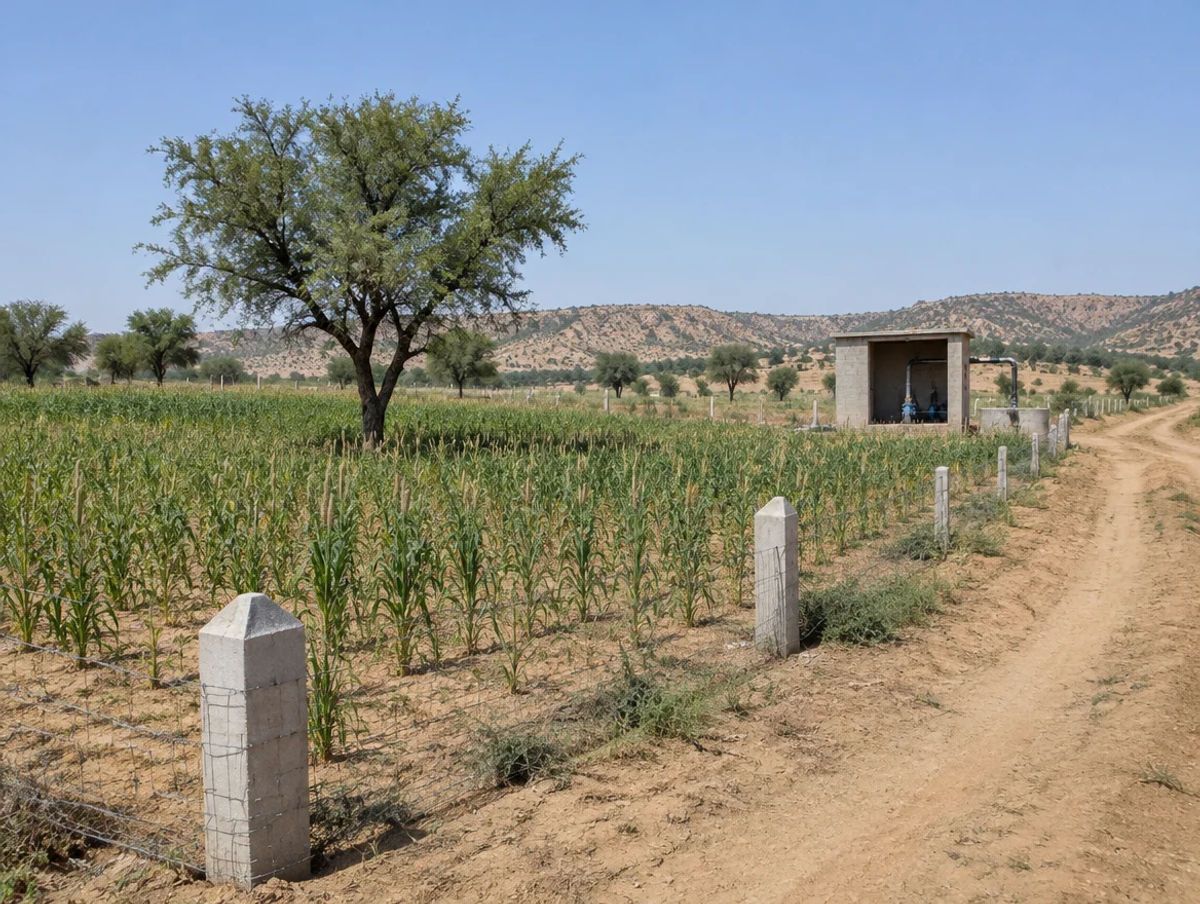
Gross irrigated area was 135,205 hectares in 2023-24: 107,476 from electric tubewells, 27,695 from open wells, 34 from other sources and none from canals. Net irrigated area was 25.47% of net sown area (Directorate of Economics and Statistics). The CGWB brochure records no canal irrigation in old Nagaur and mentions the IGNP lift canal only as a possible source for recharge.
- Tubewells
- Open wells
- No canal
💧 Water & rainfall
CGWB's 2024 assessment gives no block-level figures; its state figure is 149.86% extraction, with 214 of 302 units over-exploited, and Nagaur appears in its lists of districts with sporadic anomalies in conductivity, fluoride, nitrate and uranium (CGWB, 2024). The block figures we found are for 31 March 2009, on the old Nagaur boundary: stage of groundwater development of 162.04% in Didwana, 106.38% in Makrana, 144.35% in Parbatsar and 267.24% in Kuchaman, all over-exploited, and 91.94% in Ladnun, critical; Nawa is a tehsil without a block figure (CGWB Nagaur brochure). IMD recorded 746.7 mm of June to September 2025 rain in Nagaur against a normal of 369.5 mm, 102% above normal (IMD Jaipur, 2025); the CGWB brochure gives a long-term average of 410 mm for 1971-2005.
📐 Units and crop prices
Local units differ between tehsils, so convert every quote to hectares or acres before comparing two offers. We did not check mandi prices for this page and quote no crop price. A parcel's value here turns on location, access, water and permitted use, which the revenue record does not capture.
At a glance
Didwana-Kuchaman vs. its neighbours
| District / belt | Net sown area, 2023-24 | Evidence |
|---|---|---|
| Didwana-Kuchaman | 447,207 ha (66.07% of reporting area) | Directorate of Economics and Statistics, 2023-24; 25.47% of net sown area irrigated |
| Nagaur | 847,182 ha | Same publication, the district as left after the 2023 split |
| Jaipur Gramin | 410,891 ha | Listed separately in the 2023-24 publication; annulled on 28 Dec 2024 (Scroll); nearby, boundary not checked |
Statistics are for farm land use only. No price band is shown for any district because none could be traced to an official or news series. See the Nagaur page for the parent district and the Jaipur page for the nearby capital district.
Farmland India view
Why investors look at Didwana-Kuchaman
Five reasoned points, with an honest note that the price evidence is thin and little district-specific infrastructure could be sourced.
A stone-processing economy
Makrana's marble belt is documented in the national minerals yearbook and gives the district a non-farm economic base. It attaches to deposits, leases and processing land, which are a different asset from farmland.
A large, mostly sown district
Net sown land is 66.07% of a 676,853-hectare reporting area. Scale is not the same as productivity: only 25.47% is irrigated and 20.38% is cropped twice.
Rail electrification on the Merta Road line
The line covering the district was reported dedicated in December 2024. No station-level or freight-terminal project was sourced, so this is background, not a land catalyst.
Official rates are moving
DLC rates rose about 10% in April 2026 and by 5% to 49% in listed areas from 3 August 2026. The reports do not name this district, so the village-level rate has to be checked.
A market that rewards paperwork
A 2023 boundary change, the Section 42 bar, the holding ceiling, Section 90A conversion and mineral rights are all parcel-specific. A buyer who documents each one is better placed than one relying on a broker summary.
Confirm khatedar class, Section 90A status, mineral status and the Sub-Registrar office directly; these are not certified by Farmland India's review.
STRAIGHT TALK
Risks & challenges in Didwana-Kuchaman
Read these before shortlisting in Didwana-Kuchaman specifically.
Groundwater and salinity
Every block with a figure in the Nagaur brochure was over-exploited or critical in March 2009, up to 267.24% in Kuchaman, and the brochure records saline and alkaline belts through Didwana and Nawa. Test water and soil before assuming irrigation or a farmhouse supply.
Section 42 exposure
A sale of khatedari land by an SC or ST member to someone outside that community is void under Section 42, and the text we read offers no permission route. The Supreme Court applied the bar to a company buyer in 2012. Establish the seller's community before any advance.
Conversion and mineral land
Farmland cannot be built on without Section 90A permission, and land in the marble belt may sit inside a deposit or a lease. Ask for the conversion order and the Mines Department's position on the khasra.
Rainfall swings
IMD recorded 746.7 mm in the 2025 monsoon in Nagaur against a normal of 369.5 mm, and the brochure gives a long-term average near 410 mm. With only a quarter of the sown land irrigated, farm income here follows the rain.
New district, temporary seat
The district dates from 2023, its headquarters is reported temporary at Didwana, and papers older than 2023 name Nagaur. The tehsil list we found is a secondary compilation.
DLC-rate churn
DLC rates were revised in April 2026 and again on 3 August 2026, and the reports do not give a Didwana-Kuchaman schedule. A valuation agreed in spring may not match the rate in force at registration.
Little sourced infrastructure
We found no road, airport or canal project for this district and no sourced price series. The rail electrification is the only dated item, so price a parcel on today's roads, water and permitted use.
Who to contact
Local revenue & registration offices
The Tehsildars of the tehsils listed in the compilation (Didwana, Maulasar, Chhoti Khatu, Ladnun, Parbatsar, Makrana, Nawa and Kuchaman City) hold the revenue records for their areas (Rajras). Conversion of rural agricultural land is decided by the Tehsildar, Sub-Divisional Officer, Collector or State Government depending on use and size (Rule 9, Revenue Department rules, 2019 compilation). Sale-deed registration is handled by the Sub-Registrar through ePanjiyan, which feeds the eDharti land records for agricultural deeds (NeGD listing). The District Collector's office sits at the district level. The district portal opened but its page text carried no usable district profile, and the Apna Khata and ePanjiyan portals were not opened, so take office locations and jurisdiction maps from the departments directly.
KEEP EXPLORING
Explore more areas
Other districts in Rajasthan
- AlwarFarmhouse Estate • 12 listings
- Balotra
- Banswara
- Baran
- Barmer
- Beawar
- Bharatpur
- Bhilwara
- Bikaner
- BundiAgricultural Land • 1 listing
- Chittorgarh
- Churu
- DausaFarmhouse Estate • 2 listings
- Deeg
- Dholpur
- Dungarpur
- Ganganagar
- Hanumangarh
- JaipurFarmhouse Estate • 2 listings
- Jaisalmer
- Jalor
- Jhalawar
- Jhunjhunu
- Jodhpur
- Karauli
- Khairthal-Tijara
- Kota
- Kotputli-BehrorFarmhouse Estate • 1 listing
- Nagaur
- Pali
- Phalodi
- Pratapgarh
- Rajsamand
- Salumbar
- Sawai Madhopur
- Sikar
- Sirohi
- Tonk
- Udaipur
Guides & research
- Stamp Duty Calculator Rajasthan: DLC Land Table (2026)Wiki · P11 Taxation, Stamp Duty & Registration
- DLC Rate Jodhpur: Lookup Table and Method (2026)Wiki · P11 Taxation, Stamp Duty & Registration
- DLC Rate Jaipur: Lookup Table and Method (2026)Wiki · P11 Taxation, Stamp Duty & Registration
- Acre to Bigha in Rajasthan: Pucca, Kachcha (2026)Wiki · P01 Land Measurement Units
- Stamp Duty Rajasthan: Land Registry Charges (2026)Wiki · P11 Taxation, Stamp Duty & Registration
- DLC Rate Lookup Rajasthan: Check Circle Rate (2026)Wiki · P02 Land Records & Documentation
- Girdawari Rajasthan: Crop Record Guide (2026)Wiki · P02 Land Records & Documentation
- Mutation Status Rajasthan: Check Online (2026)Wiki · P02 Land Records & Documentation
COMMON QUESTIONS
Frequently asked questions
Everything buyers, NRIs and investors ask before their first reviewed farmland purchase in Didwana-Kuchaman.
Visit full wiki01 of 04
What does agricultural land cost in Didwana-Kuchaman?
We publish no per-acre band for Didwana-Kuchaman because no official or news price series for the district turned up and listing-site asking prices could not be traced to registered deals. The only official reference is the DLC rate, which Patrika reported rising about 10% in April 2026 and by 5% to 49% in listed areas from 3 August 2026; those reports do not name this district. Only 25.47% of the district's net sown land is irrigated, so farm value depends heavily on water.
02 of 04
Which tehsils are in Didwana-Kuchaman?
A compilation of the 2023 notification lists 6 sub-divisions and 8 tehsils: Didwana, Maulasar, Chhoti Khatu, Ladnun, Parbatsar, Makrana, Nawa and Kuchaman City, with the headquarters temporarily at Didwana until a mini-secretariat building is completed. We could not open the notification, so ask the Collector's office or the Tehsildar for the current list and for the district under which a village's records sit.
03 of 04
Can anyone buy agricultural land in Didwana-Kuchaman?
We found no farmer-only clause in the Ceiling Act, 1973 or in the part of the Tenancy Act, 1955 that we read (first 100,000 of about 108,700 characters). The limits that do appear are the Section 42 bar on sales by SC and ST khatedars to outsiders, the holding ceiling in Section 4 of the Ceiling Act and the Section 90A permission needed to use farmland for anything else. NRIs and OCIs cannot buy agricultural land, plantation property or a farm house under the RBI Master Direction. Ask the Sub-Registrar whether any further test applies to the parcel in Didwana-Kuchaman.
04 of 04
Is salinity or groundwater a problem in Didwana-Kuchaman?
The block figures we found are old and on the pre-2023 Nagaur boundary: CGWB's brochure puts Didwana at 162.04%, Makrana at 106.38%, Parbatsar at 144.35% and Kuchaman at 267.24% stage of groundwater development in March 2009, all over-exploited, and Ladnun at 91.94%, critical. It also records saline soils, an alkaline belt from Didwana towards Nawa and brackish groundwater in parts of the area. CGWB's 2024 state assessment has no block table. Test soil and water on the parcel.
Ready to look at what is available?
Browse reviewed listingsTransparency
Sources and references
Law and courts
- Rajasthan Imposition of Ceiling on Agricultural Holding Act, 1973 (ss. 4, 6, 17), India Code
- Rajasthan Tenancy Act, 1955 (s. 42), India Code
- State of Rajasthan v. Aanjaney Organic Herbal Pvt. Ltd., Civil Appeals 6741-6742 of 2012, Supreme Court, 20 Sep 2012
- Anandi Lal v. Dalip Prajapat, Rajasthan High Court, reported by LiveLaw, 14 Feb 2025
- Section 90A, Rajasthan Land Revenue Act, 1956, Indian Kanoon
- Bhanwar Singh v. State of Rajasthan, Rajasthan High Court, reported by LiveLaw, Feb 2022
- Rajasthan Stamp (Amendment) Bill, 2018 (Bill 18 of 2018), section 3-B surcharge, PRS Legislative Research
Government
- Rajasthan Land Revenue (Conversion of Agricultural Land for Non-Agricultural Purposes in Rural Areas) Rules, 2007, Revenue Department, 2019 compilation
- Agricultural Statistics of Rajasthan 2023-24 (district tables), Directorate of Economics and Statistics
- Ground water information brochure, Nagaur district (blocks as on 31 Mar 2009, soils, salinity), Central Ground Water Board
- Dynamic Ground Water Resources and Ground Water Quality of Rajasthan, 2024, Central Ground Water Board
- Indian Minerals Yearbook 2015, Marble chapter, Indian Bureau of Mines
- Rajasthan Monsoon Report 2025, India Meteorological Department, Jaipur
- Master Direction FED 12/2015-16 on immovable assets under FEMA 1999, Reserve Bank of India, updated to 1 Sep 2022
- Rajasthan listing (ePanjiyan, eDharti), India Stack Local, NeGD
News
- Rajasthan government scraps new districts and divisions, Scroll, 29 Dec 2024
- PM Modi inaugurates rail development projects worth Rs 6,525 crore in Jaipur, Rail Analysis India, 18 Dec 2024
- Rajasthan DLC rate hike effective 3 Aug 2026, Patrika, 4 Aug 2026 (Hindi-language)
- DLC rates raised up to 50%, Patrika, 3 Dec 2024 (Hindi-language)
- Rajasthan raises stamp duty surcharge from 10 to 20 for cow protection, The Tribune, 7 Sep 2018
Further reading
- Formation of New Districts in Rajasthan (tehsil and sub-division compilation), Rajras
- Nine districts and three divisions annulled, Sentinel Assam, 29 Dec 2024
- Rise in construction rates and DLC threshold, Patrika, 19 Nov 2025
- Rajasthan Stamp (Amendment) Rules 2024, TeamLease RegTech
- Budget 2026-27 press note, Rajasthan Finance Department
- Rajasthan Budget Analysis 2026-27, PRS Legislative Research
- Sambhar Lake Ramsar site information sheet, Ramsar Sites Information Service
- Didwana-Kuchaman district portal (opened; no district profile text)
Data-currency note: sources were read in October 2026. Tehsil lists come from a secondary compilation, not the notification. Farm figures are the Directorate's 2023-24 district data; groundwater block figures and soil areas are from a 2013 brochure with March 2009 data for old Nagaur and predate the 2023 boundaries; marble data is for 2013-14. The Apna Khata and ePanjiyan portals, the Revenue Department site and the India Code text of the Land Revenue Act and the Stamp Act could not be opened, so nothing here is attributed to a reading of them. Section 90A is cited through a statute copy and court reports. DLC rates, court orders and project timelines change often. This is a general guide, not legal advice. Report inaccuracies to wiki@farmlandindia.com.
For developers
Ready to explore Didwana-Kuchaman farmland?
Browse reviewed projects and individual land parcels across Didwana-Kuchaman — or if you own land here, list it with platform review and reach serious buyers.